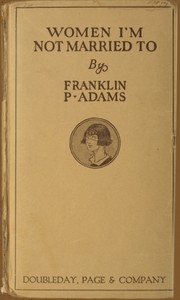
The Project Gutenberg eBook of Women I'm Not Married To
This ebook is for the use of anyone anywhere in the United States and
most other parts of the world at no cost and with almost no restrictions
whatsoever. You may copy it, give it away or re-use it under the terms
of the Project Gutenberg License included with this ebook or online
at www.gutenberg.org. If you are not located in the United States,
you will have to check the laws of the country where you are located
before using this eBook.
Title: Women I'm Not Married To
Author: Franklin P. Adams
Release date: October 2, 2017 [eBook #55671]
Most recently updated: October 23, 2024
Language: English
Credits: Produced by Chuck Greif, ellinora and the Online Distributed
Proofreading Team at http://www.pgdp.net (This file was
produced from images generously made available by The
Internet Archive/Canadian Libraries)
*** START OF THE PROJECT GUTENBERG EBOOK WOMEN I'M NOT MARRIED TO ***
WOMEN
I’M NOT MARRIED TO
WOMEN
I’M NOT MARRIED TO
BY
FRANKLIN P. ADAMS
[Illustration: colophon]
GARDEN CITY NEW YORK
DOUBLEDAY, PAGE & COMPANY
1922
COPYRIGHT, 1922, BY
DOUBLEDAY, PAGE & COMPANY
ALL RIGHTS RESERVED, INCLUDING THAT OF
TRANSLATION INTO FOREIGN LANGUAGES,
INCLUDING THE SCANDINAVIAN
COPYRIGHT, 1922, BY THE CURTIS PUBLISHING COMPANY
IN THE UNITED STATES AND GREAT BRITAIN
PRINTED IN THE UNITED STATES
AT
THE COUNTRY LIFE PRESS, GARDEN CITY, N. Y.
TO
MRS. FRANKLIN P. ADAMS
BUT FOR WHOM THIS BOOK
MIGHT NOT HAVE BEEN WRITTEN,
BUT FOR WHOM IT WAS
CONTENTS
PAGE
ELAINE 2
MAUDE 7
ANNE 11
FLO 15
BELINDA 16
BLANCHE 19
MARGUERITE 21
WOMEN
I’M NOT MARRIED TO
“Whene’er I take my walks”--you know
The rest--“abroad,” I always meet
Elaine or Maude or Anne or Flo,
Belinda, Blanche, or Marguerite;
And Melancholy, bittersweet,
Sets seal upon me when I view--
Coldly, and from a judgment seat--
The women I’m not married to.
Not mine the sighs for Long Ago;
Not mine to mourn the obsolete;
With Burns and Shelley, Keats and Poe
I have no yearning to compete.
No Dead Sea pickled pears I eat;
I never touch a drop of rue;
I toast, and drink my pleasure neat,
The women I’m not married to!
Fate with her celebrated blow
Frequently knocks me off my feet;
And Life her dice box chucks a throw
That usually has me beat.
Yet although Love has tried to treat
Me rough, award the kid his due.
Look at the list, though incomplete:
The women I’m not married to.
L’ENVOI
My dears whom gracefully I greet,
Gaze at these lucky ladies who
Are of--to make this thing concrete--
The women I’m not married to.
ELAINE
There have been more beautiful girls than Elaine, for I have read about
them, and I have utter faith in the printed word. And I expect my
public, a few of whom are--just a second--more than two and a quarter
million weekly, to put the same credence in my printed word. When I
said there have been more beautiful girls than Elaine I lied. There
haven’t been. She was a darb. Blue were her eyes as the fairy flax, her
eyebrows were like curved snowdrifts, her neck was like the swan, her
face it was the fairest that e’er the sun shone on, she walked in beauty
like the night, her lips were like the cherries ripe that sunny walls of
Boreas screen, her teeth were like a flock of sheep with fleeces newly
washen clean, her hair was like the curling mist that shades the
mountain side at e’en, and oh, she danced in such a way no sun upon an
Easter day was half so fine a sight! If I may interrupt the poets, I
should say she was one pip. She was, I might add, kind of pretty.
Enchantment was hers, and fairyland her exclusive province. I would walk
down a commonplace street with her, and it would become the primrose
path, and a one-way path at that, with nobody but us on it. If I said it
was a nice day--and if I told her that once I told her a hundred
times--she would say, “Isn’t it? My very words to Isabel when I
telephoned her this morning!” So we had, I said to myself, a lot in
common.
And after a conversation like that I would go home and lie awake and
think, “If two persons can be in such harmony about the weather, a
fundamental thing, a thing that prehistoric religions actually were
based upon, what possible discord ever could be between us? For I have
known families to be rent by disagreements as to meteorological
conditions.
“Isn’t this,” my sister used to say, “a nice day?”
“No,” my reply used to be; “it’s a dreadful day. It’s blowy, and it’s
going to rain.” And I would warn my mother that my sister Amy, or that
child, was likely to grow up into a liar.
But, as I have tried to hint, beauty was Elaine’s, and when she spoke of
the weather I used to feel sorry for everybody who had lived in the
olden times, from yesterday back to the afternoon Adam told Eve that no
matter how hot it was they always got a breeze, before there was any
weather at all.
It wasn’t only the weather. We used to agree on other things. Once when
she met a schoolgirl friend in Hyde Park whom she hadn’t seen since a
year ago, out in Lake View, she said that it was a small world after
all, and I told her she never said a truer word. And about golf--she
didn’t think, she said one day, that it was as strenuous as tennis, but
it certainly took you out in the open air--well, that was how I felt
about it, too. So you see it wasn’t just the weather, though at that
time I thought that would be enough.
Well, one day we were walking along, and she looked at me and said, “I
wonder if you’d like me so much if I weren’t pretty.”
It came over me that I shouldn’t.
“No,” I said, “I should say not.”
“That’s the first honest thing you ever said to me,” she said.
“No, it isn’t,” I said.
“It is, too,” was her rejoinder.
“It’s nothing of the kind,” I said.
“Yes, it is!” she said, her petulant temper getting the better of her.
So we parted on that, and I often think how lucky I am to have escaped
from Elaine’s distrust of honesty, and from her violent and passionate
temper.
MAUDE
Maude and I might have been happy together. She was not the kind you
couldn’t be candid with. She used to say she admired honesty and
sincerity above all other traits. And she was deeply interested in me,
which was natural enough, as I had no reservations, no reticences from
her. I believed that when you cared about a girl it was wrong to have
secrets from her.
And that was her policy, too, though now and then she carried it too
far. One day I telephoned her and asked her what she had been doing that
morning.
“I’ve been reading the most fascinating book,” she said.
“What book?” I asked politely.
“I can’t remember the title,” she said, “but it’s about a man in love
with a girl, and he----”
“Who wrote it?” I interrupted.
“Wait a minute,” said Maude. I waited four minutes. “Sorry to have kept
you waiting,” she said. “I mislaid the book. I thought I left it in my
room and I looked all around for it, and then I asked Hulda if she’d
seen it, and she said no, though I asked her that the other day about
something else, and she said no, and later I found out that she had seen
it and put it in a drawer, so I went to the library and the book wasn’t
there, and then I went back to my room and looked again, and I was just
coming back to tell you I couldn’t find it when here it is, guess where,
right on the telephone stand. Who wrote it? Hutchison is the author. A.
M. S.--no, wait a minute--A. S. M. Hutchinson, not Hutchison. There’s an
‘n’ in it. Two ‘n’s’ really. But I mean an ‘n’ between the ‘i’ and the
‘s.’ I mean it’s Hut-chin-son, and not Hut-chi-son. But what’s the
difference who writes a book as long as it’s a good book?”
There may have been more, but I was reasonably certain that the author’s
name was Hutchinson, so I hung up the receiver, though the way I felt at
the time was that hanging was too good for it.
I had dinner with her that night at a restaurant.
“Coffee?” asked the waiter.
“No,” I said. And to her: “Coffee keeps me awake. If I took a cup now I
wouldn’t close an eye all night. Some folks can drink it and not notice
it, but take me; I’m funny that way, and if I took a cup now I wouldn’t
close an eye all night. Some can, and some can’t. I like it, but it
doesn’t like me. Ha, ha! I wouldn’t close an eye all night, and if I
don’t get my sleep--and a good eight hours at that--I’m not fit for a
thing all the next day. It’s a pretty important thing, sleep; and----”
It was important to Maude, self-centred thing that she was. Here was I
confiding to her something I never had told another soul, and she wasn’t
merely dozing; she was asleep. I rattled a knife against a plate, and
she awoke.
It was a good thing I found out about her in time.
ANNE
_In winter, when the ground was white,
I thought that Anne would be all right;
In summer, quite the other way,
I knew she’d never be O. K._
She liked to go to the theatre, but what she went for was to be amused,
as there was enough sadness in real life without going to the theatre
for it. She told me that I was just a great big boy; that all men, in
fact, were just little boys grown up. I took her to a movie show, and
she read most of the captions to me, slowly; and when she read them to
herself her lips moved. She never took a drink in days of old when booze
was sold and barrooms held their sway--that is my line, not Anne’s--but
now she takes a cocktail when one is offered, saying, “This may be my
last chance.” Women, she told me, didn’t like her much, but she didn’t
care, as she was, she always said, a man’s woman. Just the same, folks
said, she told me, that she was wonderful in a sick room.
And so, what with the movies and one thing and another the winter
passed. She was glad I was a tennis player, and we’d have some exciting
sets in the summer. No, she said games. I should have known then, but I
was thinking of her hair and how cool it was to stroke.
Well, one May afternoon there we were on the tennis court. It belonged
to a friend of hers, and it hadn’t been rolled recently, nor marked,
though you could tell that here a base line and there a service line
once had been.
I asked her which court she wanted and she said it didn’t matter; she
played equally rottenly on both sides. Nor was that, I found it,
overstating things. She served, and called “Ready?” before each service.
When she sent a ball far outside she called “Home run!” or “Just out!”
And if I served a double fault she said either “Two bad” or “Thank
you.” When the score was deuce she called it “Juice!” And when I beat
her 6-0--as you could have done, or you, or even you--she said she was
off her game, that it was a lot closer than the score indicated, that
she’d beat me before the summer was over, that didn’t the net seem
terribly low or something, and that I wasn’t used to playing with women
or I wouldn’t hit the ball so hard all the time.
Little remains to be told. Anne is now the wife of a golfing banker.
Wednesday night I met her at a party.
“Golf?” she echoed. “Oh, yes. That is, I don’t play it; I play at it.
Tennis is really my game, but I haven’t had a racket in my hand in two
years. We must have some of our games again. I nearly beat you last
time, remember.”
FLO
I hadn’t seen Flo since she was about fourteen, so when I got a letter
asking me to call I said I’d go. She was pretty, but the older I get the
fewer girls I see that aren’t.
Of course I ought to have known. The letter was addressed with a “For”
preceding my name, instead of “City” or the name of the town, Flo had
written “Local.” Even a professional detective should have known then.
It was just her refined vocabulary that sent me reeling into the night.
She wondered where I “resided” and how long I’d been “located” there;
she had “purchased” something; she said “gowned” when she meant
“dressed”; she had “gotten” tired, she said, of affectation. She said
she had “retired” early the night before, and she spoke of a
“boot-limber.”
And as I was leaving she said, “Don’t remain away so long this time.
Er--you know--hath no fury like a woman scorned.”
BELINDA
I remember Belinda. She was arguing with another young woman about the
car fare. “Let me pay,” said Belinda; and she paid.
“There,” I mused, “is a perfect woman, nobly planned.”
I met her shortly after that, and she came through many a test. Once I
saw her go up to an elevated railroad station, hand in a nickel, and not
say, “One, please.” Once I asked her about what day it was, and she said
“Wednesday” without adding “All day.” She spoke once of a cultivated
taste without adding “like olives,” and once said “That’s another story”
without adding “as Kipling says.” And once--and that was the day I
nearly begged her to be mine--when she said that something had been
grossly exaggerated she failed to giggle “like the report of Mark
Twain’s death.”
So you see Belinda had points. She had a dog that wasn’t more
intelligent than most human beings; she wasn’t forever saying that there
was no reason why a man and a woman shouldn’t be just good pals; she
didn’t put me at ease, the way the others did, by looking at me for
three minutes and then saying that good looks didn’t matter much to a
man, after all; she didn’t, when you gave her something, take it and say
coyly, “For me?” as who should say, “You dear thoughtful thing, when you
might have brought it for John D. Rockefeller.” And she didn’t say that
she couldn’t draw a straight line or that she had no card sense or that
she couldn’t write a decent letter.
She could write a decent letter. She did. Lots of them. To me, too. She
wrote the best letters I ever read. They were intelligent, humorous,
and--why shouldn’t I tell the truth?--ardent. Fervid is nearer.
Candescent is not far off. And that is how I lost her.
“P. S.” she wrote. “Burn this letter, and all of them.”
A few weeks later Belinda said, “At the rate I write you, my letters
must fill a large drawer by this time.”
“Why,” I said, “I burn them. They’re all burned.”
“I never want to see you again as long as I live,” she said. “Good-by.”
And my good-by was the last communication between me and Belinda.
BLANCHE
_Blanche is a girl
I’d hate to wed,
Because of a lot
Of things she said._
_“Excuse my French”
When she says “Gee-whiz!”
On the telephone:
“Guess who this is.”_
_You ask her did
She like the show
Or book, she’ll say,
“Well, yes and no.”_
_For the “kiddie” she
Buys a “comfy” “nighty”;
She says “My bestest,”
And “All rightie.”_
_“If I had no humour,
I’d simply die,”
Says Blanche.... I know
That that’s a lie._
_She wouldn’t marry;
“Oh, heaven forbid!
“Men are such brutes!”
You said it, kid._
MARGUERITE
Marguerite was an agreer. She strove, and not without success, to
please. She hated an argument, one reason perhaps being--I found this
out later--that she couldn’t put one forth on any subject. But I had
theories, in the days of Marguerite, and I wanted to know whether she
was in sympathy with them. One of my theories was that a lot of domestic
infelicity could be avoided if a husband didn’t keep his business
affairs to himself, if he made a confidante, a possible assistant, of
his wife. I had contempt for the women whose boast it was that Fred
never brings business into the house.
So I used to talk to Marguerite about that theory. When we were married
wouldn’t it be better to discuss the affairs of the business day at home
with her? Certainly. Because simply talking about them was something,
and maybe she could even help. Yes, that was what a wife was for. Why
should a man keep his thoughts bottled up just because his wife wasn’t
in his office with him? No reason at all; I agree with you perfectly.
About politics: Wasn’t this man Harding doing a good job, and weren’t
things looking pretty good, everything considered? He certainly is and
they certainly are, was Marguerite’s adroit summing up.
Well, I had theories about books and child labour and pictures and clam
chowder and Harry Leon Wilson’s stuff and music and the younger
generation and cord tires and things like that, and she’d agree with
everything I said.
Then one night, as in a vision, something came to me. I had a theory
that it would be terrible to have somebody around all the time who
agreed with you about everything. Marguerite agreed.
I had another theory. Don’t you agree, I put it, that we shouldn’t get
along at all well? And never had she agreed more quickly. I thought she
really put her heart into it.
And we never should have hit it off, either.
End of Project Gutenberg's Women I'm Not Married To, by Franklin Pierce Adams
*** END OF THE PROJECT GUTENBERG EBOOK WOMEN I'M NOT MARRIED TO ***
Updated editions will replace the previous one—the old editions will
be renamed.
Creating the works from print editions not protected by U.S. copyright
law means that no one owns a United States copyright in these works,
so the Foundation (and you!) can copy and distribute it in the United
States without permission and without paying copyright
royalties. Special rules, set forth in the General Terms of Use part
of this license, apply to copying and distributing Project
Gutenberg™ electronic works to protect the PROJECT GUTENBERG™
concept and trademark. Project Gutenberg is a registered trademark,
and may not be used if you charge for an eBook, except by following
the terms of the trademark license, including paying royalties for use
of the Project Gutenberg trademark. If you do not charge anything for
copies of this eBook, complying with the trademark license is very
easy. You may use this eBook for nearly any purpose such as creation
of derivative works, reports, performances and research. Project
Gutenberg eBooks may be modified and printed and given away—you may
do practically ANYTHING in the United States with eBooks not protected
by U.S. copyright law. Redistribution is subject to the trademark
license, especially commercial redistribution.
START: FULL LICENSE
THE FULL PROJECT GUTENBERG LICENSE
PLEASE READ THIS BEFORE YOU DISTRIBUTE OR USE THIS WORK
To protect the Project Gutenberg™ mission of promoting the free
distribution of electronic works, by using or distributing this work
(or any other work associated in any way with the phrase “Project
Gutenberg”), you agree to comply with all the terms of the Full
Project Gutenberg™ License available with this file or online at
www.gutenberg.org/license.
Section 1. General Terms of Use and Redistributing Project Gutenberg™
electronic works
1.A. By reading or using any part of this Project Gutenberg™
electronic work, you indicate that you have read, understand, agree to
and accept all the terms of this license and intellectual property
(trademark/copyright) agreement. If you do not agree to abide by all
the terms of this agreement, you must cease using and return or
destroy all copies of Project Gutenberg™ electronic works in your
possession. If you paid a fee for obtaining a copy of or access to a
Project Gutenberg™ electronic work and you do not agree to be bound
by the terms of this agreement, you may obtain a refund from the person
or entity to whom you paid the fee as set forth in paragraph 1.E.8.
1.B. “Project Gutenberg” is a registered trademark. It may only be
used on or associated in any way with an electronic work by people who
agree to be bound by the terms of this agreement. There are a few
things that you can do with most Project Gutenberg™ electronic works
even without complying with the full terms of this agreement. See
paragraph 1.C below. There are a lot of things you can do with Project
Gutenberg™ electronic works if you follow the terms of this
agreement and help preserve free future access to Project Gutenberg™
electronic works. See paragraph 1.E below.
1.C. The Project Gutenberg Literary Archive Foundation (“the
Foundation” or PGLAF), owns a compilation copyright in the collection
of Project Gutenberg™ electronic works. Nearly all the individual
works in the collection are in the public domain in the United
States. If an individual work is unprotected by copyright law in the
United States and you are located in the United States, we do not
claim a right to prevent you from copying, distributing, performing,
displaying or creating derivative works based on the work as long as
all references to Project Gutenberg are removed. Of course, we hope
that you will support the Project Gutenberg™ mission of promoting
free access to electronic works by freely sharing Project Gutenberg™
works in compliance with the terms of this agreement for keeping the
Project Gutenberg™ name associated with the work. You can easily
comply with the terms of this agreement by keeping this work in the
same format with its attached full Project Gutenberg™ License when
you share it without charge with others.
1.D. The copyright laws of the place where you are located also govern
what you can do with this work. Copyright laws in most countries are
in a constant state of change. If you are outside the United States,
check the laws of your country in addition to the terms of this
agreement before downloading, copying, displaying, performing,
distributing or creating derivative works based on this work or any
other Project Gutenberg™ work. The Foundation makes no
representations concerning the copyright status of any work in any
country other than the United States.
1.E. Unless you have removed all references to Project Gutenberg:
1.E.1. The following sentence, with active links to, or other
immediate access to, the full Project Gutenberg™ License must appear
prominently whenever any copy of a Project Gutenberg™ work (any work
on which the phrase “Project Gutenberg” appears, or with which the
phrase “Project Gutenberg” is associated) is accessed, displayed,
performed, viewed, copied or distributed:
This eBook is for the use of anyone anywhere in the United States and most
other parts of the world at no cost and with almost no restrictions
whatsoever. You may copy it, give it away or re-use it under the terms
of the Project Gutenberg License included with this eBook or online
at www.gutenberg.org. If you
are not located in the United States, you will have to check the laws
of the country where you are located before using this eBook.
1.E.2. If an individual Project Gutenberg™ electronic work is
derived from texts not protected by U.S. copyright law (does not
contain a notice indicating that it is posted with permission of the
copyright holder), the work can be copied and distributed to anyone in
the United States without paying any fees or charges. If you are
redistributing or providing access to a work with the phrase “Project
Gutenberg” associated with or appearing on the work, you must comply
either with the requirements of paragraphs 1.E.1 through 1.E.7 or
obtain permission for the use of the work and the Project Gutenberg™
trademark as set forth in paragraphs 1.E.8 or 1.E.9.
1.E.3. If an individual Project Gutenberg™ electronic work is posted
with the permission of the copyright holder, your use and distribution
must comply with both paragraphs 1.E.1 through 1.E.7 and any
additional terms imposed by the copyright holder. Additional terms
will be linked to the Project Gutenberg™ License for all works
posted with the permission of the copyright holder found at the
beginning of this work.
1.E.4. Do not unlink or detach or remove the full Project Gutenberg™
License terms from this work, or any files containing a part of this
work or any other work associated with Project Gutenberg™.
1.E.5. Do not copy, display, perform, distribute or redistribute this
electronic work, or any part of this electronic work, without
prominently displaying the sentence set forth in paragraph 1.E.1 with
active links or immediate access to the full terms of the Project
Gutenberg™ License.
1.E.6. You may convert to and distribute this work in any binary,
compressed, marked up, nonproprietary or proprietary form, including
any word processing or hypertext form. However, if you provide access
to or distribute copies of a Project Gutenberg™ work in a format
other than “Plain Vanilla ASCII” or other format used in the official
version posted on the official Project Gutenberg™ website
(www.gutenberg.org), you must, at no additional cost, fee or expense
to the user, provide a copy, a means of exporting a copy, or a means
of obtaining a copy upon request, of the work in its original “Plain
Vanilla ASCII” or other form. Any alternate format must include the
full Project Gutenberg™ License as specified in paragraph 1.E.1.
1.E.7. Do not charge a fee for access to, viewing, displaying,
performing, copying or distributing any Project Gutenberg™ works
unless you comply with paragraph 1.E.8 or 1.E.9.
1.E.8. You may charge a reasonable fee for copies of or providing
access to or distributing Project Gutenberg™ electronic works
provided that:
• You pay a royalty fee of 20% of the gross profits you derive from
the use of Project Gutenberg™ works calculated using the method
you already use to calculate your applicable taxes. The fee is owed
to the owner of the Project Gutenberg™ trademark, but he has
agreed to donate royalties under this paragraph to the Project
Gutenberg Literary Archive Foundation. Royalty payments must be paid
within 60 days following each date on which you prepare (or are
legally required to prepare) your periodic tax returns. Royalty
payments should be clearly marked as such and sent to the Project
Gutenberg Literary Archive Foundation at the address specified in
Section 4, “Information about donations to the Project Gutenberg
Literary Archive Foundation.”
• You provide a full refund of any money paid by a user who notifies
you in writing (or by e-mail) within 30 days of receipt that s/he
does not agree to the terms of the full Project Gutenberg™
License. You must require such a user to return or destroy all
copies of the works possessed in a physical medium and discontinue
all use of and all access to other copies of Project Gutenberg™
works.
• You provide, in accordance with paragraph 1.F.3, a full refund of
any money paid for a work or a replacement copy, if a defect in the
electronic work is discovered and reported to you within 90 days of
receipt of the work.
• You comply with all other terms of this agreement for free
distribution of Project Gutenberg™ works.
1.E.9. If you wish to charge a fee or distribute a Project
Gutenberg™ electronic work or group of works on different terms than
are set forth in this agreement, you must obtain permission in writing
from the Project Gutenberg Literary Archive Foundation, the manager of
the Project Gutenberg™ trademark. Contact the Foundation as set
forth in Section 3 below.
1.F.
1.F.1. Project Gutenberg volunteers and employees expend considerable
effort to identify, do copyright research on, transcribe and proofread
works not protected by U.S. copyright law in creating the Project
Gutenberg™ collection. Despite these efforts, Project Gutenberg™
electronic works, and the medium on which they may be stored, may
contain “Defects,” such as, but not limited to, incomplete, inaccurate
or corrupt data, transcription errors, a copyright or other
intellectual property infringement, a defective or damaged disk or
other medium, a computer virus, or computer codes that damage or
cannot be read by your equipment.
1.F.2. LIMITED WARRANTY, DISCLAIMER OF DAMAGES - Except for the “Right
of Replacement or Refund” described in paragraph 1.F.3, the Project
Gutenberg Literary Archive Foundation, the owner of the Project
Gutenberg™ trademark, and any other party distributing a Project
Gutenberg™ electronic work under this agreement, disclaim all
liability to you for damages, costs and expenses, including legal
fees. YOU AGREE THAT YOU HAVE NO REMEDIES FOR NEGLIGENCE, STRICT
LIABILITY, BREACH OF WARRANTY OR BREACH OF CONTRACT EXCEPT THOSE
PROVIDED IN PARAGRAPH 1.F.3. YOU AGREE THAT THE FOUNDATION, THE
TRADEMARK OWNER, AND ANY DISTRIBUTOR UNDER THIS AGREEMENT WILL NOT BE
LIABLE TO YOU FOR ACTUAL, DIRECT, INDIRECT, CONSEQUENTIAL, PUNITIVE OR
INCIDENTAL DAMAGES EVEN IF YOU GIVE NOTICE OF THE POSSIBILITY OF SUCH
DAMAGE.
1.F.3. LIMITED RIGHT OF REPLACEMENT OR REFUND - If you discover a
defect in this electronic work within 90 days of receiving it, you can
receive a refund of the money (if any) you paid for it by sending a
written explanation to the person you received the work from. If you
received the work on a physical medium, you must return the medium
with your written explanation. The person or entity that provided you
with the defective work may elect to provide a replacement copy in
lieu of a refund. If you received the work electronically, the person
or entity providing it to you may choose to give you a second
opportunity to receive the work electronically in lieu of a refund. If
the second copy is also defective, you may demand a refund in writing
without further opportunities to fix the problem.
1.F.4. Except for the limited right of replacement or refund set forth
in paragraph 1.F.3, this work is provided to you ‘AS-IS’, WITH NO
OTHER WARRANTIES OF ANY KIND, EXPRESS OR IMPLIED, INCLUDING BUT NOT
LIMITED TO WARRANTIES OF MERCHANTABILITY OR FITNESS FOR ANY PURPOSE.
1.F.5. Some states do not allow disclaimers of certain implied
warranties or the exclusion or limitation of certain types of
damages. If any disclaimer or limitation set forth in this agreement
violates the law of the state applicable to this agreement, the
agreement shall be interpreted to make the maximum disclaimer or
limitation permitted by the applicable state law. The invalidity or
unenforceability of any provision of this agreement shall not void the
remaining provisions.
1.F.6. INDEMNITY - You agree to indemnify and hold the Foundation, the
trademark owner, any agent or employee of the Foundation, anyone
providing copies of Project Gutenberg™ electronic works in
accordance with this agreement, and any volunteers associated with the
production, promotion and distribution of Project Gutenberg™
electronic works, harmless from all liability, costs and expenses,
including legal fees, that arise directly or indirectly from any of
the following which you do or cause to occur: (a) distribution of this
or any Project Gutenberg™ work, (b) alteration, modification, or
additions or deletions to any Project Gutenberg™ work, and (c) any
Defect you cause.
Section 2. Information about the Mission of Project Gutenberg™
Project Gutenberg™ is synonymous with the free distribution of
electronic works in formats readable by the widest variety of
computers including obsolete, old, middle-aged and new computers. It
exists because of the efforts of hundreds of volunteers and donations
from people in all walks of life.
Volunteers and financial support to provide volunteers with the
assistance they need are critical to reaching Project Gutenberg™’s
goals and ensuring that the Project Gutenberg™ collection will
remain freely available for generations to come. In 2001, the Project
Gutenberg Literary Archive Foundation was created to provide a secure
and permanent future for Project Gutenberg™ and future
generations. To learn more about the Project Gutenberg Literary
Archive Foundation and how your efforts and donations can help, see
Sections 3 and 4 and the Foundation information page at www.gutenberg.org.
Section 3. Information about the Project Gutenberg Literary Archive Foundation
The Project Gutenberg Literary Archive Foundation is a non-profit
501(c)(3) educational corporation organized under the laws of the
state of Mississippi and granted tax exempt status by the Internal
Revenue Service. The Foundation’s EIN or federal tax identification
number is 64-6221541. Contributions to the Project Gutenberg Literary
Archive Foundation are tax deductible to the full extent permitted by
U.S. federal laws and your state’s laws.
The Foundation’s business office is located at 809 North 1500 West,
Salt Lake City, UT 84116, (801) 596-1887. Email contact links and up
to date contact information can be found at the Foundation’s website
and official page at www.gutenberg.org/contact
Section 4. Information about Donations to the Project Gutenberg
Literary Archive Foundation
Project Gutenberg™ depends upon and cannot survive without widespread
public support and donations to carry out its mission of
increasing the number of public domain and licensed works that can be
freely distributed in machine-readable form accessible by the widest
array of equipment including outdated equipment. Many small donations
($1 to $5,000) are particularly important to maintaining tax exempt
status with the IRS.
The Foundation is committed to complying with the laws regulating
charities and charitable donations in all 50 states of the United
States. Compliance requirements are not uniform and it takes a
considerable effort, much paperwork and many fees to meet and keep up
with these requirements. We do not solicit donations in locations
where we have not received written confirmation of compliance. To SEND
DONATIONS or determine the status of compliance for any particular state
visit www.gutenberg.org/donate.
While we cannot and do not solicit contributions from states where we
have not met the solicitation requirements, we know of no prohibition
against accepting unsolicited donations from donors in such states who
approach us with offers to donate.
International donations are gratefully accepted, but we cannot make
any statements concerning tax treatment of donations received from
outside the United States. U.S. laws alone swamp our small staff.
Please check the Project Gutenberg web pages for current donation
methods and addresses. Donations are accepted in a number of other
ways including checks, online payments and credit card donations. To
donate, please visit: www.gutenberg.org/donate.
Section 5. General Information About Project Gutenberg™ electronic works
Professor Michael S. Hart was the originator of the Project
Gutenberg™ concept of a library of electronic works that could be
freely shared with anyone. For forty years, he produced and
distributed Project Gutenberg™ eBooks with only a loose network of
volunteer support.
Project Gutenberg™ eBooks are often created from several printed
editions, all of which are confirmed as not protected by copyright in
the U.S. unless a copyright notice is included. Thus, we do not
necessarily keep eBooks in compliance with any particular paper
edition.
Most people start at our website which has the main PG search
facility: www.gutenberg.org.
This website includes information about Project Gutenberg™,
including how to make donations to the Project Gutenberg Literary
Archive Foundation, how to help produce our new eBooks, and how to
subscribe to our email newsletter to hear about new eBooks.