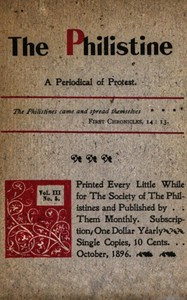
The Philistine
A Periodical of Protest.
_The Philistines came and spread themselves..._—FIRST
CHRONICLES, 14:13.
[Illustration: Vol. III No. 5.]
Printed Every Little While
for The Society of The Philistines
and Published by
Them Monthly. Subscription,
One Dollar Yearly
Single Copies, 10 Cents.
October, 1896.
THE PHILISTINE.
Contents for October.
1. A Murmur, Gardner C. Teall.
2. The Literary Sweat Shop, William McIntosh.
3. An Ominous Baby, Stephen Crane.
4. The Minor Poet, Harold MacGrath.
5. To Cadmus, John H. Finley.
6. Clangingharp Pays Up, Frank W. Noxon.
7. Carpe Diem, Charles G. D. Roberts.
8. Side Talks, The East Aurora School of Philosophy.
THE SOCIETY OF THE PHILISTINES.
(International.)
An association of Book Lovers and Folks who Write and Paint. Organized to
further Good-Fellowship among men and women who believe in allowing the
widest liberty to Individuality in Thought and Expression.
ARTICLE XII. SEC. 2. The annual dues shall be one dollar. This shall
entitle the member to all the documents issued by the Society, together
with one copy of the incomparable PHILISTINE Magazine, monthly, for one
year.
ARTICLE XIX. SEC. 4. The duties of each member shall consist in living up
to his highest Ideal (as near as possible) and in attending the Annual
Dinner (if convenient).
Address The Philistine,
East Aurora, N. Y.
THE PHILISTINE is supplied to the trade by the AMERICAN NEWS COMPANY and
its branches. Foreign agencies, BRENTANO’S, 37 Avenue de l’Opera, Paris;
G. P. PUTNAM’S SONS, 24 Bedford street, Strand, London.
Philistinic contributions solicited. All Ms. has careful and prompt
attention, and if not found acceptable is returned to the sender—stamps
or no stamps.
THE BIBELOT: A REPRINT OF POETRY AND PROSE CHOSEN IN PART FROM SCARCE
EDITIONS AND FROM SOURCES NOT GENERALLY KNOWN
1896
Subscriptions for 1896 are now 75 cents in advance, postpaid, and are
taken _for the complete year only_. On completion of Volume II, in
December, the price will be advanced to $1.00 net, in wrappers.
Foreign subscriptions are 25 cents additional to these rates.
NO MORE DESIRABLE GIFT TO A BOOK LOVING FRIEND COULD BE FOUND THAN A
COPY OF VOLUME I, AND A SUBSCRIPTION TO THE BIBELOT FOR EIGHTEEN HUNDRED
NINETY-SIX.
$2.25 net, postpaid.
THOMAS B. MOSHER AT
XXXVII EXCHANGE STREET
PORTLAND, MAINE
NEWSPAPER CLIPPINGS.
We have the greatest Reading Room in the World and clip from 15,000
publications of all kinds.
We receive them direct from the publishers, every issue, and furnish
clippings on all subjects, $1.00 per month and upwards.
Material for Speeches Books, Sermons, Lectures, Special Information,
Scrap Books, etc.
Write for particulars
THE CHICAGO PRESS CLIPPINGS BUREAU
36 La Salle Street, Chicago
A STORY IN VERSE
GLYNNE’S WIFE, BY JULIA DITTO YOUNG, AUTHOR OF “Thistle Down,” “Adrift:
a Story of Niagara,” etc. Mrs. Young is a poet who has written much but
published little. This, her latest and believed by her friends to be
her best work, is the product of a mind and heart singularly gifted by
Nature, and ripened by a long apprenticeship to Art. As a specimen of the
pure “lyric cry,” illustrating the melody possible in the English tongue,
the volume seems to stand alone among all the books written by modern
versifiers. Five hundred and ninety copies are being printed on smooth
Holland hand-made paper, and twenty-five on Tokio Vellum paper. Bound in
boards and antique silk; the Vellum copies will have on various pages
special water-color designs done by the hand of the author. Every copy
will be numbered and signed by Mrs. Young. Price on Holland paper, $2.00;
Vellum, $5.00.
THE ROYCROFT PRINTING SHOP
East Aurora, New York.
THE ROYCROFT PRINTING SHOP ANNOUNCE AS READY FOR IMMEDIATE DELIVERY
ON GOING TO CHURCH By GEORGE BERNARD SHAW, author “Quintessence of
Ibsenism,” “Arms and the Man,” etc., etc. (Authorized Edition.) This book
is done throughout in the best Roycroft style: Romanesque type, Kelmscott
initials, Dickinson’s Dekel-edge paper, wide margins
Price, stoutly bound in antique boards, One Dollar.
Twenty-five numbered copies on Tokio Vellum, special hand illuminations
on various pages done in colors by Bertha C. Hubbard, bound in genuine
vellum from skins prepared especially for us, price, Five Dollars, are
now all sold.
The Roycroft Printing Shop,
East Aurora,
N. Y.
THE PHILISTINE.
NO. 5. October, 1896. VOL. 3.
A MURMUR.
Out from the heart
Creeps a tiny sigh,
And the wondering! why
In the sombre part
Of the ravelling web
Of a destiny,
No colored thread
Off-sets the gray.
GARDNER C. TEALL.
THE LITERARY SWEAT SHOP.
Bill Nye dead.
Eugene Field dead.
Bob Burdette forgotten.
Mark Twain lecturing for a living.
Bret Harte a reminiscence.
Danbury Bailey a memory.
So then they have gone to their account—the princes of humor and song.
All have their reward of silence. Some already stand in the deepening
shade of oblivion. The language of earlier eulogy would have some
reference to the sheaves they bring to their harvest. The more sharply
real imagery of to-day calls for a change of figure, and substitutes for
sheaves the black bundles of the clothing district that we see borne by
pallid women in cotton drapery, with needle-pricked fingers, on Saturday
mornings. For the sweat shop has engulfed them all. They fed the yawning
demand for “copy” till their rest came.
It is a strange sequence of change from the time of American
didactics, when literature thought and spoke as a child, with the
simplicity of childhood and single aims. Deeper soundings have been
made in every department of letters than the pellucid ripple of the
Osgood-Hemans-Longfellow days afforded. A dozen of our poets have told
more that is in human hearts than the Sunnyside group ever gauged.
Riley has quickened more smiles and tapped more tears than Poe with
his property Niobes and his taxidermist shudders put in the verse that
ranked him among our immortals. The humor that bubbled in Artemus Ward,
Showman, was clarified and made high proof in the satire of Burdette and
the Danbury man. The child songs of Field are truer than those of Willis
and Sigourney and the Cary sisters. Bret Harte in the stately march of
Miss Blanche’s monologue and the “Saber cuts of Saxon speech” made more
vivid war pictures than all the trumpeters of the abolition period. The
paragraphers succeeded the phonetic spellers in the field of humor and
bettered their instruction. The short story writer took the place of
the two volume novelist, and the poetry of direct appeal superseded the
didactic inheritance wherein classic types were represented by domestic
lay figures scarcely more automatic.
The successive groups—the paragraphers, the short story builders, the
dialect poets, the feulletonists, the humorists of the Bailey and Nye
school, met the same fate. Prosperity opened its jaws and nearly all have
disappeared therein. The making of monumental newspapers was the fatal
suction in which each group was lost. Riley celebrating Hoosier scenery
in dialect _bouts rimes_ and Mark Twain “moving wild laughter in the
throat of death” on the lecture platform, are survivals. The multiplex
Hoe has done the business for each succeeding phase of American sentiment
and humor since the magazines degenerated into compends of crochet and
pseudo-biography.
In Mr. James L. Ford’s “Literary Shop” the author reads a severe lesson
to the young people who have ambition to write and be printed. They
should do newspaper work, he says. The desire for covers and immortality
is reprobated. It is to much more that they should know life, and
especially the life beyond the confines of the barbed wire fence that
shuts out the odorous East side of the metropolis. But Mr. Ford does not
tell his young people of a literary shop that stifles more genius than
the verse works in Jersey City or the anglomaniac reminiscence mills on
Union Square. He has forgotten the metropolitan paper that counts its
pages by the ream. What the exclusive clique-ridden magazine discourages
by closed doors the Sunday maelstrom swallows alive. The glory of bigness
is the destruction of individuality in literary work. The brand of the
sweat shop is on all the yawning jaws consume—like the slaver cm the
boa’s feast.
The successor of the humorist and the domestic poet is the caustic
free lance of the little magazines. The reaction is a sequence of the
unreasoning greed of the sweat shop. The bibelot is born of the surfeit
of the big newspaper. Readers seek it out—stawed with too much for their
money. And it is a hopeful sign for individuality in literature that a
clean cut idea is valued for a time more than quantity of words on paper,
even if the latter have the vanishing magic of a name.
Tonnage has had its day in the literature of America. The product of the
literary sweat shop is taking its rank with the other things commercially
dear to the money changers and despised of all Philistines.
WILLIAM MCINTOSH.
AN OMINOUS BABY.
A baby was wandering in a strange country. He was a tattered child with
a frowsled wealth of yellow hair. His dress, of a checked stuff, was
soiled and showed the marks of many conflicts, like the chain-shirt of
a warrior. His suntanned knees shone above wrinkled stockings which he
pulled up occasionally with an impatient movement when they entangled his
feet. From a gaping shoe there appeared an array of tiny toes.
He was toddling along an avenue between rows of stolid, brown houses.
He went slowly, with a look of absorbed interest on his small, flushed
face. His blue eyes stared curiously. Carriages went with a musical
rumble over the smooth asphalt. A man with a chrysanthemum was going
up steps. Two nursery maids chatted as they walked slowly, while their
charges hobnobbed amiably between perambulators. A truck wagon roared
thunderously in the distance.
The child from the poor district made his way along the brown street
filled with dull gray shadows. High up, near the roofs, glancing sun-rays
changed cornices to blazing gold and silvered the fronts of windows.
The wandering baby stopped and stared at the two children laughing and
playing in their carriages among the heaps of rugs and cushions. He
braced his legs apart in an attitude of earnest attention. His lower jaw
fell and disclosed his small, even teeth. As they moved on, he followed
the carriages with awe in his face as if contemplating a pageant. Once
one of the babies, with twittering laughter, shook a gorgeous rattle at
him. He smiled jovially in return.
Finally a nursery maid ceased conversation and, turning, made a gesture
of annoyance.
“Go ’way, little boy,” she said to him. “Go ’way. You’re all dirty.”
He gazed at her with infant tranquility for a moment and then went slowly
off, dragging behind him a bit of rope he had acquired in another street.
He continued to investigate the new scenes. The people and houses struck
him with interest as would flowers and trees. Passengers had to avoid the
small, absorbed figure in the middle of the sidewalk. They glanced at the
intent baby face covered with scratches and dust as with scars and powder
smoke.
After a time, the wanderer discovered upon the pavement, a pretty child
in fine clothes playing with a toy. It was a tiny fire engine painted
brilliantly in crimson and gold. The wheels rattled as its small owner
dragged it uproariously about by means of a string. The babe with his
bit of rope trailing behind him paused and regarded the child and the
toy. For a long while he remained motionless, save for his eyes, which
followed all movements of the glittering thing. The owner paid no
attention to the spectator but continued his joyous imitations of phases
of the career of a fire engine. His gleeful baby laugh rang against the
calm fronts of the houses. After a little, the wandering baby began
quietly to sidle nearer. His bit of rope, now forgotten, dropped at his
feet. He removed his eyes from the toy and glanced expectantly at the
other child.
“Say,” he breathed softly.
The owner of the toy was running down the walk at top speed. His tongue
was clanging like a bell and his legs were galloping. He did not look
around at the coaxing call from the small, tattered figure on the curb.
The wandering baby approached still nearer and, presently, spoke again.
“Say,” he murmured, “le’ me play wif it?”
The other child interrupted some shrill tootings. He bended his head and
spoke disdainfully over his shoulder.
“No,” he said.
The wanderer retreated to the curb. He failed to notice the bit of rope,
once treasured. His eyes followed as before the winding course of the
engine, and his tender mouth twitched.
“Say,” he ventured at last, “is dat yours?”
“Yes,” said the other, tilting his round chin. He drew his property
suddenly behind him as if it were menaced. “Yes,” he repeated, “it’s
mine.”
“Well, le’ me play wif it?” said the wandering baby, with a trembling
note of desire in his voice.
“No,” cried the pretty child with determined lips. “It’s mine! My ma-ma
buyed it.”
“Well, tan’t I play wif it?” His voice was a sob. He stretched forth
little, covetous hands.
“No,” the pretty child continued to repeat. “No, it’s mine.”
“Well, I want to play wif it,” wailed the other. A sudden, fierce frown
mantled his baby face. He clenched his fat hands and advanced with a
formidable gesture. He looked some wee battler in a war.
“It’s mine! It’s mine,” cried the pretty child, his voice in the treble
of outraged rights.
“I want it,” roared the wanderer.
“It’s mine! It’s mine!”
“I want it!”
“It’s mine!”
The pretty child retreated to the fence, and there paused at bay. He
protected his property with outstretched arms. The small vandal made a
charge. There was a short scuffle at the fence. Each grasped the string
to the toy and tugged. Their faces were wrinkled with baby rage, the
verge of tears. Finally, the child in tatters gave a supreme tug and
wrenched the string from the other’s hands. He set off rapidly down the
street, bearing the toy in his arms. He was weeping with the air of a
wronged one who has at last succeeded in achieving his rights. The other
baby was squalling lustily. He seemed quite helpless. He wrung his chubby
hands and railed.
After the small barbarian had got some distance away, he paused and
regarded his booty. His little form curved with pride. A soft, gleeful
smile loomed through the storm of tears. With great care, he prepared
the toy for traveling. He stopped a moment on a corner and gazed at the
pretty child whose small figure was quivering with sobs. As the latter
began to show signs of beginning pursuit, the little vandal turned and
vanished down a dark side street as into a swallowing cavern.
STEPHEN CRANE.
THE MINOR POET.
Pegasus rose as I drew near,
But, Lor’! I grabbed his tail,
And now on to Olympus Heights
We both serenely sail!
HAROLD MACGRATH.
[Illustration: CADMUS]
TO CADMUS.
To good St. Cad we sing,
For he’s patron Saint and King
Of lettered men.
He was both wise and strong
And he had a marked penchant
To use the pen.
He laid the walls of Thebes
When he’d sowed Bœotian Glebes
In martial oats.
He was Minerva’s pet,
For she gave the alphabet
To him with notes.
A serpent he became,
When he’d tired of human fame
And yellow gold.
And now a tempter sly,
He but tries to make men buy,
Rare book and old.
So here’s to good St. Cad,
For he isn’t half so bad
In spite of looks.
If I must tempted be
Pray let Cadmus come to me
With musty books.
John H. Finley.
CLANGINGHARP PAYS UP.
When Championoar and Padmarx tiptoed out of the elevator the three women
were sitting on a bench in the hall waiting for Clangingharp. Padmarx
sketched a mental cartoon of them, and with a nod at the bench and a
funereal mandamus to silence, the lawyer led the way into the entry.
Clangingharp let them in. He went on snapping studs into his shirt,
and the callers sat down. Championoar put his fingers into his vacant
waist-coat pocket and said it must be half-past eleven. Clangingharp said
he couldn’t help that; it was every man’s privilege to get up when he
pleased. Besides, how could he go to breakfast with Them out there? He
drew on lavender trousers suspended with embroidered galluses.
“Now see here,” began Championoar, “I don’t want to make trouble for you,
Strings, but this is my first case, and I’m going to recover or know the
reason why. Friendship’s all right, and I haven’t forgotten the time you
pulled me out of the river by the neck and nearly broke the neck. But a
lawyer has to win cases.”
“Old man,” said Clangingharp, adjusting his necktie, “I’m proud to be
your first defendant, and I wish you luck. I think your chances are
mighty bad, but I wish you luck.”
Championoar said if every cent was not paid up to the first of the month
before the next morning, Padmarx would print the story in _The Evening
Coat_, with pictures of the women.
“You bet your upright piano I will,” said Padmarx, but Clangingharp said
it wasn’t a piano, it was a folding bed.
Championoar said Clangingharp had no idea what he had been through trying
to keep each of those women from knowing the others were attempting to
collect alimony.
“Look here, Padmarx,” said Clangingharp, “buckle up this waist-coat, will
you? Well, how in thunder did they all happen to go to you?”
“They didn’t,” said Championoar. “I went to them. The Knittenpin woman
claims you never have paid her a dollar”——
“That’s just what I have paid her,” said the defendant, pulling on a
patent leather boot.
“Which makes three hundred. The actress wants two hundred, and Volumnia”——
“Ah, sweet Volumnia!”
“Volumnia says she hasn’t had a cent from you in two months—that’s one
hundred and fifty. Now what you going to do about it?”
Clangingharp buttoned up his Prince Albert coat and pinned a white
rose-bud into his button-hole. Then he said he would have much money at
noon, and would pay up before five. “Hold on, though. I never was married
to the Knittenpin woman. She’s got her divorce like the rest—I swear I
was never married to her. I’ll pay the others, but I’m damned if I pay
the Knittenpin woman.”
“Nonsense,” said Championoar, “I was best man.”
“Were you?” said Clangingharp. “I’d forgotten. Very well, I’ll pay them
all. Keep ’em there as long as you can. I go this way.”
He donned his silken tile and disappeared onto the fire-escape. They
watched him climb by a hall window into the floor below, and then they
heard the quick, impatient ring of the elevator bell.
Strings Clangingharp hastened to the corner drug store. Hermia
Clinkplunks was pensively sipping soda water.
“Ah, punctual, my dear,” he whispered. “Did you get it?”
Looking fondly into his false face she handed him a small leathern bag
and murmured, “Ten thousand.”
Clangingharp thankfully detached a $20 bill from the stacks in the bag
and bought her a package of chewing gum. Then they went out and were
married.
The Knittenpin woman, the Soubrette and Volumnia at last became hungry
and made for the elevator. The bride was just getting out of it as they
approached, and inquired, “Have you seen anything of Mr. Clangingharp?”
FRANK W. NOXON.
CARPE DIEM.
(An Old Song Resung.)
Full of life as it will hold
Let us fill the fleeting day,
For to-morrow we grow old.
Let’s be lovers blithe and bold,
Hot with folly while we may,
For to-morrow we grow old.
Let our eager eyes behold
Shining wonders on our way,
For to-morrow we grow old.
Let delight be uncontrolled,
Let the bubble dream be gay,
For to-morrow we grow old.
When the heart and lips are cold,
What will stir this sluggish clay—
When to-morrow we grow old?
What to us the hoarded gold,
Ample lands, and proud display,
When to-morrow we grow old?
Soon, too soon, the tale is told;
Soon, too soon, the dumb dismay.
Full of life as it will hold
Let us fill the fleeting day,
For to-morrow we grow old.
CHARLES G. D. ROBERTS.
SIDE TALKS WITH THE PHILISTINES: CONDUCTED BY THE EAST AURORA SCHOOL OF
PHILOSOPHY.
It having come to my notice that nine out of ten of the people who
buy this magazine read from the back page forward, on account of the
phosphorus in these “notes,” I have decided to make the Side Talks in
future fully one-half of the entire magazine. The large crop of potatoes,
and the prosperous condition of the School of Philosophy, make it easier
for me to be wiser and more joshuescent than ever before.
* * * * *
I note a disposition in some quarters to roundly censure the western
college paper that dished over that old joke of Dean Swift’s, and
reported Mr. Hubbard dead. Why, that story is as true as anything the
present editor of the intercollegiate periodical has written in the
calendar year!
* * * * *
In summing up a comparison between two prominent literary men, one of
whom is keenly malicious, and the other graspingly selfish, Clangingharp
decided in favor of the latter in this wise: “I don’t like either, but if
you demand which kind it is best to encourage, I say as Congressman Horr
said of the farmers of the south, ‘Less hell and more hogs.’”
* * * * *
A modest knock was heard at Heaven’s Gate. “Who is it?” called St. Peter.
“A Philistine!” came the assuring answer.
“Goodness! We don’t get anything but Philistines now-a-days,” remarked
the old gentleman. “Wait a few moments until there is a dozen ready to
come in and I’ll open the gate!”
* * * * *
In _Munsey’s_ (circulation seven million) for July, first column on page
512, is this expression, “that terrible foe of the aborigine—the demon
familiarly personified as John Barleycorn.”
* * * * *
Oh, oh, oh! This passion for saying something else, when you wish to
say a thing, is the terrible foe of the inkling aborigine—familiarly
personified as Munsey’s Monkey.
* * * * *
About that picture of Miss Jeannette Gilder in the September _Bookman_—go
on with you, I didn’t say a thing, did I?
* * * * *
Skipkinson Smith, who is quite a Hivite himself, is said to have said
that Clangingharp’s scheme of making photographic reproductions of all
rough drafts of your poems, so your biographer could trace the progress
of your soul-evolution, was pinched from Cudahy, and is rot in any event.
* * * * *
The Rev. Doctor Slicer once went down into a Cornish mine. After
traversing the murky moral darkness through various winding ways, the
safety lamp carried by the guide suddenly began to splutter; the flame
shot up, flared, flickered and the wires became red hot, showing the
presence of fire-damp.
“Is there no danger?” asked the clergyman of the miner.
“Well, I’ll tell you. You see the flame now is _there_?”
“Yes!”
“Well, when it gets to _there_, you and me will be in hell in a minute.”
* * * * *
Calvinism has gone, but it had several advantages: for one thing, it gave
you peace by supplying a hell for your rivals and enemies.
* * * * *
If some latter-day skeptics had been amongst the twelve apostles, poor
Thomas would hardly have received honorable mention.
* * * * *
Mr. William McIntosh, author of a fine article printed herein, is the
Great Original Philistine. He is also Managing Editor of the Buffalo
_News_, a paper that has a larger circulation than any daily between New
York and Chicago. But Mr. McIntosh will live in history because he wrote
the leading article in the first number of the PHILISTINE Magazine, and
not because he is Managing Editor of the Buffalo _News_, a paper that has
a larger circulation than any daily between New York and Chicago.
* * * * *
“Where do you get your plots?” asked the interviewer of Mr. Zangwill.
“I’ll tell you, young man, if you’ll say nothing about it: I get my plots
from stories that are sent me for criticism by little boys and girls.”
“But does not your conscience trouble you?”
“Oh, no. You see it gives the little boys and girls a chance to call
attention to themselves by crying aloud that they have been robbed.”
* * * * *
It is now pretty generally conceded that Steve Crane is in the secret pay
of the British Government, with intent to throw all possible discredit on
the patriotism of the American Volunteer.
* * * * *
_Scribner’s_ for July shows a picture entitled, “Mr. Hornaday at work
on his Bengal Tiger.” Now my friend Hornaday, being a genuine Jebusite,
is really a fine looking man; but Frank Stockton writes me that in the
picture it is a toss-up to know which is Hornaday and which is the tiger.
* * * * *
In the _Missus’ Home Journal_ of Philadelphia it is learned that “Ice
cream may be eaten with either a fork or a spoon.” It is so nice to have
an option in these important matters. Sometimes it is inconvenient to gum
it over the edge of a butter plate in the New York fashion.
* * * * *
It is still permissible to wear a white tie in daylight—especially if the
tie is fresh.
* * * * *
Populist whiskers are worn long and bloomers short.
* * * * *
Finger bowls are made larger this season—with fluted edges. This avoids
mistakes.
* * * * *
We have proceeded so far in our imitation of foreign refinements that
one who reads the _Loidy’s Own_ may easily determine where to improve
on Providence in the giving of good gifts. The _Loidy’s_ advises that
“In a hotel one only tips those servants who have rendered some special
service. It is not necessary to tip servants for doing their usual work.”
In private life the old-fashioned providential way of bestowing on the
just and the unjust, still prevails.
* * * * *
If you would have friends, be one.
* * * * *
The ’Bus drivers of London are a proud and ’aughty class; yet they
recognize a gentleman at sight, and often unbend—showing a friendliness
bordering on confidence. Among them I have several dear friends. The true
type wears a ’igh ’at, a ’igh collar and a red scarf, dimun pin, kid
gloves and in the lapel of his coat is a half-blown moss rose, supplied
stealthily by some sweet maid. Then he has his own private lap robe, used
only in fine weather, with his initials worked in yellow worsted across
the center. I never saw John the slightest frustrated or impatient. He
may be “laid out,” or bumped into, or bump into others, which he prefers,
yet the reins are still held lightly in one hand and with the whip in the
other, he tosses a kiss to some fair lidy, and all so deftly done that
none but she (and I) understand. ’Bus conductors get only half the pay of
drivers and are a cringing, knavish lot, totally unfit to associate with
gentlemen, and are never recognized by women who possess any degree of
self respect.
* * * * *
I went to the Tabernacle where Spurgeon, the son of his father, preaches
to six thousand people. The great man waved his arms, stamped wildly and
spoke with vehemence of the iniquities of the wicked city of London. “Why
does not God sink the place in a night, as he did Sodom and Gomorrah!”
shrieked Mr. Spurgeon.
A man from Oshkosh, Wisconsin, seated next me, wrote on the fly leaf
of his hymn book: “Because Henry Irving, play actor; William Morris,
infidel, and Zangwill, Jew, live here.”
* * * * *
I see that Mr. W. W. Denslow is being spoken of by the Chicago papers
as the Leonardo da Vinci of the North Side. Den draws things, paints
divinely, is a good collar-and-elbow philosopher, an all ’round wit, a
story teller of no mean repute, and like Mr. Boffin, occasionally drops
into poetry. But they do say that all of Den’s really choice ideas are
supplied by his wife, daughter of Amber and child of her gifted mother.
Happy Den! he doesn’t have to think; like a hippocampus, he just absorbs.
* * * * *
I have received from the publishers a book written by an Englishman,
entitled, _The Art of Graceful Horseback Riding Taught in Ten Chapters_.
The work reads like a lecture on rhetoric by the Shock-headed Youth in
English A at Harvard.
* * * * *
Haven’t you ever felt that the prince is as good as the pauper even if he
is no better?
* * * * *
Who says that we are not an artistic people? All that was necessary was
the faith of two American patriots like Koster and Bial, to pack the
galleries with spectators of such masterpieces as _The Bath_ and _The
Flea Hunt_ whose living models had been chosen with great care so as not
to offend the delicate popular sense of beauty.
* * * * *
“Ephemeral?” Yes!—I’m still, you see, the butterfly flitting from flower
to flower; while the busy, bumptious bumble-bee improves each shining
hour.
* * * * *
One James L. Ford claims to have discovered Bok. But Ford is not like
charity; he is exceeding puffed up and doth vaunt himself unseemly. In
homeopathic doses Ford is funny, but one reaches a point where he wants
to carry this too funny man in a buck basket to the wharf and dump him
for good and all.
* * * * *
To Anxious One: No, _Every Man His Own Trainer_, by Jack Splan, is not a
work on Theosophy. Its general theme is education after the manner taught
in _Successward_.
* * * * *
Mr. Chester S. Lord, managing editor of the New York _Sun_, recently
discharged a reporter for wearing a pink shirt with a blue collar. Mr.
Lord declares that any man who gets a salary of thirty dollars a week and
yet is in such financial distress that he cannot match up his linen is
not to be trusted.
* * * * *
Plain living and high thinking do not go together through choice, for if
you think high you will not have the money to live high, and not having
the money to live high you live plain—see?
* * * * *
Yes, let sound and perfume and color evolve from the wild, natural,
divine joy of life. Let art be born that is wayward as the western winds;
so long as it expresses that which the many feel, or arouses to life the
hopes that are dead, or animates with renewed strength the ambitions that
falter, or fans to flame the loves that languish, so long will we bid it
hail and God-speed!
* * * * *
Let the bicycle teach the great moral truth that unstable equilibrium is
made stable by progressive motion. He who stands still is lost.
* * * * *
Certain of the truths herein set forth have been expressed before, but
not well.
* * * * *
A retentive memory is a great thing, but the ability to forget is the
true token of greatness.
* * * * *
Latest advices confirm the report that Mephisto (who walks with a slight
limp, having had a fall) was put out of Heaven on account of his shocking
bad temper. He was afflicted with dyspepsia. After all, Heaven is largely
a matter of digestion, and come to think of it digestion is mostly a
matter of mind.
* * * * *
I know not what others may say, but as for me, my single self, the Great
Big Black Things that loomed against the horizon, threatening to come and
devour me, simply loomed and nothing more. The things that really made me
miss my train were soft, sweet, pleasant, pretty things of which I was
not in the least afraid.
* * * * *
This, which seemed at first to be a non-sequitur, was found in the
Buffalo _Courier_ of recent date:
“Bishop Walker is a man of extremely lovable nature and may be
seen during his stay at the Iroquois, or taking constitutional
walks about the blocks surrounding the hotel.”
On more mature consideration it seems that the Cathedral Car prelate was
simply candidating. There are other persons of extremely lovable nature
who meander around the same part of Buffalo betimes, and devour all they
pick up.
* * * * *
I fear there will not be general public sympathy with Mr. F. Tennyson
Neeley of Chicago in his defense of the suit of Col. Richard Henry
Savage, but as a matter of justice, it would seem that $12,000 is a small
fine for inflicting such books as _My Official Wife_ and others on a
suffering public. And if Mr. Neeley, having gotten some of the Colonel’s
pile, keeps it, the latter gentleman should remember it’s Chicago and
thank his stars they didn’t take it all.
* * * * *
The Anti-Slang Club of Somerset, N. J., sent $5.50 the other day to the
New York _Herald’s_ Ice Fund and one of the members confidentially writes
me, “They can’t say now that Anti-Slang don’t cut no ice.”
* * * * *
Now that Winter is in the offing and Discontent at the door, it is
pleasant to think that Organized Charity is getting ready for the season.
The plan of campaign is a simple one, but lest I should provoke a charge
of misconstruction, I take leave to state it in the words of the author
of _Oliver Twist_, who was never accused of exaggerating anything:
“Mrs. Corney,” said the beadle, smiling as men smile who
are conscious of superior information, “out-of-door relief,
properly managed, properly managed, ma’am, is the parochial
safeguard. The great principle of out-of-door relief is, to
give the paupers exactly what they don’t want, and then they
get tired of coming.”
* * * * *
On the authority of Mr. Frank L. Stanton of Atlanta, Hamlin Garland is
quoted as saying, “I will stick to the soil till I die.” That is a very
sub-tropical way of putting it, and I don’t wonder the Georgian likes
it. To be more accurate, the soil will stick to Hamlin—and it will do so
after he dies too.
* * * * *
Way down South where tradition is king and they hark back for all the
glory of life, it has been surmised that Li is in some way connected with
the family of the great soldier of the Confederacy and an investigation
is going on with the hope of establishing a relation of elbow kin with
the Celestial prince. It ought not to be news to my Southern friends
that the Lees are great people in China. For these many years the secret
faction fights which take the place of politics in the land of the sun
have been between the Lees and the Chews. The latter are supposed to be
in some way consanguine to the Chaws of Castle Garden. If so, it will
be seen that the Flowery Kingdom is divided on much the same lines as
Tammany Hall, and Li may have good reasons for feeling much at home in
New York.
* * * * *
From the PHILISTINE view-point it is very funny to note the panic among
our friends of the cloth at the inroads that bicycles are making on
the attendance at the churches. Some of the reverend gentlemen seem to
overlook the well-established philosophic fact that religion is innate
and fundamental in human nature and is bound to assert itself somehow.
The present symptom fills them with anxiety, and what most gets them,
so to speak, is that “fair weather Christians,” so-called, are the ones
who are missing now. When it rains it’s too wet and when it’s fair they
go wheeling. One minister takes his robes and his liturgy and follows
his sheep to the park—but that’s a stern chase. Another checks wheels
and his Sunday school room looks like a road house. I suppose a bowling
alley and golf links will be next. There’s no real reason for alarm, of
course. Relief will come from the opposite side, as it usually comes.
Wheeling is going to diminish the ranks of the old maids, and marriage is
the nursery of the church. But in all fairness I think there should be no
commutation of wedding fees in favor of wheel marriages. It costs just as
much to splice a pair in bloomers and goff socks as if they wore point
lace and waiter coats and it has happened that future millionaires and
millionairesses have been married with a foot on the pedal, so to say.
Let no gilty one escape.
* * * * *
The true Driver of the Quill is a virtuous Person. He wears his hair long
in token that he does not sleep with his precious head in the lap of
Delilah. To every literary Aspirant my advice is: Leave thy sconce well
thatched and keep comb and scissors at the distance of an Irish mile.
Let thy shock grow like a young forest, allowing it to be tossed by the
wanton western wind, but touched not by horse clippers nor sheep shears.
The Greeks were called the long-haired. Scissors were a barbarous Roman
invention, afterwards adopted by the Puritans. In olden time the first
mark set on a slave was to shave his head, and any man who getteth even
now a sentence of sixty days secures a close crop; whereas thirty-day
guests go untrimmed. Yea, wear thy hair longer than a lawsuit. It is the
sign that thou art Free.
* * * * *
When Philip asked that eunuch “Understandest thou what thou readest?”
he propounded a very needless question. Only men and women who are well
sexed understand what they read; ’tis they, and they only, who possess
the ability to see the unseen.
* * * * *
“Do you ever get lonesome?” asked the Giddy Youth of the Only Bernhardt.
“Do I get lonesome? Why, little boy, I often get as lonesome as my feet
were the first time I rode a horse astride,” was the answer.
* * * * *
Come, fellows: leave thinking of your thoughts and feeling of your
feelings; never mind how your heroine would have regarded herself if the
lover had spoken earlier or later—he didn’t, so it doesn’t matter a rap;
and don’t fret too awfully much about the way your yarn is to get itself
into words. Only give us something behind the words. Give us action,
story, incident, life. More things are happening right here in Yankeeland
than in any other equal space of earth. Tell about them.
* * * * *
If Dr. Conan Doyle and Miss Mary Wilkins and Miss Sarah O. Jewett had
sent the same kind of literature to the magazines, and things, ten years
ago that they send now, how cheerfully it would not have been accepted.
* * * * *
My Trans-Asian neighbor, Li Hung Chang, tells me he felt quite at home
when he came into this country and found everybody wearing button
decorations. He was a little shocked though when he found the insignia
of rank devoted to party cries and ribald slang—for he comes of a
sincere race, and veneration for dignities is a principle of life with
them. However, he thinks we are well on the way to the establishment
of privileged orders. The self made crests on our carriages further
encouraged him. No doubt he will see more of these as he goes on. If he
attends our theaters he will find privilege pretty well installed, as the
managers can tell him to their sorrow. It has its drawbacks of course.
For example, the desire for special honors leads some people who have
money to spend to go to great effort to get newspaper credentials at
such places. In one of our provincial cities you will see millionaires
enjoying the play at the expense of a newspaper. In the Buffalo suburb of
this metropolis of Philistia is a society leaderess who has been known
to extort “passes” in exchange for society items and then go to the box
office and have them exchanged so she “would not have to sit in newspaper
seats.” This is the sordid side of privilege. I think it may surprise Li.
* * * * *
An eminent Pittsburg physician with a scientific bent has made the
revelation that if you are a normal man you have one hundred and
twenty-eight eye-winkers on one side and one hundred and thirty-two
on the other; and that if you lose six from either side you have
appendicitis. It was Balzac who discovered that any woman with two tiny
black specks on the end of her nose was fond of amusement. Great is
Science!
* * * * *
“A widow does not pay formal visits for one year after her bereavement,”
according to Mrs. Isabel Wallon. This is almost an incitement to murder.
It’s a wonder it wasn’t in the Chicago platform.
* * * * *
The kind of self-consciousness that calls itself propriety enters even
the sanctuary of devotion. The _Betchersweetlife-I’m-a-Lady’s Home
Journal_ reminds its devotees that “It is very improper to recognize an
acquaintance during service in church.” Nothing is left to instinct in
the Narcissean _Lady’s Own_.
* * * * *
Ruth Ashmore is authority that “Flowers may, with perfect propriety, be
accepted from gentlemen.” There is no disputing this decision. Ruth knows
the limit.
* * * * *
Corn is still eaten from the cob. Cobs are indigestible.
* * * * *
They refer me to the mortality rates to prove the healthfulness of the
city of London. They say that coal smoke is only carbon and as such is
nourishing rather than otherwise. But I submit that a London cupid is
smirched by more than soot alone.
* * * * *
Ras Wilson says (and I hope you know Ras Wilson, for if you don’t you
have dropped something out of your life) Ras he says to the new reporter,
“Young man, write as you feel; but try and feel right. Feel good humored
towards every one and every thing. Believe that other folks are just as
good and just as smart as you, for they are. Give ’em your best and bear
in mind that God has sent ’em in His wisdom all the trouble they need,
and it’s for you to scatter gladness and decent, helpful things as you
go. Don’t be too particular about how the stuff will look in type, but
let ’er go—some one will understand. That is better than to write so dosh
bing high and so tarnashun deep that no one understands—let ’er go!”
* * * * *
ADVERTISEMENT.—A copy of THE PHILISTINE FANTASIA, a brilliant piece of
music composed and published by E. A. Richmond, Medford, Mass., will be
sent gratis to all persons sending yearly subscriptions for this Magazine
during the month of October. Persons wishing the music only should remit
50 cents direct to the composer.
We are printing four hundred copies on Japan Vellum of Mr. Hubbard’s
Essay on the artist, Turner. The book will contain twelve full-page
photogravures from negatives taken especially for us in the National
Gallery at London.
Bound in classic limp vellum, tied with tapes; price, Five dollars per
copy. Ready November 1st.
ART AND LIFE, by Vernon Lee.
We have printed a small edition on Japan Vellum of this exquisite Essay
and are illuminating the copies by hand. Price per volume, $5.00.
VOLUME TWO of the Philistine,
Handsomely bound in Buckram and Antique Boards, One Dollar. A few copies
of Volume One of the PHILISTINE bound in Antique Boards, price $2.00 each.
OUT OF PRINT:
The Song of Songs, The Journal of Koheleth.
THE
ROYCROFT PRINTING SHOP,
EAST AURORA, N. Y.
MODERN ART.
Four Times a Year.
Edited by J. M. BOWLES.
[Illustration: MODERN ART
L. PRANG & CO.: PUBLISHERS: BOSTON]
First in its field in this country. Published in Winter, Spring, Summer
and Autumn Numbers. Two Dollars a Year. Each number contains four full
page illustrations, with many large initial letter, head and tail pieces
and other ornaments. Printed on an imported French hand-made paper.
Its aim is to give expression to the spirit of Art of our day. The
most beautiful and interesting art periodical published. Sample copies
(back numbers) fifty cents in stamps. Circulars and sample pages free.
Subscription Two Dollars a Year. Published by
L. PRANG & COMPANY,
286 Roxbury Street, Boston.
_THIRD EDITION._
SUCCESSWARD
A Young Man’s Book for Young Men, by Edward W. Bok, Editor of The Ladies’
Home Journal
CONTENTS: A Correct Knowledge of Himself; What Really is Success; The
Young Man in Business; His Social Life and Amusements; “Sowing His Wild
Oats;” In Matters of Dress; His Religious Life; His Attitude Toward
Women; The Question of Marriage
Bound in Buckram, Decorated, Gilt Top, 12mo, $1.00
Everywhere bought and received as the best, most practical and helpful
book for Young Men published for years. For sale by all booksellers, or
sent postpaid on receipt of price by the publishers
Fleming H. Revell Company,
New York: 112 Fifth Avenue,
Chicago: 63 Washington Street,
Toronto: 140 and 142 Yonge Street.
Philistine Readers will be interested in a monthly illustrated magazine
that is devoted exclusively to literature and its progress in America and
England. No person who lays claims to culture and wide reading can afford
to be without The Bookman.
To any reader mentioning The Philistine we will send a sample copy free
of all charge.
ADDRESS
THE BOOKMAN
151 Fifth Ave New York City
We make a specialty of Dekel Edge Papers and carry the largest stock and
best variety in the country. Fine Hand-made Papers in great variety.
Exclusive Western Agents for L. L. Brown Paper Company’s Hand-mades.
GEO. H. TAYLOR & CO.,
207-209 Monroe Street,
Chicago, Ill.
LAY OF THE NEW POET.
Alack!
The man with the bellows cometh not,
Lingereth he where the growler
Foams at high noon?
You interrogate.
Aye, there’s the massage.
Stillness smothers herself in silence;
Adjust the goggles and
Observe!
There’s dust on papa’s whiskers.
[Illustration]