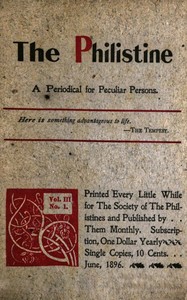
The Philistine
A Periodical for Peculiar Persons.
_Here is something advantageous to life._—THE
TEMPEST.
[Illustration: Vol. III. No. 1.]
Printed Every Little While
for The Society of The Philistines
and Published by
Them Monthly. Subscription,
One Dollar Yearly
Single Copies, 10 Cents.
June, 1896.
THE PHILISTINE.
CONTENTS FOR JUNE.
Extremes, William James Baker.
Some Things America Needs, Clavigera.
By a man who knows; yet who is willing to
forgive the sinners to seventy times seven.
The Railer, John Jerome Rooney.
The railer forgives no one! he is one of the
things America does not need.
Shadows, Faith Bigelow Savage.
Lines, Stephen Crane.
As to Bores, Annie L. Mearkle.
Have patience with the bore, you are often
one yourself.
To My Ladye Love, Ronsard.
Written quite a while ago but still timely.
Side Talks with the Philistines.
A chronicle of opinion conducted by the East Aurora
School of Philosophy.
_Entered at the Postoffice at East Aurora, New York, for transmission as
mail matter of the second class._
_COPYRIGHT, 1896, by B. C. Hubbard._
NOTICE TO
Collectors of Artistic Posters.
On receipt of 10 cents we will send to any address, a copy of our largely
illustrated catalogue of 500 posters exhibited by “The Echo” and “The
Century.”
“The Echo” is the pioneer in fostering the poster in America. It began
its department of Poster-Lore in August, 1895, and has printed it
fortnightly, with many illustrations, ever since.
Each issue of “The Echo” bears a poster design, in two or more colors,
on its cover. During the past year seven of these covers were by Will H.
Bradley.
“The Echo” is $2.00 a year, 10 cents a number. NEW YORK, 130 Fulton
Street.
LOOK OUT for the second and popular edition of “Cape of Storms,” price 25
cents. One sent free with every year’s subscription to “The Echo.”
_THE LOTUS._
_A Miniature Magazine of Art and Literature Uniquely Printed and
Illustrated._
A graceful flower.—_Rochester Herald._
It is a wonder.—_Chicago Times-Herald._
The handsomest of all the bibelots.—_The Echo._
Alone in its scope and piquancy.—_Boston Ideas._
Artistic in style and literary in character.—_Brooklyn Citizen._
The prettiest of the miniature magazines.—_Syracuse Herald._
Each bi-weekly visit brings a charming surprise.—EVERYBODY.
THE LOTUS _seeks to be novel, unconventional and entertaining without
sacrificing purity and wholesomeness. It seeks to be a medium for the
younger writers._
THE LOTUS _is published every two weeks and is supplied to subscribers
for One Dollar a year; foreign subscription, $1.25. Sample copy five
cents. On sale at all news stands._
THE LOTUS, Kansas City, Mo.
The Roycroft Quarterly:
Being a Goodly collection of Literary Curiosities obtained from Sources
not easily accessible to the average Book-Lover. Offered to the
Discerning every three months for 25c. per number or one dollar per year.
Contents for May:
I. Glints of Wit and Wisdom: Being replies from sundry Great Men who
missed a Good Thing.
II. Some Historical Documents by W. Irving Way, Phillip Hale and Livy S.
Richard.
III. As to Stephen Crane. E. H. A preachment by an admiring friend.
IV. Seven poems by Stephen Crane.
1—The Chatter of a Death Demon.
2—A Lantern Song.
3—A Slant of Sun on Dull Brown Walls.
4—I have heard the Sunset Song of the Birches
5—What Says the Sea?
6—To the Maiden the Sea was Blue Meadow.
7—Fast Rode the Knight.
V. A Great Mistake. Stephen Crane. Recording the venial sin of a mortal
under sore temptation.
VI. A Prologue. Stephen Crane.
THE ROYCROFT PRINTING SHOP,
East Aurora, New York.
THE PHILISTINE.
NO. 1. June, 1896. VOL. 3.
EXTREMES.
When our day’s competitive course is run,
And its gross triumphs, that crude wealth increase,
Are trumpeted from ramparts of fat peace—
As fine achievements duly wondered on—
What of the unfed squalors ’neath the sun?
What of the purient crimes night hours release,
And woes that from nor day nor night draw ease,
That unquenched greed may gold gold heap upon?
The rich man, gazing on his winged wealth,
Calls church and state to underwrite his claim;
The poor protest that law works bane by stealth;
Nor rich nor poor know God but as a name.
O, far off Christ, thy text to rear and van
Shows forth God’s law is—brotherhood of man.
WILLIAM JAMES BAKER.
SOME THINGS AMERICA NEEDS.
What you call a Discerning Person has told me that THE PHILISTINE is
read by all the really thoughtful people in America. This surely is not
a large class, as I hear you print only twenty thousand copies a month.
Now I do not exactly admire your brown paper cover, but I do like your
wholesome spirit, and although you have a touch of Yankee flippancy,
yet I will help you all I can in clearing the ground, that we may sow a
crop worth harvesting. And before I begin my little preachment let me
say I like the word Roycroft. “Roy” means king, and “croft” means a home
or rest—hence Roycroft means the King’s Rest. But best of all Master
Roycroft was really the first man in England to do artistic printing.
I am also told that the wives of the rich men in the States are the most
ignorant among your women; the reason being that it takes all their time
to look after their households; and none of your servants staying in
one place longer than three weeks, that your Woman’s Clubs are given up
to discussing the servant girl problem. That is, each woman relates her
woes to ease her nerves and fight off hysteria till a more convenient
season. And this class of care-laden people is largely increasing with
you, and yet you continue to sing _Yankee Doodle_ and talk large about
twisting the tail of an honest lion. Very well, I pardon you, knowing how
childishly ignorant you are, and if I now say some things that I have
said before you will pardon me.
Observe the two opposite kinds of labor. The first, just mentioned by
me, lavishly supported by Capital, and producing Nothing. The second,
tramping from place to place, asking for bread, and you giving it a stone
pile—and thirty days.
Observe further. These two kinds of labor, producing no useful result,
are demoralizing. All such labor is.
And the first condition of education, the thing General Coxey and all
of his cohorts are crying out for, is being put to wholesome and useful
work. And it is nearly the last condition of it, too; you need very
little more; but, as things go, there will yet be difficulty in getting
that. As things have hitherto gone, the difficulty has been to get the
reverse of that.
During the last eight hundred years, the upper classes of Europe have
been one large Picnic Party. Most of them have been religious also; and
in sitting down, by companies, upon the green grass, in parks, gardens,
and the like, have considered themselves commanded into that position
by Divine authority, and fed with bread from Heaven: of which they
considered it proper to bestow the fragments in support, and the tithes
in tuition, of the poor.
But, without even such small cost, they might have taught the poor
many beneficial things. In some places they have taught them manners,
which is already much. They might have cheaply taught them merriment
also—dancing and singing, for instance. The young English ladies who
sit nightly to be instructed themselves, at some cost, in melodies
illustrative of the consumption of Camille, and the decline of La
Traviata, and the damnation of Don Juan, might have taught every girl
peasant in England to join in costless choirs of innocent song. Here
and there, perhaps, a gentleman might have been found able to teach his
peasantry some science and art. Science and fine art don’t pay; but
they cost little. Tithes—not of the income of the country, but of the
income, say, of its brewers—nay, probably the sum devoted annually by
England to provide drugs for the adulteration of its own beer—would have
founded choice little museums, and perfect libraries, in every village.
And if here and there an English churchman had been found (such as Dean
Stanley) willing to explain to peasants the sculpture of his and their
own cathedral, and to read its black letter inscriptions for them; and,
on warm Sundays, when they were too sleepy to attend to anything more
proper—to tell them a story about some of the people who had built it, or
lay buried in it—we perhaps might have been quite as religious as we are,
and yet need not now have been offering prizes for competition in art
schools, nor lecturing with tender sentiment on the inimitableness of
the works of Fra Angelico.
These things the great Picnic Party might have taught without cost, and
with amusement to themselves. One thing, at least, they were bound to
teach, whether it amused them or not—how, day by day, the daily bread
they expected their village children to pray to God for, might be earned
in accordance with the laws of God. This they might have taught, not only
without cost, but with gain.
Of all attainable liberties, then, be sure the first to strive for is
leave to be useful. Independence you had better cease to talk of (you
Americans talk too much about it anyway), for you are dependent on every
act of what has been dust for a thousand years, so also, does the course
of a thousand years to come, depend upon the little perishing strength
that is in you. Now what is your American Picnic Party going to do with
its leisure? On that your fate as a Nation hangs.
Understand this: Virtue does not consist in doing what will be presently
paid, or even paid at all, to you, the virtuous person. It may so chance;
or may not. It will be paid, some day; but the vital condition of it, as
virtue, is that it shall be content in its own deed, and desirous rather
that the pay of it, if any, should be for others; just as it is also the
vital condition of vice to be content in its own deed, and desirous that
the pay thereof, if any, should be to others.
You have, it seems, now set your little hearts much on Education. You
will have education for all men and women now, and for all boys and
girls that are to be. Nothing, indeed, can be more desirable, if only
we determine also what kind of education they are to have. It is taken
for granted that any education must be good; that the more of it we get,
the better; that bad education only means little education; and that
the worst thing we have to fear is getting none. Alas, that is not at
all so. Getting no education is by no means the worst thing that can
happen to us. One of the pleasantest friends I ever had in my life was a
Savoyard guide, who could only read with difficulty, and write, scarcely
intelligibly, and by great effort. He knew no language but his own—no
science, except as much practical agriculture as served him to till his
fields. But he was, without exception, one of the happiest persons, and,
on the whole, one of the best I have ever known; and after lunch, he
would often as we walked up some quiet valley in the afternoon light,
give me a little lecture on philosophy; and after I had fatigued and
provoked him with less cheerful views of the world than his own, he would
fall back to my servant behind me, and console himself with a shrug of
the shoulders, and a whispered “The poor child, he doesn’t know how to
live.”
No, my friends, believe me, it is not the going without education at all
that we have most to dread. The real thing to be feared is getting a bad
one. There are all sorts—good, and very good; bad, and very bad. The
children of rich people often get the worst education that is to be had
for money; the children of the poor often get the best for nothing. And
you have really these two things now to decide for yourselves before you
can take one quite safe practical step in the matter, namely, first: What
a good education is; and, secondly, who is likely to give it you.
What it is? “Everybody knows that,” I suppose you would most of you
answer. “Of course—to be taught to read, and write, and cast accounts;
and to learn geography, and geology, and astronomy, and chemistry, and
German, and French, and Italian, and Latin, and Greek, and the aboriginal
Aryan language.”
Well, when you have learned all that, what would you do next? “Next?
Why then we should be perfectly happy, and make as much money as ever
we liked, and we would turn out our toes before any company.” I am not
sure myself, and I don’t think you can be, of any one of these three
things. At least, as to making you very happy, I know something, myself,
of nearly all these matters—not much, but still quite as much as most men
under the ordinary chances of life, with a fair education, are likely to
get together—and I assure you the knowledge does not make me happy at
all. When I was a boy I used to like seeing the sunrise. I didn’t know
then, there were any spots on the sun; now I do, and am always frightened
lest any more should come. When I was a boy, I used to care about pretty
stones. I got some Bristol diamonds at Bristol and some dog-tooth spar in
Derbyshire; my whole collection had cost, perhaps, three half-crowns, and
was worth considerably less; and I knew nothing whatever, rightly, about
any single stone in it—could not even spell their names; but words cannot
tell the joy they used to give me. Now, I have a collection of minerals
worth, perhaps, three thousand pounds; and I know more about some of
them than most other people. But I am not a whit happier, either for my
knowledge, or possessions, for other geologists dispute my theories, to
my grievous indignation and discontentment; and I am miserable about all
my best specimens, because there are better in the British Museum.
And as to your wonderful inventions, why talk at a distance, when you
have nothing to say? Or go fast from this place to that, with nothing to
do at either? These are powers certainly! Much more, power of increased
Production, if you, indeed, had got it, would be something to boast of.
Now just cast your Cathode ray this way and observe this fact: A man
and a woman, with their children, properly trained, are able easily to
cultivate as much ground as will feed them; to build as much wall and
roof as will lodge them, and to spin and weave as much cloth as will
clothe them. They can all be perfectly happy and healthy in doing this.
Supposing that they invent machinery which will build, plough, thresh,
cook, and weave, and that they have none of these things any more to do,
but may read, or play croquet, or cricket, all day long, I believe myself
that they will neither be so good nor so happy as without the machines.
But I waive my belief in this matter for the time. I will assume that
they become more refined and moral persons, and that idleness is in
future to be the mother of all good. But observe, I repeat, the power
of your machine is only in enabling them to be idle. It will not enable
them to live better than they did before, nor to live in greater numbers.
Get your heads quite clear on this matter. Out of so much ground, only
so much living is to be got, with or without machinery. You may set a
million of steam-ploughs to work on an acre, if you like—out of that
acre only a given number of grains of corn will grow, scratch or score
it as you will. So that the question is not at all whether, by having
more machines, more of you can live. No machine will increase the
possibilities of life. It only increases the possibilities of idleness.
Suppose, for instance, you could get the oxen on your plough driven
by a goblin, who would ask for no pay, not even his beer,—well, your
furrow will take no more seeds than if you had held the stilts yourself.
But, instead of holding them, you sit, I presume, on a bank beside the
field, under an eglantine—watch the goblin at his work, and read poetry.
Meantime, your wife in the house has also got a goblin to weave and wash
for her; and she is lying on the sofa, revelling in Stephen Crane’s lines.
Now, as I said, I don’t believe you would be happier so, but I am willing
to believe it; only, since you are already such brave machinists, show
me at least one or two places where you are happier. Let me see one
small example of approach to this seraphic condition. I can show you
examples, millions of them, of happy people made happy by their own
industry. Farm after farm I can show you in Bavaria, Switzerland, the
Tyrol, and such other places, where men and women are perfectly happy
and good, without any iron servants. Show me, therefore, some Kansas or
Ohio family happier than these. Or bring me—for I am not inconvincible
by any kind of evidence—bring me the testimony of an Illinois family or
two to their increased felicity. Or if you cannot do so much as that, can
you convince even themselves of it? They are perhaps happy, if only they
knew how happy they were. Virgil thought so, long ago, of simple rustics;
but at present your steam-propelled rustics are crying out that they are
anything else than happy, and that they regard their boasted progress “in
the light of a monstrous Sham.”
There are three Material things, not only useful, but essential to Life.
No one knows how to live till he has got them.
These are, Pure Air, Water and Earth.
There are three Immaterial things, not only useful, but essential to
Life. No one knows how to live till he has got them also.
These are, Admiration, Hope and Love.
Admiration—the power of discerning and taking delight in what is
beautiful in visible Form, and lovely in human Character; and,
necessarily, striving to produce what is beautiful in form, and to become
what is lovely in character.
Hope—the recognition, by true Foresight, of better things to be reached
hereafter, whether by ourselves or others; necessarily issuing in the
straightforward and undisappointable effort to advance, according to our
proper power, the gaining of them.
Love, both of family and neighbor, faithful, and satisfied.
These are the six chiefly useful things to be got by Political
Economy—the great “savoir mourir” is doing with them.
The first three, I said, are Pure Air, Water, and Earth.
Heaven gives you the main elements of these. You can destroy them at your
pleasure, or increase, almost without limit, the available quantities of
them.
You can vitiate the air by your manner of life, and of death, to any
extent. You might easily vitiate it so as to bring such a pestilence on
the globe as would end all of you. Some of you Jingo Americans at present
want to vitiate it in every direction;—chiefly with corpses, and animal
and vegetable ruin in war: changing men, horses, and garden-stuff into
noxious gas. But everywhere, and all day long, you are vitiating it with
foul chemical exhalations; and the horrible nests, which you call towns,
Buffalo, Pittsburg, Chicago and the like (thank God I’ve been in none of
them), are little more than laboratories for the distillation into heaven
of venomous smokes and smells, mixed with effluvia from decaying animal
matter, and infectious miasmata from purulent disease.
On the other hand, your power of purifying the air, by dealing properly
and swiftly with all substances in corruption; by absolutely forbidding
noxious manufactures; and by planting in all soils the trees which
cleanse and invigorate earth and atmosphere—is literally infinite. You
might make every breath of air you draw, food.
Secondly, your power over the rain and rain-waters of the earth is
infinite. You can bring rain where you will, by planting wisely and
tending carefully—drought, where you will, by ravage of woods and neglect
of the soil. You might have the rivers as pure as the crystal of the
rock; beautiful in falls, in lakes, in living pools—so full of fish that
you might take them out with your hands. Or you may do always as you have
done now, turn your rivers into a common sewer, so that you cannot as
much as baptize a Yankee baby but with filth, unless you hold its face
out in the rain; and even that falls dirty.
Then for the third, Earth—meant to be nourishing for you, and
blossoming—you have used your scientific hands and scientific brains,
inventive of explosive and deathful things, to make it grow cotton and
tobacco, and grain for malt and whiskey, giving nothing back to the earth
that she may be blossoming and life-giving. Yes, you have turned the
Mother-Earth, Demeter, into the Avenger-Earth, Tisiphone—with the voice
of your brother’s blood crying out of it, in one wild cry round all its
murderous sphere.
That is what you have done for the three Material Useful Things.
Then for the three Immaterial Useful Things. For admiration, you have
learned contempt and conceit. There is no lovely thing ever yet done
by man that you care for, or can understand; but you are persuaded you
are able to do much finer things yourselves. You gather, and exhibit
together, as if equally instructive, what is infinitely bad, with what
is infinitely good. You do not know which is which: most Americans
instinctively prefer the bad, and do more of it. You instinctively hate
the Good, and destroy it.
Then, secondly, for Hope. You have not so much spirit of it in you as to
begin any plan which will not pay for ten years; nor so much intelligence
of it in you (either politicians or workmen) as to be able to form one
clear idea of what you would like your country to become.
Then, thirdly, for Love. You were ordered by the Founder of your
religion to love your neighbor as yourselves. But you have framed an
entire Science of Political Economy, founded on rivalry and strife, which
is what you have stated to be the constant instinct of man—the desire to
overreach his neighbor.
And you have driven your women so that they ask no more for Love, nor for
fellowship with you; but stand against you, and ask for “justice.”
Are there any of you who are tired of all this?
Well then try to make some small piece of ground beautiful, peaceful, and
fruitful. We will have no untended or unthought-of creatures on it; none
wretched, but the sick; none idle, but the dead. We will have no liberty
upon it; but instant obedience to known law, and appointed persons; no
equality upon it, but recognition of every good that we can find. We will
have plenty of flowers and vegetables in our gardens, plenty of corn
and grass in our fields. We will have some music and some poetry; the
children shall learn to dance it and sing—perhaps some of the old people,
in time, may also. We will have some art, moreover pictures and hand-made
books; we will at least try if, like the Greeks, we can’t make pottery.
The Greeks used to paint pictures of gods on their pots; we, probably,
cannot do as much, but we may put some pictures of flowers—butterflies,
and frogs, if nothing better. Little by little, some higher art and
imagination may manifest themselves among us; and feeble rays of science
may dawn for us. Botany, though too dull to dispute the existence of
flowers; and history, though too simple to question the nativity of men;
nay—even perhaps an uncalculating and uncovetous wisdom, as of rude Magi,
presenting, at such nativity, gifts of gold and frankincense.
CLAVIGERA.
Cumberland, April 6, 1896.
THE RAILER.
“There is no joy thro’ all the earth:
Hope is a witless mocker’s jest:
There is no nobler second birth—
Nor fair, nor best!
“The touch of Death is over all
And life is portal to the hell
Where men are cattle in a stall
To buy and sell!
“Yea, he who tears his brother’s heart
To cast it to the ravening crowd
Is hailed as master of the mart
With plaudits loud.
“He wears his crown a little space
Until a fiercer knave than he
Shall push him from his vantage place
And monarch be!
“The shadows drive away the sun—
The flowers are hid by jealous Night,
The fruit is plundered—never won—
And Might rules Right!”
Thus raves the scoffer, age in age,
Who bears no message of his own
Save the blind clamor of his rage
From breast of stone.
He holds a balance in his claw
To weigh with loaded penny-weights
The mighty universe of Law
With all its fates!
This, to the railer from the tombs
Who makes not, neither loves nor gives:
Spite of the crackle of thy dooms
God lives! God lives!
JOHN JEROME ROONEY.
SHADOWS.
“My wife? She is dead!” said the man.
“God help you to bear it,” were the answering words of the woman.
“And you would have me do my duty?”
“You could do naught else. There are other things than love, my friend;
there is honor, and we must abide by that—and the inevitable.”
* * * * *
“I am the resurrection and the life saith the Lord; he that believeth in
me though he were dead yet shall he live: and whosoever believeth in me,
shall never die.”
* * * * *
The last friend had paid his final tribute to the departed. All had gone
save the husband, his little daughter, the mother—and a woman simply
clad in black. Her face was pale, marked by delicate traceries of mental
suffering—a suffering so intense that the whole contour was radiant
with martyrdom and the inner spiritual beauty of her woman’s soul. Her
eyes, earth brown and blazing with the hidden sunlight of her year’s sad
spring, were fixed in mute appeal upon the still, white face within its
house of immortality.
It was the husband now, who, taking her gently by the hand, lead her to
the carriage.
Was it “kismet” that, by some grim coincidence, placed these two human,
saddened souls in the same carriage—alone!
The way was long, and the roads as yet unsoftened by the Spring’s
nestling bloom. For a while neither spoke, and then the woman’s voice
vibrated through the silence like a breath of air light as the apple
blossoms caroling in May, when leaf and bud unite in song to praise their
creator.
“Dear, you and I are soon to say good bye; by some strange fateful turn
of Life’s orbit, we must say it here. You were always generous and loyal
to her—you always will be. She has forgiven you, but bids me lead my life
alone. The voice of circumstance says to us what we interpret it to say.
It is in the needs of a high nature wherein doth lie nobility and honor.
We loved; it was so to be, but we did not sin; therein lies the truest
and purest love. You”——
The carriage stopped before the open grave, and as the woman watched
the damp earth fall—kneeling, she dropped a single passion flower upon
the coffin’s lid, and through her mist of tears beheld the cross; then
murmuring “In His Name,” she entered the carriage—alone!
FAITH BIGELOW SAVAGE.
FAST RODE THE KNIGHT
WITH SPURS, HOT AND REEKING
EVER WAVING AN EAGER SWORD.
“TO SAVE MY LADY!”
FAST RODE THE KNIGHT
AND LEAPED FROM SADDLE TO WAR.
MEN OF STEEL FLICKERED AND GLEAMED
LIKE RIOT OF SILVER LIGHTS
AND THE GOLD OF THE GOOD KNIGHTS BANNER
STILL WAVED ON A CASTLE WALL.
...
A HORSE
BLOWING, STAGGERING, BLOODY THING
FORGOTTEN AT FOOT OF CASTLE WALL.
A HORSE
DEAD AT FOOT OF CASTLE WALL.
STEPHEN CRANE.
AS TO BORES.
A little while ago I read in a paper the following scathing paragraph:
There is nothing so terrible as to be fairly well informed on a
subject and have some unutterable bore come around and insist
on pouring into your ear a mass of ill-digested misinformation
on that subject.
This looks profoundly, dismally true. It undoubtedly is. No, there is one
thing more terrible, and that is to be conscious of being the bore.
The boree has been heard from frequently since the Renaissance, and his
sentiments have undergone little change. The borer hasn’t had much to say
for himself. Yet who can place his hand upon his heart and assert that
he has never experienced what it is to be one? To have to be the victim
of such, dear sir, is the payment the gods exact for the treasure of
extraordinary learning. Nobody has a monopoly of advanced knowledge on
this planet, but most of us are born ignorant and remain so until by the
grace of heaven we become bores. The state of borehood is the chrysalis
stage of the human intelligence, intermediate between grub and butterfly.
The apple-borer has such a stage, so has the ordinary unqualified borer
of urban life. He has eaten his modicum of the tough, indigestible
portion of the tree of knowledge, and must undergo metamorphosis
before sipping the nectar of its fruit. The writer of my text may be
an exception to this generalization, for clearly he never advanced from
ignorance through the purgatory of borehood to celestial learning, or he
would know how terrible it is to be an unutterable bore.
Alas, poor bore! Will nobody pray for you, or drop a pitying tear?
The bore we have always with us. He who would enjoy his superior culture
in immunity from the eleemosynary appeals of spiritual mendicants should
go into the desert and become a hermit and learn to say like the hermit
in Homo Sum, nihil humanum alienum me puto. I do suspect, though, that
the saint in question himself fled into the desert to avoid a bore. And
that reminds me that a saint of my acquaintance was once called upon to
help one of these spiritual apple-borers through the tough integuments of
a theological cocoon. He received a visit from the painful creature about
every day. How unutterably it must have bored him! But he never said so.
At last the poor bore achieved wings and flew away into a Universalist
orchard; and as there are few things about which people in general know
so much that ain’t so as they do about the subject on which he is now
well posted, he probably realizes how terrible it is to be the victim of
the morally dyspeptic, misinformed or uninformed, unutterable bore.
But the man who has a mission to mankind can’t afford to be bored. Jesus
Christ, who was, if anybody ever was, born with fine intuitions, on some
subjects, that transcended any laboriously acquired knowledge, must have
been the worst bored man in Palestine when his disciples came around and
asked him such questions as who should be first in the kingdom of heaven,
or the Sadducees propounded that conundrum about the woman with seven
husbands. But instead of putting his unutterable boredom on record in a
crisp text he answered their irritating questions in that sweetly wise
way of his, which must, if anything could, have caused those poor souls
to sprout wings.
He also said, whatsoever we would that men should do to us, we ought to
do to them; and did not except bores.
ANNIE L. MEARKLE.
TO MY LADYE LOVE.
Downe I sat,
I sat downe
Where Flora had bestowed her graces.
Greene it was,
It was greene,
Far passing other places;
For art and nature did combine
With sights to witch the gasers eine.
There I sat,
I sat there,
Viewing of this pride of places.
Straight I saw,
I saw straight
The sweetest faire of all faces:
Such a face as did containe,
Heaven’s shine in every raine?
I did looke,
Looke did I,
And there I saw Apollo’s wyres:
Bright they were,
They were bright;
With them Aurora’s head he tires;
But this I wondered, how that now,
That shadowed in Cassander’s bow.
Still I gazde,
I gazde still,
Spying Luna’s milke white glasse:
Commixt fine,
Fine commixt
With the morning’s ruddy blase;
This white and red their seating seekes,
Upon Cassandraes smiling cheeks.
RONSARD.
SIDE TALKS WITH THE PHILISTINES: BEING SOUL EASEMENT AND WISDOM
INCIDENTALLY.
The report that Miss Jeannette Gilder has been engaged as Editor of the
PHILISTINE is entirely unfounded. No such arrangement has been thought of.
* * * * *
It’s getting so that ’tis harder to find a gentleman than a genius.
* * * * *
“What did you do when the contralto flew into a passion and berated you
for choosing your own hymns?” asked the Fledgling of the Wise Pastor.
“What did I do? why, I did nothing—simply sat there and watched her grow
old.”
* * * * *
Florence Turner fires at me A Deduction and A Query, thus:
All animals having the cloven hoof chew a cud. The Devil has
the cloven hoof, ergo—he chews a cud. Is it the cud of sweet
and bitter fancy?
Heaven bless me! how do I know? But still I have no doubt but that he
chews—probably “Tin Tag.”
* * * * *
Verily, in the midst of life we are in debt.
* * * * *
The loyalty of men to their Alma Mater is ever charming, but the loyalty
of a youth to his prospective Mother-in-Law is sublime. In the past two
weeks every mail has brought me letters from Harvard men protesting
against a certain preachment that appeared in the May PHILISTINE
entitled, “By Rule of Three.” For the most part the literary style of
these missives corroborates the strictures made as to English as she is
writ at Harvard. But the crowning feature of the paper fusilade is a
foolscap proposition signed by four sophomores wherein they offer to put
the author of “By Rule of Three” under the pump if he will name a day and
hour when he dare walk across Harvard Yard. The author, I believe, is not
a Baptist, but even if he were, and if the rite referred to should be
performed (in lieu of argument), why, Barrett Wendell would still be an
Anglomaniac and the facts about English at Harvard would remain unchanged!
* * * * *
Mr. S. E. Kiser, that good honest Wit, writes me after this wise:
At present not more than three out of every possible five
persons to be met in this country are possessed of the honest
conviction that Nature intended them for dalliance with the
Muse.
Why does this deplorable state of affairs exist? The answer is
not far to seek. We do not give our poets enough encouragement.
On the contrary, there seems to be a widespread conspiracy to
keep them down. Every time champing Pegasus is mounted by a
new aspirant you may see a score of critics flirt their lassoos
at him, with the hope of yanking him from his perch; unless,
perchance, he be an adept in the Free Masonry that occasionally
exempts some favored one from the onslaughts of the iconoclasts.
To come to a case in point, _Duncey’s_ endeavors to dispose of
a few bards who are presumed to have furnished Uncle Frank’s
critic with complimentary volumes of their own make. One of
them, a Mr. W. B. Yeats, is taken to task for asserting that
“Down by the salley gardens he and his love did meet.” The
salley garden is objected to, forsooth, upon the ground that
nobody but the inventor knows what it is. Here is a fine
proposition! What would some of our most prosperous bards
amount to in the estimation of the public if their verses were
always couched in terms that anybody could understand? In the
very number of the magazine that contains the raillery against
Mr. Yeats’ salley garden, Samuel Minturn Peck warbles in this
wise:
I’m dreaming of the fragrant South,
My native pine clad hills afar;
I seem to feel upon my mouth
The sweetness of a jasmine star!
Soon time and space are vanished,
And leagues on leagues away,
With every grief far banished,
My aching heart is hay.
This, it is fair to presume, was paid for “at the regular
rates” for such matter, and published as an example of
praiseworthy song, notwithstanding the fact that mighty
few of _Duncey’s_ million subscribers could depose and say
whether a jasmine star is sweet or sour, or whether it would
be necessary, in order to get the full benefit of its flavor,
to peel it and slice it as one would an apple, or suck it
like a lemon. It would also be difficult to explain to the
satisfaction of a hypercritical person why, “with every grief
far banished,” any one could have the faintest shadow of an
excuse for possessing an aching heart; or, that point cleared
up, how the aching heart aforesaid could still be timothy. But
these are trifles that ought not to be permitted to embarrass
the sweet singer. I mention them only to illustrate the
unfairness with which Mr. Yeats has been treated. Mr. Peck is
in vogue, to a certain extent, while Mr. Yeats is not. Ergo:
Yeats and his muse must not fool around in the salley garden.
This matter disposed of, Sophie M. Almon-Hensley is chided for
asseverating that
My ship’s in the bay,
The glad, blue bay,
The wind’s from the west,
And the waves have a crest,
But my bird’s in the nest,
And my ship’s in the bay.
“It must,” says _Duncey’s_ astute critic, “be a consolation to
the writer of these inspired lines to know that her various
possessions are where they belong. After all, there is nothing
like having a place for everything and everything in its
place.” Which may be witty as well as true, but why ridicule
Sophie M. Almon-Hensley on one page and on the next laud Robert
Louis Stevenson—God rest his soul—for such verses as these:
Through all the pleasant meadow side
The grass grew shoulder high,
Till the shining scythes went far and wide,
And cut it down to dry.
These green and sweetly smelling crops
They led in wagons home,
and so on. No one is likely to suppose for a moment that the
scythes went up and down, or that the grass was cut up to soak,
or that the green and sweetly smelling crops were led away
from home in top buggies. Yet, from an artistic standpoint,
Stevenson was justified in acquainting us with the details
of the operation, which fact makes the attack upon Sophie M.
Almon-Hensley particularly aggravating.
The truth seems to be that a large majority of the publishers
do not like the idea of breeding up a new race of poets. Those
who are already in the field must be tolerated, and those who
are well dead may be quoted _ad. lib._ without fear of the
copyright law. It is gratifying to note one shining exception
to this rule. The editor of the transitory _Chip-Munk_ has
evidently determined to publish anything and everything in the
shape of verse that falls into his hands. This, if not actually
announced, is clearly implied in his Easter number, where,
among other things, are to be found these lines:
Or there, or here, to toil or pleasure led,
The tenants pass, and cut each other dead;
Jones, second floor, administers affronts,
Because his father was a governor once.
After this, the amateur may comfort himself with the assurance
that he has at least one friend, with a helping hand
outstretched. While young Mr. Bumball’s paper, ink and type
hold out, there is no reason why every state, every county,
every town and every hamlet may not have a rhymesmith of its
very own. This is encouraging, and leads to the hope that in
time, if the brood of the mother hen keeps on increasing, it
may come to pass that he who runs may rhyme and get his rhyme
in print.
* * * * *
How far can a woman go to win in love’s race? A step backward is often
good policy.
* * * * *
Beg pardon—but who is this Richard Arden Davies that _The London Bookman_
is chewing about?
* * * * *
That good savage and excellent Wm. T. Hornaday is about to fall into line
and start a magazinelet, patterned after the _Chip-Munk_ brood. It will
be called _The Dyak_ and the cover will be cut decolette.
* * * * *
Way & Williams are sending out _A Mountain Woman_. We used to have only
two kinds of women, the good and the bad, but now we have many. The book
is as good as _The Essays of Elia_, and that is high praise.
* * * * *
The poor writers we have always with us—if we take the daily paper.
* * * * *
No one knows the vanity of riches save he who has been rich; therefore
I would have every man rich, and I would give every youth a College
education that he might know the insignificance of it.
* * * * *
A Good Philistine is known by his never saying:
“As it were.”
“So to speak.”
“Red letter day.”
“Seldom if ever.”
“Macedonian cry.”
“All along the line.”
“Signs of the times.”
“Peace to his ashes.”
“The blush of shame.”
“The deadly upas tree.”
“We are pained to learn.”
“The devouring element.”
“Will not soon be forgotten.”
“Our loss is his eternal gain.”
“None knew him but to love.”
“They are left to mourn his loss.”
“The right man in the right place.”
“If I may be allowed the expression.”
* * * * *
To recognize the accidentally impolitic from the essentially wrong is a
step always first taken by a Philistine. The Chosen People damn him for
his pains, after which they adopt his view and swear on their beards that
they always held it.
* * * * *
Who are the bores? Oh, you make me weary—the others, the others, the
others!
* * * * *
Mr. Wallace, of Chicago, publisher of _Wallace’s Stud-Book_, disputes the
statement that the Windy City is losing her literary prestige.
* * * * *
Clangingharp says the sanest sentiment ever expressed by any of the
Vanderbilt family was when the Commodore remarked, “The Public be damned!”
* * * * *
“Be not righteous overmuch,” said the Preacher. Of course such advice to
the average mortal is quite needless—the matter may safely be left in
his hands. Still, good things can be overdone: industry for instance.
There is a sort of pismire activity that makes for bankruptcy. I once
knew a man who used to get up at four o’clock in the morning to hammer
and saw (those very early risers always hammer and saw), yet I believe
the administrator found hardly enough to pay forty cents on the dollar.
The reason was that the man pounded too much early in the morning and not
enough in the middle of the day; and the sleek-headed men who sleep o’
nights overmatched his petty busyness and got the trade.
* * * * *
Nothing is so pleasant as to air our worldly wisdom in epigramatic
nuggets. To sit quiet and listen to another do it—well that is another
matter!
* * * * *
It is called _A School for Saints_, and the perpetrator is John Oliver
Hobbes. I have sent my name to Mrs. Cragie, entering as a Freshman.
Little Journeys
SERIES FOR 1896
Little Journeys to the Homes of American Authors.
The papers below specified were, with the exception of that contributed
by the editor, Mr. Hubbard, originally issued by the late G. P. Putnam,
in 1853, in a book entitled _Homes of American Authors_. It is now
nearly half a century since this series (which won for itself at the
time a very noteworthy prestige) was brought before the public; and the
present publishers feel that no apology is needed in presenting to a new
generation of American readers papers of such distinctive biographical
interest and literary value.
No. 1, Emerson, by Geo. W. Curtis.
” 2, Bryant, by Caroline M. Kirkland.
” 3, Prescott, by Geo. S. Hillard.
” 4, Lowell, by Charles F. Briggs.
” 5, Simms, by Wm. Cullen Bryant.
” 6, Walt Whitman, by Elbert Hubbard.
” 7, Hawthorne, by Geo. Wm. Curtis.
” 8, Audubon, by Parke Godwin.
” 9, Irving, by H. T. Tuckerman.
” 10, Longfellow, by Geo. Wm. Curtis.
” 11, Everett, by Geo. S. Hillard.
” 12, Bancroft, by Geo. W. Greene.
The above papers will form the series of _Little Journeys_ for the year
1896.
They will be issued monthly, beginning January, 1896, in the same general
style as the series of 1895, at 50 cents a year, and single copies will
be sold for 5 cents, postage paid.
G. P. PUTNAM’S SONS,
NEW YORK AND LONDON
A MOUNTAIN WOMAN. By ELIA W. PEATTIE. With cover design by Mr. Bruce
Rogers. 16mo, cloth, gilt top, $1.25.
The author of “A Mountain Woman” is an editorial writer on the Omaha
_World-Herald_, and is widely known in the Middle West as a writer of a
number of tales of Western life that are characterized by much finish and
charm.
THE LAMP OF GOLD. By FLORENCE L. SNOW, President of the Kansas Academy
of Language and Literature. Printed at the De Vinne Press on French hand
made paper. With title-page and cover designs by Mr. Edmund H. Garrett.
16mo, cloth, gilt top, $1.25.
PURCELL ODE AND OTHER POEMS. By ROBERT BRIDGES. 16mo, cloth, gilt top,
$1.25 net.
Two hundred copies printed on Van Gelder hand-made paper for sale in
America.
HAND AND SOUL. By DANTE GABRIEL ROSSETTI. Printed by Mr. William Morris
at the Kelmscott Press.
This book is printed in the “Golden” type, with a specially designed
title-page and border, and in special binding. “Hand and Soul” first
appeared in “The Germ,” the short-lived magazine of the Pre-Raphælite
Brotherhood. A few copies remain for sale at $3.50. Vellum copies all
sold.
_For sale by all booksellers, or mailed postpaid by the publishers, on
receipt of price._
WAY & WILLIAMS,
Monadnock Block. Chicago.
[Illustration: MODERN ART
Edited by J. M. BOWLES.]
Quarterly. Illustrated.
“If Europe be the home of Art, America can at least lay claim to the most
artistically compiled publication devoted to the subject that we know of.
This is _Modern Art_.”—_Galignani Messenger (Paris)._
“The most artistic of American art periodicals. A work of art
itself.”—_Chicago Tribune._
_Fifty Cents a Number. Two Dollars a Year. Single Copies (back numbers)
50 Cents in Stamps. Illustrated Sample Page Free._
Arthur W. Dow has designed a new poster for _Modern Art_. It is exquisite
in its quiet harmony and purely decorative character, with breadth and
simplicity in line and mass, and shows the capacity of pure landscape for
decorative purposes.—_The Boston Herald._
_Price, 25 Cents in Stamps, Sent Free to New Subscribers to Modern Art._
L. Prang & Company, Publishers.
286 ROXBURY STREET, BOSTON
We make a specialty of Dekel Edge Papers and carry the largest stock and
best variety in the country. Fine Hand-made Papers in great variety.
Exclusive Western Agents for L. L. Brown Paper Company’s Hand-mades.
GEO. H. TAYLOR & CO.,
207-209 Monroe Street,
Chicago, Ill.
_Have you seen the Roycroft Quarterly? The May issue is a “Stephen Crane
Number.” 25c. a copy or one dollar a year._
The Roycroft Printing Shop,
East Aurora,
New York.
THE ROYCROFT PRINTING SHOP at this time desires to announce a sister book
to the Song of Songs: which is Solomon’s. It is the Journal of Koheleth:
being a Reprint of the Book of Ecclesiastes with an Essay by Mr. Elbert
Hubbard. The same Romanesque types are used that served so faithfully
and well in the Songs, but the initials, colophon and rubricated borders
are special designs. After seven hundred and twelve copies are printed
the types will be distributed and the title page, colophon and borders
destroyed.
IN PREPARATION of the text Mr. Hubbard has had the scholarly assistance
of his friend, Dr. Frederic W. Sanders, of Columbia University. The
worthy pressman has also been helpfully counseled by several Eminent
Bibliophiles.
_Bound in buckram and antique boards. The seven hundred copies that are
printed on Holland hand-made paper are offered at two dollars each, but
the twelve copies on Japan Vellum at five dollars are all sold. Every
book will be numbered and signed by Mr. Hubbard._
The Roycroft Printing Shop,
East Aurora, N. Y.
ANÆMIC.
Oh pray excuse,
this muse.
Anæmic she—
Nipping,
at crackers,
Sipping,
at tea—
A bloodless she!
Stuff her
’till she cries, enough!
Cuff her,
’twill make her tough.
Puff her— ——
if you want a duffer
Nipping at crackers, sipping at tea—
...
A buxom muse is the muse for me.
ELEANOR B. CALDWELL.
[Illustration]