The Project Gutenberg eBook of The Non-Electronic Bug
This ebook is for the use of anyone anywhere in the United States and
most other parts of the world at no cost and with almost no restrictions
whatsoever. You may copy it, give it away or re-use it under the terms
of the Project Gutenberg License included with this ebook or online
at www.gutenberg.org. If you are not located in the United States,
you will have to check the laws of the country where you are located
before using this eBook.
Title: The Non-Electronic Bug
Author: E. Mittleman
Illustrator: Gray Morrow
Release date: December 10, 2019 [eBook #60897]
Most recently updated: October 17, 2024
Language: English
Credits: Produced by Greg Weeks, Mary Meehan and the Online
Distributed Proofreading Team at http://www.pgdp.net
*** START OF THE PROJECT GUTENBERG EBOOK THE NON-ELECTRONIC BUG ***
THE NON-ELECTRONIC BUG
By E. MITTLEMAN
_There couldn't be a better
tip-off system than mine--it
wasn't possible--but he had one!_
[Transcriber's Note: This etext was produced from
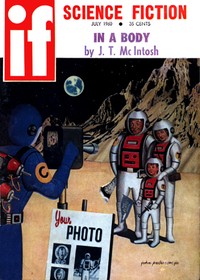
Worlds of If Science Fiction, July 1960.
Extensive research did not uncover any evidence that
the U.S. copyright on this publication was renewed.]
I wouldn't take five cents off a legitimate man, but if they want to
gamble that's another story.
What I am is a genius, and I give you a piece of advice: Do not ever
play cards with a stranger. The stranger might be me. Where there are
degenerate card players around, I sometimes get a call. Not dice--I
don't have a machine to handle them. But with cards I have a machine to
force the advantage.
The first thing is a little radio receiver, about the size of a pack
of cigarettes. You don't hear any music. You feel it on your skin. The
next thing is two dimes. You stick them onto you, anywhere you like.
Some like to put them on their legs, some on their belly. Makes no
difference, just so they're out of sight. Each dime has a wire soldered
to it, and the wires are attached to the little receiver that goes in
your pocket.
The other thing is the transmitter I carry around.
My partner was a fellow named Henry. He had an electronic surplus
hardware business, but business wasn't good and he was looking for
a little extra cash on the side. It turns out that the other little
wholesalers in the loft building where he has his business are all
card players, and no pikers, either. So Henry spread the word that
he was available for a gin game--any time at all, but he would only
play in his own place--he was expecting an important phone call and he
didn't want to be away and maybe miss it.... It never came; but the
card players did.
I was supposed to be his stock clerk. While Henry and the other fellow
were working on the cards at one end of the room, I would be moving
around the other--checking the stock, packing the stuff for shipment,
arranging it on the shelves, sweeping the floor. I was a regular model
worker, busy every second. I had to be. In order to see the man's
hand I had to be nearby, but I had to keep moving so he wouldn't pay
attention to me.
And every time I got a look at his hand, I pushed the little button on
the transmitter in my pocket.
Every push on the button was a shock on Henry's leg. One for spades,
two for hearts, three for diamonds, four for clubs.
Then I would tip the card: a short shock for an ace, two for a king,
three for a queen, and so on down to the ten. A long and a short
for nine, a long and two shorts for an eight ... it took a little
memorizing, but it was worth it. Henry knew every card the other man
held every time. And I got fifty per cent.
* * * * *
We didn't annihilate the fish. They hardly felt they were being hurt,
but we got a steady advantage, day after day. We did so well we took on
another man--I can take physical labor or leave it alone, and I leave
it alone every chance I get.
That was where we first felt the trouble.
Our new boy was around twenty. He had a swept-wing haircut, complete
with tail fins. Also he had a silly laugh. Now, there are jokes in a
card game--somebody taking a beating will sound off, to take away some
of the sting, but nobody laughs because the cracks are never funny. But
they were to our new boy.
He laughed.
He laughed not only when the mark made some crack, but a lot of the
time when he didn't. It got so the customers were looking at him with a
lot of dislike, and that was bad for business.
So I called him out into the hall. "Skippy," I said--that's what we
called him, "lay off. _Never_ rub it in to a sucker. It's enough to
take his money."
He ran his fingers back along his hair. "Can't a fellow express
himself?"
I gave him a long, hard unhealthy look. _Express_ himself? He wouldn't
have to. I'd express him myself--express him right out of our setup.
But before I got a chance, this fellow from Chicago came in, a big
manufacturer named Chapo; a wheel, and he looked it. He was red-faced,
with hanging jowls and a big dollar cigar; he announced that he only
played for big stakes ... and, nodding toward the kid and me, that he
didn't like an audience.
Henry looked at us miserably. But what was he going to do? If he didn't
go along, the word could spread that maybe there was something wrong
going on. He had to play. "Take the day off, you two," he said, but he
wasn't happy.
I thought fast.
There was still one chance. I got behind Chapo long enough to give
Henry a wink and a nod toward the window. Then I took Skippy by the
elbow and steered him out of there.
Down in the street I said, fast: "You want to earn your pay? You have
to give me a hand--an eye is really what I mean. Don't argue--just say
yes or no."
He didn't stop to think. "Sure," he said. "Why not?"
"All right." I took him down the street to where they had genuine
imported Japanese field glasses and laid out twenty bucks for a pair.
The man was a thief, but I didn't have time to argue. Right across the
street from Henry's place was a rundown hotel. That was our next stop.
The desk man in the scratch house looked up from his comic book. "A
room," I said. "Me and my nephew want a room facing the street." And I
pointed to the window of Henry's place, where I wanted it to face.
Because we still had a chance. With the field glasses and Skippy's
young, good eyes to look through them, with the transmitter that would
carry an extra hundred yards easy enough--with everything going for us,
we had a chance. Provided Henry had been able to maneuver Chapo so his
back was to the window.
The bed merchant gave us a long stall about how the only room we wanted
belonged to a sweet old lady that was sick and couldn't be moved. But
for ten bucks she could be.
All the time I was wondering how many hands were being played, if we
were stuck money and how much--all kinds of things. But finally we
got into the room and I laid it out for Skippy. "You aim those field
glasses out the window," I told him. "Read Chapo's cards and let me
know; that's all. I'll take care of the rest."
I'll say this for him, duck-tail haircut and all, he settled right
down to business. I made myself comfortable on the bed and rattled them
off on the transmitter as he read the cards to me. I couldn't see the
players, didn't know the score; but if he was giving the cards to me
right, I was getting them out to Henry.
I felt pretty good. I even began to feel kindly toward the kid. At my
age, bifocals are standard equipment, but to judge from Skippy's fast,
sure call of the cards, his eyesight was twenty-twenty or better.
After about an hour, Skippy put down the glasses and broke the news:
the game was over.
We took our time getting back to Henry's place, so Chapo would have
time to clear out. Henry greeted us with eight fingers in the air.
Eight hundred? But before I could ask him, he was already talking:
"Eight big ones! Eight thousand bucks! And how you did it, I'll never
know!"
Well, eight thousand was good news, no doubt of that. I said, "That's
the old system, Henry. But we couldn't have done it if you hadn't
steered the fish up to the window." And I showed him the Japanese field
glasses, grinning.
But he didn't grin back. He looked puzzled. He glanced toward the
window.
I looked too, and then I saw what he was puzzled about. It was pretty
obvious that Henry had missed my signal. He and the fish had played by
the window, all right.
But the shade was down.
* * * * *
When I turned around to look for Skippy, to ask him some questions, he
was gone. Evidently he didn't want to answer.
I beat up and down every block in the neighborhood until I spotted him
in a beanery, drinking a cup of coffee and looking worried.
I sat down beside him, quiet. He didn't look around. The counterman
opened his mouth to say hello. I shook my head, but Skippy said,
"That's all right. I know you're there."
I blinked. This was a creep! But I had to find out what was going on. I
said, "You made a mistake, kid."
"Running out?" He shrugged. "It's not the first mistake I made," he
said bitterly. "Getting into your little setup with the bugged game
came before that."
I said, "You can always quit," but then stopped. Because it was a lie.
He couldn't quit--not until I found out how he read Chapo's cards
through a drawn shade.
He said drearily, "You've all got me marked lousy, haven't you? Don't
kid me about Henry--I know. I'm not so sure about you, but it wouldn't
surprise me."
"What are you talking about?"
"I can hear every word that's on Henry's mind," he said somberly.
"You, no. Some people I can hear, some I can't; you're one I can't."
"What kind of goofy talk is that?" I demanded. But, to tell you the
truth, I didn't think it was so goofy. The window shade was a lot
goofier.
"All my life," said Skippy, "I've been hearing the voices. It doesn't
matter if they talk out loud or not. Most people I can hear, even when
they don't want me to. Field glasses? I didn't need field glasses. I
could hear every thought that went through Chapo's mind, clear across
the street. Henry too. That's how I know." He hesitated, looking at me.
"You think Henry took eight thousand off Chapo, don't you? It was ten."
I said, "Prove it."
The kid finished his coffee. "Well," he said, "you want to know what
the counterman's got on his mind?" He leaned over and whispered to me.
I yelled, "That's a lousy thing to say!"
Everybody was looking at us. He said softly, "You see what it's like? I
don't want to hear all this stuff! You think the counterman's got a bad
mind, you ought to listen in on Henry's." He looked along the stools.
"See that fat little woman down at the end? She's going to order
another cheese Danish."
He hadn't even finished talking when the woman was calling the
counterman, and she got another cheese Danish. I thought it over. What
he said about Henry holding out on me made it real serious. I had to
have more proof.
But I didn't like Skippy's idea of proof. He offered to call off what
everybody in the beanery was going to do next, barring three or four he
said were silent, like me. That wasn't good enough. "Come along with
me," I told him, and we took off for Jake's spot.
That's a twenty-four-hour place and the doorman knows me. I knew Jake
and I knew his roulette wheel was gaffed. I walked right up to the
wheel, and whispered to the kid, "Can you read the dealer?" He smiled
and nodded. "All right. Call black or red."
The wheel spun, but that didn't stop the betting. Jake's hungry. In
his place you can still bet for a few seconds after the wheel starts
turning.
"Black," Skippy said.
I threw down fifty bucks. Black it was.
That rattled me.
"Call again," I said.
When Skippy said black, I put the fifty on red. Black won it.
"Let's go," I said, and led the kid out of there.
He was looking puzzled. "How come--"
"How come I played to lose?" I patted his shoulder. "Sonny, you got a
lot to learn. Jake's is no fair game. This was only a dry run."
Then I got rid of him, because I had something to do.
* * * * *
Henry came across. He even looked embarrassed. "I figured," he said,
"uh, I figured that the expenses--"
"Save it," I told him. "All I want is my split."
He handed it over, but I kept my hand out, waiting. After a minute he
got the idea. He reached down inside the waistband of his pants, pulled
loose the tape that held the dimes to his skin and handed over the
radio receiver. "That's it, huh?" he said.
"That's it."
"Take your best shot," he said glumly. "But mark my words. You're not
going to make out on your own."
"I won't be on my own," I told him, and left him then. By myself? Not
a chance! It was going to be Skippy and me, all the way. Not only
could he read minds, but the capper was that he couldn't read mine!
Otherwise, you can understand, I might not want him around all the time.
But this way I had my own personal bug in every game in town, and I
didn't even have to spend for batteries. Card games, gaffed wheels,
everything. Down at the track he could follow the smart-money guys
around and let me know what they knew, which was plenty. We could even
go up against the legit games in Nevada, with no worry about bluffs.
And think of the fringe benefits! With Skippy giving the women a
preliminary screening, I could save a lot of wasted time. At my age,
time is nothing to be wasted.
I could understand a lot about Skippy now--why he didn't like most
people, why he laughed at jokes nobody else thought were funny, or even
could hear. But everybody has got to like somebody, and I had the edge
over most of the human race. He didn't know what I was thinking.
And then, take away the voices in his head, and Skippy didn't have much
left. He wasn't very smart. If he had half as much in the way of brains
as he did in the way of private radar, he would have figured all these
angles out for himself long ago. No, he needed me. And I needed him.
We were all set to make a big score together, so I went back to his
rooming house where I'd told him to wait, to get going on the big time.
However, Henry had more brains than Skippy.
I hadn't told Henry who tipped me off, but it didn't take him long to
work out. After all, I had told him I was going out to look for Skippy,
and I came right back and called him for holding out. No, it didn't
take much brains. All he had to do was come around to Skippy's place
and give him a little lesson about talking.
So when I walked in the door, Skippy was there, but he was out cold,
with lumps on his forehead and a stupid grin on his face. I woke him up
and he recognized me.
But you don't make your TV set play better by kicking it. You don't
help a fine Swiss watch by pounding it on an anvil. Skippy could walk
and talk all right, but something was missing. "The voices!" he yelled,
sitting up on the edge of the bed.
I got a quick attack of cold fear. "Skippy! What's the matter? Don't
you hear them any more?"
He looked at me in a panic. "Oh, I hear them all right. But they're all
different now. I mean--it isn't English any more. In fact, it isn't any
language at all!"
* * * * *
Like I say, I'm a genius. Skippy wouldn't lie to me; he's not smart
enough. If he says he hears voices, he hears voices.
Being a genius, my theory is that when Henry worked Skippy over, he
jarred his tuning strips, or whatever it is, so now Skippy's receiving
on another frequency. Make sense? I'm positive about it. He sticks to
the same story, telling me about what he's hearing inside his head, and
he's too stupid to make it all up.
There are some parts of it I don't have all figured out yet, but I'll
get them. Like what he tells me about the people--I _guess_ they're
people--whose voices he hears. They're skinny and furry and very
religious. He can't understand their language, but he gets pictures
from them, and he told me what he saw. They worship the Moon, he says.
Only that's wrong too, because he says they worship two moons, and
everybody knows there's only one. But I'll figure it out; I have to,
because I have to get Skippy back in business.
Meanwhile it's pretty lonesome. I spend a lot of time down around the
old neighborhood, but I haven't set up another partner for taking the
card players. That seems like pretty small stuff now. And I don't talk
to Henry when I see him. And I _never_ go in the beanery when that
counterman is on duty. I've got enough troubles in the world; I don't
have to add to them by associating with _his_ kind.
*** END OF THE PROJECT GUTENBERG EBOOK THE NON-ELECTRONIC BUG ***
Updated editions will replace the previous one—the old editions will
be renamed.
Creating the works from print editions not protected by U.S. copyright
law means that no one owns a United States copyright in these works,
so the Foundation (and you!) can copy and distribute it in the United
States without permission and without paying copyright
royalties. Special rules, set forth in the General Terms of Use part
of this license, apply to copying and distributing Project
Gutenberg™ electronic works to protect the PROJECT GUTENBERG™
concept and trademark. Project Gutenberg is a registered trademark,
and may not be used if you charge for an eBook, except by following
the terms of the trademark license, including paying royalties for use
of the Project Gutenberg trademark. If you do not charge anything for
copies of this eBook, complying with the trademark license is very
easy. You may use this eBook for nearly any purpose such as creation
of derivative works, reports, performances and research. Project
Gutenberg eBooks may be modified and printed and given away—you may
do practically ANYTHING in the United States with eBooks not protected
by U.S. copyright law. Redistribution is subject to the trademark
license, especially commercial redistribution.
START: FULL LICENSE
THE FULL PROJECT GUTENBERG LICENSE
PLEASE READ THIS BEFORE YOU DISTRIBUTE OR USE THIS WORK
To protect the Project Gutenberg™ mission of promoting the free
distribution of electronic works, by using or distributing this work
(or any other work associated in any way with the phrase “Project
Gutenberg”), you agree to comply with all the terms of the Full
Project Gutenberg™ License available with this file or online at
www.gutenberg.org/license.
Section 1. General Terms of Use and Redistributing Project Gutenberg™
electronic works
1.A. By reading or using any part of this Project Gutenberg™
electronic work, you indicate that you have read, understand, agree to
and accept all the terms of this license and intellectual property
(trademark/copyright) agreement. If you do not agree to abide by all
the terms of this agreement, you must cease using and return or
destroy all copies of Project Gutenberg™ electronic works in your
possession. If you paid a fee for obtaining a copy of or access to a
Project Gutenberg™ electronic work and you do not agree to be bound
by the terms of this agreement, you may obtain a refund from the person
or entity to whom you paid the fee as set forth in paragraph 1.E.8.
1.B. “Project Gutenberg” is a registered trademark. It may only be
used on or associated in any way with an electronic work by people who
agree to be bound by the terms of this agreement. There are a few
things that you can do with most Project Gutenberg™ electronic works
even without complying with the full terms of this agreement. See
paragraph 1.C below. There are a lot of things you can do with Project
Gutenberg™ electronic works if you follow the terms of this
agreement and help preserve free future access to Project Gutenberg™
electronic works. See paragraph 1.E below.
1.C. The Project Gutenberg Literary Archive Foundation (“the
Foundation” or PGLAF), owns a compilation copyright in the collection
of Project Gutenberg™ electronic works. Nearly all the individual
works in the collection are in the public domain in the United
States. If an individual work is unprotected by copyright law in the
United States and you are located in the United States, we do not
claim a right to prevent you from copying, distributing, performing,
displaying or creating derivative works based on the work as long as
all references to Project Gutenberg are removed. Of course, we hope
that you will support the Project Gutenberg™ mission of promoting
free access to electronic works by freely sharing Project Gutenberg™
works in compliance with the terms of this agreement for keeping the
Project Gutenberg™ name associated with the work. You can easily
comply with the terms of this agreement by keeping this work in the
same format with its attached full Project Gutenberg™ License when
you share it without charge with others.
1.D. The copyright laws of the place where you are located also govern
what you can do with this work. Copyright laws in most countries are
in a constant state of change. If you are outside the United States,
check the laws of your country in addition to the terms of this
agreement before downloading, copying, displaying, performing,
distributing or creating derivative works based on this work or any
other Project Gutenberg™ work. The Foundation makes no
representations concerning the copyright status of any work in any
country other than the United States.
1.E. Unless you have removed all references to Project Gutenberg:
1.E.1. The following sentence, with active links to, or other
immediate access to, the full Project Gutenberg™ License must appear
prominently whenever any copy of a Project Gutenberg™ work (any work
on which the phrase “Project Gutenberg” appears, or with which the
phrase “Project Gutenberg” is associated) is accessed, displayed,
performed, viewed, copied or distributed:
This eBook is for the use of anyone anywhere in the United States and most
other parts of the world at no cost and with almost no restrictions
whatsoever. You may copy it, give it away or re-use it under the terms
of the Project Gutenberg License included with this eBook or online
at www.gutenberg.org. If you
are not located in the United States, you will have to check the laws
of the country where you are located before using this eBook.
1.E.2. If an individual Project Gutenberg™ electronic work is
derived from texts not protected by U.S. copyright law (does not
contain a notice indicating that it is posted with permission of the
copyright holder), the work can be copied and distributed to anyone in
the United States without paying any fees or charges. If you are
redistributing or providing access to a work with the phrase “Project
Gutenberg” associated with or appearing on the work, you must comply
either with the requirements of paragraphs 1.E.1 through 1.E.7 or
obtain permission for the use of the work and the Project Gutenberg™
trademark as set forth in paragraphs 1.E.8 or 1.E.9.
1.E.3. If an individual Project Gutenberg™ electronic work is posted
with the permission of the copyright holder, your use and distribution
must comply with both paragraphs 1.E.1 through 1.E.7 and any
additional terms imposed by the copyright holder. Additional terms
will be linked to the Project Gutenberg™ License for all works
posted with the permission of the copyright holder found at the
beginning of this work.
1.E.4. Do not unlink or detach or remove the full Project Gutenberg™
License terms from this work, or any files containing a part of this
work or any other work associated with Project Gutenberg™.
1.E.5. Do not copy, display, perform, distribute or redistribute this
electronic work, or any part of this electronic work, without
prominently displaying the sentence set forth in paragraph 1.E.1 with
active links or immediate access to the full terms of the Project
Gutenberg™ License.
1.E.6. You may convert to and distribute this work in any binary,
compressed, marked up, nonproprietary or proprietary form, including
any word processing or hypertext form. However, if you provide access
to or distribute copies of a Project Gutenberg™ work in a format
other than “Plain Vanilla ASCII” or other format used in the official
version posted on the official Project Gutenberg™ website
(www.gutenberg.org), you must, at no additional cost, fee or expense
to the user, provide a copy, a means of exporting a copy, or a means
of obtaining a copy upon request, of the work in its original “Plain
Vanilla ASCII” or other form. Any alternate format must include the
full Project Gutenberg™ License as specified in paragraph 1.E.1.
1.E.7. Do not charge a fee for access to, viewing, displaying,
performing, copying or distributing any Project Gutenberg™ works
unless you comply with paragraph 1.E.8 or 1.E.9.
1.E.8. You may charge a reasonable fee for copies of or providing
access to or distributing Project Gutenberg™ electronic works
provided that:
• You pay a royalty fee of 20% of the gross profits you derive from
the use of Project Gutenberg™ works calculated using the method
you already use to calculate your applicable taxes. The fee is owed
to the owner of the Project Gutenberg™ trademark, but he has
agreed to donate royalties under this paragraph to the Project
Gutenberg Literary Archive Foundation. Royalty payments must be paid
within 60 days following each date on which you prepare (or are
legally required to prepare) your periodic tax returns. Royalty
payments should be clearly marked as such and sent to the Project
Gutenberg Literary Archive Foundation at the address specified in
Section 4, “Information about donations to the Project Gutenberg
Literary Archive Foundation.”
• You provide a full refund of any money paid by a user who notifies
you in writing (or by e-mail) within 30 days of receipt that s/he
does not agree to the terms of the full Project Gutenberg™
License. You must require such a user to return or destroy all
copies of the works possessed in a physical medium and discontinue
all use of and all access to other copies of Project Gutenberg™
works.
• You provide, in accordance with paragraph 1.F.3, a full refund of
any money paid for a work or a replacement copy, if a defect in the
electronic work is discovered and reported to you within 90 days of
receipt of the work.
• You comply with all other terms of this agreement for free
distribution of Project Gutenberg™ works.
1.E.9. If you wish to charge a fee or distribute a Project
Gutenberg™ electronic work or group of works on different terms than
are set forth in this agreement, you must obtain permission in writing
from the Project Gutenberg Literary Archive Foundation, the manager of
the Project Gutenberg™ trademark. Contact the Foundation as set
forth in Section 3 below.
1.F.
1.F.1. Project Gutenberg volunteers and employees expend considerable
effort to identify, do copyright research on, transcribe and proofread
works not protected by U.S. copyright law in creating the Project
Gutenberg™ collection. Despite these efforts, Project Gutenberg™
electronic works, and the medium on which they may be stored, may
contain “Defects,” such as, but not limited to, incomplete, inaccurate
or corrupt data, transcription errors, a copyright or other
intellectual property infringement, a defective or damaged disk or
other medium, a computer virus, or computer codes that damage or
cannot be read by your equipment.
1.F.2. LIMITED WARRANTY, DISCLAIMER OF DAMAGES - Except for the “Right
of Replacement or Refund” described in paragraph 1.F.3, the Project
Gutenberg Literary Archive Foundation, the owner of the Project
Gutenberg™ trademark, and any other party distributing a Project
Gutenberg™ electronic work under this agreement, disclaim all
liability to you for damages, costs and expenses, including legal
fees. YOU AGREE THAT YOU HAVE NO REMEDIES FOR NEGLIGENCE, STRICT
LIABILITY, BREACH OF WARRANTY OR BREACH OF CONTRACT EXCEPT THOSE
PROVIDED IN PARAGRAPH 1.F.3. YOU AGREE THAT THE FOUNDATION, THE
TRADEMARK OWNER, AND ANY DISTRIBUTOR UNDER THIS AGREEMENT WILL NOT BE
LIABLE TO YOU FOR ACTUAL, DIRECT, INDIRECT, CONSEQUENTIAL, PUNITIVE OR
INCIDENTAL DAMAGES EVEN IF YOU GIVE NOTICE OF THE POSSIBILITY OF SUCH
DAMAGE.
1.F.3. LIMITED RIGHT OF REPLACEMENT OR REFUND - If you discover a
defect in this electronic work within 90 days of receiving it, you can
receive a refund of the money (if any) you paid for it by sending a
written explanation to the person you received the work from. If you
received the work on a physical medium, you must return the medium
with your written explanation. The person or entity that provided you
with the defective work may elect to provide a replacement copy in
lieu of a refund. If you received the work electronically, the person
or entity providing it to you may choose to give you a second
opportunity to receive the work electronically in lieu of a refund. If
the second copy is also defective, you may demand a refund in writing
without further opportunities to fix the problem.
1.F.4. Except for the limited right of replacement or refund set forth
in paragraph 1.F.3, this work is provided to you ‘AS-IS’, WITH NO
OTHER WARRANTIES OF ANY KIND, EXPRESS OR IMPLIED, INCLUDING BUT NOT
LIMITED TO WARRANTIES OF MERCHANTABILITY OR FITNESS FOR ANY PURPOSE.
1.F.5. Some states do not allow disclaimers of certain implied
warranties or the exclusion or limitation of certain types of
damages. If any disclaimer or limitation set forth in this agreement
violates the law of the state applicable to this agreement, the
agreement shall be interpreted to make the maximum disclaimer or
limitation permitted by the applicable state law. The invalidity or
unenforceability of any provision of this agreement shall not void the
remaining provisions.
1.F.6. INDEMNITY - You agree to indemnify and hold the Foundation, the
trademark owner, any agent or employee of the Foundation, anyone
providing copies of Project Gutenberg™ electronic works in
accordance with this agreement, and any volunteers associated with the
production, promotion and distribution of Project Gutenberg™
electronic works, harmless from all liability, costs and expenses,
including legal fees, that arise directly or indirectly from any of
the following which you do or cause to occur: (a) distribution of this
or any Project Gutenberg™ work, (b) alteration, modification, or
additions or deletions to any Project Gutenberg™ work, and (c) any
Defect you cause.
Section 2. Information about the Mission of Project Gutenberg™
Project Gutenberg™ is synonymous with the free distribution of
electronic works in formats readable by the widest variety of
computers including obsolete, old, middle-aged and new computers. It
exists because of the efforts of hundreds of volunteers and donations
from people in all walks of life.
Volunteers and financial support to provide volunteers with the
assistance they need are critical to reaching Project Gutenberg™’s
goals and ensuring that the Project Gutenberg™ collection will
remain freely available for generations to come. In 2001, the Project
Gutenberg Literary Archive Foundation was created to provide a secure
and permanent future for Project Gutenberg™ and future
generations. To learn more about the Project Gutenberg Literary
Archive Foundation and how your efforts and donations can help, see
Sections 3 and 4 and the Foundation information page at www.gutenberg.org.
Section 3. Information about the Project Gutenberg Literary Archive Foundation
The Project Gutenberg Literary Archive Foundation is a non-profit
501(c)(3) educational corporation organized under the laws of the
state of Mississippi and granted tax exempt status by the Internal
Revenue Service. The Foundation’s EIN or federal tax identification
number is 64-6221541. Contributions to the Project Gutenberg Literary
Archive Foundation are tax deductible to the full extent permitted by
U.S. federal laws and your state’s laws.
The Foundation’s business office is located at 809 North 1500 West,
Salt Lake City, UT 84116, (801) 596-1887. Email contact links and up
to date contact information can be found at the Foundation’s website
and official page at www.gutenberg.org/contact
Section 4. Information about Donations to the Project Gutenberg
Literary Archive Foundation
Project Gutenberg™ depends upon and cannot survive without widespread
public support and donations to carry out its mission of
increasing the number of public domain and licensed works that can be
freely distributed in machine-readable form accessible by the widest
array of equipment including outdated equipment. Many small donations
($1 to $5,000) are particularly important to maintaining tax exempt
status with the IRS.
The Foundation is committed to complying with the laws regulating
charities and charitable donations in all 50 states of the United
States. Compliance requirements are not uniform and it takes a
considerable effort, much paperwork and many fees to meet and keep up
with these requirements. We do not solicit donations in locations
where we have not received written confirmation of compliance. To SEND
DONATIONS or determine the status of compliance for any particular state
visit www.gutenberg.org/donate.
While we cannot and do not solicit contributions from states where we
have not met the solicitation requirements, we know of no prohibition
against accepting unsolicited donations from donors in such states who
approach us with offers to donate.
International donations are gratefully accepted, but we cannot make
any statements concerning tax treatment of donations received from
outside the United States. U.S. laws alone swamp our small staff.
Please check the Project Gutenberg web pages for current donation
methods and addresses. Donations are accepted in a number of other
ways including checks, online payments and credit card donations. To
donate, please visit: www.gutenberg.org/donate.
Section 5. General Information About Project Gutenberg™ electronic works
Professor Michael S. Hart was the originator of the Project
Gutenberg™ concept of a library of electronic works that could be
freely shared with anyone. For forty years, he produced and
distributed Project Gutenberg™ eBooks with only a loose network of
volunteer support.
Project Gutenberg™ eBooks are often created from several printed
editions, all of which are confirmed as not protected by copyright in
the U.S. unless a copyright notice is included. Thus, we do not
necessarily keep eBooks in compliance with any particular paper
edition.
Most people start at our website which has the main PG search
facility: www.gutenberg.org.
This website includes information about Project Gutenberg™,
including how to make donations to the Project Gutenberg Literary
Archive Foundation, how to help produce our new eBooks, and how to
subscribe to our email newsletter to hear about new eBooks.