The Project Gutenberg eBook of The Irish War
This ebook is for the use of anyone anywhere in the United States and
most other parts of the world at no cost and with almost no restrictions
whatsoever. You may copy it, give it away or re-use it under the terms
of the Project Gutenberg License included with this ebook or online
at www.gutenberg.org. If you are not located in the United States,
you will have to check the laws of the country where you are located
before using this eBook.
Title: The Irish War
Author: David Burr
Creator: Public Library of Fort Wayne and Allen County
Release date: March 9, 2021 [eBook #64763]
Most recently updated: October 18, 2024
Language: English
Credits: Stephen Hutcheson and the Online Distributed Proofreading Team at https://www.pgdp.net
*** START OF THE PROJECT GUTENBERG EBOOK THE IRISH WAR ***
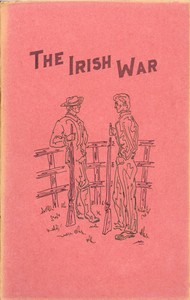
_THE IRISH WAR_
Prepared by the staff of the
Public Library of Fort Wayne and Allen County
1953
One of a historical series, this pamphlet is published under the
direction of the governing Boards of the Public Library of Fort Wayne
and Allen County.
BOARD OF TRUSTEES OF THE SCHOOL CITY OF FORT WAYNE
B.F. Geyer, President
Joseph E. Kramer, Secretary
W. Page Yarnelle, Treasurer
Willard Shambaugh
Mrs. Sadie Fulk Roehrs
PUBLIC LIBRARY BOARD FOR ALLEN COUNTY
The members of this Board include the members of the Board of Trustees
of the School City of Fort Wayne (with the same officers) together with
the following citizens chosen from Allen County outside the corporate
City of Fort Wayne:
James E. Graham
Arthur Nieneier
Mrs. Glenn Henderson
Mrs. Charles Reynolds
FOREWORD
Irishmen who had recently immigrated to the United States were the chief
source of labor for the construction of the Wabash-Erie Canal. Much
strife among the canal workers stemmed from regional antagonisms in
their homeland, and personal violence resulted on more than one
occasion; the so-called “Irish War” was one such episode.
David Burr, one of the canal commissioners, made the following report on
the incident. It was printed as an Indiana state document and is often
quoted as authority for statements made about the “Irish War.” It is now
out-of-print. Because the Boards and staff of the Public Library of Fort
Wayne and Allen County consider it valuable source material, it is
reprinted here, together with the accompanying letter of transmittal.
Grammar, spelling, and punctuation have been changed to conform to
current practice.
STATE OF INDIANA
HOUSE OF REPRESENTATIVES
December 31, 1835
Read and referred to the Committee on Claims
Executive Department
Indianapolis, Indiana
December 30, 1835
The Honorable C. B. Smith
Speaker of the House of Representatives
Sir:
I lay before the House of Representatives the particulars, in writing,
of the late riots upon the line of the Wabash Canal, which details were
furnished at my request by one of the canal commissioners. With this
history, I also submit the claims of the commandants, Captains Murray
and Tipton, who, at the heads of their companies, repaired to the scene
of disorder in support of the civil authority and liberally advanced
money and provisions for the service. It will be seen that the laborers
along the line in the adjoining counties had assembled in preparation
for battle, making Wabash County the theater of their riotous conduct;
consequently, that county would seem to be chargeable with the expense
of the arrests and the prosecutions which followed. But as the
occurrence was one of an unusual kind, growing out of, and threatening
the progress of, the work in which the state is engaged, it is believed
the treasury of that county is not justly chargeable with the expense.
It is recommended that the commissioners appointed to assess damages to
private property or one of the fund commissioners be authorized to
examine the different claims and to direct their payment, so far as
would be right, out of the canal fund.
Respectfully,
Noah Noble
Indianapolis, Indiana
December 30, 1835
The Honorable Noah Noble
Governor of Indiana
Dear Sir:
In conformity with your request in relation to the disturbance amongst
the Irish laborers on the Canal, it is proper to state that many persons
of the two parties into which they are unfortunately divided,
“Corkonians and Fardowns,” had been engaged in those bloody affrays at
Williamsport in Maryland and at the “high rocks on the Potomac” within
the last two years. They had come since September in 1834 to the Wabash
and Erie Canal with, as it is said, many of their leaders. Of course,
they had brought their animosities with them. And from that time up to
the twelfth of July last, when the general riot took place, they
manifested their ill will to each other by merciless beatings on such
persons of each party as chanced to fall in the power of the other.
On a considerable portion of the line there was no justice of the peace
in these newly organized counties. As these frays were confined to the
Irish alone, and to the least worthy amongst them, not much effort was
made, and perhaps could not have been made, by the civil authority to
suppress them. This exasperating course of hostilities increased until
it became unsafe for the Irish to travel from one part of the line to
the other without great precautions for their safety. Events proceeded
to such an extent that they were mutually afraid that each party would
have its cabins burnt and the inmates slain in the night.
[Illustration: uncaptioned]
Because of mutual fears and for safety the laborers had so hired out to
the contractors that they had about equally divided the line between the
parties; the Corkmen worked on the upper part, and the Fardowns on the
lower part of the line. The beatings of such persons who were caught
away from their friends increased to such a degree, and the parties
became so exasperated, that about the first of July a determination
became general that one or the other should leave the line. The
worthless amongst them, by carrying threats of burnings and murders
which were to be committed by falling on the defenseless in the night,
so excited their fears that they left their houses and cabins and hid
out in the woods without light or fire to betray their hiding places.
The whole line, armed in military array, worked generally in the daytime
until some idle report would get in circulation that one party was
marching to fight the other. Then they would leave their work and hasten
with great rapidity to the supposed point of danger.
From the fourth to the tenth of July, these alarms were constant and
were aggravated by the threats and outrages of the worthless. The length
of line occupied by these belligerent parties was nearly fifty miles. On
the tenth of July the parties hastily collected; or rather, they left
their work and commenced a march towards the center of the line for a
general battle.
[Illustration: uncaptioned]
Two days before this, I reached that part of the line, heard there was
to be a turnout, but supposed it only rumor without foundation. I saw
several persons and tried to convince them that no such thing would take
place. On the tenth, however, one of the engineers reported that all the
workmen on the lower end of the line were armed and were marching to the
reputed battlefield. I met them about half a mile from my residence.
They were in very orderly array and well armed; not a noisy or a drunken
man was amongst them. They were forced, so they considered, to fight in
order to protect themselves and to avoid being slain and to keep their
property from being burned at night. They stated that the civil
authority did not, or could not, protect them; that their families could
not stay in their shanties but had to sleep in the woods; and that they
had no resource left but a battle. They further stated that the weaker
party should leave the line; that they wished to work and remain
peaceable but could not; and that they would rather fight fairly in open
day than be subject to these depredations at night. With the assurance
that order would be restored and that I would negotiate a suspension of
hostilities with the other party, I prevailed on them to wait until I
could see their belligerent friends.
I then went to the reputed battlefield with three or four persons whom I
supposed had influence with them. I found them fully prepared, well
disposed in a strong military position, and exceedingly exasperated; and
I had some difficulty in saving those who went with me from being
killed. They expressed the same fears as the others but, after some
persuasion, consented to appoint persons to agree on terms of peace with
the Fardowns. They also agreed to suspend hostile operations until the
result of the meetings between the persons deputed to negotiate the
peace could be known.
In the meantime, the citizens at Huntington had become exceedingly
alarmed at seeing this hostile array; three or four hundred armed men on
each side had the avowed intention of meeting in battle; the civil
authority was completely powerless. Fearing their persons and property
would not be safe, they sent to Fort Wayne for aid of the militia. A
company immediately was collected and in a few hours was sent to their
relief. Meanwhile, the citizens of Huntington had collected and
organized a company also.
By this time, the citizens of Lagro became alarmed; they sent to
Huntington for the troops to come and protect them and aid the civil
authority. As soon as I learned that the militia had turned out from
sixty to one hundred in number, I thought the force altogether too small
to do any good against seven or eight hundred armed men. Therefore, I
sent to Logansport and requested assistance, which was promptly
rendered. The militia at Lagro, at my request, marched to Miamisport and
met the two volunteer companies from Logansport; and all marched back to
Lagro.
Two magistrates, an associate judge, the sheriffs of Huntington and
Wabash counties, and the militia arrested and committed eight of the
ringleaders. There was no safe jail on the canal line. Therefore, in
order to remove the cause of contention, these men were sent under a
strong guard to Indianapolis for safekeeping. Here they were confined
until they were liberated by a writ of habeas corpus because of some
informality in the proceedings.
There were more than six hundred armed Irishmen, and I am satisfied that
no course other than the one pursued would have been sufficient to
restore order. The commissioning of justices of the peace and the
organizing of militia companies at Wabash, Lagro, and Huntington have
restored, and I trust will preserve, order.
[Illustration: uncaptioned]
The commissioners, Messrs. Johnson and Lewis, were at Fort Wayne at the
time; and I had not the benefit of their advice. As soon as order was
restored, the canal board took more decided steps in their regulations.
They now require each contractor to dismiss any laborer who may engage
in a broil and to give his name to the engineers so that he may not be
employed on the line.
The militia turned out on the first moment’s warning; many of the men
just happened to be in town and marched off without any preparation
whatever. They had of necessity to be supplied with money and provisions
for their subsistence. These were furnished by many of the contractors
and people on the line. Amongst those incurring the greatest expense was
Captain Elias Murray, of Huntington; he took command of the temporary
garrison at Lagro, assisted the civil authority in making the arrests,
and, with his company, marched the prisoners to Indianapolis. He was
engaged some three weeks in the service.
Colonel John Spencer, of Fort Wayne, who headed the militia from that
city, and General John Tipton, who was active in forwarding the
volunteer companies from Logansport, paid a large portion of the
expenses. One of the prisoners who had been sent to Indianapolis was
arrested on his return to the canal line, was convicted, and was sent to
the penitentiary. On his way there he escaped from Mr. Johnson, the
sheriff, who offered a reward of $100.00 and paid it for his
apprehension. Wabash County was also at great expense in sending the
prisoners to Indianapolis. Other persons on the line were also at much
expense in money and provisions.
This expenditure was absolutely necessary for the preservation of order;
it was the means of saving many human lives by preventing at least seven
hundred armed and highly exasperated men from fighting a battle. It was
also the means of preventing a total suspension of canal work which
might have ensued for the greater part of the season since July. It
would, therefore, be very desirable indeed if some provision could be
made by law to remunerate those persons who have been at so great
expense.
Some of the bills for the money expended are in the possession of the
Board of Canal Commissioners. But, as they have only a small part, the
appointment of some person to hear and examine claims and to authorize
payment is respectfully suggested. The selection of a member of the
Board of Fund Commissioners, who had no part in these transactions and
would therefore constitute an impartial tribunal, is also suggested. As
the matter in question grew out of the operations on the Canal, and as
the commissioners have the funds in their possession, such an
appointment would seem to be suitable.
With great respect,
David Burr
Transcriber’s Notes
—Silently corrected a few typos.
—Retained publication information from the printed edition: this eBook
is public-domain in the country of publication.
—In the text versions only, text in italics is delimited by
_underscores_.
*** END OF THE PROJECT GUTENBERG EBOOK THE IRISH WAR ***
Updated editions will replace the previous one—the old editions will
be renamed.
Creating the works from print editions not protected by U.S. copyright
law means that no one owns a United States copyright in these works,
so the Foundation (and you!) can copy and distribute it in the United
States without permission and without paying copyright
royalties. Special rules, set forth in the General Terms of Use part
of this license, apply to copying and distributing Project
Gutenberg™ electronic works to protect the PROJECT GUTENBERG™
concept and trademark. Project Gutenberg is a registered trademark,
and may not be used if you charge for an eBook, except by following
the terms of the trademark license, including paying royalties for use
of the Project Gutenberg trademark. If you do not charge anything for
copies of this eBook, complying with the trademark license is very
easy. You may use this eBook for nearly any purpose such as creation
of derivative works, reports, performances and research. Project
Gutenberg eBooks may be modified and printed and given away—you may
do practically ANYTHING in the United States with eBooks not protected
by U.S. copyright law. Redistribution is subject to the trademark
license, especially commercial redistribution.
START: FULL LICENSE
THE FULL PROJECT GUTENBERG LICENSE
PLEASE READ THIS BEFORE YOU DISTRIBUTE OR USE THIS WORK
To protect the Project Gutenberg™ mission of promoting the free
distribution of electronic works, by using or distributing this work
(or any other work associated in any way with the phrase “Project
Gutenberg”), you agree to comply with all the terms of the Full
Project Gutenberg™ License available with this file or online at
www.gutenberg.org/license.
Section 1. General Terms of Use and Redistributing Project Gutenberg™
electronic works
1.A. By reading or using any part of this Project Gutenberg™
electronic work, you indicate that you have read, understand, agree to
and accept all the terms of this license and intellectual property
(trademark/copyright) agreement. If you do not agree to abide by all
the terms of this agreement, you must cease using and return or
destroy all copies of Project Gutenberg™ electronic works in your
possession. If you paid a fee for obtaining a copy of or access to a
Project Gutenberg™ electronic work and you do not agree to be bound
by the terms of this agreement, you may obtain a refund from the person
or entity to whom you paid the fee as set forth in paragraph 1.E.8.
1.B. “Project Gutenberg” is a registered trademark. It may only be
used on or associated in any way with an electronic work by people who
agree to be bound by the terms of this agreement. There are a few
things that you can do with most Project Gutenberg™ electronic works
even without complying with the full terms of this agreement. See
paragraph 1.C below. There are a lot of things you can do with Project
Gutenberg™ electronic works if you follow the terms of this
agreement and help preserve free future access to Project Gutenberg™
electronic works. See paragraph 1.E below.
1.C. The Project Gutenberg Literary Archive Foundation (“the
Foundation” or PGLAF), owns a compilation copyright in the collection
of Project Gutenberg™ electronic works. Nearly all the individual
works in the collection are in the public domain in the United
States. If an individual work is unprotected by copyright law in the
United States and you are located in the United States, we do not
claim a right to prevent you from copying, distributing, performing,
displaying or creating derivative works based on the work as long as
all references to Project Gutenberg are removed. Of course, we hope
that you will support the Project Gutenberg™ mission of promoting
free access to electronic works by freely sharing Project Gutenberg™
works in compliance with the terms of this agreement for keeping the
Project Gutenberg™ name associated with the work. You can easily
comply with the terms of this agreement by keeping this work in the
same format with its attached full Project Gutenberg™ License when
you share it without charge with others.
1.D. The copyright laws of the place where you are located also govern
what you can do with this work. Copyright laws in most countries are
in a constant state of change. If you are outside the United States,
check the laws of your country in addition to the terms of this
agreement before downloading, copying, displaying, performing,
distributing or creating derivative works based on this work or any
other Project Gutenberg™ work. The Foundation makes no
representations concerning the copyright status of any work in any
country other than the United States.
1.E. Unless you have removed all references to Project Gutenberg:
1.E.1. The following sentence, with active links to, or other
immediate access to, the full Project Gutenberg™ License must appear
prominently whenever any copy of a Project Gutenberg™ work (any work
on which the phrase “Project Gutenberg” appears, or with which the
phrase “Project Gutenberg” is associated) is accessed, displayed,
performed, viewed, copied or distributed:
This eBook is for the use of anyone anywhere in the United States and most
other parts of the world at no cost and with almost no restrictions
whatsoever. You may copy it, give it away or re-use it under the terms
of the Project Gutenberg License included with this eBook or online
at www.gutenberg.org. If you
are not located in the United States, you will have to check the laws
of the country where you are located before using this eBook.
1.E.2. If an individual Project Gutenberg™ electronic work is
derived from texts not protected by U.S. copyright law (does not
contain a notice indicating that it is posted with permission of the
copyright holder), the work can be copied and distributed to anyone in
the United States without paying any fees or charges. If you are
redistributing or providing access to a work with the phrase “Project
Gutenberg” associated with or appearing on the work, you must comply
either with the requirements of paragraphs 1.E.1 through 1.E.7 or
obtain permission for the use of the work and the Project Gutenberg™
trademark as set forth in paragraphs 1.E.8 or 1.E.9.
1.E.3. If an individual Project Gutenberg™ electronic work is posted
with the permission of the copyright holder, your use and distribution
must comply with both paragraphs 1.E.1 through 1.E.7 and any
additional terms imposed by the copyright holder. Additional terms
will be linked to the Project Gutenberg™ License for all works
posted with the permission of the copyright holder found at the
beginning of this work.
1.E.4. Do not unlink or detach or remove the full Project Gutenberg™
License terms from this work, or any files containing a part of this
work or any other work associated with Project Gutenberg™.
1.E.5. Do not copy, display, perform, distribute or redistribute this
electronic work, or any part of this electronic work, without
prominently displaying the sentence set forth in paragraph 1.E.1 with
active links or immediate access to the full terms of the Project
Gutenberg™ License.
1.E.6. You may convert to and distribute this work in any binary,
compressed, marked up, nonproprietary or proprietary form, including
any word processing or hypertext form. However, if you provide access
to or distribute copies of a Project Gutenberg™ work in a format
other than “Plain Vanilla ASCII” or other format used in the official
version posted on the official Project Gutenberg™ website
(www.gutenberg.org), you must, at no additional cost, fee or expense
to the user, provide a copy, a means of exporting a copy, or a means
of obtaining a copy upon request, of the work in its original “Plain
Vanilla ASCII” or other form. Any alternate format must include the
full Project Gutenberg™ License as specified in paragraph 1.E.1.
1.E.7. Do not charge a fee for access to, viewing, displaying,
performing, copying or distributing any Project Gutenberg™ works
unless you comply with paragraph 1.E.8 or 1.E.9.
1.E.8. You may charge a reasonable fee for copies of or providing
access to or distributing Project Gutenberg™ electronic works
provided that:
• You pay a royalty fee of 20% of the gross profits you derive from
the use of Project Gutenberg™ works calculated using the method
you already use to calculate your applicable taxes. The fee is owed
to the owner of the Project Gutenberg™ trademark, but he has
agreed to donate royalties under this paragraph to the Project
Gutenberg Literary Archive Foundation. Royalty payments must be paid
within 60 days following each date on which you prepare (or are
legally required to prepare) your periodic tax returns. Royalty
payments should be clearly marked as such and sent to the Project
Gutenberg Literary Archive Foundation at the address specified in
Section 4, “Information about donations to the Project Gutenberg
Literary Archive Foundation.”
• You provide a full refund of any money paid by a user who notifies
you in writing (or by e-mail) within 30 days of receipt that s/he
does not agree to the terms of the full Project Gutenberg™
License. You must require such a user to return or destroy all
copies of the works possessed in a physical medium and discontinue
all use of and all access to other copies of Project Gutenberg™
works.
• You provide, in accordance with paragraph 1.F.3, a full refund of
any money paid for a work or a replacement copy, if a defect in the
electronic work is discovered and reported to you within 90 days of
receipt of the work.
• You comply with all other terms of this agreement for free
distribution of Project Gutenberg™ works.
1.E.9. If you wish to charge a fee or distribute a Project
Gutenberg™ electronic work or group of works on different terms than
are set forth in this agreement, you must obtain permission in writing
from the Project Gutenberg Literary Archive Foundation, the manager of
the Project Gutenberg™ trademark. Contact the Foundation as set
forth in Section 3 below.
1.F.
1.F.1. Project Gutenberg volunteers and employees expend considerable
effort to identify, do copyright research on, transcribe and proofread
works not protected by U.S. copyright law in creating the Project
Gutenberg™ collection. Despite these efforts, Project Gutenberg™
electronic works, and the medium on which they may be stored, may
contain “Defects,” such as, but not limited to, incomplete, inaccurate
or corrupt data, transcription errors, a copyright or other
intellectual property infringement, a defective or damaged disk or
other medium, a computer virus, or computer codes that damage or
cannot be read by your equipment.
1.F.2. LIMITED WARRANTY, DISCLAIMER OF DAMAGES - Except for the “Right
of Replacement or Refund” described in paragraph 1.F.3, the Project
Gutenberg Literary Archive Foundation, the owner of the Project
Gutenberg™ trademark, and any other party distributing a Project
Gutenberg™ electronic work under this agreement, disclaim all
liability to you for damages, costs and expenses, including legal
fees. YOU AGREE THAT YOU HAVE NO REMEDIES FOR NEGLIGENCE, STRICT
LIABILITY, BREACH OF WARRANTY OR BREACH OF CONTRACT EXCEPT THOSE
PROVIDED IN PARAGRAPH 1.F.3. YOU AGREE THAT THE FOUNDATION, THE
TRADEMARK OWNER, AND ANY DISTRIBUTOR UNDER THIS AGREEMENT WILL NOT BE
LIABLE TO YOU FOR ACTUAL, DIRECT, INDIRECT, CONSEQUENTIAL, PUNITIVE OR
INCIDENTAL DAMAGES EVEN IF YOU GIVE NOTICE OF THE POSSIBILITY OF SUCH
DAMAGE.
1.F.3. LIMITED RIGHT OF REPLACEMENT OR REFUND - If you discover a
defect in this electronic work within 90 days of receiving it, you can
receive a refund of the money (if any) you paid for it by sending a
written explanation to the person you received the work from. If you
received the work on a physical medium, you must return the medium
with your written explanation. The person or entity that provided you
with the defective work may elect to provide a replacement copy in
lieu of a refund. If you received the work electronically, the person
or entity providing it to you may choose to give you a second
opportunity to receive the work electronically in lieu of a refund. If
the second copy is also defective, you may demand a refund in writing
without further opportunities to fix the problem.
1.F.4. Except for the limited right of replacement or refund set forth
in paragraph 1.F.3, this work is provided to you ‘AS-IS’, WITH NO
OTHER WARRANTIES OF ANY KIND, EXPRESS OR IMPLIED, INCLUDING BUT NOT
LIMITED TO WARRANTIES OF MERCHANTABILITY OR FITNESS FOR ANY PURPOSE.
1.F.5. Some states do not allow disclaimers of certain implied
warranties or the exclusion or limitation of certain types of
damages. If any disclaimer or limitation set forth in this agreement
violates the law of the state applicable to this agreement, the
agreement shall be interpreted to make the maximum disclaimer or
limitation permitted by the applicable state law. The invalidity or
unenforceability of any provision of this agreement shall not void the
remaining provisions.
1.F.6. INDEMNITY - You agree to indemnify and hold the Foundation, the
trademark owner, any agent or employee of the Foundation, anyone
providing copies of Project Gutenberg™ electronic works in
accordance with this agreement, and any volunteers associated with the
production, promotion and distribution of Project Gutenberg™
electronic works, harmless from all liability, costs and expenses,
including legal fees, that arise directly or indirectly from any of
the following which you do or cause to occur: (a) distribution of this
or any Project Gutenberg™ work, (b) alteration, modification, or
additions or deletions to any Project Gutenberg™ work, and (c) any
Defect you cause.
Section 2. Information about the Mission of Project Gutenberg™
Project Gutenberg™ is synonymous with the free distribution of
electronic works in formats readable by the widest variety of
computers including obsolete, old, middle-aged and new computers. It
exists because of the efforts of hundreds of volunteers and donations
from people in all walks of life.
Volunteers and financial support to provide volunteers with the
assistance they need are critical to reaching Project Gutenberg™’s
goals and ensuring that the Project Gutenberg™ collection will
remain freely available for generations to come. In 2001, the Project
Gutenberg Literary Archive Foundation was created to provide a secure
and permanent future for Project Gutenberg™ and future
generations. To learn more about the Project Gutenberg Literary
Archive Foundation and how your efforts and donations can help, see
Sections 3 and 4 and the Foundation information page at www.gutenberg.org.
Section 3. Information about the Project Gutenberg Literary Archive Foundation
The Project Gutenberg Literary Archive Foundation is a non-profit
501(c)(3) educational corporation organized under the laws of the
state of Mississippi and granted tax exempt status by the Internal
Revenue Service. The Foundation’s EIN or federal tax identification
number is 64-6221541. Contributions to the Project Gutenberg Literary
Archive Foundation are tax deductible to the full extent permitted by
U.S. federal laws and your state’s laws.
The Foundation’s business office is located at 809 North 1500 West,
Salt Lake City, UT 84116, (801) 596-1887. Email contact links and up
to date contact information can be found at the Foundation’s website
and official page at www.gutenberg.org/contact
Section 4. Information about Donations to the Project Gutenberg
Literary Archive Foundation
Project Gutenberg™ depends upon and cannot survive without widespread
public support and donations to carry out its mission of
increasing the number of public domain and licensed works that can be
freely distributed in machine-readable form accessible by the widest
array of equipment including outdated equipment. Many small donations
($1 to $5,000) are particularly important to maintaining tax exempt
status with the IRS.
The Foundation is committed to complying with the laws regulating
charities and charitable donations in all 50 states of the United
States. Compliance requirements are not uniform and it takes a
considerable effort, much paperwork and many fees to meet and keep up
with these requirements. We do not solicit donations in locations
where we have not received written confirmation of compliance. To SEND
DONATIONS or determine the status of compliance for any particular state
visit www.gutenberg.org/donate.
While we cannot and do not solicit contributions from states where we
have not met the solicitation requirements, we know of no prohibition
against accepting unsolicited donations from donors in such states who
approach us with offers to donate.
International donations are gratefully accepted, but we cannot make
any statements concerning tax treatment of donations received from
outside the United States. U.S. laws alone swamp our small staff.
Please check the Project Gutenberg web pages for current donation
methods and addresses. Donations are accepted in a number of other
ways including checks, online payments and credit card donations. To
donate, please visit: www.gutenberg.org/donate.
Section 5. General Information About Project Gutenberg™ electronic works
Professor Michael S. Hart was the originator of the Project
Gutenberg™ concept of a library of electronic works that could be
freely shared with anyone. For forty years, he produced and
distributed Project Gutenberg™ eBooks with only a loose network of
volunteer support.
Project Gutenberg™ eBooks are often created from several printed
editions, all of which are confirmed as not protected by copyright in
the U.S. unless a copyright notice is included. Thus, we do not
necessarily keep eBooks in compliance with any particular paper
edition.
Most people start at our website which has the main PG search
facility: www.gutenberg.org.
This website includes information about Project Gutenberg™,
including how to make donations to the Project Gutenberg Literary
Archive Foundation, how to help produce our new eBooks, and how to
subscribe to our email newsletter to hear about new eBooks.