Produced by Stephen Hutcheson, Lisa Corcoran and the Online
Distributed Proofreading Team at http://www.pgdp.net
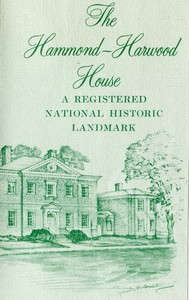
_The
Hammond-Harwood House_
A REGISTERED NATIONAL HISTORIC LANDMARK
MARYLAND AVENUE AT KING GEORGE STREET
ANNAPOLIS, MARYLAND
THE BUILDER
The Hammond-Harwood House was built in 1774 by Matthias Hammond, a
Maryland patriot deeply involved in the public affairs of his day. A man
of wealth, education and spirit, he wished his house to occupy a proud
place among the distinguished buildings already lending character and
urbanity to the colonial city of Annapolis. William Eddis, Crown
Surveyor of the Customs, said of the city in 1769,--"there are few towns
of the same size, in any part of the British dominions, that can boast a
more polished society."
At the age of 25, Matthias Hammond was elected to the Provincial
Assembly. He was a member of the General Convention of 1774 and a member
of the Committee of Correspondence. He signed the Proclamation of
Freemen of Maryland, the Declaration of Rights, and was Quartermaster of
the Severn Battalion of Anne Arundel Militia.
DISAPPOINTED HOPES
The legend has persisted through the years that Mr. Hammond built the
beautiful house for his intended bride. The delicacy and abundance of
the carved ornamentation, the elegance and refinement of detail, seem to
bear witness to the story. A bachelor would have been content, perhaps,
with the splendid plan, solid construction and fine proportion of his
house. Ironically, it was because of his intense preoccupation with the
very details designed to please her, that his fiancée became
disenchanted and refused to marry him. Whether broken-hearted or
embittered, he remained a bachelor to the end of his days, devoting
himself to affairs of state.
THE ARCHITECT
The talented architect William Buckland was entrusted with the design.
His mastery of mass and proportion, as well as the perfect execution of
detail had been well demonstrated by his work at Gunston Hall, George
Mason's famed house in Virginia, and other fine houses of the period.
The Hammond-Harwood House is eloquent testimony of his ability, and
marks the zenith of his career. Built in three sections of handsome
salmon-coloured brick typical of Maryland clay, it is considered by all
authorities to be one of the finest examples of Georgian architecture in
the United States.
[Illustration: The Doorway]
THE DOORWAY
The tall Ionic columns of the doorway, often called the most beautiful
in America, support an entablature with architrave, pediment and frieze
of ribboned laurel. Exquisitely carved roses ornament the spandrels and
egg and dart moldings outline the door and fan-light.
THE INTERIOR
The handsome doorway is but a prelude to the elaboration of detail
within the house. Acanthus and tobacco leaves, reminiscent of Hammond's
extensive tobacco plantations, ornament the broken pediment and frame
over-mantels. The dining room acclaims the woodcarver at his best, with
moldings, shutters, doors, chair-rail and fireplace decorated with
beauty and restraint. The great charm of the ballroom, considered to be
one of the most beautiful colonial rooms ever built, lies in its fine
proportions, high ceiling, and atmosphere of grace and dignity. It was a
setting to add lustre to the many brilliant social gatherings which were
reflected in its mirrors.
THE FURNISHINGS
The house has been decorated and furnished with strict adherence to the
period of the eighteenth century. There are many pieces which were
originally in the house, as well as an outstanding collection of
furniture made by Maryland cabinetmakers including the famous John Shaw
of Annapolis and by cabinetmakers of Philadelphia and New England.
Maryland's own Charles Willson Peale is represented by a number of
portraits and there is such refinement of detail as the very doll which
is pictured in the portrait of little Miss Proctor which hangs in a
bedroom. The house looks much as it must have, when the flower of
colonial society passed through its elegant doors.
THE OCCUPANTS
Lafayette visited the Hammond-Harwood House, and it was a favorite
meeting place of the planter society of Maryland. Through the years it
has been lived in and loved by the prominent Maryland families of
Pinkney, Chase, Loockerman and Harwood. The Harwoods owned and lived in
the house for some 75 years before it became a museum, thus the
hyphenated name Hammond-Harwood explains and completes the beginning and
end of its private ownership.
THE MUSEUM
The museum is owned and operated by The Hammond-Harwood House
Association, Inc., a non-profit organization, and it is supported by
visitors and friends, chief among which is the Maryland House and Garden
Pilgrimage which conducts a tour of outstanding Maryland houses and
gardens each Spring. For further information write: Hammond-Harwood
House, 19 Maryland Avenue, Annapolis, Maryland.
While in Annapolis be sure to visit ...
--Historic Annapolis
--The State House
--The Naval Academy.
FOR SALE AT THE MUSEUM
· Hammond-Harwood House Cook Book
MARYLAND'S WAY $5.00 plus 30¢ postage--plus Maryland sales tax.
· Hammond-Harwood House
PAINT SAMPLE $1.00 each.
· Hammond-Harwood House
INTERIOR PAINT $7.00 per gal.--plus shipping charges.
_Annapolis_
[Illustration: Map]
[Illustration: Housefront]
_Visiting Hours_
_March through October_
Weekdays 10 a.m. to 5 p.m.
Sundays 2 p.m. to 5 p.m.
_November through February_
Weekdays 10 a.m. to 4 p.m.
Sundays 1 p.m. to 4 p.m.
Closed on Christmas Day
Admission $1.00
Special rates for groups.
Transcriber's Notes
--Silently corrected a few typos.
--Retained publication information from the printed edition: this eBook
is public-domain in the country of publication.
--In the text versions only, text in italics is delimited by
_underscores_.