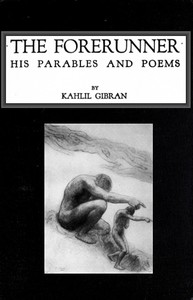
THE FORERUNNER
HIS PARABLES AND POEMS
BOOKS BY KAHLIL GIBRAN
“_He is the William Blake of the twentieth century._”
--_AUGUSTE RODIN._
_THE MADMAN (1918)_
[_With three original drawings by the author._]
“His is an irresistible vigor and clarity of thought and feeling,
together with a power of simple picturing, which makes it unforgettable.
It is the voice and genius of the Arabic people.”--_The New York Evening
Post._
“Never have I read anything like it, never has a little book brought me
so deep and passionate a pleasure. He has breathed the spirit of the
East on our cold and indifferent souls; and I, for one, feel almost as
if I had been suffocated by the breath of an intense beauty.”--_The
Liberator._
_TWENTY DRAWINGS (1919)_
[_With an Introductory Essay by Alice Raphael._]
“It is Rodin that comes instantly to mind as a comparison. He has sensed
a relation between man and the universe, and, with his astounding
technique, is able to make us sense it too. Mr. Knopf is entitled to our
gratitude.”--_Detroit Journal._
_These may be had at all bookshops or from the publisher_
ALFRED A. KNOPF
220 WEST FORTY-SECOND STREET
NEW YORK
[Illustration: drawing signed K. Gibran, 1920]
· THE FORERUNNER ·
HIS PARABLES AND POEMS
BY
KAHLIL GIBRAN
[Illustration: colophon]
NEW YORK ALFRED · A · KNOPF MCMXX
COPYRIGHT, 1920, BY
KAHLIL GIBRAN
PRINTED IN THE UNITED STATES OF AMERICA
CONTENTS
GOD’S FOOL 9
LOVE 15
THE KING-HERMIT 17
THE LION’S DAUGHTER 22
TYRANNY 26
THE SAINT 27
THE PLUTOCRAT 29
THE GREATER SELF 30
WAR AND THE SMALL NATIONS 32
CRITICS 33
POETS 35
THE WEATHER-COCK 37
THE KING OF ARADUS 38
OUT OF MY DEEPER HEART 39
DYNASTIES 41
KNOWLEDGE AND HALF-KNOWLEDGE 44
“SAID A SHEET OF SNOW-WHITE PAPER....” 46
THE SCHOLAR AND THE POET 47
VALUES 50
OTHER SEAS 51
REPENTANCE 52
THE DYING MAN AND THE VULTURE 53
BEYOND MY SOLITUDE 55
THE LAST WATCH 57
THE FIVE ILLUSTRATIONS
IN THIS VOLUME ARE RE-
PRODUCED FROM ORIGINAL
DRAWINGS BY THE AUTHOR
You are your own forerunner, and the towers you have builded are but the
foundation of your giant-self. And that self too shall be a foundation.
And I too am my own forerunner, for the long shadow stretching before me
at sunrise shall gather under my feet at the noon hour. Yet another
sunrise shall lay another shadow before me, and that also shall be
gathered at another noon.
Always have we been our own forerunners, and always shall we be. And all
that we have gathered and shall gather shall be but seeds for fields yet
unploughed. We are the fields and the ploughmen, the gatherers and the
gathered.
When you were a wandering desire in the mist, I too was there, a
wandering desire. Then we sought one another, and out of our eagerness
dreams were born. And dreams were time limitless, and dreams were space
without measure.
And when you were a silent word upon Life’s quivering lips, I too was
there, another silent word. Then Life uttered us and we came down the
years throbbing with memories of yesterday and with longing for
tomorrow, for yesterday was death conquered and tomorrow was birth
pursued.
And now we are in God’s hands. You are a sun in His right hand and I an
earth in His left hand. Yet you are not more, shining, than I, shone
upon.
And we, sun and earth, are but the beginning of a greater sun and a
greater earth. And always shall we be the beginning.
* * * * *
You are your own forerunner, you the stranger passing by the gate of my
garden.
And I too am my own forerunner, though I sit in the shadows of my trees
and seem motionless.
GOD’S FOOL
Once there came from the desert to the great city of Sharia a man who
was a dreamer, and he had naught but his garment and a staff.
And as he walked through the streets he gazed with awe and wonder at the
temples and towers and palaces, for the city of Sharia was of surpassing
beauty. And he spoke often to the passersby, questioning them about
their city--but they understood not his language, nor he their language.
At the noon hour he stopped before a vast inn. It was built of yellow
marble, and people were going in and coming out unhindered.
“This must be a shrine,” he said to himself, and he too went in. But
what was his surprise to find himself in a hall of great splendour and
a large company of men and women seated about many tables. They were
eating and drinking and listening to the musicians.
“Nay,” said the dreamer. “This is no worshipping. It must be a feast
given by the prince to the people, in celebration of a great event.”
At that moment a man, whom he took to be the slave of the prince,
approached him, and bade him be seated. And he was served with meat and
wine and most excellent sweets.
When he was satisfied, the dreamer rose to depart. At the door he was
stopped by a large man magnificently arrayed.
“Surely this is the prince himself,” said the dreamer in his heart, and
he bowed to him and thanked him.
Then the large man said in the language of the city:
“Sir, you have not paid for your dinner.” And the dreamer did not
understand, and again thanked him heartily. Then the large man bethought
him, and he looked more closely upon the dreamer. And he saw that he was
a stranger, clad in but a poor garment, and that indeed he had not
wherewith to pay for his meal. Then the large man clapped his hands and
called--and there came four watchmen of the city. And they listened to
the large man. Then they took the dreamer between them, and they were
two on each side of him. And the dreamer noted the ceremoniousness of
their dress and of their manner and he looked upon them with delight.
“These,” said he, “are men of distinction.”
And they walked all together until they came to the House of Judgment
and they entered.
The dreamer saw before him, seated upon a throne, a venerable man with
flowing beard, robed majestically. And he thought he was the king. And
he rejoiced to be brought before him.
Now the watchmen related to the judge, who was the venerable man, the
charge against the dreamer; and the judge appointed two advocates, one
to present the charge and the other to defend the stranger. And the
advocates rose, the one after the other, and delivered each his
argument. And the dreamer thought himself to be listening to addresses
of welcome, and his heart filled with gratitude to the king and the
prince for all that was done for him.
Then sentence was passed upon the dreamer, that upon a tablet hung about
his neck his crime should be written, and that he should ride through
the city on a naked horse, with a trumpeter and a drummer before him.
And the sentence was carried out forthwith.
Now as the dreamer rode through the city upon the naked horse, with the
trumpeter and the drummer before him, the inhabitants of the city came
running forth at the sound of the noise, and when they saw him they
laughed one and all, and the children ran after him in companies from
street to street. And the dreamer’s heart was filled with ecstasy, and
his eyes shone upon them. For to him the tablet was a sign of the king’s
blessing and the procession was in his honour.
Now as he rode, he saw among the crowd a man who was from the desert
like himself and his heart swelled with joy, and he cried out to him
with a shout:
“Friend! Friend! Where are we? What city of the heart’s desire is this?
What race of lavish hosts?--who feast the chance guest in their palaces,
whose princes companion him, whose king hangs a token upon his breast
and opens to him the hospitality of a city descended from heaven.”
And he who was also of the desert replied not. He only smiled and
slightly shook his head. And the procession passed on.
And the dreamer’s face was uplifted and his eyes were overflowing with
light.
LOVE
They say the jackal and the mole
Drink from the self-same stream
Where the lion comes to drink.
And they say the eagle and the vulture
Dig their beaks into the same carcass,
And are at peace, one with the other,
In the presence of the dead thing.
O love, whose lordly hand
Has bridled my desires,
And raised my hunger and my thirst
To dignity and pride,
Let not the strong in me and the constant
Eat the bread or drink the wine
That tempt my weaker self.
Let me rather starve,
And let my heart parch with thirst,
And let me die and perish,
Ere I stretch my hand
To a cup you did not fill,
Or a bowl you did not bless.
THE KING-HERMIT
They told me that in a forest among the mountains lives a young man in
solitude who once was a king of a vast country beyond the Two Rivers.
And they also said that he, of his own will, had left his throne and the
land of his glory and come to dwell in the wilderness.
And I said, “I would seek that man, and learn the secret of his heart;
for he who renounces a kingdom must needs be greater than a kingdom.”
On that very day I went to the forest where he dwells. And I found him
sitting under a white cypress, and in his hand a reed as if it were a
sceptre. And I greeted him even as I would greet a king.
And he turned to me and said gently, “What would you in this forest of
serenity? Seek you a lost self in the green shadows, or is it a
home-coming in your twilight?”
And I answered, “I sought but you--for I fain would know that which made
you leave a kingdom for a forest.”
And he said, “Brief is my story, for sudden was the bursting of the
bubble. It happened thus: One day as I sat at a window in my palace, my
chamberlain and an envoy from a foreign land were walking in my garden.
And as they approached my window, the lord chamberlain was speaking of
himself and saying, ‘I am like the king; I have a thirst for strong wine
and a hunger for all games of chance. And like my lord the king I have
storms of temper.’ And the lord chamberlain and the envoy disappeared
among the trees. But in a few minutes they returned, and this time the
lord chamberlain was speaking of me, and he was saying, ‘My lord the
king is like myself--a good marksman; and like me he loves music and
bathes thrice a day.’”
After a moment he added, “On the eve of that day I left my palace with
but my garment, for I would no longer be ruler over those who assume my
vices and attribute to me their virtues.”
And I said, “This is indeed a wonder, and passing strange.”
And he said, “Nay, my friend, you knocked at the gate of my silences and
received but a trifle. For who would not leave a kingdom for a forest
where the seasons sing and dance ceaselessly? Many are those who have
given their kingdom for less than solitude and the sweet fellowship of
aloneness. Countless are the eagles who descend from the upper air to
live with moles that they may know the secrets of the earth. There are
those who renounce the kingdom of dreams that they may not seem distant
from the dreamless. And those who renounce the kingdom of nakedness and
cover their souls that others may not be ashamed in beholding truth
uncovered and beauty unveiled. And greater yet than all of these is he
who renounces the kingdom of sorrow that he may not seem proud and
vainglorious.”
Then rising he leaned upon his reed and said, “Go now to the great city
and sit at its gate and watch all those who enter into it and those who
go out. And see that you find him who, though born a king, is without
kingdom; and him who though ruled in flesh rules in spirit--though
neither he nor his subjects know this; and him also who but seems to
rule yet is in truth slave of his own slaves.”
After he had said these things he smiled on me, and there were a
thousand dawns upon his lips. Then he turned and walked away into the
heart of the forest.
And I returned to the city, and I sat at its gate to watch the passersby
even as he had told me. And from that day to this numberless are the
kings whose shadows have passed over me and few are the subjects over
whom my shadow has passed.
THE LION’S DAUGHTER
Four slaves stood fanning an old queen who was asleep upon her throne.
And she was snoring. And upon the queen’s lap a cat lay purring and
gazing lazily at the slaves.
The first slave spoke, and said, “How ugly this old woman is in her
sleep. See her mouth droop; and she breathes as if the devil were
choking her.”
_Then the cat said, purring, “Not half so ugly in her sleep as you in
your waking slavery.”_
And the second slave said, “You would think sleep would smooth her
wrinkles instead of deepening them. She must be dreaming of something
evil.”
_And the cat purred, “Would that you_
[Illustration: drawing signed K. Gibran, 1920]
_might sleep also and dream of your freedom.”_
And the third slave said, “Perhaps she is seeing the procession of all
those that she has slain.”
_And the cat purred, “Aye, she sees the procession of your forefathers
and your descendants.”_
And the fourth slave said, “It is all very well to talk about her, but
it does not make me less weary of standing and fanning.”
_And the cat purred, “You shall be fanning to all eternity; for as it is
on earth so it is in heaven.”_
At this moment the old queen nodded in her sleep, and her crown fell to
the floor.
And one of the slaves said, “That is a bad omen.”
_And the cat purred, “The bad omen of one is the good omen of another.”_
And the second slave said, “What if she should wake, and find her crown
fallen! She would surely slay us.”
_And the cat purred, “Daily from your birth she has slain you and you
know it not.”_
And the third slave said, “Yes, she would slay us and she would call it
making sacrifice to the gods.”
_And the cat purred, “Only the weak are sacrificed to the gods.”_
And the fourth slave silenced the others, and softly he picked up the
crown and replaced it, without waking her, on the old queen’s head.
_And the cat purred, “Only a slave restores a crown that has fallen.”_
And after a while the old queen woke, and she looked about her and
yawned. Then she said, “Methought I dreamed, and I saw four caterpillars
chased by a scorpion around the trunk of an ancient oaktree. I like not
my dream.”
Then she closed her eyes and went to sleep again. And she snored. And
the four slaves went on fanning her.
_And the cat purred, “Fan on, fan on, stupids. You fan but the fire that
consumes you.”_
TYRANNY
Thus sings the She-Dragon that guards the seven caves by the sea:
“My mate shall come riding on the waves. His thundering roar shall fill
the earth with fear, and the flames of his nostrils shall set the sky
afire. At the eclipse of the moon we shall be wedded, and at the eclipse
of the sun I shall give birth to a Saint George, who shall slay me.”
Thus sings the She-Dragon that guards the seven caves by the sea.
THE SAINT
In my youth I once visited a saint in his silent grove beyond the hills;
and as we were conversing upon the nature of virtue a brigand came
limping wearily up the ridge. When he reached the grove he knelt down
before the saint and said, “O saint, I would be comforted! My sins are
heavy upon me.”
And the saint replied, “My sins, too, are heavy upon me.”
And the brigand said, “But I am a thief and a plunderer.”
And the saint replied, “I too am a thief and a plunderer.”
And the brigand said, “But I am a murderer, and the blood of many men
cries in my ears.”
And the saint replied, “I too am a murderer, and in my ears cries the
blood of many men.”
And the brigand said, “I have committed countless crimes.”
And the saint replied, “I too have committed crimes without number.”
Then the brigand stood up and gazed at the saint, and there was a
strange look in his eyes. And when he left us he went skipping down the
hill.
And I turned to the saint and said, “Wherefore did you accuse yourself
of uncommitted crimes? See you not that this man went away no longer
believing in you?”
And the saint answered, “It is true he no longer believes in me. But he
went away much comforted.”
At that moment we heard the brigand singing in the distance, and the
echo of his song filled the valley with gladness.
THE PLUTOCRAT
In my wanderings I once saw upon an island a man-headed, iron-hoofed
monster who ate of the earth and drank of the sea incessantly. And for a
long while I watched him. Then I approached him and said, “Have you
never enough; is your hunger never satisfied and your thirst never
quenched?”
And he answered saying, “Yes, I am satisfied, nay, I am weary of eating
and drinking; but I am afraid that tomorrow there will be no more earth
to eat and no more sea to drink.”
THE GREATER SELF
This came to pass. After the coronation of Nufsibaäl, King of Byblus, he
retired to his bed chamber--the very room which the three
hermit-magicians of the mountain had built for him. He took off his
crown and his royal raiment, and stood in the centre of the room
thinking of himself, now the all-powerful ruler of Byblus.
Suddenly he turned; and he saw stepping out of the silver mirror which
his mother had given him, a naked man.
The king was startled, and he cried out to the man, “What would you?”
And the naked man answered, “Naught but this: Why have they crowned you
king?”
And the king answered, “Because I am the noblest man in the land.”
Then the naked man said, “If you were still more noble, you would not be
king.”
And the king said, “Because I am the mightiest man in the land they
crowned me.”
And the naked man said, “If you were mightier yet, you would not be
king.”
Then the king said, “Because I am the wisest man they crowned me king.”
And the naked man said, “If you were still wiser you would not choose to
be king.”
Then the king fell to the floor and wept bitterly.
The naked man looked down upon him. Then he took up the crown and with
tenderness replaced it upon the king’s bent head.
And the naked man, gazing lovingly upon the king, entered into the
mirror.
And the king roused, and straightway he looked into the mirror. And he
saw there but himself crowned.
WAR AND THE SMALL NATIONS
Once, high above a pasture, where a sheep and a lamb were grazing, an
eagle was circling and gazing hungrily down upon the lamb. And as he was
about to descend and seize his prey, another eagle appeared and hovered
above the sheep and her young with the same hungry intent. Then the two
rivals began to fight filling the sky with their fierce cries.
The sheep looked up and was much astonished. She turned to the lamb and
said,
“How strange, my child, that these two noble birds should attack one
another. Is not the vast sky large enough for both of them? Pray, my
little one, pray in your heart that God may make peace between your
winged brothers.”
And the lamb prayed in his heart.
[Illustration: drawing signed K. Gibran, 1920]
CRITICS
One nightfall a man travelling on horseback toward the sea reached an
inn by the roadside. He dismounted, and confident in man and night like
all riders toward the sea, he tied his horse to a tree beside the door
and entered into the inn.
At midnight, when all were asleep, a thief came and stole the
traveller’s horse.
In the morning the man awoke, and discovered that his horse was stolen.
And he grieved for his horse, and that a man had found it in his heart
to steal.
Then his fellow-lodgers came and stood around him and began to talk.
And the first man said, “How foolish of you to tie your horse outside
the stable.”
And the second said, “Still more foolish, without even hobbling the
horse!”
And the third man said, “It is stupid at best to travel to the sea on
horseback.”
And the fourth said, “Only the indolent and the slow of foot own
horses.”
Then the traveller was much astonished. At last he cried, “My friends,
because my horse is stolen, you have hastened one and all to tell me my
faults and my shortcomings. But strange, not one word of reproach have
you uttered about the man who stole my horse.”
POETS
Four poets were sitting around a bowl of punch that stood on a table.
Said the first poet, “Methinks I see with my third eye the fragrance of
this wine hovering in space like a cloud of birds in an enchanted
forest.”
The second poet raised his head and said, “With my inner ear I can hear
those mist-birds singing. And the melody holds my heart as the white
rose imprisons the bee within her petals.”
The third poet closed his eyes and stretched his arm upward, and said,
“I touch them with my hand. I feel their wings, like the breath of a
sleeping fairy, brushing against my fingers.”
Then the fourth poet rose and lifted up the bowl, and he said, “Alas,
friends! I am too dull of sight and of hearing and of touch. I cannot
see the fragrance of this wine, nor hear its song, nor feel the beating
of its wings. I perceive but the wine itself. Now therefore must I drink
it, that it may sharpen my senses and raise me to your blissful
heights.”
And putting the bowl to his lips, he drank the punch to the very last
drop.
The three poets, with their mouths open, looked at him aghast, and there
was a thirsty yet unlyrical hatred in their eyes.
THE WEATHER-COCK
Said the weather-cock to the wind, “How tedious and monotonous you are!
Can you not blow any other way but in my face? You disturb my God-given
stability.”
And the wind did not answer. It only laughed in space.
THE KING OF ARADUS
Once the elders of the city of Aradus presented themselves before the
king, and besought of him a decree to forbid to men all wine and all
intoxicants within their city.
And the king turned his back upon them and went out from them laughing.
Then the elders departed in dismay.
At the door of the palace they met the lord chamberlain. And the lord
chamberlain observed that they were troubled, and he understood their
case.
Then he said, “Pity, my friends! Had you found the king drunk, surely he
would have granted you your petition.”
OUT OF MY DEEPER HEART
Out of my deeper heart a bird rose and flew skyward.
Higher and higher did it rise, yet larger and larger did it grow.
At first it was but like a swallow, then a lark, then an eagle, then as
vast as a spring cloud, and then it filled the starry heavens.
Out of my heart a bird flew skyward. And it waxed larger as it flew. Yet
it left not my heart.
* * * * *
O my faith, my untamed knowledge, how shall I fly to your height and see
with you man’s larger self pencilled upon the sky?
How shall I turn this sea within me into mist, and move with you in
space immeasurable?
How can a prisoner within the temple behold its golden domes?
How shall the heart of a fruit be stretched to envelop the fruit also?
O my faith, I am in chains behind these bars of silver and ebony, and I
cannot fly with you.
Yet out of my heart you rise skyward, and it is my heart that holds you,
and I shall be content.
[Illustration: drawing signed K. Gibran, 1920]
DYNASTIES
The Queen of Ishana was in travail of childbirth; and the King and the
mighty men of his court were waiting in breathless anxiety in the great
hall of the Winged Bulls.
At eventide there came suddenly a messenger in haste and prostrated
himself before the King, and said, “I bring glad tidings unto my lord
the King, and unto the kingdom and the slaves of the King. Mihrab the
Cruel, thy life-long enemy, the King of Bethroun, is dead.”
When the King and the mighty men heard this, they all rose and shouted
for joy; for the powerful Mihrab, had he lived longer, had assuredly
overcome Ishana and carried the inhabitants captive.
At this moment the court physician also entered the hall of Winged
Bulls, and behind him came the royal midwives. And the physician
prostrated himself before the king, and said, “My lord the King shall
live for ever, and through countless generations shall he rule over the
people of Ishana. For unto thee, O King, is born this very hour a son,
who shall be thy heir.”
Then indeed was the soul of the King intoxicated with joy, that in the
same moment his foe was dead and the royal line was established.
Now in the City of Ishana lived a true prophet. And the prophet was
young, and bold of spirit. And the King that very night ordered that the
prophet should be brought before him. And when he was brought, the King
said unto him, “Prophesy now, and foretell what shall be the future of
my son who is this day born unto the kingdom.”
And the prophet hesitated not, but said, “Hearken, O King, and I will
indeed prophesy of the future of thy son, that is this day born. The
soul of thy enemy, even of thy enemy King Mihrab, who died yestereve,
lingered but a day upon the wind. Then it sought for itself a body to
enter into. And that which it entered into was the body of thy son that,
is born unto thee this hour.”
Then the King was enraged, and with his sword he slew the prophet.
And from that day to this, the wise men of Ishana say one to another
secretly, “Is it not known, and has it not been said from of old, that
Ishana is ruled by an enemy.”
KNOWLEDGE AND HALF-KNOWLEDGE
Four frogs sat upon a log that lay floating on the edge of a river.
Suddenly the log was caught by the current and swept slowly down the
stream. The frogs were delighted and absorbed, for never before had they
sailed.
At length the first frog spoke, and said, “This is indeed a most
marvellous log. It moves as if alive. No such log was ever known
before.”
Then the second frog spoke, and said, “Nay, my friend, the log is like
other logs, and does not move. It is the river, that is walking to the
sea, and carries us and the log with it.”
And the third frog spoke, and said, “It is neither the log nor the
river that moves. The moving is in our thinking. For without thought
nothing moves.”
And the three frogs began to wrangle about what was really moving. The
quarrel grew hotter and louder, but they could not agree.
Then they turned to the fourth frog, who up to this time had been
listening attentively but holding his peace, and they asked his opinion.
And the fourth frog said, “Each of you is right, and none of you is
wrong. The moving is in the log and the water and our thinking also.”
And the three frogs became very angry, for none of them was willing to
admit that his was not the whole truth, and that the other two were not
wholly wrong.
Then the strange thing happened. The three frogs got together and pushed
the fourth frog off the log into the river.
“SAID A SHEET OF SNOW-WHITE PAPER....”
Said a sheet of snow-white paper, “Pure was I created, and pure will I
remain for ever. I would rather be burnt and turn to white ashes than
suffer darkness to touch me or the unclean to come near me.”
The ink-bottle heard what the paper was saying, and it laughed in its
dark heart; but it never dared to approach her. And the multicoloured
pencils heard her also, and they too never came near her.
And the snow-white sheet of paper did remain pure and chaste for
ever--pure and chaste--and empty.
THE SCHOLAR AND THE POET
Said the serpent to the lark, “Thou flyest, yet thou canst not visit the
recesses of the earth where the sap of life moveth in perfect silence.”
And the lark answered, “Aye, thou knowest over much, nay thou art wiser
than all things wise--pity thou canst not fly.”
And as if he did not hear, the serpent said, “Thou canst not see the
secrets of the deep, nor move among the treasures of the hidden empire.
It was but yesterday I lay in a cave of rubies. It is like the heart of
a ripe pomegranate, and the faintest ray of light turns it into a
flame-rose. Who but me can behold such marvels?”
And the lark said, “None, none but thee can lie among the crystal
memories of the cycles: pity thou canst not sing.”
And the serpent said, “I know a plant whose root descends to the bowels
of the earth, and he who eats of that root becomes fairer than
Ashtarte.”
And the lark said, “No one, no one but thee could unveil the magic
thought of the earth--pity thou canst not fly.”
And the serpent said, “There is a purple stream that runneth under a
mountain, and he who drinketh of it shall become immortal even as the
gods. Surely no bird or beast can discover that purple stream.”
And the lark answered, “If thou willest thou canst become deathless even
as the gods--pity thou canst not sing.”
And the serpent said, “I know a buried temple, which I visit once a
moon: It was built by a forgotten race of giants, and upon its walls are
graven the secrets of time and space, and he who reads them shall
understand that which passeth all understanding.”
And the lark said, “Verily, if thou so desirest thou canst encircle with
thy pliant body all knowledge of time and space--pity thou canst not
fly.”
Then the serpent was disgusted, and as he turned and entered into his
hole he muttered, “Empty headed songster!”
And the lark flew away singing, “Pity thou canst not sing. Pity, pity,
my wise one, thou canst not fly.”
VALUES
Once a man unearthed in his field a marble statue of great beauty. And
he took it to a collector who loved all beautiful things and offered it
to him for sale, and the collector bought it for a large price. And they
parted.
And as the man walked home with his money he thought, and he said to
himself, “How much life this money means! How can any one give all this
for a dead carved stone buried and undreamed of in the earth for a
thousand years?”
And now the collector was looking at his statue, and he was thinking,
and he said to himself, “What beauty! What life! The dream of what a
soul!--and fresh with the sweet sleep of a thousand years. How can any
one give all this for money, dead and dreamless?”
OTHER SEAS
A fish said to another fish, “Above this sea of ours there is another
sea, with creatures swimming in it--and they live there even as we live
here.”
The fish replied, “Pure fancy! Pure fancy! When you know that everything
that leaves our sea by even an inch, and stays out of it, dies. What
proof have you of other lives in other seas?”
REPENTANCE
On a moonless night a man entered into his neighbour’s garden and stole
the largest melon he could find and brought it home.
He opened it and found it still unripe.
Then behold a marvel!
The man’s conscience woke and smote him with remorse; and he repented
having stolen the melon.
[Illustration: drawing signed K. Gibran, 1920]
THE DYING MAN AND THE VULTURE
Wait, wait yet awhile, my eager friend.
I shall yield but too soon this wasted thing,
Whose agony overwrought and useless
Exhausts your patience.
I would not have your honest hunger
Wait upon these moments:
But this chain, though made of a breath,
Is hard to break.
And the will to die,
Stronger than all things strong,
Is stayed by a will to live
Feebler than all things feeble.
Forgive me comrade; I tarry too long.
It is memory that holds my spirit;
A procession of distant days,
A vision of youth spent in a dream,
A face that bids my eyelids not to sleep,
A voice that lingers in my ears,
A hand that touches my hand.
Forgive me that you have waited too long.
It is over now, and all is faded:--
The face, the voice, the hand and the mist
that brought them hither.
The knot is untied.
The cord is cleaved.
And that which is neither food nor drink is withdrawn.
Approach, my hungry comrade;
The board is made ready,
And the fare, frugal and spare,
Is given with love.
Come, and dig your beak here, into the left side,
And tear out of its cage this smaller bird,
Whose wings can beat no more:
I would have it soar with you into the sky.
Come now, my friend, I am your host tonight,
And you my welcome guest.
BEYOND MY SOLITUDE
Beyond my solitude is another solitude, and to him who dwells therein my
aloneness is a crowded market-place and my silence a confusion of
sounds.
Too young am I and too restless to seek that above-solitude. The voices
of yonder valley still hold my ears, and its shadows bar my way and I
cannot go.
Beyond these hills is a grove of enchantment and to him who dwells
therein my peace is but a whirlwind and my enchantment an illusion.
Too young am I and too riotous to seek that sacred grove. The taste of
blood is clinging in my mouth, and the bow and the arrows of my fathers
yet linger in my hand and I cannot go.
Beyond this burdened self lives my freer self; and to him my dreams are
a battle fought in twilight and my desires the rattling of bones.
Too young am I and too outraged to be my freer self.
And how shall I become my freer self unless I slay my burdened selves,
or unless all men become free?
How shall my leaves fly singing upon the wind unless my roots shall
wither in the dark?
How shall the eagle in me soar against the sun until my fledglings leave
the nest which I with my own beak have built for them?
THE LAST WATCH
At the high-tide of night, when the first breath of dawn came upon the
wind, the Forerunner, he who calls himself echo to a voice yet unheard,
left his bed-chamber and ascended to the roof of his house. Long he
stood and looked down upon the slumbering city. Then he raised his head,
and even as if the sleepless spirits of all those asleep had gathered
around him, he opened his lips and spoke, and he said:
“My friends and my neighbours and you who daily pass my gate, I would
speak to you in your sleep, and in the valley of your dreams I would
walk naked and unrestrained; far heedless are your waking hours and deaf
are your sound-burdened ears.
“Long did I love you and overmuch.
“I love the one among you as though he were all, and all as if you were
one. And in the spring of my heart I sang in your gardens, and in the
summer of my heart I watched at your threshing-floors.
“Yea, I loved you all, the giant and the pigmy, the leper and the
anointed, and him who gropes in the dark even as him who dances his days
upon the mountains.
“You, the strong, have I loved, though the marks of your iron hoofs are
yet upon my flesh; and you the weak, though you have drained my faith
and wasted my patience.
“You the rich have I loved, while bitter was your honey to my mouth; and
you the poor, though you knew my empty-handed shame.
“You the poet with the barrowed lute and blind fingers, you have I loved
in self indulgence; and you the scholar, ever gathering rotted shrouds
in potters’ fields.
“You the priest I have loved, who sit in the silences of yesterday
questioning the fate of my tomorrow; and you the worshippers of gods the
images of your own desires.
“You the thirsting woman whose cup is ever full, I have loved you in
understanding; and you the woman of restless nights, you too I have
loved in pity.
“You the talkative have I loved, saying, ‘Life hath much to say’; and
you the dumb have I loved, whispering to myself, ‘Says he not in silence
that which I fain would hear in words?’
“And you the judge and the critic, I have loved also; yet when you have
seen me crucified, you said, ‘He bleeds rhythmically, and the pattern
his blood makes upon his white skin is beautiful to behold.’
“Yea, I have loved you all, the young and the old, the trembling reed
and the oak.
“But alas! it was the over-abundance of my heart that turned you from
me. You would drink love from a cup, but not from a surging river. You
would hear love’s faint murmur, but when love shouts you would muffle
your ears.
“And because I have loved you all you have said, ‘Too soft and yielding
is his heart, and too undiscerning is his path. It is the love of a
needy one, who picks crumbs even as he sits at kingly feasts. And it is
the love of a weakling, for the strong loves only the strong.’
“And because I have loved you overmuch you have said, ‘It is but the
love of a blind man who knows not the beauty of one nor the ugliness of
another. And it is the love of the tasteless who drinks vinegar even as
wine. And it is the love of the impertinent and the overweening, for
what stranger could be our mother and father and sister and brother?’
“This you have said, and more. For often in the marketplace you pointed
your fingers at me and said mockingly, ‘There goes the ageless one, the
man without seasons, who at the noon hour plays games with our children
and at eventide sits with our elders and assumes wisdom and
understanding.’
“And I said ‘I will love them more. Aye, even more. I will hide my love
with seeming to hate, and disguise my tenderness as bitterness. I will
wear an iron mask, and only when armed and mailed shall I seek them.’
“Then I laid a heavy hand upon your bruises, and like a tempest in the
night I thundered in your ears.
“From the housetop I proclaimed you hypocrites, pharisees, tricksters,
false and empty earth-bubbles.
“The short-sighted among you I cursed for blind bats, and those too near
the earth I likened to soulless moles.
“The eloquent I pronounced fork-tongued, the silent, stone-lipped, and
the simple and artless I called the dead never weary of death.
“The seekers after world knowledge I condemned as offenders of the holy
spirit and those who would naught but the spirit I branded as hunters of
shadows who cast their nets in flat waters and catch but their own
images.
“Thus with my lips have I denounced you, while my heart, bleeding within
me, called you tender names.
“It was love lashed by its own self that spoke. It was pride half slain
that fluttered in the dust. It was my hunger for your love that raged
from the housetop, while my own love, kneeling in silence, prayed your
forgiveness.
“But behold a miracle!
“It was my disguise that opened your eyes, and my seeming to hate that
woke your hearts.
“And now you love me.
“You love the swords that strike you and the arrows that crave your
breast. For it comforts you to be wounded and only when you drink of
your own blood can you be intoxicated.
“Like moths that seek destruction in the flame you gather daily in my
garden: and with faces uplifted and eyes enchanted you watch me tear the
fabric of your days. And in whispers you say the one to the other, ‘He
sees with the light of God. He speaks like the prophets of old. He
unveils our souls and unlocks our hearts, and like the eagle that knows
the way of foxes he knows our ways.’
“Aye, in truth, I know your ways, but only as an eagle knows the ways of
his fledglings. And I fain would disclose my secret. Yet in my need for
your nearness I feign remoteness, and in fear of the ebbtide of your
love I guard the floodgates of my love.”
After saying these things the Forerunner covered his face with his hands
and wept bitterly. For he knew in his heart that love humiliated in its
nakedness is greater than love that seeks triumph in disguise; and he
was ashamed.
But suddenly he raised his head, and like one waking from sleep he
outstretched his arms and said, “Night is over, and we children of night
must die when dawn comes leaping upon the hills; and out of our ashes a
mightier love shall rise. And it shall laugh in the sun, and it shall be
deathless.”