The DEEDS CARILLON
and
Carillon Park
[Illustration: Throughout her life, Mrs. Edward A. Deeds was a lover
of music. By the time she had reached her early teens she was an
accomplished musician. From then until her passing in 1949, music
remained one of the dominant interests of her life. Her desire to
share the beauty of good music with others found expression in many
ways and culminated in her decision to erect a Carillon which for
generations to come would be a source of enjoyment and relaxation
for the people of this community. She saw this dream fulfilled when
on Easter Sunday in April, 1942, the Deeds Carillon bells rang out
in a program of Easter music. The beautiful shaft with its
thirty-two bells became a striking symbol of the interest of Mrs.
Deeds in music and in the community of which she was so long a
part.]
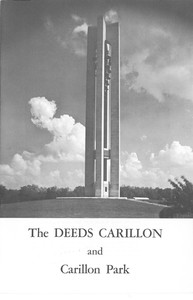
[Illustration: Deeds Carillon]
The Deeds Carillon
Carillon Park owes its existence to the generosity of two
public-spirited Dayton citizens, Colonel and Mrs. Edward A. Deeds. It is
an expression of the interests of two people expanded for the pleasure
and advancement of the entire community.
The Park had its inception with the Carillon, the gift of Mrs. Deeds.
Devoted to music from her girlhood, and herself an accomplished
musician, she had the inspiration for it while listening to the chimes
in one of the famous old belfries of Bruges. As the melodious notes fell
on her ears she said to herself, “In no other way can simple and
inspiring music be spread among the entire populace.” In that hour was
born the idea of the Deeds Carillon which rears its majestic height in
the midst of Carillon Park.
The idea of combining a group of bells to form a carillon dates back to
the Middle Ages. Since bells provided the world’s oldest and most simple
form of musical expression there came the evolution from a call to
prayer to a musical program. Some of Europe’s most famed and beautiful
towers have carillons. The carillon was developed to a greater and more
artistic extent in Belgium than in any other continental country, not
only in Bruges but also in Antwerp, Ghent, and Mechlin. Around the
carillon bells has been woven a tradition of beauty and inspirational
service.
[Illustration: Mrs. Edward A. Deeds and Colonel Deeds at the first
regularly scheduled carillon program August 23, 1942.]
Before embarking on her enterprise Mrs. Deeds viewed many carillons at
home and abroad and made a careful study of bells. The initial
requirement was to find a site which would provide the best ultimate
results from carillon music without echo and the jumbling of tone. Early
in her planning Mrs. Deeds considered Deeds Park at the junction of the
Miami River and Mad River. This park—a gift of Colonel Deeds to the city
of Dayton—would have made an appropriate setting. The idea was
reluctantly abandoned because of interfering noises and sound deflection
which would occur in the area. Finally Mrs. Deeds decided upon a site in
the triangular area located between Patterson Boulevard and Carillon
Boulevard almost adjacent to Old River, The National Cash Register
Company recreational park.
[Illustration: The beautiful bronze door at the Carillon is more
than an entranceway. In the cherished words of Longfellow’s
“Christmas Bells” it expresses the spirit in which the Carillon was
conceived and dedicated to the service of the people ... “With Peace
on Earth, good will to men.”]
IT WAS AS IF AN EARTHQUAKE RENT
THE HEARTHSTONES OF A CONTINENT
AND MADE FORLORN
THE HOUSEHOLDS BORN
OF PEACE ON EARTH GOOD WILL TO MEN
AND IN DESPAIR I BOWED MY HEAD
THERE IS NO PEACE ON EARTH I SAID
FOR HATE IS STRONG
AND MOCKS THE SONG
OF PEACE ON EARTH GOOD WILL TO MEN
THEN PEALED THE BELLS MORE LOUD AND DEEP
GOD IS NOT DEAD NOR DOES HE SLEEP
THE WRONG SHALL FAIL
THE RIGHT PREVAIL
WITH PEACE ON EARTH GOOD WILL TO MEN
LONGFELLOW
The sixty-one acres comprised in Carillon Park represent a notable piece
of reclamation. For many years it was periodically flooded and became a
bushy swamp breeding mosquitoes and germs. It was one of Dayton’s
eyesores in addition to being a menace to health. The decision to build
the Deeds Carillon led to its transformation. Within a year the one-time
“dismal swamp” emerged as an ideal pleasure ground equipped with a
parking space for hundreds of motor cars. In this lovely, wooded, and
verdant environment the citizens of Dayton and all others who come,
relax and enjoy the music of the carillon bells.
Including both large and small examples, there were only six true
carillon towers in the United States prior to the construction of the
Deeds Carillon. Of these, two were on college grounds, two on private
estates, one in a cemetery, while the sixth was the one built by the
late Edward K. Bok on his Florida estate. A true carillon must have a
minimum of twenty-three bells providing the tones and semitones to
encompass the full octaves. Except in rare instances when they were hung
in the gabled arches of the old Spanish missions and outside oriental
temples, carillon bells are seldom seen. For hundreds of years
architects have struggled with the problem of providing structures to
support carillons which will elevate them to a height at which they can
be adequately heard over the surrounding countryside. The solution had
invariably been to erect an enclosed tower in which the bells are hidden
from view and covered with grilles which screen the bells from sight and
tend to muffle the sound.
[Illustration: The casting of carillon bells is an art handed down
from father to son. The Meneely Company which cast the Deeds
Carillon bells practiced the art for six generations. Once a bell is
cast, no alterations can be made in it. If a true tone is not
achieved the work must be done over.]
[Illustration: The largest bell in the chandelier of 32 bells in the
Deeds Carillon weighs 7,000 pounds, and the smallest 250 pounds.
They are cast in bronze and the total weight of all the bells and
the chandelier is 32 tons.]
[Illustration: Hours of planning and consultation with architects
and the bell casters went into the building of the Deeds Carillon.]
Starting with the instruction from Mrs. Deeds that the thirty-two bells
in the Deeds Carillon must all be exposed to view, the architects, after
long study and investigation, were able to carry out her wishes. The
Deeds Carillon is the first tower to have all the bells mounted entirely
in the open, thus insuring greater carrying power and purest,
unrestricted beauty of tone. Such a departure from the old method of
construction required a complete rechecking of the science of carillon
tower design and bell placement.
Like Colonel Deeds, Mrs. Deeds was a perfectionist. She visioned the
ideal structure, and the architects, Reinhard, Hofmeister & Walquist of
New York, designers of Rockefeller Center, met every requirement. The
landscaping surrounding the tower was in the hands of Olmstead Brothers
of Boston, foremost in their field.
An unusual feature of the design is the so-called entasis of the sides
of the tower in which they were reduced toward the top as much as
eighteen inches, not in a straight line but by means of a curve which
bows three inches from top to bottom. The purpose of this is not to make
the sides bulge but to correct the optical illusion of pinching in and
actually making the sides look straight. This was the device employed by
the ancient Greeks for the same purpose in the design of their classic
columns.
[Illustration: The stone shafts of the Carillon are built around a
steel core.]
[Illustration: A mass of scaffolding was a requisite in building the
Carillon.]
[Illustration: Moving the bells from the freight cars which brought
them to Dayton and hanging them in position were operations which
called for great skill.]
[Illustration: The impressive array of the 32 bells in the Carillon
arranged at its base just previous to being placed in position.]
The Carillon tower, built of granite, steel, and limestone, soars
skyward 151 feet from the base planted on a green and friendly hill. It
is a shaft of precise beauty, dramatic in its simplicity, and
terminating in noble arches. Suspended from the cross-shaped
intersections of the arches, in full sight from all directions and
visible for miles around, is the chandelier of bells. At the base of the
Carillon is the Console Room. From here an elaborate electrical system
plays the bells through the touch of the operator’s fingers at the
console.
The actual ringing of the bells requires an unusual mechanism consisting
of an electrical solenoid, delivering a blow of proper force for each
size of bell. Suitable screens, designed so as not to interfere with the
sound, are placed at the bottom of the mechanism so that each bell, when
viewed from the ground, presents a uniform appearance, only the clapper
being visible. This was the first time that such a type of construction
in all its details had been followed, making possible a full, rich
beauty of tone.
[Illustration: The console which controls the playing of the
Carillon is located in a special room within the structure.]
In kinship with the spiritual fervor and idealism built into the
Carillon is the impressive bronze door bearing these inspirational words
by Longfellow:
It was as if an earthquake rent
The hearthstones of a continent,
And made forlorn the households born
Of peace on earth good will to men.
And in despair I bowed my head
There is no peace on earth I said
For hate is strong and mocks the song
Of peace on earth good will to men.
Then pealed the bells more loud and deep
God is not dead nor does He sleep,
The wrong shall fail, the right prevail
With peace on earth good will to men.
The bells range in size from six feet in diameter with a weight of 7,000
pounds to the smallest one which is eighteen inches in diameter weighing
250 pounds. Of the thirty-two bells in the Carillon, twenty-three are
speaking bells covering a range of two full octaves from B flat below
middle C. On the speaking bells were inscribed the names of the Deeds
family then living, while on the silent bells appear the names of six
deceased members.
[Illustration: The Celestron was added several years after the
Carillon was built. This is an amplifying system incorporating a
number of advanced features and making it possible to play recorded
music so that it can be heard over a wide area. The Celestron has no
connection with the Carillon bells. Since the addition of the
Celestron, most programs are divided between carillon music and
recorded music.]
[Illustration: This scene in the Carillon parking area has been
duplicated many times, as Sunday afternoon programs and others have
been presented.]
[Illustration: Easter Dawn Services at the Carillon.]
The same loving care that was lavished on the planning of the Carillon
has found expression in the arrangement of the programs. Mrs. Deeds
personally supervised the selection and arrangement of more than 400
musical selections so they could be played on the bells. The music has
been transferred to sheets of white Bristol paper bearing the Carillon
crest which are filed systematically for reference.
Thirty-five feet above the base of the Carillon tower is a balcony-like
structure in bronze which contains a room twelve feet in diameter and
six feet high. In this room are installed thirty-two powerful
high-fidelity speakers of the most advanced design. On Easter morning,
Christmas Eve, and other occasions, programs are broadcast directly to
the countryside. Recorded music, performed by the world’s finest bands,
choruses, orchestras and soloists, is to be heard with all its beauty
for nearly a mile in every direction throughout the wide-open spaces
about the Carillon tower. This Celestron is not connected in any way
with the chandelier of bells of the Carillon. It is an additional
instrument for the pleasure of those who love good music.
The science of bell-making is an old one. Sometimes it is necessary to
cast twenty or thirty bells to fill an order for a ten-bell chime. The
Deeds Carillon bells were made by The Meneely Bell Company of Troy, New
York.
Typical Sunday Afternoon Carillon Park Program
CARILLON
1. America
2. Song of Faith
3. Rock of Ages
4. The Holy City
5. In the Garden
6. When They Ring the Golden Bells
7. Goin’ Home
8. Great God of Nations
9. In a Monastery Garden
10. The Bells of London
11. The Bells of St. Mary’s
12. Ah! Sweet Mystery of Life
13. Pilgrim’s Chorus
14. Land of Hope and Glory
15. Jesu, Joy of Man’s Desiring
16. Rhapsody for Bells
CELESTRON
1. Glorious Things of Thee Are Spoken (Haydn)
World Choristers
2. Spanish Caprice (Rimsky-Korsakoff)
Cincinnati Summer Opera Orchestra
3. Come Where My Love Lies Dreaming (Foster)
Jesse Crawford, Organist
4. Fight On (Sweet and Grant)
Frank Westerfield Band
5. The Hills of Home (Fox)
Nelson Eddy, Baritone
6. King Cotton March (Sousa)
Frank Westerfield Band
7. I’m Falling in Love With Someone (Herbert)
Jane Marcy and Roland Smythe
8. Flapperette (Greer)
Wilson Ames, Organist
9. Just A-Wearyin’ for You (Bond)
Walter Preston, Baritone
10. Waltzing Doll (Poldini)
Daniel Lieberfeld Orchestra
11. The Star-Spangled Banner
CELESTRON
An especially designed amplifying installation for the playing of
recorded music.
32 high-fidelity speakers. Uniform frequency range from 50 to 15,000
cycles.
Total operating power—5,500 watts.
Bronze Galeria 12 ft. in width; located 35 ft. above terrace.
Record player in Console Room.
Control panels in Power Room.
[Illustration: The sectional diagram at the left shows the
construction and arrangement of the Carillon both above and below
ground. The map shows location and parking area.]
Number of bells 32
Total weight of bell chandelier 32 tons
Diameter smallest bell 1 ft. 6 in.
Diameter largest bell 6 ft.
Height of tower above terrace 151 ft. 6 in.
Height of tower from bottom of 183 ft. 7 in.
foundation
Construction:
Indiana Limestone with Granite Base.
1 _Chandelier of bells_
2 _Galeria for Celestron_
3 _Carillon Console Room and Celestron
Record Player_
4 _Power Room_
5 _Basement_
A most spectacular step in bell-making comes when the copper and tin are
melted and mixed in the oil furnace, brought to just the proper
temperature, and then carried in a huge ladle from which the molten
alloy is poured into the mold.
Larger bells are kept buried in dirt for days after the casting to
retard their cooling. Sometimes weeks go by before the bell can be
“shaken out” and the founder gets the final check on the accuracy of his
calculations.
The Meneely Bell Company foundry represented a curious mixture of the
old and the new. There was the main foundry with its large modern oil
melting furnaces in which was blended the age-old mixture of copper and
tin which is known in the textbooks as “bell metal”.... Out in the next
shop were the blacksmith and his helper, skillfully working iron into
the special bell mountings. Immediately behind this was the finishing
room where large and small bells were cleaned and buffed, while finished
ones were being set into their mountings for final tests before
shipment. Upstairs, patterns and cabinets were fashioned from wood;
while on a nearby drafting board a chime would take form as it would fit
into its final position in the tower.
In making bells, there must be a complete understanding of the technical
elements that make a bell ring true. Meneely’s men knew that a pure tone
was a definite number of vibrations per second as sensed by the human
ear.
The sound of a single tone is pleasant but colorless. The usual tone is
made up of a number of different pure tones, blending together, with the
dominant one giving the tone its pitch. Practically everything that will
vibrate will produce a tone, but only certain combinations will have the
musical qualities which distinguish them from unpleasant “noise.”
In this country, the commonest form of chime is that found in clock
towers. Principally used to strike the quarters and hours, these bells
are usually stationary and seldom number more than four or five; hence
no complete airs can be played with them.
[Illustration: From an acoustical standpoint the Deeds Carillon is
ideally located. The hills to the south provide a natural sounding
board and enhance the tone of the music.]
Chimes usually contain a minimum of ten bells, which give enough tones
in the diatonic scale to permit the rendering of hundreds of complete
hymns, folk songs, etc., in simple harmonies. Chimes are typically an
American form of art and are found in our churches in every part of the
country. The bells do not move, but the clappers are operated from
manual claviers, or by modern electrical methods employing small
piano-like keyboards.
[Illustration: This picture shows how the bells are mounted on the
chandelier and hang suspended from the top of the Carillon. The
larger bells are at the top of the chandelier.]
[Illustration: The regular Sunday afternoon concerts at Carillon
Park have drawn music lovers in ever-increasing numbers. In the
informal atmosphere of a beautiful park on a sunny summer afternoon,
there is pleasure and relaxation for all the family. The hour-long
program is now divided between numbers played on the bells and
recorded music amplified through the Celestron.]
[Illustration: People in Carillon Park]
[Illustration: People in Carillon Park]
The first regularly scheduled Deeds Carillon program was presented on
Sunday, August 23, 1942, in the presence of a capacity crowd. The first
two programs were played by Mrs. Deeds. Since that inaugural day,
programs are given every Sunday afternoon, June through October, and at
Easter Sunrise.
Once Carillon Park had been created, Colonel Deeds stepped into the
picture for his contribution to the project. His wise counsel and sense
of perfection had contributed much to the success of the tower
construction. He now set about to gratify his love for the historic with
the larger conception of providing a group of exhibits that would be a
visual lesson in history. The striking parade of transportation in the
Park dating from the picturesque days of the Conestoga wagon and the
Concord coach to the Wright airplane is the result. Every exhibit meant
painstaking research and discriminating choice.
The Deeds Carillon stands on a three-acre tract purchased by Mrs. Deeds
from NCR. The property was, in turn deeded to Educational and Musical
Arts, Incorporated. This is an administrative subsidiary of the Dayton
Foundation, especially created to carry out the construction and
perpetuation plans through a group of Dayton’s civic leaders who were
proud and glad to assume the responsibility. The financial requirements
for maintenance and operation are met through an endowment fund created
by Mrs. Deeds and contributions of Colonel Deeds.
Carillon Park is unique among the gifts for public enjoyment in that it
serves a threefold purpose. The Carillon itself, with its eloquent and
deep-toned bells, is a spiritual stimulant for Dayton, a source of
beauty and inspiration. The Park, a natural beauty spot, is a sanctuary
for all people, while the historical exhibits are highly educational.
[Illustration: People in Carillon Park]
[Illustration: People in Carillon Park]
The Historical Exhibits at Carillon Park
In a desire to perpetuate some of those links with the past which are
rapidly passing from the scene, an historical exhibit has been set up in
Carillon Park. The caretaker’s house has been built as a replica of an
old grist mill and includes a water wheel which turns a millstone, just
as in the mills of yesterday.
Most of the other exhibits are concerned with transportation and tell
the story of man’s progress from the days of the Conestoga wagon, the
Concord coach and the canal, to the airplane. They also include a
covered bridge which long served the people of this valley and a
grasshopper locomotive, the oldest in existence.
[Illustration: The Concord Coach]
[Illustration: The Steam Fire Engine]
[Illustration: The Old Covered Bridge]
[Illustration: Original Canal Lock]
[Illustration: The Old Grist Mill]
[Illustration: The Conestoga Wagon]
[Illustration: The restored 1905 Wright airplane]
[Illustration: The Grasshopper Locomotive]
[Illustration: The Pioneer Home]
[Illustration: Deeds Barn]
[Illustration: The Deeds Carillon is no less impressive by night
than by day. Softly lighted, it reaches skyward, symbolic in its
strength and simplicity of the spirit of the people to whom it is
dedicated.]
CARILLON PARK
DAYTON, OHIO
One of a series of Carillon Park booklets.
Price ten cents.
PRINTED IN U.S.A.
Transcriber’s Notes
—Silently corrected a few typos.
—Retained publication information from the printed edition: this eBook
is public-domain in the country of publication.
—In the text versions only, text in italics is delimited by
_underscores_.