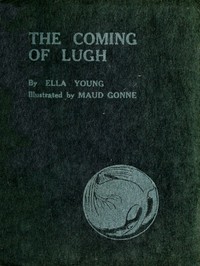
The Project Gutenberg eBook of The Coming of Lugh: A Celtic Wonder-Tale Retold
This ebook is for the use of anyone anywhere in the United States and
most other parts of the world at no cost and with almost no restrictions
whatsoever. You may copy it, give it away or re-use it under the terms
of the Project Gutenberg License included with this ebook or online
at www.gutenberg.org. If you are not located in the United States,
you will have to check the laws of the country where you are located
before using this eBook.
Title: The Coming of Lugh: A Celtic Wonder-Tale Retold
Author: Ella Young
Illustrator: Maud Gonne
Release date: December 6, 2019 [eBook #60859]
Most recently updated: October 17, 2024
Language: English
Credits: Produced by Mary Glenn Krause, Stephen Hutcheson, and the
Online Distributed Proofreading Team at http://www.pgdp.net
(This file was produced from images generously made
available by The Internet Archive/American Libraries.)
*** START OF THE PROJECT GUTENBERG EBOOK THE COMING OF LUGH: A CELTIC WONDER-TALE RETOLD ***
THE COMING OF LUGH
A CELTIC WONDER-TALE
RETOLD BY ELLA YOUNG
ILLUSTRATED BY MAUD GONNE
DUBLIN: MAUNSEL & CO., LTD.
96 MIDDLE ABBEY STREET
1909
All Rights Reserved
TO
SEAGHAN
[Illustration: Lugh.]
THE COMING OF LUGH
Mananaan Mac Lir who rules the ocean took the little Sun-God, Lugh, in
his arms and held him up so that he could see the whole of Ireland with
the waves whispering about it everywhere.
“Say farewell to the mountains and rivers and the big trees and the
flowers in the grass, O Lugh, for you are coming away with me.”
The child stretched out his hands and cried—
“Good-bye, mountains and flowers and rivers; some day I will come back
to you.”
Then Mananaan wrapped Lugh in his cloak and stepped into his boat, the
Ocean-Sweeper, and without oar or sail they journeyed over the sea till
they crossed the waters at the edge of the world and came to the country
of Mananaan—a beautiful country shining With the colours of the dawn.
Lugh stayed in that country with Mananaan. He raced the waves along the
strand; he gathered apples sweeter than honey from trees with crimson
blossoms, and wonderful birds came to play with him. Mananaan’s
daughter, Niav, took him through woods where there were milk-white deer
with horns of gold, and black-maned lions and spotted panthers, and
unicorns that shone like silver, and strange beasts that no one ever
heard of; and all the animals were glad to see him, and he played with
them and called them by their names. Every day he grew taller and
stronger and more beautiful, but he did not any day ask Mananaan to take
him back to Ireland.
Every night when darkness had come into the sky, Mananaan wrapped
himself in his mantle of power and crossed the sea and walked all round
Ireland, stepping from rock to rock. No one saw him, because his mantle
made him invisible, but he saw everything and knew that trouble had
found the De Danaanans. The ugly, misshapen folk of the Fomor had come
into Ireland and spread themselves over the country like a pestilence.
They had stolen the Cauldron of Plenty and carried it away to their own
land, where Balor of the Evil Eye reigned. They had taken the Spear of
Victory also, and the only one of the four great Jewels of Sovereignity
remaining to the De Danaanans was the Stone of Destiny. It was hidden
deep in the earth of Ireland, and because of it the Fomorians could not
altogether conquer the country, nor could they destroy the De Danaanans,
though they drove them from their pleasant palaces and hunted them
through the glens and valleys like outlaws.
Mananaan himself had the fourth Jewel, the Sword of Light: he kept it
and waited.
When Lugh was full grown Mananaan said to him—
“It is three times seven years as mortals count time since I brought you
to Tir-nan-oge, and in all that time I have never given you a gift.
To-day I will give you a gift.”
He brought out the Sword of Light and gave it to Lugh, and when Lugh
took it in his hand he remembered how he had cried to the hills and
rivers of Ireland, “Some day I will come back to you,” and he said to
Mananaan—
“I want to go back to Ireland.”
“You will not find joyousness there, O Lugh, or the music of harp
strings, or feasting. The De Danaanans are shorn of their strength.
Ogmai, their champion, carries logs to warm Fomorian hearths; Angus
wanders like an outcast; and Nuada, the King, has but one dun where
those who had once the lordship of the world meet in secret like hunted
folk.”
“I have a good sword,” said Lugh. “I will go to my kinsfolk.”
[Illustration: Lugh saying Farewell to the Irish Hills.]
“O Lugh,” said Mananaan, “they have never known you. Will you leave me
and Niav and this land where sorrow has never touched you, for the sake
of stranger kinsfolk?”
Lugh answered—
“I remember the hills and the woods and the rivers of Ireland, and
though all my kinsfolk were gone from it and the sea covered everything
but the tops of the mountains, I would go back.”
“You have the hardiness that wins victory,” said Mananaan. “I will set
you on my own white horse and give you companions as high-hearted as
yourself. I will put my helmet on your head and my breastplate over your
heart; you shall drive the Fomorians out of Ireland as chaff is driven
by the wind.”
When Lugh put on the helmet of Mananaan, brightness shot into the sky as
if a new sun had risen; when he put on the breastplate, a great wave of
music swelled and sounded through Tir-nan-oge; when he mounted the white
horse, a mighty wind swept past him, and lo! the companions Mananaan had
promised, rode beside him. Their horses were white like his, and
gladness that age cannot wither shone in their faces. When they came to
the sea that is about Tir-nan-oge, the little crystal waves lifted
themselves up to look at Lugh, and when he and his comrades sped over
the sea as lightly as blown foam, the little waves followed them till
they came to Ireland, and the three great waves of Ireland thundered a
welcome—the wave of Thoth, the wave of Rury, and the long, snow-white,
foaming wave of Cleena.
No one saw the Faery Host coming into Ireland. At the place where their
horses leaped from sea to land there was a great wood of pine trees.
“Let us go into the wood,” said Lugh, and they rode between the tall,
straight tree-trunks into the silent heart of the wood.
“Rest here,” said Lugh, “till morning; I will go to the dun of Nuada and
get news of my kinsfolk.”
He put his shining armour from him and wrapped himself in a dark cloak
and went on foot to the dun of Nuada. He struck the brazen door, and the
Guardian of the Door spoke to him from within—
“What do you seek?”
“My way into the dun.”
“No one enters here who has not his craft. What can you do?”
“I have the craft of a carpenter.”
“We have a carpenter within; he is Luchtae, son of Luchaid.”
“I have the craft of a smith.”
“We have a smith within, Colum of the three new ways of working.”
“I have the craft of a champion.”
“We have a champion within, he is Ogmai himself.”
“I have the craft of a harper.”
“We have a harper within, even Abhcan, son of Bicelmos; the Men of the
three Gods chose him in the faery hills.”
“I have the craft of a poet and historian.”
“We have a poet and historian within, even En, son of Ethaman.”
“I have the craft of a wizard.”
“We have many wizards and magicians within.”
“I have the craft of a physician.”
“We have a physician within, even Dian Cecht.”
“I have the craft of a cupbearer.”
“We have nine cupbearers within.”
“I have the craft of a brazier.”
“We have a brazier within, even Credne Cerd.”
“Go hence and ask your king if he has within any one man who can do all
these things. If he has, I will not seek to enter.”
The Guardian of the Door hurried in to Nuada.
“O King!” he said, “the most wonderful youth in the world is waiting
outside your door to-night. He seeks admittance as the Ildana, the
Master of every craft.”
[Illustration: Lugh in Tir-nan-oge.]
“Let him come in,” said King Nuada.
Lugh came into the dun. Ogmai, the champion, took a good look at him. He
thought him young and slender, and was minded to test him. There was a
great stone before the seat of the king. It was flat and round, and
fourscore yoke of oxen could not move it. Ogmai stooped and lifted the
stone. He cast it through the door, so that it crossed the fosse which
was round the dun. That was his challenge to the Ildana.
“It is a good champion-cast,” said Lugh, “I will better it.”
He went outside. He lifted the stone and cast it back, not through the
door, but through the strong wall of the dun so that it fell in the
place where it had lain before Ogmai lifted it.
“Your cast is better than mine,” said Ogmai, “sit in the seat of the
champion with your face to the King.”
Lugh drew his hand over the wall; it became whole as before. He sat in
the champion-seat.
“Let chess be brought,” said the King.
They played, and Lugh won all the games, so that thereafter it passed
into a proverb “to make the Cro of Lugh.”
“Truly you are the Ildana,” said Nuada. “I would fain hear music of your
making, but I have no harp to offer you.”
“I see a kingly harp within reach of your hand,” said Lugh.
“That is the harp of the Dagda. No one can bring music from that harp
but himself: when he plays on it the four Seasons—Spring, Summer, Autumn
and Winter—pass over the earth.”
“I will play on it,” said Lugh.
The harp was given to him.
Lugh played the music of joy, and outside the dun the birds began to
sing as though it were morning, and wonderful crimson flowers sprang
through the grass—flowers that trembled with delight and swayed and
touched each other with a delicate, faery ringing as of silver bells.
Inside the dun a subtle sweetness of laughter filled the hearts of
everyone: it seemed to them that they had never known gladness till that
night.
Lugh played the music of sorrow: the wind moaned outside, and where the
grass and flowers had been there was a dark sea of moving waters. The De
Danaanans within the dun bowed their heads on their hands and wept as
they had never wept for any sorrow.
Lugh played the music of peace and outside there fell silently a strange
snow. Flake by flake it settled on the earth and changed to starry dew.
Flake by flake the quiet of the Land of the Silver Fleece settled in the
hearts and minds of Nuada and his people: they closed their eyes and
slept, each in his seat.
Lugh put the harp from him and stole out of the dun. The snow was still
falling outside: it settled on his dark cloak and shone like silver
scales; it settled on the thick curls of his hair and shone like
jewelled fire; it filled the night about him with white radiance. He
went back to his companions.
The sun had risen in the sky when the De Danaanans awoke in Nuada’s dun.
They were light-hearted and joyous, and it seemed to them that they had
dreamed over-night a strange, beautiful dream.
“The Fomorians have not taken the sun out of the sky,” said Nuada. “Let
us go to the Hill of Usna and send to our scattered comrades that we may
make a stand against our enemies.”
They took their weapons and went to the Hill of Usna, and they were not
long upon it when a band of Fomorian devastators came on them. The
Fomorians scoffed among themselves when they saw how few the De
Danaanans were and how ill-prepared for fighting.
“Behold!” they cried, “what mighty kings are to-day upon Usna, the Hill
of Sovereignity. Come down, O Kings, and bow yourselves before your
masters!”
[Illustration: Mananaan giving the Sword to Lugh.]
“We will not bow ourselves before you,” said Nuada, “for ye are ugly and
vile, and lords neither of us nor of Ireland.”
With hoarse cries the Fomorians fell on the De Danaanans, but Nuada and
his folk held together and withstood them as well as they were able.
Scarcely had the weapons clashed when a light appeared in the horizon
and a sound of mighty battle-trumpets shook the air. The light was so
white that no one could look at it, and great rose-red streamers shot
from it into the sky.
“It is a second sunrise,” said the Fomorians.
“It is the Deliverer!” said the De Danaanans.
Out of the light came the glorious company of warriors from Tir-nan-oge.
Lugh was leading them. He had the helmet of Mananaan on his head, the
breastplate of Mananaan over his heart, and the great white horse of
Mananaan beneath him.
The Sword of Light was bare in his hand. He fell on the Fomorians as a
sea-eagle falls on her prey, as lightning flashes out of a clear sky.
Before him and his companions they were destroyed as stubble is
destroyed by fire. He held his hand when only nine of them remained
alive.
“Bow yourselves,” he said, “before the King, Nuada, and before the De
Danaanans, for they are your Lords and the Lords of Ireland, and go
hence to Balor of the Evil Eye and tell him and his misshapen brood that
the De Danaanans have taken their own again, and they will wage war
against the Fomorians till there is not one left to darken the earth
with his shadow.”
The nine Fomorians bowed themselves before the King, Nuada, and before
the De Danaanans, and before Lugh Lauvauda, the Ildana, and they arose
and carried his message to Balor of the Evil Eye, King of the Fomorians.
Transcriber’s Notes
--Copyright notice provided as in the original—this e-text is public
domain in the country of publication.
--Silently corrected palpable typos; left non-standard (or amusing)
spellings and dialect unchanged.
--In the text versions, delimited italics text in _underscores_ (the
HTML version reproduces the font form of the printed book.)
End of Project Gutenberg's The Coming of Lugh, by Ella Young and Maud Gonne
*** END OF THE PROJECT GUTENBERG EBOOK THE COMING OF LUGH: A CELTIC WONDER-TALE RETOLD ***
Updated editions will replace the previous one—the old editions will
be renamed.
Creating the works from print editions not protected by U.S. copyright
law means that no one owns a United States copyright in these works,
so the Foundation (and you!) can copy and distribute it in the United
States without permission and without paying copyright
royalties. Special rules, set forth in the General Terms of Use part
of this license, apply to copying and distributing Project
Gutenberg™ electronic works to protect the PROJECT GUTENBERG™
concept and trademark. Project Gutenberg is a registered trademark,
and may not be used if you charge for an eBook, except by following
the terms of the trademark license, including paying royalties for use
of the Project Gutenberg trademark. If you do not charge anything for
copies of this eBook, complying with the trademark license is very
easy. You may use this eBook for nearly any purpose such as creation
of derivative works, reports, performances and research. Project
Gutenberg eBooks may be modified and printed and given away—you may
do practically ANYTHING in the United States with eBooks not protected
by U.S. copyright law. Redistribution is subject to the trademark
license, especially commercial redistribution.
START: FULL LICENSE
THE FULL PROJECT GUTENBERG LICENSE
PLEASE READ THIS BEFORE YOU DISTRIBUTE OR USE THIS WORK
To protect the Project Gutenberg™ mission of promoting the free
distribution of electronic works, by using or distributing this work
(or any other work associated in any way with the phrase “Project
Gutenberg”), you agree to comply with all the terms of the Full
Project Gutenberg™ License available with this file or online at
www.gutenberg.org/license.
Section 1. General Terms of Use and Redistributing Project Gutenberg™
electronic works
1.A. By reading or using any part of this Project Gutenberg™
electronic work, you indicate that you have read, understand, agree to
and accept all the terms of this license and intellectual property
(trademark/copyright) agreement. If you do not agree to abide by all
the terms of this agreement, you must cease using and return or
destroy all copies of Project Gutenberg™ electronic works in your
possession. If you paid a fee for obtaining a copy of or access to a
Project Gutenberg™ electronic work and you do not agree to be bound
by the terms of this agreement, you may obtain a refund from the person
or entity to whom you paid the fee as set forth in paragraph 1.E.8.
1.B. “Project Gutenberg” is a registered trademark. It may only be
used on or associated in any way with an electronic work by people who
agree to be bound by the terms of this agreement. There are a few
things that you can do with most Project Gutenberg™ electronic works
even without complying with the full terms of this agreement. See
paragraph 1.C below. There are a lot of things you can do with Project
Gutenberg™ electronic works if you follow the terms of this
agreement and help preserve free future access to Project Gutenberg™
electronic works. See paragraph 1.E below.
1.C. The Project Gutenberg Literary Archive Foundation (“the
Foundation” or PGLAF), owns a compilation copyright in the collection
of Project Gutenberg™ electronic works. Nearly all the individual
works in the collection are in the public domain in the United
States. If an individual work is unprotected by copyright law in the
United States and you are located in the United States, we do not
claim a right to prevent you from copying, distributing, performing,
displaying or creating derivative works based on the work as long as
all references to Project Gutenberg are removed. Of course, we hope
that you will support the Project Gutenberg™ mission of promoting
free access to electronic works by freely sharing Project Gutenberg™
works in compliance with the terms of this agreement for keeping the
Project Gutenberg™ name associated with the work. You can easily
comply with the terms of this agreement by keeping this work in the
same format with its attached full Project Gutenberg™ License when
you share it without charge with others.
1.D. The copyright laws of the place where you are located also govern
what you can do with this work. Copyright laws in most countries are
in a constant state of change. If you are outside the United States,
check the laws of your country in addition to the terms of this
agreement before downloading, copying, displaying, performing,
distributing or creating derivative works based on this work or any
other Project Gutenberg™ work. The Foundation makes no
representations concerning the copyright status of any work in any
country other than the United States.
1.E. Unless you have removed all references to Project Gutenberg:
1.E.1. The following sentence, with active links to, or other
immediate access to, the full Project Gutenberg™ License must appear
prominently whenever any copy of a Project Gutenberg™ work (any work
on which the phrase “Project Gutenberg” appears, or with which the
phrase “Project Gutenberg” is associated) is accessed, displayed,
performed, viewed, copied or distributed:
This eBook is for the use of anyone anywhere in the United States and most
other parts of the world at no cost and with almost no restrictions
whatsoever. You may copy it, give it away or re-use it under the terms
of the Project Gutenberg License included with this eBook or online
at www.gutenberg.org. If you
are not located in the United States, you will have to check the laws
of the country where you are located before using this eBook.
1.E.2. If an individual Project Gutenberg™ electronic work is
derived from texts not protected by U.S. copyright law (does not
contain a notice indicating that it is posted with permission of the
copyright holder), the work can be copied and distributed to anyone in
the United States without paying any fees or charges. If you are
redistributing or providing access to a work with the phrase “Project
Gutenberg” associated with or appearing on the work, you must comply
either with the requirements of paragraphs 1.E.1 through 1.E.7 or
obtain permission for the use of the work and the Project Gutenberg™
trademark as set forth in paragraphs 1.E.8 or 1.E.9.
1.E.3. If an individual Project Gutenberg™ electronic work is posted
with the permission of the copyright holder, your use and distribution
must comply with both paragraphs 1.E.1 through 1.E.7 and any
additional terms imposed by the copyright holder. Additional terms
will be linked to the Project Gutenberg™ License for all works
posted with the permission of the copyright holder found at the
beginning of this work.
1.E.4. Do not unlink or detach or remove the full Project Gutenberg™
License terms from this work, or any files containing a part of this
work or any other work associated with Project Gutenberg™.
1.E.5. Do not copy, display, perform, distribute or redistribute this
electronic work, or any part of this electronic work, without
prominently displaying the sentence set forth in paragraph 1.E.1 with
active links or immediate access to the full terms of the Project
Gutenberg™ License.
1.E.6. You may convert to and distribute this work in any binary,
compressed, marked up, nonproprietary or proprietary form, including
any word processing or hypertext form. However, if you provide access
to or distribute copies of a Project Gutenberg™ work in a format
other than “Plain Vanilla ASCII” or other format used in the official
version posted on the official Project Gutenberg™ website
(www.gutenberg.org), you must, at no additional cost, fee or expense
to the user, provide a copy, a means of exporting a copy, or a means
of obtaining a copy upon request, of the work in its original “Plain
Vanilla ASCII” or other form. Any alternate format must include the
full Project Gutenberg™ License as specified in paragraph 1.E.1.
1.E.7. Do not charge a fee for access to, viewing, displaying,
performing, copying or distributing any Project Gutenberg™ works
unless you comply with paragraph 1.E.8 or 1.E.9.
1.E.8. You may charge a reasonable fee for copies of or providing
access to or distributing Project Gutenberg™ electronic works
provided that:
• You pay a royalty fee of 20% of the gross profits you derive from
the use of Project Gutenberg™ works calculated using the method
you already use to calculate your applicable taxes. The fee is owed
to the owner of the Project Gutenberg™ trademark, but he has
agreed to donate royalties under this paragraph to the Project
Gutenberg Literary Archive Foundation. Royalty payments must be paid
within 60 days following each date on which you prepare (or are
legally required to prepare) your periodic tax returns. Royalty
payments should be clearly marked as such and sent to the Project
Gutenberg Literary Archive Foundation at the address specified in
Section 4, “Information about donations to the Project Gutenberg
Literary Archive Foundation.”
• You provide a full refund of any money paid by a user who notifies
you in writing (or by e-mail) within 30 days of receipt that s/he
does not agree to the terms of the full Project Gutenberg™
License. You must require such a user to return or destroy all
copies of the works possessed in a physical medium and discontinue
all use of and all access to other copies of Project Gutenberg™
works.
• You provide, in accordance with paragraph 1.F.3, a full refund of
any money paid for a work or a replacement copy, if a defect in the
electronic work is discovered and reported to you within 90 days of
receipt of the work.
• You comply with all other terms of this agreement for free
distribution of Project Gutenberg™ works.
1.E.9. If you wish to charge a fee or distribute a Project
Gutenberg™ electronic work or group of works on different terms than
are set forth in this agreement, you must obtain permission in writing
from the Project Gutenberg Literary Archive Foundation, the manager of
the Project Gutenberg™ trademark. Contact the Foundation as set
forth in Section 3 below.
1.F.
1.F.1. Project Gutenberg volunteers and employees expend considerable
effort to identify, do copyright research on, transcribe and proofread
works not protected by U.S. copyright law in creating the Project
Gutenberg™ collection. Despite these efforts, Project Gutenberg™
electronic works, and the medium on which they may be stored, may
contain “Defects,” such as, but not limited to, incomplete, inaccurate
or corrupt data, transcription errors, a copyright or other
intellectual property infringement, a defective or damaged disk or
other medium, a computer virus, or computer codes that damage or
cannot be read by your equipment.
1.F.2. LIMITED WARRANTY, DISCLAIMER OF DAMAGES - Except for the “Right
of Replacement or Refund” described in paragraph 1.F.3, the Project
Gutenberg Literary Archive Foundation, the owner of the Project
Gutenberg™ trademark, and any other party distributing a Project
Gutenberg™ electronic work under this agreement, disclaim all
liability to you for damages, costs and expenses, including legal
fees. YOU AGREE THAT YOU HAVE NO REMEDIES FOR NEGLIGENCE, STRICT
LIABILITY, BREACH OF WARRANTY OR BREACH OF CONTRACT EXCEPT THOSE
PROVIDED IN PARAGRAPH 1.F.3. YOU AGREE THAT THE FOUNDATION, THE
TRADEMARK OWNER, AND ANY DISTRIBUTOR UNDER THIS AGREEMENT WILL NOT BE
LIABLE TO YOU FOR ACTUAL, DIRECT, INDIRECT, CONSEQUENTIAL, PUNITIVE OR
INCIDENTAL DAMAGES EVEN IF YOU GIVE NOTICE OF THE POSSIBILITY OF SUCH
DAMAGE.
1.F.3. LIMITED RIGHT OF REPLACEMENT OR REFUND - If you discover a
defect in this electronic work within 90 days of receiving it, you can
receive a refund of the money (if any) you paid for it by sending a
written explanation to the person you received the work from. If you
received the work on a physical medium, you must return the medium
with your written explanation. The person or entity that provided you
with the defective work may elect to provide a replacement copy in
lieu of a refund. If you received the work electronically, the person
or entity providing it to you may choose to give you a second
opportunity to receive the work electronically in lieu of a refund. If
the second copy is also defective, you may demand a refund in writing
without further opportunities to fix the problem.
1.F.4. Except for the limited right of replacement or refund set forth
in paragraph 1.F.3, this work is provided to you ‘AS-IS’, WITH NO
OTHER WARRANTIES OF ANY KIND, EXPRESS OR IMPLIED, INCLUDING BUT NOT
LIMITED TO WARRANTIES OF MERCHANTABILITY OR FITNESS FOR ANY PURPOSE.
1.F.5. Some states do not allow disclaimers of certain implied
warranties or the exclusion or limitation of certain types of
damages. If any disclaimer or limitation set forth in this agreement
violates the law of the state applicable to this agreement, the
agreement shall be interpreted to make the maximum disclaimer or
limitation permitted by the applicable state law. The invalidity or
unenforceability of any provision of this agreement shall not void the
remaining provisions.
1.F.6. INDEMNITY - You agree to indemnify and hold the Foundation, the
trademark owner, any agent or employee of the Foundation, anyone
providing copies of Project Gutenberg™ electronic works in
accordance with this agreement, and any volunteers associated with the
production, promotion and distribution of Project Gutenberg™
electronic works, harmless from all liability, costs and expenses,
including legal fees, that arise directly or indirectly from any of
the following which you do or cause to occur: (a) distribution of this
or any Project Gutenberg™ work, (b) alteration, modification, or
additions or deletions to any Project Gutenberg™ work, and (c) any
Defect you cause.
Section 2. Information about the Mission of Project Gutenberg™
Project Gutenberg™ is synonymous with the free distribution of
electronic works in formats readable by the widest variety of
computers including obsolete, old, middle-aged and new computers. It
exists because of the efforts of hundreds of volunteers and donations
from people in all walks of life.
Volunteers and financial support to provide volunteers with the
assistance they need are critical to reaching Project Gutenberg™’s
goals and ensuring that the Project Gutenberg™ collection will
remain freely available for generations to come. In 2001, the Project
Gutenberg Literary Archive Foundation was created to provide a secure
and permanent future for Project Gutenberg™ and future
generations. To learn more about the Project Gutenberg Literary
Archive Foundation and how your efforts and donations can help, see
Sections 3 and 4 and the Foundation information page at www.gutenberg.org.
Section 3. Information about the Project Gutenberg Literary Archive Foundation
The Project Gutenberg Literary Archive Foundation is a non-profit
501(c)(3) educational corporation organized under the laws of the
state of Mississippi and granted tax exempt status by the Internal
Revenue Service. The Foundation’s EIN or federal tax identification
number is 64-6221541. Contributions to the Project Gutenberg Literary
Archive Foundation are tax deductible to the full extent permitted by
U.S. federal laws and your state’s laws.
The Foundation’s business office is located at 809 North 1500 West,
Salt Lake City, UT 84116, (801) 596-1887. Email contact links and up
to date contact information can be found at the Foundation’s website
and official page at www.gutenberg.org/contact
Section 4. Information about Donations to the Project Gutenberg
Literary Archive Foundation
Project Gutenberg™ depends upon and cannot survive without widespread
public support and donations to carry out its mission of
increasing the number of public domain and licensed works that can be
freely distributed in machine-readable form accessible by the widest
array of equipment including outdated equipment. Many small donations
($1 to $5,000) are particularly important to maintaining tax exempt
status with the IRS.
The Foundation is committed to complying with the laws regulating
charities and charitable donations in all 50 states of the United
States. Compliance requirements are not uniform and it takes a
considerable effort, much paperwork and many fees to meet and keep up
with these requirements. We do not solicit donations in locations
where we have not received written confirmation of compliance. To SEND
DONATIONS or determine the status of compliance for any particular state
visit www.gutenberg.org/donate.
While we cannot and do not solicit contributions from states where we
have not met the solicitation requirements, we know of no prohibition
against accepting unsolicited donations from donors in such states who
approach us with offers to donate.
International donations are gratefully accepted, but we cannot make
any statements concerning tax treatment of donations received from
outside the United States. U.S. laws alone swamp our small staff.
Please check the Project Gutenberg web pages for current donation
methods and addresses. Donations are accepted in a number of other
ways including checks, online payments and credit card donations. To
donate, please visit: www.gutenberg.org/donate.
Section 5. General Information About Project Gutenberg™ electronic works
Professor Michael S. Hart was the originator of the Project
Gutenberg™ concept of a library of electronic works that could be
freely shared with anyone. For forty years, he produced and
distributed Project Gutenberg™ eBooks with only a loose network of
volunteer support.
Project Gutenberg™ eBooks are often created from several printed
editions, all of which are confirmed as not protected by copyright in
the U.S. unless a copyright notice is included. Thus, we do not
necessarily keep eBooks in compliance with any particular paper
edition.
Most people start at our website which has the main PG search
facility: www.gutenberg.org.
This website includes information about Project Gutenberg™,
including how to make donations to the Project Gutenberg Literary
Archive Foundation, how to help produce our new eBooks, and how to
subscribe to our email newsletter to hear about new eBooks.