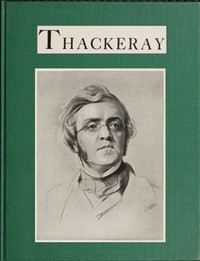
[Illustration: WILLIAM MAKEPEACE THACKERAY
FROM A DRAWING BY SAMUEL LAURENCE.]
THACKERAY
BY
G. K. CHESTERTON
AND
LEWIS MELVILLE
WITH NUMEROUS ILLUSTRATIONS
NEW YORK
JAMES POTT AND COMPANY
LONDON
HODDER AND STOUGHTON
PRINTED BY
HAZELL, WATSON AND VINEY, LD.,
LONDON AND AYLESBURY,
ENGLAND.
LIST OF ILLUSTRATIONS
PAGE
WILLIAM MAKEPEACE THACKERAY, _circa_ 1853 _Frontispiece_
W. M. THACKERAY (from a drawing by Daniel Maclise about 1840) 1
LARKBEARE, THE HOME OF THACKERAY’S MOTHER 2
THE CHARTERHOUSE IN THE TIME OF THACKERAY 2
RICHMOND THACKERAY, FATHER OF THE NOVELIST 3
W. M. THACKERAY IN 1822 4
THACKERAY AT THE AGE OF THREE, WITH HIS FATHER AND MOTHER 5
THACKERAY AMONG THE FRASERIANS 6
RUE NEUVE ST. AUGUSTIN, PARIS, 1836 7
W. M. THACKERAY (by Frank Stone, 1836) 9
NO. 18, ALBION STREET, HYDE PARK 10
NO. 13, GREAT CORAM STREET, BRUNSWICK SQUARE 11
DRAWING FROM _PUNCH_: AUTHORS’ MISERIES, NO. 6 12
“COMIC TALES AND SKETCHES” 13
BUST OF THACKERAY (after Joseph Durham) 14
WILLIAM MAKEPEACE THACKERAY 15
THE STRANGERS’ ROOM, REFORM CLUB 17
NO. 13 (NOW 16), YOUNG STREET, KENSINGTON 18
NO. 36, ONSLOW SQUARE, BROMPTON 19
CHAEAU DE BREQUERECQUE, BOULOGNE-SUR-MER, 1854 20
MR. MICHAEL ANGELO TITMARSH 21
W. M. THACKERAY (from a sketch by Sir John E. Millais, P.R.A.) 23
W. M. THACKERAY (from the painting by Samuel Laurence in the National
Portrait Gallery) 24
W. M. THACKERAY (from a photograph) 25
THE WRITING TABLE AND CHAIR USED BY THACKERAY AT YOUNG STREET,
ONSLOW SQUARE, AND PALACE GREEN 27
W. M. THACKERAY (from a pencil drawing by Richard Doyle in the British
Museum) 28
A POSTHUMOUS PORTRAIT OF THACKERAY (by Sir John Gilbert, R.A.) 29
W. M. THACKERAY (from a photograph) 30
A PAGE OF THACKERAY’S MANUSCRIPT 31
THE HOUSE AT NO. 2, PALACE GREEN, KENSINGTON, IN WHICH THACKERAY
DIED 32
THACKERAY’S GRAVE IN KENSAL GREEN CEMETERY 33
W. M. THACKERAY (from the statuette by Sir Edgar Boehm, R.A.) 34
THACKERAY
[Illustration:
_From a drawing by Daniel Maclise about 1840_
W. M. THACKERAY
(Reproduced from the Biographical Edition of Thackeray’s Works, by kind
permission of Messrs. Smith, Elder & Co.)]
Amid all the eulogies and all the slanders that are lavished upon the
English character, very few people would appear to take any real trouble
to obtain a sincere view of it. Rhetorical phrases about its
inarticulate strength and nobility do not commonly bring us very much
further, for it may be questioned whether it is good for a people
excitedly to articulate their own inarticulate disposition. But, when
all is said and done, it may truly be said that among all the national
temperaments the English is pre-eminently simple and profoundly
well-meaning. This well-meaningness combined with this simplicity is
responsible for every one of its crimes, and it is the basis of its real
and indestructible magnificence. But this union of moral soundness with
mental innocence is responsible also for a certain tendency noticeable
in all English life and character: the tendency to get hold of the
truth, but to get hold of it falsely; to grasp the fact, but to
[Illustration:
_From a photo by H. D. Badcock, Ottery St. Mary_
LARKBEARE
The home of Thackeray’s Mother in Devonshire]
[Illustration: THE CHARTERHOUSE IN THE TIME OF THACKERAY]
grasp it somehow by the wrong end. A hundred instances might be given of
this. To take a random example. I was taught at my mother’s knee, in the
intervals of hymns and childish ballads, that Germans smoked bad cigars.
I see now that this is true, and yet unfathomably false: that is to say,
there are, if you choose to put it in that way, more bad cigars smoked
in Germany than in England, but that is only because, tobacco being
cheaper, more cigars of every kind are smoked. It is as if a Hindoo
peasant, who had never seen a jewel in his life, were to say that
England was a land of false diamonds. In India only the rulers have such
things at all; in the Strand any one may have them; and similarly the
cigar is in England merely a badge of luxury, while abroad it is often a
common possession, like a pipe. In this mere casual instance we have the
constant English attitude: the
[Illustration: RICHMOND THACKERAY, FATHER OF THE NOVELIST
_From a painting by an unknown artist, in the possession of Mrs.
Richmond Ritchie_
(Reproduced by kind permission of the owner)]
[Illustration: W. M. THACKERAY IN 1822
_After the plaster cast by J. Devile_
Collection of Augustin Rischgitz]
strong and even humble curiosity which does really know something about
foreign nations, but along with it that strange tendency to put the true
thing the wrong way round, to seize on the unimportant side of the
matter first. It is just as if a foreign critic of England, instead of
knowing nothing at all about us, as is usually the case--were to grasp
the fact that the most luxurious English people went fox-hunting, and
then explain it by saying that these Sybarites had one weird hatred, a
venomous hatred of foxes. Such a man would have got the facts right and
the truth wrong; and such is our constant national condition with regard
to foreign ideas. But there is an even more curious example of it than
this, and that is the fact that even in our own discussions, and in the
matter of the great reputations of our own country, we
[Illustration: THACKERAY AT THE AGE OF THREE, with his Father and
Mother, Mr. and Mrs. Richmond Thackeray
_From a water-colour sketch done in India by Chinnery in 1814, now in
the possession of Mrs. Richmond Ritchie_
(Reproduced from the Biographical Edition of Thackeray’s Works, by kind
permission of Messrs. Smith, Elder & Co.)]
exhibit this same singular tendency to catch hold of truth only by the
tail or the hind leg. Our judgments--that is, our current and
conventional judgments--on our great men of genius have a singular
disposition to begin in enormous letters with the unimportant defect,
and miss in comparison the great merit out of which that defect
[Illustration: THACKERAY AMONG THE FRASERIANS
_Drawn by Daniel Maclise, 1835_]
arises. Thus, for instance, Englishmen have wearied themselves with
asserting that Dickens was vulgar and could not describe a gentleman.
Dickens could not describe a gentleman, but he was never vulgar except
when he attempted that snobbish and unworthy enterprise. Most men do
become vulgar when they describe those who are called vulgar people; and
it is precisely here that Dickens was never vulgar there is no trace of
vulgarity about Silas Wegg or Dick Swiveller. The supreme function of
Dickens in the universe was to point out that robust and humorous common
life is not vulgar, cannot in its nature be vulgar, and the only thing
that his countryman can see about him is that he could not describe a
member of the upper classes. We might as well say that Michael Angelo
never really painted a chartered accountant. Here again our sincere
people have got to the wrong end of the telescope. But of all these
examples there is none more perfect and more amusing than the fashion
which called Thackeray a cynic. He was a cynic, if the critics will, in
the same sense that Leonardo da Vinci was a chemist or Mr. Chamberlain a
horticulturalist. But the cynic in him was not merely subordinate to his
other characteristics; it was the mere product--nay, the by-product of
them. His cynicism was a minor result, a thing left over by his
triumphant tendency to sentiment.
[Illustration:
_From a drawing by Eyre Crowe, A.R.A._
RUE NEUVE ST. AUGUSTIN, PARIS, 1836
(Reproduced from “Thackeray’s Haunts and Homes,” by kind permission of
Messrs. Scribner’s Sons and Messrs. Smith, Elder & Co.)]
Thackeray, from the beginning of his life until the end, consistently
and seriously preached a gospel. His gospel, like all deep and genuine
ones, may be hard to sum up in a phrase, but if we wished so to sum it
up we could hardly express it better than by saying that it was the
philosophy of the beauty and the glory of fools. He believed as
profoundly as St. Paul that in the ultimate realm of essential values
God made the foolish things of the earth to confound the wise. He
looked out with lucent and terrible eyes upon the world with all its
pageants and achievements; he saw men of action, he saw men of genius,
he saw heroes; and amid men of action, men of genius, and heroes he saw
with absolute sincerity only one thing worth being--a gentleman. And
when we understand what he meant by the phrase, the absolute sufficiency
of a limpid kindliness, of an obvious and dignified humility, of a
softness for noble memories and a readiness for any minute
self-sacrifice, we may, without any affected paradox, but rather with
serious respect, sum up Thackeray’s view of life by saying that amid all
the heroes and geniuses he saw only one thing worth being--a fool.
The real falsehood--if there be a falsehood--of Thackeray’s view of the
world was, in fact, the very opposite of that cynicism and worldliness
once attributed to him. In so far as he did misrepresent life, it was
rather in the direction of showing too much bold disdain of Vanity Fair
and too much absolute faith in the saints, his unworldly women and his
easily swindled gentlemen. He permitted this pietism of his to blind him
to the vivid atrocities of the character of Helen Pendennis, supposing
that her having lived all her life in a country homestead was some kind
of preventive against cruelty and paganism and heathen pride. Thackeray
is, if anything, too much on the side of the angels. He was a monk who
rushed out of his monastery to cry out against a gaudy masquerade that
was roaring around it, and ever since his monk’s frock has been mistaken
for one of the masquerade dresses and applauded as the best joke in the
whole fancy dress ball.
There are, of course, exceptions, or what may appear to be exceptions,
to such a generalisation. So deep and genuine was Thackeray’s insight
into the normal human spirit that he detected this element of idealism
where it might least be expected. The
[Illustration: W. M. THACKERAY
From a portrait painted by Frank Stone in 1836, in the possession of
Mrs. Richmond Ritchie, and reproduced by kind permission of the owner]
[Illustration: NO. 18, ALBION STREET, HYDE PARK
The residence of Thackeray’s mother, where the novelist lived for a time
on his return from Paris in 1837]
character of Major Pendennis, for instance, is simply a great lighthouse
or beacon tower, not merely of social satire, but of eternal ethical
philosophy. In Major Pendennis, consciously or unconsciously, is traced
the valuable truth that almost every man is, by the nature of things, an
idealist. To go to great houses, to wear the latest and yet the most
dignified attire, to know the right people, to do and say at every
instant the thing which is most perfectly and exquisitely ordinary, this
is a principle of life against which a sane man might have a great deal
to say; but one thing he could not say, he could not say that it is
materialistic. One moral merit it has: at least it is totally useless. A
place in Society is not something to drink; an invitation card from Lord
Steyne is not something to eat. Poor old Pendennis did not sleep softer
in his incomparable clothing; he was a poor man, lonely and constantly
troubled. Nothing supported him but his own monstrous and insane
religion. He was, as it were, a glorious heretic, a martyr to false
gods; and nothing sadder or more honourable has ever been conceived in
fiction than that scene in the end of “Pendennis,” in which the old man,
having, with a valour and energy that stirs us like a cavalry charge,
defeated all machinations that would have robbed his nephew of name and
fame, suddenly finds the nephew himself ready to fling down the whole
laborious edifice in the name of an unintelligible scruple. “And
Shakespeare was right, and Cardinal Wolsey, begad. If I had served my
God as I’ve served you----” It has the pathos of the meeting of two
faiths; the good Moslem staring at the good Crusader.
[Illustration: NO. 13, GREAT CORAM STREET, BRUNSWICK SQUARE
Thackeray’s residence from 1837 to 1840, where “The Paris Sketch-Book”
was written]
This was the greatness of Thackeray, the man whom sentimentalists
without hearts or stomachs have conceived as a mere satirist, that he
felt, perhaps, more fully and heavily than any other Englishman the
immeasurable and almost unbearable emotion that is involved in the mere
fact of human life. Dickens, with his indestructible vanity and
boyishness, is always looking forward. Thackeray is always looking back
in life. And no man will ever properly comprehend him until he has
reached for a moment that state of the soul in which melancholy is the
greatest of all the joys.
G. K. CHESTERTON.
[Illustration: DRAWING FROM _PUNCH_: AUTHORS’ MISERIES, No. 6]
THE CHARACTERS AND PLACES OF THACKERAY’S BOOKS
“Since the author of ‘Tom Jones’ was buried, no writer of fiction among
us has been permitted to depict to the utmost of his power a MAN. We
must drape him and give him a certain conventional simper. Society will
not tolerate the Natural in our Art. Many ladies have remonstrated and
subscribers left me, because, in the course of the story, I described a
young man resisting and affected by temptation. My object was to say,
that he had the passions to feel, and the manliness and generosity to
overcome them. You will not hear--it is best to know it--what
[Illustration: LONDON: H. CUNNINGHAM, 1, Sᵗ. MARTINS PLACE, TRAFALGAR
SQUARE.
1841.
De La Pluche M. A. Titmarsh Major Gahagan
“COMIC TALES AND SKETCHES”]
moves in the real world, what passes in society, in the clubs, colleges,
mess-rooms, what is the life and talk of your sons. A little more
frankness than is customary has been attempted in this story; with no
bad desire on the writer’s part, it is hoped, and with no
ill-consequence to any reader. If truth is not always pleasant, at any
rate truth is best, from whatever chair--from those whence graver
writers or thinkers argue, as from that at which the story-teller sits
as he concludes his labour, and bids his kind reader farewell.” So runs
a passage in the preface to “Pendennis.”
[Illustration: W. M. THACKERAY
_From a terra-cotta bust by Sir Edgar Boehm, R.A. after the plaster cast
by Joseph Durham_
In the National Portrait Gallery]
“If truth is not always pleasant, at any rate truth is best.”
[Illustration: WILLIAM MAKEPEACE THACKERAY
(Reproduced from the Biographical Edition of Thackeray’s Works, by kind
permission of Messrs. Smith, Elder & Co.)]
There, in a sentence, is the secret underlying all Thackeray’s work. The
novelist is inclined to portray the men and women of fiction rather than
the men and women of life. This fault of his weaker brethren of the
quill Thackeray avoided. His characters are always human. There are no
immaculate heroes, no perfect heroines, no utterly unredeemed scoundrels
of either sex to be met with in the pages of his books. He conceived it
to be his duty to describe the world as he saw it, and to draw the men
and women he knew. If he has nowhere joined pure goodness to pure
intelligence, if he has not bestowed on any woman the humour of Becky
Sharp _and_ the simplicity of Amelia Sedley, it is because he had never
met this union of forces in life. To have described the unreal and
passed it off as the real would have been an offence against the pen
which was able to boast:
Stranger! I never writ a flattery,
Nor signed the page that registered a lie.
“I cannot help telling the truth as I view it, and describing what I
see. To describe it otherwise than it seems to me would be falsehood in
that calling in which it has pleased Heaven to place me; treason to that
conscience which says that men are weak; that truth must be told; that
faults must be owned; that pardon must be prayed for; and that Love
reigns supreme over all.” This is Thackeray’s confession of literary
faith.
“My object is not to make a perfect character of anything like it,” he
wrote to his mother when “Vanity Fair” was appearing in monthly parts.
“Our friend is not Amadis or Sir Charles Grandison,” he wrote of Philip
Firmin, “and I don’t for a moment set him up as a person to be revered
or imitated, but try to draw him faithfully as Nature made him.”
The late Anthony Trollope stigmatised Thackeray as an unmethodical
writer. Certainly the great man, as author, bound himself by no hard and
fast rules. His plan was to create mentally two or three of his chief
characters and write from page to page, with only a general notion of
the course he would be taking a few chapters later. But then to
compensate for the lack of method he lived with his characters, shared
their joys and sorrows, and spoke of them as if they were real creatures
of flesh and blood. “Being entirely occupied with my two new friends,
Mrs. Pendennis and
[Illustration: THE STRANGERS’ ROOM, REFORM CLUB
Showing the portrait of Thackeray by Samuel Laurence, and busts of Sir
William Molesworth and Charles Buller
(Reproduced by kind permission of the Committee of the Reform Club)]
her son Arthur Pendennis,” he wrote to Mrs. Brookfield from Brighton in
1849, “I got up very early again this morning. He is a very
good-natured, generous young fellow, and I begin to like him
considerably. I wonder if he is interesting to me from selfish reasons,
and because I fancy we resemble each other in many parts.” “I wonder
what will happen to Pendennis and Fanny Bolton,” he remarked in another
letter to the same correspondent; “writing and sending it to you,
somehow it seems as if it were true.” Mrs. Ritchie remembers entering
her father’s study one morning about two years later and being motioned
away, and how, an hour later, he went to the school-room and,
half-laughing, half-ashamed, said: “I do not know what James can have
thought of me when he came in with the tax-gatherer after you left, and
found me blubbering over Helen Pendennis’s death.”
[Illustration: NO. 13 (now 16), YOUNG STREET, KENSINGTON
Thackeray’s home from 1846 to 1853, where “Vanity Fair,” “Pendennis,”
and “Esmond” were written]
“I don’t control my characters,” he asserted one day. “I am in their
hands, and they take me where they please.” And when a friend
remonstrated with him for having made Esmond marry “his mother-in-law,”
he only replied: “_I_ didn’t make him do it; they did it themselves.” It
may be because the characters were so real to the creator that they live
in the memory of the reader. If Thackeray was the first to shed tears
over the death of Helen, certainly he has not been the last. Who can
read with dry eyes of the reconciliation of mother and son at the
death-bed? “As they were talking the clock struck nine, and Helen
reminded him how, when he was a little boy, she used to go up to his
bed-room at that hour and hear him say Our Father. And once more, oh
once more, the young man fell down at his mother’s sacred knees, and
sobbed out the prayer which the Divine Tenderness uttered for us, and
which has been echoed for twenty ages since by millions of sinful and
humble men. And as he spoke the last words of the supplication, the
mother’s head fell down on her boy’s, and her arms closed around him,
and together they repeated the words ‘for ever and ever’ and ‘Amen.’”
[Illustration: NO. 36 ONSLOW SQUARE, BROMPTON
Where Thackeray lived from 1853 to 1862, during which period he wrote
the “Lectures on the Georges,” the end of “The Newcomes,” “The
Virginians,” part of “Philip,” and many of the “Roundabout Papers.”]
Readers of Thackeray’s works must have noticed how frequently the
characters reappear in tales other than that in which they are first
introduced. Reference is made to them and to their doings in book after
book, until we feel that we know them personally. Thackeray loved to
reintroduce his old friends, and it was his intention--frustrated by an
all too early death to write a novel of the times of Henry V., in which
the ancestors of his Pendennises and Warringtons should have
foregathered. A long and fascinating article might be written tracing
the subsequent careers of the characters from the glances we obtain of
them at odd moments.
How many novelists are there who have such a gallery of characters as
can be collected from Thackeray’s books? What admirable realism! What
marvellous insight into the natures of men and women!
[Illustration:
_From a drawing by Eyre Crowe, A.R A._
CHÂTEAU DE BREQUERECQUE, BOULOGNE-SUR-MER, 1854
(Reproduced from “Thackeray’s Haunts and Homes,” by kind permission of
Messrs. Scribner’s Sons and Messrs. Smith, Elder & Co.)]
In his earlier years, however, he was too bitter, and his stories
contain far too many scoundrels. “I don’t know where I get all these
rascals for my books,” he said apologetically: “I have certainly never
lived with such people.” “The Yellowplush Correspondence” does not
contain a single man or woman we should like to meet. Yellowplush is a
scamp; Dawkins is silly and snobbish; Blewitt, the cardsharper, is a
bully and a fool; Lady Griffin is not pleasant, and though she is badly
treated, her revenge is too cruel; the Earl of Crabs--the creation of a
master hand--is a terrible man, whose sense of humour only makes him
more dangerous; and Deuceace himself, cardsharper, swindler,
fortune-hunter ... yet with such a father what was he to become? The
foolish Mathilda demands some pity; for at least she is loyal to the man
who married her only because he thought she had money: “My Lord, my
place is with him.”
Who will record the unwritten chapters of the life of the Honourable
Algernon Percy Deuceace? There is plenty of material, if not for
authentic history, at least for legitimate speculation. It
[Illustration: MR. MICHAEL ANGELO TITMARSH
as he appeared at Willis’s Rooms in his celebrated character of Mr.
Thackeray
_From a sketch by John Leech_]
is known that at Lord Bagwig’s the Honourable Algie won from young Tom
Rook the sum of thirty pounds; that with his friend Mr. Ringwood (who,
with the invaluable assistance of his hostess, trapped the commercial
traveller, Pogson, into the signing of bills for huge amounts at the
house of Madame la Baronne de Florval-Delval, _née_ de Melval-Norval) he
won heavily at the card-table from Mr. Vanjohn; and that with
Blundell-Blundell (who was up at Oxford with Arthur Pendennis) he
contrived to swindle Colonel Altamont. Then there is the paragraph in
“_Galignani’s Messenger_,” quoted in the last chapter of “A Shabby
Genteel Story”: “Married at the British Embassy, by Bishop Luxcombe,
Andrew Fitch, Esq., to Marianne Caroline Matilda, widow of the late
Antony Carrickfergus, of Lombard Street, and Gloucester Place,
Esquire.... Miss Runt officiated as bridesmaid; and we remarked among
the company Earl and Countess Crabs, General Sir Rice Curry, K.C.B.,
Colonel Wapshot, Sir Charles Swang, the Hon. Algernon Percy Deuceace and
his lady, Count Punter, and others of the _élite_ of the fashionables
now in Paris. The bridegroom was attended by his friend Michael Angelo
Titmarsh, Esq., and the lady was given away by the Right Hon. the Earl
of Crabs....” Had the Hon. Mrs. Deuceace forgiven her husband the blow
in the _Bois_, with the account of which the adventure of Mr. Deuceace
at Paris concluded? Was the younger couple reconciled to the elder? and
if so, by what means? As the author does not solve the problem, each
reader must do so for himself.
“Catherine,” a satire upon the “Newgate Novels,” naturally contains a
collection of jail-birds; and these, of course, are not treated as they
would have been by Ainsworth or Bulwer Lytton, but are shown in all
their hideousness. “A Shabby Genteel Story” is a very fine piece of
work, but its theme is unpleasant--the trapping into a mock marriage of
trusting Cinderella--and the characters objectionable: Mr. and Mrs. Gann
and the Misses Macarty; Brandon, Tufthunt, and Cinqbars. Fitch is the
one honest person, save the heroine, and he is vulgar. Tufthunt is,
perhaps, the worst man Thackeray ever depicted, for Sir Francis
Clavering is weak rather than vile, and Brandon--the Dr. Firmin of
“Philip”--suffers from a moral sense so perverted that he cannot realise
his own weakness.
[Illustration: See note on page 40.]
The rascal Fitz-Boodle is a humorist of the first water. His iniquity
was the writing of those scandalous chronicles of his friends’ private
lives, “Men’s Wives,” which tell of the scoundrel Walker, the blackguard
Boroski, and the selfish, vain, and terribly vulgar Mrs. Dennis
Haggarty. The stories of “Dorothea” and “Ottilia,” however, are
agreeable enough. Even “Barry Lyndon,” one of the author’s masterpieces,
is a disagreeable story. This, indeed, Thackeray fully realised. “You
need not read it,” he said to his eldest daughter; “you would not like
it.” The villain Barry, who never realises that he is not a hero, and
his foolish wife, are only in part counterbalanced by Barry’s vulgar,
loving mother, who goes to him in the day of his ruin and nurses him
until he dies of _delirium tremens_ in the nineteenth year of his
residence in the Fleet prison.
After “Barry Lyndon” appeared “Vanity Fair,” “Pendennis,” “The
Newcomes,” “Esmond,” and “The Virginians,” which contain so vast a
number of characters that it is impossible to treat of them one by one.
[Illustration: W. M. THACKERAY
_From the painting by Samuel Laurence in the National Portrait Gallery_]
“Wherever shines the sun, you are sure to find Folly basking in it.
Knavery is the shadow at Folly’s heels,” Thackeray wrote in the
character sketch of “Captain Rook and Mr. Pigeon.” It seems as if he had
not quite grasped the fact that there were other things than folly and
knavery to write about, and that a surfeit of rogues has an unpleasant
after-effect. “Oh! for a little manly, honest. God-relying simplicity,
cheerful, affected, and humble!” he had prayed in one of his earliest
reviews; but it was only with “Vanity Fair” that he began to _give_ it.
It has been stated by more than one critic that Thackeray could not
depict a good woman, and that those that were without blemish were also
without any attractive qualities. Yet Helen Pendennis was a good woman,
a good wife, and a good mother; and Laura Bell was clever as well as
good; and certainly Ethel Newcome
[Illustration:
_From a Photograph_
W. M. THACKERAY
(Reproduced from the Biographical Edition of Thackeray’s Works, by kind
permission of Messrs. Smith, Elder & Co.)]
was not a fool; nor Theo and Kitty Lambert other than good and true
women. It seems strange that while his female readers can forgive him
Becky Sharp, greatest of adventuresses, and can tolerate even Blanche
Amory of “Mes Larmes,” they cannot pardon him Amelia Sedley. There are
many other admirable sketches. Mrs. Peggy O’Dowd, lion-hearted, loyal
and wise enough; the Dowager Countess of Southdown, Mrs. Bute Crawley,
Miss Briggs, Miss Crawley, the lovable Catherine (the “Little Sister” of
“Philip”); Miss Fotheringay and Fanny Bolton, who ensnared the
affections of young Pendennis--what man has not met one or both of
these?--Madame de Florac, the old lady with the beautiful face; the
terrible Campaigner; Mrs. Warrington, who preferred to be known as
Madame Esmond; Lady Castlewood, tender, loving, unreasoning, who can
rise to the dignity of a great situation: “My daughter may receive
presents from the Head of our House; my daughter may thankfully take
kindnesses from her father’s, her mother’s, her brother’s dearest
friend; and be grateful for one more benefit besides the thousand we
owe him”; and, above all, irresistible, wayward Trix--that contradiction
in words, an ambitious woman. So alluring is Beatrix that it is absurd
to expect any man to think that she was ever all bad. Who knows but that
if Harry Esmond had been a little less sensitive of his own demerits,
and had let her see him as he was, they might have married and lived as
happy as most couples? But her chance of redemption passed, and Beatrix
became the Madame de Bernstein of “The Virginians.”
Thackeray’s men are no whit less successful. George Osborne and his
purse-proud father; old Mr. Sedley and Jos; Sir Pitt Crawley--that most
daring piece of character drawing--and his sons, Pitt and Rawdon;
Pendennis and “Bluebeard,” as Lady Rockingham called George Warrington;
little Bows; the valet, Morgan; Clive Newcome and his cousin, the little
bounder, Sir Barnes; the Virginians, Harry and George; the inimitable
Foker and the irrepressible Costigan. Thackeray drew gentlemen in a way
that has never been excelled and rarely equalled. “They [the
Kickleburys] are travelling with Mr. Bloundell, who was a gentleman
once, and still retains about him some faint odour of that time of
bloom.” “It is true poor Plantagenet [Gaunt] is only an idiot ... a
zany, ... and yet you see he is a gentleman.” And the author makes the
reader see it is so. In spite of the debaucheries and his behaviour to
his family, the Marquis of Steyne is always _grand seigneur_. Esmond is
a gentleman, and so is the intriguing Major Pendennis, Half-Pay; and
Florac and Dobbin, and the little-worldly-wise Colonel Newcome. It has
been said that the Colonel is too good for this world, too innocent, too
ignorant, too transparently a child of nature, yet surely the
noble-hearted man is human and true. Indeed, by this one character alone
Thackeray could take his place among the masters. The whole gallery of
his creations places him at the head of the
[Illustration: THE WRITING TABLE AND CHAIR USED BY THACKERAY AT YOUNG
STREET, ONSLOW SQUARE, AND PALACE GREEN
Reproduced by kind permission of Mrs. Richmond Ritchie]
English novelists of the nineteenth century.
[Illustration:
_From a pencil drawing by Richard Doyle in the British Museum_
W. M. THACKERAY]
A paper dealing with Thackeray’s characters may not ignore the question
of the “originals.” Great interest has always been taken in Thackeray’s
originals. Much has been written about them which is worth reading; much
also has been written that is misleading. The novelist was personal
sometimes, but it was seldom that he modelled a character on a man or
woman of his acquaintance. He told his daughters that he never wilfully
copied anyone; and there is no reason to disbelieve his statement. The
Marquis of Steyne was a sublimation of half a dozen characters, and so
were Captain Shandon and Costigan; and Becky, Dobbin, Jos Sedley, and
Colonel Newcome were wholly original--from the celebrity point of view
at least. Many of the people in “Esmond” are portraits of historical
personages--the Duke of Hamilton, Lord Mohun, and
[Illustration:
_Painted by Sir John Gilbert, R.A., and presented to the Garrick
Club_
A POSTHUMOUS PORTRAIT OF THACKERAY
Collection of Augustin Rischgitz]
Beatrix, for instance--but in the tales of modern life there are few
characters that can be traced to any particular source. “You know you
are only a piece of Amelia. My mother is another half; my poor little
wife--_y’est pour beaucoup_,” the author wrote to Mrs. Brookfield.
Edmund Yates always insisted that Wagg in “Pendennis” stood for
Theodore Hook; that Lord Lonsdale was the original of Major Pendennis’s
noble friend Lord Colchicum; and that Bunn was the model for Dolphin,
the theatrical manager. It has been said that Mr. J. M. Evans, the
publisher, was portrayed in “The Kickleburys on the Rhine”; that Mr.
Flam in “Mrs. Perkins’s Ball” was a portrait of Abraham Hayward; that
the Rev. W. H. Brookfield stood for the curate, Frank Whitestock; that
Leigh Hunt was the original of Gandish in “The Newcomes”; and that the
third Marquis of Hertford was the prototype of Lord Steyne. Mrs. Ritchie
once saw the young lady who was supposed to have suggested Becky Sharp
to her father; and Carlyle and his wife knew--and disliked--the original
Blanche Amory.
[Illustration:
_From a photograph by Ernest Edwards_
W. M. THACKERAY]
Thackeray was not topographical in the
[Illustration: A PAGE OF THACKERAY’S MANUSCRIPT
Showing an original sketch in the margin
(Reproduced from “Denis Duval,” by kind permission of Mrs. Richmond
Ritchie)]
sense that Dickens was. Often the briefest mention of a street satisfied
him. Yet somehow the places of the principal scenes of his novels linger
in the memory. As a young man he studied at Weimar, and later, while
serving his apprenticeship both to art and letters, he resided from time
to time at Paris. Had he never visited Germany, perhaps Amelia and Jos
and Dobbin would not have gone Am Rhein, and the chapter about Becky and
the Pumpernickel students would never have been written. Many of his
characters went to Paris, which had for him a strong personal interest.
It was there he wooed and won his wife. It was at Paris that he wrote
the autobiographical verse in the ballad which tells of the
Bouillabaisse served at Terré’s Tavern in the Rue Neuve des Petits
Champs:
Ah me! how quick the days are flitting!
I mind me of a time that’s gone,
When here I’d sit, as now I’m sitting,
In this same place--but not alone.
A fair young form was nestled near me,
A dear dear face looked fondly up,
And sweetly spoke and smiled to cheer me,
--There’s no one now to share my cup.
[Illustration: _From a photo by H. N. King, Avenue Road, W._
THE HOUSE AT NO. 2, PALACE GREEN, KENSINGTON, IN WHICH THACKERAY DIED]
“I have been to the Hotel de la Terrasse, where Becky used to live, and
shall pass by Captain Osborne’s lodgings,” he wrote from Paris to Mrs.
Brookfield. “I believe perfectly in all these people, and feel quite an
interest in the inn in which they lived.” It was at Brussels, in the
Church of St. Gudule, the church in which he was christened, that Esmond
met the inveterate intriguer, Father Holt, masquerading in a green
uniform as a captain in the Bavarian Elector’s service; and in the
convent cemetery knelt before the cross which marked the grave of Sœur
Mary Madeleine, the unhappy Lady Castlewood, who was his mother. In that
same city many years later the author of “Vanity Fair,” not claiming to
rank among the military novelists, took his place with the
non-combatants while the armies marched to the field of Waterloo, and
portrayed many folk with anxious hearts awaiting news that must bring
them happiness or misery. “No more firing was heard at Brussels--the
pursuit rolled miles away. The darkness came down on the field and city;
and Amelia was praying for George, who was lying on his face, dead, with
a bullet through his heart.”
[Illustration: THACKERAY’S GRAVE IN KENSAL GREEN CEMETERY]
Thackeray was pre-eminently the novelist of the upper classes, and as a
natural result the majority of his characters lived in the West End of
London, chiefly in the area enclosed by Park Lane, Oxford Street, Bond
Street, and Piccadilly, known as Mayfair. But no part of the metropolis
escaped him. The Sedleys lived in Russell Square before they removed to
St. Adelaide’s Villas, Anna Maria Road, West, “where the houses look
like baby-houses; where the people looking out of the first floor
windows must infallibly, as you think, sit with their feet in the
parlours; where the shrubs in the little gardens in front bloom with a
perennial display of little children’s pinafores, little red socks,
caps, etc. (polyandria polygyria); whence you hear the sound of jingling
spirits and women singing; whither of evenings you see city clerks
plodding wearily....” Dr. Firmin practised in Old Parr Street; and
Colonel Newcome and James Binnie, on their return from India, rented a
house in Fitzroy Square. Bungay and Bacon carried on their business in
Paternoster Row, and lived over their shops. It was to the sponging
house in Cursitor Street that Rawdon
[Illustration:
_From the statuette by Sir Edgar Boehm, R.A._
W. M. THACKERAY]
Crawley was taken after the ball at Gaunt House. Among others, Pendennis
and Warrington lived in the Temple; while Colonel Newcome and his son,
Dr. Firmin and Philip, Pendennis, young Rawdon--to name a few--were
educated at the Charterhouse. “The Newcomes” immortalised that public
school, and earned for the author the well-deserved title of
“Carthusianus Carthusianorum.” The clubs and Bohemian resorts of the day
were introduced into the various stories: the visit of Colonel Newcome
to the “Cave of Harmony” is not easily forgotten. In Mayfair was
situated Gaunt House, and in Curzon Street, near by, Becky and Rawdon
practised the art of living on nothing a year. It was in the Curzon
Street house that Becky is made to admire her husband, when he gives
Lord Steyne the chastisement that _ruins_ her for life. “When I wrote
that sentence,” Thackeray remarked subsequently, “I slapped my fist on
the table and said, ‘That is a stroke of genius.’”
LEWIS MELVILLE.
BIOGRAPHICAL NOTE
[Sidenote: =William Makepeace Thackeray=
_see frontispiece_]
[Sidenote: =Richmond Thackeray, Father of the Novelist=
_see page 3_]
[Sidenote: =Thackeray at the age of three, with his father and mother=
_see page 5_]
William Makepeace Thackeray, the only child of Richmond and Anne
Thackeray, was born at Calcutta on July 18th, 1811. He was descended
from Yorkshire yeomen who for several generations had been settled at
Hampsthwaite, in the West Riding. In 1766 his grandfather, likewise
named William Makepeace Thackeray, sailed for India at the age of
seventeen, to enter the service of the East India Company. Under
Cartier, the predecessor of Warren Hastings as Governor of Bengal, his
promotion was very rapid. In 1776 he married Amelia Richmond, and the
same year returned to England. His fourth son, Richmond Thackeray,
father of the novelist, went to India in 1798 also in the service of the
Company. In 1807 he became Secretary to the Board of Revenue at
Calcutta, and undoubtedly possessed brilliant gifts for administration
and public work. He married on October 13th, 1810, the reigning beauty
of Calcutta, Anne, daughter of John Harman Becher. The painting by
Chinnery, executed in 1814, gives a glimpse of the Thackerays at the
time when their son had reached the age of three years. He is drawn
perched on a large pile of books, with his arms round his mother’s neck,
his father stiffly seated in a chair close by.
[Sidenote: =The Charterhouse in the time of Thackeray=
_see page 2_]
[Sidenote: =Thackeray, from the replica of a plaster cast by J. Devile=
_see page 4_]
Richmond Thackeray was at this time Collector of the district called the
Twenty-four Pergunnahs. Two years later he died, and in 1817 his son was
sent to England to be educated, and was placed in the charge of his aunt
Mrs. Ritchie, who first sent him to a school in Hampshire, and then to
the establishment of Dr. Turner at Chiswick. About 1818 Mrs. Richmond
Thackeray married a second time, and in 1821 returned to England with
her husband, Major Carmichael Smyth, and settled at Addiscombe. The
following year Thackeray was sent to the Charterhouse, where he remained
until 1828. This famous school figured largely in his writings as
“Greyfriars.” It was here that Colonel Newcome and Clive, Pendennis,
George Osborne, Philip Firmin, and Rawdon Crawley were educated.
Charterhouse was the scene of Thackeray’s fight with Venables, in which
he sustained the unfortunate accident to his nose that caused a
permanent disfigurement in his otherwise handsome countenance. Evidence
of this is noticeable in the plaster cast executed by J. Devile, which
represents Thackeray at the age of eleven.
[Sidenote: =Larkbeare, the home of Thackeray’s mother=
_see page 2_]
In 1825 Thackeray’s mother removed to Larkbeare, a house situated a mile
and a half from Ottery St. Mary, where her son used to spend his
holidays. On leaving school he remained at Larkbeare until he took up
his residence at Trinity College, Cambridge, in February 1829. The
scenery surrounding his mother’s home is described in “Pendennis,”
Ottery St. Mary, Exeter, and Sidmouth figuring respectively as Clavering
St. Mary, Chatteris, and Baymouth.
While at Cambridge Thackeray contributed to a small paper called _The
Snob, a literary and scientific journal not conducted by members of the
University_. In it appeared “Timbuctoo,” a mock poem on the subject
chosen for the Chancellor’s medal, won that year by Alfred Tennyson. In
1829 Thackeray spent the long vacation in Paris, and left college after
the following Easter term.
Having inherited a fortune from his father, it was arranged that he
should finish his education by travelling abroad for a couple of years.
Accordingly he spent several months at Dresden, Rome, Paris, and Weimar,
and finally resolved to study for the Bar on his return to England. In
1831 he entered the Middle Temple, and by November of that year was
settled in chambers in Hare Court. On coming of age, however, he
abandoned all pretence of following the profession he had chosen, and
made his way to Paris, whence he wrote letters for _The National
Standard_, and collected material for miscellaneous articles. Having
speedily lost the greater part of his fortune, he turned his thoughts
seriously to painting as a means of livelihood, and at this period
frequented various studios, probably working in the atelier of Gros.
Later he copied pictures assiduously at the Louvre, but though he
delighted in the art he failed to acquire any great technical skill as a
draughtsman.
[Sidenote: =Thackeray among the Fraserians=
_see page 6_]
In January 1835 Thackeray appeared as one of the Fraserians in a sketch
drawn by Maclise and published in _Fraser’s Magazine_. This celebrated
cartoon depicts the Fraser writers at one of the frequent banquets held
at 212, Regent Street. It was in this company that Thackeray first
gained distinction as an author.
[Sidenote: =Rue Neuve St. Augustin, Paris=
_see page 7_]
In 1836 he was appointed Paris correspondent of _The Constitutional_,
and in August of the same year he married Miss Shawe. The wedding took
place at the British Embassy, Bishop Luscombe, at that time chaplain,
officiating at the ceremony. The newly married couple lived in
apartments in the Rue Neuve St. Augustin, a street quite close by the
Rue Neuve des Petits Champs, where is situated the restaurant made
famous in the “Ballad of Bouillabaisse.”
[Sidenote: =No. 18, Albion Street, Hyde Park=
_see page 10_]
[Sidenote: =No. 13, Great Coram Street, Brunswick Square=
_see page 11_]
_The Constitutional_ came to an end in 1837, and Thackeray returned to
London and took up his abode for a time at 18, Albion Street, Hyde Park,
where his mother was then living, and where he had stayed in 1834 when
first contributing to _Fraser’s Magazine_. Anne Isabella Thackeray, his
eldest daughter, was born at this house. A removal was made not long
afterwards to No. 13, Great Coram Street, Brunswick Square, where the
Thackerays lived for some years. During this period “The Paris
Sketch-Book” was written, being published in 1840 by Macrone. Owing to
the misfortune of his wife’s illness the author’s household became
unsettled, and about 1843 the home at Great Coram Street was given up.
[Sidenote: =“Comic Tales and Sketches”=
_see page 13_]
Thackeray had published in 1841 a collection of “Comic Tales and
Sketches, edited and illustrated by Mr. Michael Angelo Titmarsh,” with a
preface dated “Paris, April 1st, 1841,” from which the following is an
extract:
When there came to be a question of republishing the tales in these
volumes, the three authors, Major Gahagan, Mr. Fitzroy Yellowplush,
and myself, had a violent dispute upon the matter of editing; and
at one time we talked of editing each other all round. The toss of
a halfpenny, however, decided the question in my favour.... On the
title-page the reader is presented with three accurate portraits of
the authors of these volumes. They are supposed to be marching
hand-in-hand, and are just on the very brink of Immortality.
[Sidenote: =Drawing from “Punch”: “Authors’ Miseries”=
_see page 12_]
During the same year “The History of Samuel Titmarsh and the Great
Hoggarty Diamond” commenced to run its course in _Fraser’s Magazine_.
_Punch_ had been started on July 17th, and Thackeray’s first
contributions appeared the following June. In the course of his ten
years’ connection with this periodical he contributed something like 500
sketches irrespective of letterpress. One of these, reproduced on page
12, is taken from a series entitled “Authors’ Miseries,” and represents
Jerrold and the artist himself in a railway carriage listening to the
other occupants discussing the members of the _Punch_ staff:--
_Old Gentleman, Miss Wiggets, Two Authors._
_Old Gentleman_: “I am so sorry to see you occupied, my dear Miss
Wiggets, with that trivial paper, _Punch_. A railway is not a
place, in my opinion, for jokes. I never joke--never.”
_Miss W._: “So I should think, sir.”
_Old Gentleman_: “And besides, are you aware who are the conductors
of that paper, and that they are Chartists, Deists, Atheists,
Anarchists, to a man? I have it from the best authority, that they
meet together once a week in a tavern in St. Giles’s, where they
concoct their infamous print. The chief part of their income is
derived from threatening letters, which they send to the nobility
and gentry. The principal writer is a returned convict. Two have
been tried at the Old Bailey; and as for their artist--as for their
artist....”
_Guard_: “Swin-dun! Station!”
[_Exeunt two Authors._
In the latter half of 1842 Thackeray made a tour in Ireland, and
recorded his experiences in “The Irish Sketch-Book,” which made its
appearance the following year.
[Sidenote: =The Strangers’ Room, Reform Club=
_see page 17_]
Thackeray, who for some time had been a member of the Garrick Club, was
elected to the Reform in 1840, being proposed by Mr. Martin Thackeray
and seconded by Mr. Henry Webbe. Sir Wemyss Reid gives an interesting
description of the author at this Club. “Again and again I have heard
descriptions of how he used to stand in the smoking-room, his back to
the fire, his legs rather wide apart, his hands thrust into the
trouser-pockets, and his head stiffly thrown backward, while he joined
in the talk of the men occupying the semi-circle of chairs in front of
him.... To some of us, at least, the Club is endeared by the thought
that he was once one of ourselves; that he sat in these chairs, dined at
these tables, chatted in these rooms, and, with his wise, far-seeing
eyes surveyed the world from these same windows.” In the strangers’ room
at the Reform Club hangs a portrait of Thackeray by Samuel Laurence. On
one side of it there stands a bust of Sir William Molesworth, on the
other of Charles Buller. The latter seconded Thackeray when he was
proposed by the Rev. W. Harness as a member of the Athenæum on February
12th, 1846. Thackeray was elected to this Club in 1851 under the rule
which provides for the introduction of “persons of distinguished
eminence in science, literature, or public services.”
[Sidenote: =No. 13, Young Street, Kensington=
_see page 18_]
In 1846 Thackeray took a house at 13 (now 16), Young Street, Kensington,
where he established a home for his daughters. “Vanity Fair,”
“Pendennis,” and “Esmond” were written there. “Vanity Fair” made its
appearance in yellow covers, being brought out in monthly parts by
Messrs. Bradbury & Evans. The first number was issued in January 1847,
the last in July 1848.
When passing his house in Young Street with Mr. J. T. Fields, the
American publisher, Thackeray exclaimed, “Go down on your knees, you
rogue, for here ‘Vanity Fair’ was penned, and I will go down with you,
for I have a high opinion of that little production myself.”
[Sidenote: =Mr. Michael Angelo Titmarsh as he appeared at Willis’s Rooms=
_see page 21_]
The first number of “Pendennis” appeared in November 1848, but the
author’s severe illness at the end of 1849 interrupted its publication,
which was not concluded until 1850. “Pendennis” was followed by “Esmond”
in 1852. Whilst residing in Young Street Thackeray delivered his famous
lectures on the English humorists at Willis’s Rooms. On page 21 an
admirable caricature by John Leech is reproduced from _The Month_
representing Mr. Michael Angelo Titmarsh as he appeared in these rooms
in his celebrated character of Mr. Thackeray:
Mr. Thackeray, of Vanity Fair, announced a simple course of
lectures on a purely literary subject; and for the reason that Mr.
Thackeray, living entirely by his pen, was still recognised as a
fine gentleman by all--and they were many--who knew him in private,
so accordingly his room was filled by an audience as brilliant and
fashionable, as intelligent and judicious--in fact, after the
lecturer, the agreeable sight of the excellent set of people who
gathered about him with such thoughtful attention was really an
attraction.
[Sidenote: =Château de Brequerecque, Boulogne-sur-Mer=
_see page 20_]
[Sidenote: =No. 36, Onslow Square, Brompton=
_see page 19_]
On October 30th, 1852, Thackeray set sail for the United States, where
he remained until the spring of 1853. He lectured in various towns--New
York, Philadelphia, Baltimore, Charleston, and Richmond amongst others.
Upon his return to Europe he made a very short stay in London, and then
proceeded to Switzerland, where the story of “The Newcomes” was,
according to his own statement, “revealed to him somehow.” Much of the
novel was written abroad while its author was travelling in Germany,
Switzerland, Italy, or staying at the Château de Brequerecque at
Boulogne, where he is said to have evolved the noble figure of Colonel
Newcome. The Château de Brequerecque lies pleasantly nestled in trees
and shrubberies on the outskirts of the town, and is surrounded by a
high wall screening it from public gaze. “The Newcomes” was completed at
No. 36, Onslow Square, where Thackeray moved from Young Street in 1857.
“The result of my father’s furnishings,” wrote Mrs. Richmond Ritchie of
this residence, “was a pleasant, bowery sort of home, with green
curtains and carpets, looking out upon the elm trees of Onslow Square.
We lived for seven years at No. 36, and it was there he wrote the
‘Lectures on the George’s, and the end of ‘The Newcomes,’ and ‘The
Virginians,’ part of ‘Philip,’ and many of the ‘Roundabout Papers.’ His
study was over the drawing-room, and looked out upon the elm trees.”
Thackeray stood for Parliament in the Oxford City division in July of
1857, but was defeated by a small majority. In 1860 he undertook the
editorship of the _Cornhill Magazine_, of which Messrs. Smith & Elder
had commenced publication in the January of that year. Though continuing
to contribute to this magazine until the last, he retired from the
editorship in April 1862, doubtless finding the work too exacting for
his now failing health.
[Sidenote: =No. 2, Palace Green, Kensington, where Thackeray died=
_see page 32_]
[Sidenote: =The M.S. of “Denis Duval.”=
_see page 31_]
[Sidenote: =Thackeray’s Grave at Kensal Green Cemetery=
_see page 33_]
In the year 1861 the firm of Jackson & Graham built for Thackeray the
beautiful house at No. 2, Palace Green, Kensington, which alone of all
his homes has the Society of Arts oval commemorative tablet inserted in
its wall. An old house stood on the site at the time of purchase, but
after careful consideration Thackeray wisely gave up the idea of
repairing and adding to it, and erected in its place a fine mansion of
red brick with stone facings in the style of Queen Anne. At this period,
besides working for the _Cornhill_, Thackeray was writing “Denis Duval,”
his last book, which remained unfinished. After several severe attacks
of illness, the novelist died at his residence in Palace Green on
December 23rd, 1863, and was interred at Kensal Green Cemetery on the
30th of the month. The Middle Temple, of which he was a member,
requested that they might be allowed to bury him in the Temple, near the
grave of Goldsmith. The offer was, however, declined. A bust of
Thackeray by his friend, Baron Marochetti, was placed in Westminster
Abbey.
NOTES ON THE PORTRAITS OF THACKERAY
Thackeray was striking in appearance, being over six feet in height and
broad in proportion. He was erect in his gait and stalwart in bearing.
His countenance was very expressive and capable of much dignity, and his
peculiarly sweet smile, combined with a great gentleness of voice and
manner, particularly endeared him to children. “Grand and stern and
silent,” wrote Jerrold of him in later years, “a mighty form crowned
with a massive, snow-haired head.”
[Sidenote: =W. M. Thackeray, from a painting by Frank Stone=
_see page 9_]
Among the portraits of Thackeray in early manhood is the painting by
Frank Stone, executed in 1836 about the time of his marriage with Miss
Shawe. This picture has never been engraved.
[Sidenote: =W. M. Thackeray from a drawing by Daniel Maclise about 1840=
_see page 1_]
In 1832 and 1833 Maclise made two beautiful drawings of Thackeray from
life, depicting him as a fashionably dressed young man, seated in a
_néglige_ attitude, displaying a massive eyeglass. These are now in the
Garrick Club. Some years later the same artist made another delicately
pencilled sketch, which Thackeray himself very skilfully copied.
Of the various portraits by Samuel Laurence, the one of greatest
interest is perhaps the chalk drawing executed in 1853 and here
reproduced as a frontispiece.
[Sidenote: =W. M. Thackeray, from the painting by Samuel Laurence in the
National Portrait Gallery=
_see page 24_]
Charlotte Brontë, when she first saw this portrait, exclaimed, “And
there came up a lion out of Judah.” Later she wrote: “My father stood
for a quarter of an hour this morning examining the great man’s picture.
The conclusion of his survey was that he thought it a puzzling head; if
he had known nothing previously of the original’s character, he could
not have read it in his features. I wonder at this. To me the broad
brow seems to express intellect. Certain lines about the nose and
cheek betray the satirist and cynic; the mouth indicates a
child-like simplicity, perhaps even a degree of irresoluteness,
inconsistency--weakness, in short, but a weakness not unamiable.”
A replica of the painting by the same artist in the National Portrait
Gallery was presented by Thackeray to Sir Frederick Pollock, and
remained for many years in the possession of the Dowager Lady Pollock.
[Sidenote: =W. M. Thackeray, from a copy of the bust by Joseph Durham,
A.R.A.=
_see page 14_]
[Sidenote: =W. M. Thackeray, from the statuette by Sir Edgar Boehm, R.A.=
_see page 34_]
[Sidenote: =W. M. Thackeray, from a sketch by Sir John E. Millais, P.R.A.=
_see page 23_]
In the National Portrait Gallery is also a bust modelled in terra-cotta
by Sir Edgar Boehm from the original plaster mould by Joseph Durham,
A.R.A., which was presented to the Garrick Club. And the same sculptor
executed in 1860 a statuette for which Thackeray when in Paris gave only
two short sittings of half an hour’s duration. “The eminent sculptor,”
writes Mr. F. G. Kitton in the _Magazine of Art_, “even in that space of
time succeeded in all but completing one of the most successful
portraits of his subject ever attempted.” “The work of Sir John Millais
possesses exceptional interest,” continues the same writer, “and
especially may this be said of a full-length delineation by that
master-hand of his famous literary contemporary. Although but a slight
memory-sketch, it is very characteristic of the man, and the portraiture
so very life-like and true that Sir Edgar Boehm derived from it
considerable assistance when completing his excellent statuette of the
novelist.”
[Sidenote: =Thackeray, from a painting by Sir John Gilbert, R.A.=
_see page 29_]
The posthumous portrait of Thackeray painted by Sir John Gilbert, R.A.,
was amongst those presented to the Garrick Club. It represents the
novelist with long white hair and spectacles seated at a small table on
which tea-things are displayed. In the background appears Stanfield’s
picture of a Dutch vessel, which may still be seen in one of the Club
apartments.
[Sidenote: =Thackeray, from a drawing by Richard Doyle=
_see page 28_]
The pencil drawing taken from the life by Richard Doyle, which is now in
the British Museum, is an interesting and very characteristic sketch of
the novelist.
He was a cynic; you might read it writ
In that broad brow, crowned with its silver hair;
In those blue eyes, with childlike candour lit,
In the sweet smile his lips were wont to wear.
A cynic? Yes--if ’tis the cynic’s part
To track the serpent’s trail, with saddened eye,
To mark how good and ill divide the heart,
How lives in chequered shade and sunshine lie.
--_Commemorative verses from_ Punch.
* * * * *
The portrait of Thackeray by Sir John E. Millais, P.R.A., which appears
on page 23, is in the possession of Mrs. Richmond Ritchie, and is
reproduced by her kind permission.
End of Project Gutenberg's Thackeray, by G. K. Chesterton and Lewis Melville