The Project Gutenberg eBook of Talk about Socialism with an old shopmate
This ebook is for the use of anyone anywhere in the United States and
most other parts of the world at no cost and with almost no restrictions
whatsoever. You may copy it, give it away or re-use it under the terms
of the Project Gutenberg License included with this ebook or online
at www.gutenberg.org. If you are not located in the United States,
you will have to check the laws of the country where you are located
before using this eBook.
Title: Talk about Socialism with an old shopmate
Author: Anonymous
Release date: June 18, 2020 [eBook #62420]
Most recently updated: October 18, 2024
Language: English
Credits: Transcribed from the 1800’s Religious Tract Society pamphlet by David Price
*** START OF THE PROJECT GUTENBERG EBOOK TALK ABOUT SOCIALISM WITH AN OLD SHOPMATE ***
Transcribed from the 1800’s Religious Tract Society pamphlet by David
Price, email ccx074@pglaf.org
[Picture: Public domain cover]
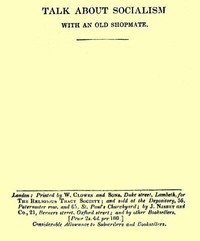
TALK ABOUT SOCIALISM
WITH AN OLD SHOPMATE.
* * * * *
THE RELIGIOUS TRACT SOCIETY, INSTITUTED 1799.
56, PATERNOSTER ROW, AND 65, ST. PAUL’S CHURCHYARD.
THINKS I to myself the other sabbath afternoon, as I sat alone with my
Bible before me—thinks I to myself, that was a comforting text in God’s
holy word that our minister preached from this morning; “All things work
together for good to them that love God:” and a capital sermon it was,
too, that he gave us; for though it cut me to the heart on account of my
sins, it brought the tears into my eyes, on account of God’s mercy and
grace.
Well, I read the chapter that the text was taken from all to myself; for
my Nancy was gone to public worship, and I was left to take care of the
house, and our little Mary, and the young one in the cradle. The house
was clean and tidy, and everything was quiet, and I felt happy like.
Trust me for having as many cares as my neighbours; a poor man ought not
to expect to be without them, nor, for the matter of that, a rich man
neither: but I felt happy, and though I said nothing, my heart thanked
God.
Thinks I to myself, we are bad enough as it is; ay, the very best of us;
but if places of worship were to be shut up, and we had no ministers to
preach to us, and had no Bibles to read, we should be a deal worse than
we are: and this set me a thinking about the blessing of the sabbath day,
and the comfort of prayer, and the peace of mind there is in thinking of
the salvation of Christ, and the promises of God. Not that I can always
get the comfort from them as I could wish, for I am a poor ignorant
creature, and the turn of a straw is enough, at times, to turn my
thoughts from good things to bad. But I felt, as I said, happy like in
the quietness that a God fearing man enjoys on the sabbath day, and in
the peace of that religion in which my dear father and mother before me
had lived and died; and I was determined, with God’s help, to stick to
it, while I had any breath in my body. Thinks I, there is many of us
that have sadly stood in our own light, in neglecting the sabbath and
holy things. What fools we are to cheat ourselves as we do! When we run
after our follies, the jack o’ lanterns that dance before us, and lead us
astray, no wonder that we get into the mire; “but they that wait upon the
Lord shall renew their strength; they shall mount up with wings as
eagles; they shall run, and not be weary; and they shall walk, and not
faint,” Isaiah xl. 31.
As I sat musing in this way over my Bible, the door-way was darkened a
little, all on a sudden; so I lifted up my head, and there I saw Tom
Fletcher with a lot of books in his hand.
Tom was once a shopmate of mine; and, though I never took him to be a
very wise man, nor over bright in his upper story, yet, for all that, he
was better than many. He had brought his books on purpose to talk to me
about them. In a minute or two we were in the thick of them.
Says he, “I have not seen you for some time; and since you and I met, I
have joined the Socialists.” “Joined who?” says I. “Why,” says he, “the
Socialists;” and with that he told me all about it. By his account it
seemed that the world had been going round the wrong way ever since it
was made, but the Socialists were going to put matters to rights again.
“Just shut up your Bible,” says he, “and I will show you my books.”
Now I had heard of the Socialists before, and as I had not the best
opinion of them, I thought my Bible quite as good, and a pretty deal
better than their books. “Tom,” says I, “a bird in the hand is worth two
in the bush. If I shut my Bible, you are not likely to open as good a
book, I have a notion; so we had better let well alone.” But Tom was
very pressing; and so, putting his books on the table, he began to tell
me, that the Socialists had no object in the world but the good of
mankind; that everything had been for ages, and now was, all sixes and
sevens; and that matters were not likely to be mended, till, burning our
Bibles, and putting aside religion, and all our other fanciful notions,
we became Socialists.
Thinks I to myself, Great cry and little wool, Tom; but as I had never
looked into any of the books of the Socialists, I picked up the one that
lay at the top, and turned over a few pages, dipping here and there.
I suppose the colour came into my cheeks; for Tom looked hard at me.
“Tom,” says I, “if so be that I haven’t been walking on my head instead
of my heels all the days of my life, and if I know black from white, why
then this book of yours is an indecent and abominable book, that I should
be ashamed to put into any body’s hand. Is it possible that Tom
Fletcher, my old shopmate, can hold—” “Oh,” says Tom, looking as sharp
as a hawk at the book in my hand, “oh,” says he, “I didn’t mean you to
see that! I thought I had put that number a one side. I don’t hold
exactly with it.” “Don’t hold exactly with it!” says I; “why it’s no
more fit to be touched than a tarred stick. If the rest of your books
are like it, a precious lot they must be altogether.”
Tom looked a little queerish, as if he was ashamed of the book and of
himself too. Thinks I to myself, Now’s my time to have a rap at him; for
though I feel kindly to him, yet as he seems to want it, a rap on the
knuckles mayhap will do him good.
“And so, Tom,” says I, “this is one of the books of the Socialists, is
it? One of the books that you want to recommend to me? Now tell me if
you really think in your heart and conscience that that book is fit to be
read by anybody?”
Tom looked first one way, then another; he was all abroad. At last, says
he, “I meant to burn that book.” “Glad to hear it,” says I; so taking up
the book, with his consent, I poked it between the bars of the grate, and
a rare blaze it made, flaring half way up to the mantel piece, giving
more light to the world than it had ever done before, or ever would have
done in any other way.
Says I to Tom, when the filthy book was burned, says I, “Tom, when a man
goes to market to buy a cheese, and the cheesemonger pushes in his borer
that he may taste it, if he doesn’t like the bit that he bores out, it
sets him against the whole cheese; for he naturally expects that one is
like the other. Now it is just the same with your books: birds of a
feather, you know, flock together; and as one of them has turned out to
be a black crow, I hardly expect to find the rest of ’em to be white
pigeons.”
Well, I took up all his books, one after another: some things in them I
did understand and some I did’nt; for there was so much about
_impressions_, and _principles_, and _institutions_, and _propensities_
and _organizations_ that it flustered me. It was clear that a longer
head than mine had been concerned in getting ’em up; so all that I could
do was to try to get at some of the marrow of them here and there.
I’m not over clever at book learning, but still I had gumption enough to
make out a few points that settled my opinion about Socialism. I saw, or
thought I saw, that the god of the Socialists was only a “Cause of all
existences;” that he never troubled his head about us, and that we ought
never to trouble our heads about him. That, in fact, there was no such
God, in the Socialists’ opinion, as the gracious Almighty Being whom
Christians worship.
I saw, too, that Socialists believed the Bible to be a lie, trumped up to
keep silly people in bondage: that marriage was considered “the greatest
crime against nature,” that ought to be done away with; that theft,
adultery, blasphemy, and murder were no crimes, for man was “not a
responsible being;” he was “neither to be blamed or praised, rewarded or
punished for either his thoughts, feelings, or actions;” that death was
“simply a change of one organization for another;” and that the Christian
notions of hell, heaven, and hereafter were all a bag full of moonshine.
Now it grieved me that an old shopmate of mine should have tumbled into
such a bog hole as Socialism; but thinks I, mayhap, after all, he has
only been led out of the way by sharper fellows than himself, and doesn’t
above half believe the juggling claptraps that are printed in his books;
so I said to him, “Tom, look at me and answer me this question, Do you
believe that there is a God?” Tom blinked, and shuffled, and stammered,
and opened one of the books and read a bit about “nature,” and a “first
cause,” and “a general principle,” and a “supreme power,” and “an
external cause of all existence,” and an “all pervading cause of motion
and change;” but I stopped him at once.
“Tom,” said I, “you may spare yourself the trouble of running over that
long rigmarole; for I’m not to have dust flung in my eyes in that way. I
do not want to know what _your book says_, but what _you believe_; so
answer my question. A handful of good grain is better than a bushel of
chaff, and a yes or a no can be understood by any body. Do you believe
that there is a gracious and merciful God, that you are bound to fear and
to love with all your heart, with all your mind, with all your soul, and
with all your strength, to worship him, to give him thanks, to put your
whole trust in him, to call upon him, to honour his holy name and his
word, and to serve him truly all the days of your life?”
I saw that whether Tom said yes or no, it was all one, for he didn’t know
which to say. It suited him better to read to me out of his books than
it did to answer my questions; but I asked him another question. “Tom,”
says I, “do you really believe that the Bible is a lie? You don’t doubt
the history of England, the history of Rome, and the history of Greece,
and these have never been kept with half the care, nor gone through a
tenth part of the sifting that the Bible has. Do you really believe that
the Bible is a lie?” Tom had not the boldness to say that he did; and I
felt sure in my heart that he did not think it was. “Tom,” says I, “are
you so far gone as to think that marriage is a foolish and wicked
institution? I thought your sister was going to be married; is it all
off, then, or is she to disgrace you and her family?”
This question twisted Tom as much as the last, and I saw that I was about
as likely to get a badger out of his hole, as to get an answer from him.
“Well,” says I, “Tom, I’ll say nothing about your sister, if its
disagreeable, but ask you another question instead. Have you so little
uprightness left in your deceived heart as to suppose that theft,
adultery, blasphemy, and murder are no reproach to a man; and that any
one may set up the trade of a robber on the highway, and justify himself
by saying that he cannot help it, for ‘his character is formed for him by
circumstances?’”
Tom was not at all staunch; he did not stick up like one that believes
and has confidence in what he says. “Tom,” says I, “t’other day a loaded
cart was standing in the road half way up Gravelly Hill, with the wheels
scotched, when a mischievous lad knocked the stones from under the
wheels, and away went the loaded cart, over his foot, rattling down the
hill, clearing every thing before it. The young urchin was half
frightened out of his wits; he set the cart off easily enough, but not
the whole neighbourhood could stop it. Now I take it, Tom, that the
young rapscallion played just the same game as the Socialists are
playing, with this difference, that the wheel of the cart only went over
his toes, whereas the mischief that the Socialists are setting on foot
will in the long run, go over their own necks.”
Tom kept fumbling at his books, not knowing what to be at. He wanted
somebody to back him. He believed his books just as much, and no more,
than he would have believed any other tale of a tub, told him by a
cleverer fellow than himself.
“Tom,” says I, “when a man once turns his back upon God, there is no
folly and no sin that he may not be led to commit. You have gone a long
way, and I’m sorry for it; but I hardly think you are gone as far as your
famous books will take you. Speak up now like a man, and tell me, have
you been fooled into the belief that there is no hereafter?—no hell, and
no heaven?”
At this Tom looked like any thing but a conjurer. At length he said that
if I would read more of his books I should understand them better than I
did.
“Read your books, Tom!” says I, “I should just as soon think of taking a
dose of arsenic. A pretty deal rather had I walk barefoot through Boxley
Bog, and many a better man than me has been stuck fast there,—a pretty
deal rather had I do that, than turn Socialist. If I wanted to be worse
than I am, to deprive myself of all hope, and to plunge myself into
despair, I couldn’t do a better thing than read your trumpery; but as it
is, I will have nothing to do with it. Tom,” says I, “you are no fool in
driving a bargain: you would not be persuaded to exchange a quartern loaf
for a handful of sawdust. Now Socialism takes away from a Christian man
the Bible that comforts him, the sabbath that is his delight, the God
that he worships, the Saviour that died for him, and the heaven that he
hopes for: tell me, then, Tom, what does it give him in return?”
If ever poor fellow was confounded, it was Tom Fletcher. Had he been
sitting on a furze bush, he could hardly have been more fidgetty. He got
out a few words, but they were very scarce and a long way apart; and as
he could’nt well put ’em together, no wonder that I can’t.
Well, I had only been firing at him, as it were, a pop, now and then,
from a long way off, but now I was determined to bear upon him all at
once.
“It isn’t for me, Tom,” says I, “that am not what I ought to be by a
great deal—it isn’t for me, knowing as I do a little of the wickedness of
my own heart, to deal out fire and brimstone against my fellow sinners,
and to pretend that I am white as snow and they as black as soot; but for
all that, Tom, we may be too tender with one another. If I see an adder
lying in a thoroughfare where he may sting the passer by, I’m bound to
disable him; and if I see a mad dog, foaming at the mouth, running
through the crowded street, I’m bound, if I can, to kill him. Now the
adder and the mad dog are not likely to do half the mischief that your
books are, and therefore I hold up both my hands, and cry out aloud
against them.
“Look you,” says I, “Tom, there lies the Bible. It condemns every thing
that is evil, even every sinful thought, and upholds every thing that is
good. It teaches me to fear God, and to love my neighbour; and tells me,
sinner as I am, that there is mercy for me through Jesus Christ who died
for sinners. It gives me comfort in life, it promises me support in
death, and holds up before me the bright prospect of a happy eternity;
and it has done this for thousands who have left this world in peace, and
who are now, as I believe, in a world of glory.
“And there, Tom, be your wretched books, which tell me, that is, if I at
all understand them, that there is no God; that the Bible is a lie; that
marriage is a foolish institution; that men ought to live just as they
think proper; that theft, adultery, blasphemy and murder are no crimes;
that there is neither hell nor heaven; and that it is idle to dream of a
hereafter.
“If I know my own heart, Tom, or even any part of it, I wouldn’t
knowingly say a cruel thing of a butcher’s dog; but this I will say, that
I should as soon expect to be taught manners by a Hottentot, cleanliness
by a sweep, honesty by a highwayman, and godliness by a heathen, as to be
made either wiser, better, holier, or happier by having any thing to do
with Socialism. But what says that book? ‘The grace of God that
bringeth salvation hath appeared to all men, teaching us that, denying
ungodliness and worldly lusts, we should live soberly, righteously, and
godly, in this present world; looking for that blessed hope, and the
glorious appearing of the great God and our Saviour Jesus Christ; who
gave himself for us, that he might redeem us from all iniquity, and
purify unto himself a peculiar people, zealous of good works,’ Titus ii.
11–14.”
Never did a poor fellow caught in the fact of robbing a hen-roost, slink
away in a more humble, chopfallen spirit than poor Tom Fletcher did.
Whether he will ever bring me another batch of his Socialism books or
not, I can’t tell; but if he does, the first question that I shall ask
him will be this, What have you got to offer me in exchange for the
consolations of my Bible, the comfort of prayer, the peace of the
sabbath, the goodness of God, the mercy of the Redeemer, and the
never-ending joys of heaven? And never till he gives me something like a
reasonable answer will I ever open another of his books on Socialism.
* * * * *
HYMN.
GOD, in the gospel of his Son,
Makes his eternal counsels known;
’Tis here his richest mercy shines,
And truth is drawn in fairest lines.
Here sinners of an humble frame,
May taste his grace and learn his name;
’Tis writ in characters of blood,
Severely just, immensely good.
Wisdom its dictates here imparts,
To form our minds, to cheer our hearts;
Its influence makes the sinner live,
It bids the drooping saint revive.
Our raging passions it controls,
And comfort yields to contrite souls;
It brings a better world in view,
And guides us all our journey through.
May this bless’d volume ever lie
Close to my heart, and near my eye,
Till life’s last hour my soul engage,
And be my chosen heritage!
* * * * *
* * * * *
_London_: _Printed by_ W. CLOWES _and_ SONS, _Duke street_, _Lambeth_,
_for_ THE RELIGIOUS TRACT SOCIETY; _and told at the Depository_, 56,
_Paternoster row_, _and_ 65, _St. Paul’s Churchyard_; _by_ J. NISBET
_and_ Co., 21, _Berners street_, _Oxford street_;_ and by other
Booksellers_.
[_Price_ 2_s._ 4_d._ _per_ 100]
_Considerable Allowance to Subscribers and Booksellers_.
*** END OF THE PROJECT GUTENBERG EBOOK TALK ABOUT SOCIALISM WITH AN OLD SHOPMATE ***
Updated editions will replace the previous one—the old editions will
be renamed.
Creating the works from print editions not protected by U.S. copyright
law means that no one owns a United States copyright in these works,
so the Foundation (and you!) can copy and distribute it in the United
States without permission and without paying copyright
royalties. Special rules, set forth in the General Terms of Use part
of this license, apply to copying and distributing Project
Gutenberg™ electronic works to protect the PROJECT GUTENBERG™
concept and trademark. Project Gutenberg is a registered trademark,
and may not be used if you charge for an eBook, except by following
the terms of the trademark license, including paying royalties for use
of the Project Gutenberg trademark. If you do not charge anything for
copies of this eBook, complying with the trademark license is very
easy. You may use this eBook for nearly any purpose such as creation
of derivative works, reports, performances and research. Project
Gutenberg eBooks may be modified and printed and given away—you may
do practically ANYTHING in the United States with eBooks not protected
by U.S. copyright law. Redistribution is subject to the trademark
license, especially commercial redistribution.
START: FULL LICENSE
THE FULL PROJECT GUTENBERG LICENSE
PLEASE READ THIS BEFORE YOU DISTRIBUTE OR USE THIS WORK
To protect the Project Gutenberg™ mission of promoting the free
distribution of electronic works, by using or distributing this work
(or any other work associated in any way with the phrase “Project
Gutenberg”), you agree to comply with all the terms of the Full
Project Gutenberg™ License available with this file or online at
www.gutenberg.org/license.
Section 1. General Terms of Use and Redistributing Project Gutenberg™
electronic works
1.A. By reading or using any part of this Project Gutenberg™
electronic work, you indicate that you have read, understand, agree to
and accept all the terms of this license and intellectual property
(trademark/copyright) agreement. If you do not agree to abide by all
the terms of this agreement, you must cease using and return or
destroy all copies of Project Gutenberg™ electronic works in your
possession. If you paid a fee for obtaining a copy of or access to a
Project Gutenberg™ electronic work and you do not agree to be bound
by the terms of this agreement, you may obtain a refund from the person
or entity to whom you paid the fee as set forth in paragraph 1.E.8.
1.B. “Project Gutenberg” is a registered trademark. It may only be
used on or associated in any way with an electronic work by people who
agree to be bound by the terms of this agreement. There are a few
things that you can do with most Project Gutenberg™ electronic works
even without complying with the full terms of this agreement. See
paragraph 1.C below. There are a lot of things you can do with Project
Gutenberg™ electronic works if you follow the terms of this
agreement and help preserve free future access to Project Gutenberg™
electronic works. See paragraph 1.E below.
1.C. The Project Gutenberg Literary Archive Foundation (“the
Foundation” or PGLAF), owns a compilation copyright in the collection
of Project Gutenberg™ electronic works. Nearly all the individual
works in the collection are in the public domain in the United
States. If an individual work is unprotected by copyright law in the
United States and you are located in the United States, we do not
claim a right to prevent you from copying, distributing, performing,
displaying or creating derivative works based on the work as long as
all references to Project Gutenberg are removed. Of course, we hope
that you will support the Project Gutenberg™ mission of promoting
free access to electronic works by freely sharing Project Gutenberg™
works in compliance with the terms of this agreement for keeping the
Project Gutenberg™ name associated with the work. You can easily
comply with the terms of this agreement by keeping this work in the
same format with its attached full Project Gutenberg™ License when
you share it without charge with others.
1.D. The copyright laws of the place where you are located also govern
what you can do with this work. Copyright laws in most countries are
in a constant state of change. If you are outside the United States,
check the laws of your country in addition to the terms of this
agreement before downloading, copying, displaying, performing,
distributing or creating derivative works based on this work or any
other Project Gutenberg™ work. The Foundation makes no
representations concerning the copyright status of any work in any
country other than the United States.
1.E. Unless you have removed all references to Project Gutenberg:
1.E.1. The following sentence, with active links to, or other
immediate access to, the full Project Gutenberg™ License must appear
prominently whenever any copy of a Project Gutenberg™ work (any work
on which the phrase “Project Gutenberg” appears, or with which the
phrase “Project Gutenberg” is associated) is accessed, displayed,
performed, viewed, copied or distributed:
This eBook is for the use of anyone anywhere in the United States and most
other parts of the world at no cost and with almost no restrictions
whatsoever. You may copy it, give it away or re-use it under the terms
of the Project Gutenberg License included with this eBook or online
at www.gutenberg.org. If you
are not located in the United States, you will have to check the laws
of the country where you are located before using this eBook.
1.E.2. If an individual Project Gutenberg™ electronic work is
derived from texts not protected by U.S. copyright law (does not
contain a notice indicating that it is posted with permission of the
copyright holder), the work can be copied and distributed to anyone in
the United States without paying any fees or charges. If you are
redistributing or providing access to a work with the phrase “Project
Gutenberg” associated with or appearing on the work, you must comply
either with the requirements of paragraphs 1.E.1 through 1.E.7 or
obtain permission for the use of the work and the Project Gutenberg™
trademark as set forth in paragraphs 1.E.8 or 1.E.9.
1.E.3. If an individual Project Gutenberg™ electronic work is posted
with the permission of the copyright holder, your use and distribution
must comply with both paragraphs 1.E.1 through 1.E.7 and any
additional terms imposed by the copyright holder. Additional terms
will be linked to the Project Gutenberg™ License for all works
posted with the permission of the copyright holder found at the
beginning of this work.
1.E.4. Do not unlink or detach or remove the full Project Gutenberg™
License terms from this work, or any files containing a part of this
work or any other work associated with Project Gutenberg™.
1.E.5. Do not copy, display, perform, distribute or redistribute this
electronic work, or any part of this electronic work, without
prominently displaying the sentence set forth in paragraph 1.E.1 with
active links or immediate access to the full terms of the Project
Gutenberg™ License.
1.E.6. You may convert to and distribute this work in any binary,
compressed, marked up, nonproprietary or proprietary form, including
any word processing or hypertext form. However, if you provide access
to or distribute copies of a Project Gutenberg™ work in a format
other than “Plain Vanilla ASCII” or other format used in the official
version posted on the official Project Gutenberg™ website
(www.gutenberg.org), you must, at no additional cost, fee or expense
to the user, provide a copy, a means of exporting a copy, or a means
of obtaining a copy upon request, of the work in its original “Plain
Vanilla ASCII” or other form. Any alternate format must include the
full Project Gutenberg™ License as specified in paragraph 1.E.1.
1.E.7. Do not charge a fee for access to, viewing, displaying,
performing, copying or distributing any Project Gutenberg™ works
unless you comply with paragraph 1.E.8 or 1.E.9.
1.E.8. You may charge a reasonable fee for copies of or providing
access to or distributing Project Gutenberg™ electronic works
provided that:
• You pay a royalty fee of 20% of the gross profits you derive from
the use of Project Gutenberg™ works calculated using the method
you already use to calculate your applicable taxes. The fee is owed
to the owner of the Project Gutenberg™ trademark, but he has
agreed to donate royalties under this paragraph to the Project
Gutenberg Literary Archive Foundation. Royalty payments must be paid
within 60 days following each date on which you prepare (or are
legally required to prepare) your periodic tax returns. Royalty
payments should be clearly marked as such and sent to the Project
Gutenberg Literary Archive Foundation at the address specified in
Section 4, “Information about donations to the Project Gutenberg
Literary Archive Foundation.”
• You provide a full refund of any money paid by a user who notifies
you in writing (or by e-mail) within 30 days of receipt that s/he
does not agree to the terms of the full Project Gutenberg™
License. You must require such a user to return or destroy all
copies of the works possessed in a physical medium and discontinue
all use of and all access to other copies of Project Gutenberg™
works.
• You provide, in accordance with paragraph 1.F.3, a full refund of
any money paid for a work or a replacement copy, if a defect in the
electronic work is discovered and reported to you within 90 days of
receipt of the work.
• You comply with all other terms of this agreement for free
distribution of Project Gutenberg™ works.
1.E.9. If you wish to charge a fee or distribute a Project
Gutenberg™ electronic work or group of works on different terms than
are set forth in this agreement, you must obtain permission in writing
from the Project Gutenberg Literary Archive Foundation, the manager of
the Project Gutenberg™ trademark. Contact the Foundation as set
forth in Section 3 below.
1.F.
1.F.1. Project Gutenberg volunteers and employees expend considerable
effort to identify, do copyright research on, transcribe and proofread
works not protected by U.S. copyright law in creating the Project
Gutenberg™ collection. Despite these efforts, Project Gutenberg™
electronic works, and the medium on which they may be stored, may
contain “Defects,” such as, but not limited to, incomplete, inaccurate
or corrupt data, transcription errors, a copyright or other
intellectual property infringement, a defective or damaged disk or
other medium, a computer virus, or computer codes that damage or
cannot be read by your equipment.
1.F.2. LIMITED WARRANTY, DISCLAIMER OF DAMAGES - Except for the “Right
of Replacement or Refund” described in paragraph 1.F.3, the Project
Gutenberg Literary Archive Foundation, the owner of the Project
Gutenberg™ trademark, and any other party distributing a Project
Gutenberg™ electronic work under this agreement, disclaim all
liability to you for damages, costs and expenses, including legal
fees. YOU AGREE THAT YOU HAVE NO REMEDIES FOR NEGLIGENCE, STRICT
LIABILITY, BREACH OF WARRANTY OR BREACH OF CONTRACT EXCEPT THOSE
PROVIDED IN PARAGRAPH 1.F.3. YOU AGREE THAT THE FOUNDATION, THE
TRADEMARK OWNER, AND ANY DISTRIBUTOR UNDER THIS AGREEMENT WILL NOT BE
LIABLE TO YOU FOR ACTUAL, DIRECT, INDIRECT, CONSEQUENTIAL, PUNITIVE OR
INCIDENTAL DAMAGES EVEN IF YOU GIVE NOTICE OF THE POSSIBILITY OF SUCH
DAMAGE.
1.F.3. LIMITED RIGHT OF REPLACEMENT OR REFUND - If you discover a
defect in this electronic work within 90 days of receiving it, you can
receive a refund of the money (if any) you paid for it by sending a
written explanation to the person you received the work from. If you
received the work on a physical medium, you must return the medium
with your written explanation. The person or entity that provided you
with the defective work may elect to provide a replacement copy in
lieu of a refund. If you received the work electronically, the person
or entity providing it to you may choose to give you a second
opportunity to receive the work electronically in lieu of a refund. If
the second copy is also defective, you may demand a refund in writing
without further opportunities to fix the problem.
1.F.4. Except for the limited right of replacement or refund set forth
in paragraph 1.F.3, this work is provided to you ‘AS-IS’, WITH NO
OTHER WARRANTIES OF ANY KIND, EXPRESS OR IMPLIED, INCLUDING BUT NOT
LIMITED TO WARRANTIES OF MERCHANTABILITY OR FITNESS FOR ANY PURPOSE.
1.F.5. Some states do not allow disclaimers of certain implied
warranties or the exclusion or limitation of certain types of
damages. If any disclaimer or limitation set forth in this agreement
violates the law of the state applicable to this agreement, the
agreement shall be interpreted to make the maximum disclaimer or
limitation permitted by the applicable state law. The invalidity or
unenforceability of any provision of this agreement shall not void the
remaining provisions.
1.F.6. INDEMNITY - You agree to indemnify and hold the Foundation, the
trademark owner, any agent or employee of the Foundation, anyone
providing copies of Project Gutenberg™ electronic works in
accordance with this agreement, and any volunteers associated with the
production, promotion and distribution of Project Gutenberg™
electronic works, harmless from all liability, costs and expenses,
including legal fees, that arise directly or indirectly from any of
the following which you do or cause to occur: (a) distribution of this
or any Project Gutenberg™ work, (b) alteration, modification, or
additions or deletions to any Project Gutenberg™ work, and (c) any
Defect you cause.
Section 2. Information about the Mission of Project Gutenberg™
Project Gutenberg™ is synonymous with the free distribution of
electronic works in formats readable by the widest variety of
computers including obsolete, old, middle-aged and new computers. It
exists because of the efforts of hundreds of volunteers and donations
from people in all walks of life.
Volunteers and financial support to provide volunteers with the
assistance they need are critical to reaching Project Gutenberg™’s
goals and ensuring that the Project Gutenberg™ collection will
remain freely available for generations to come. In 2001, the Project
Gutenberg Literary Archive Foundation was created to provide a secure
and permanent future for Project Gutenberg™ and future
generations. To learn more about the Project Gutenberg Literary
Archive Foundation and how your efforts and donations can help, see
Sections 3 and 4 and the Foundation information page at www.gutenberg.org.
Section 3. Information about the Project Gutenberg Literary Archive Foundation
The Project Gutenberg Literary Archive Foundation is a non-profit
501(c)(3) educational corporation organized under the laws of the
state of Mississippi and granted tax exempt status by the Internal
Revenue Service. The Foundation’s EIN or federal tax identification
number is 64-6221541. Contributions to the Project Gutenberg Literary
Archive Foundation are tax deductible to the full extent permitted by
U.S. federal laws and your state’s laws.
The Foundation’s business office is located at 809 North 1500 West,
Salt Lake City, UT 84116, (801) 596-1887. Email contact links and up
to date contact information can be found at the Foundation’s website
and official page at www.gutenberg.org/contact
Section 4. Information about Donations to the Project Gutenberg
Literary Archive Foundation
Project Gutenberg™ depends upon and cannot survive without widespread
public support and donations to carry out its mission of
increasing the number of public domain and licensed works that can be
freely distributed in machine-readable form accessible by the widest
array of equipment including outdated equipment. Many small donations
($1 to $5,000) are particularly important to maintaining tax exempt
status with the IRS.
The Foundation is committed to complying with the laws regulating
charities and charitable donations in all 50 states of the United
States. Compliance requirements are not uniform and it takes a
considerable effort, much paperwork and many fees to meet and keep up
with these requirements. We do not solicit donations in locations
where we have not received written confirmation of compliance. To SEND
DONATIONS or determine the status of compliance for any particular state
visit www.gutenberg.org/donate.
While we cannot and do not solicit contributions from states where we
have not met the solicitation requirements, we know of no prohibition
against accepting unsolicited donations from donors in such states who
approach us with offers to donate.
International donations are gratefully accepted, but we cannot make
any statements concerning tax treatment of donations received from
outside the United States. U.S. laws alone swamp our small staff.
Please check the Project Gutenberg web pages for current donation
methods and addresses. Donations are accepted in a number of other
ways including checks, online payments and credit card donations. To
donate, please visit: www.gutenberg.org/donate.
Section 5. General Information About Project Gutenberg™ electronic works
Professor Michael S. Hart was the originator of the Project
Gutenberg™ concept of a library of electronic works that could be
freely shared with anyone. For forty years, he produced and
distributed Project Gutenberg™ eBooks with only a loose network of
volunteer support.
Project Gutenberg™ eBooks are often created from several printed
editions, all of which are confirmed as not protected by copyright in
the U.S. unless a copyright notice is included. Thus, we do not
necessarily keep eBooks in compliance with any particular paper
edition.
Most people start at our website which has the main PG search
facility: www.gutenberg.org.
This website includes information about Project Gutenberg™,
including how to make donations to the Project Gutenberg Literary
Archive Foundation, how to help produce our new eBooks, and how to
subscribe to our email newsletter to hear about new eBooks.