Produced by Stephen Hutcheson and the Online Distributed
Proofreading Team at http://www.pgdp.net
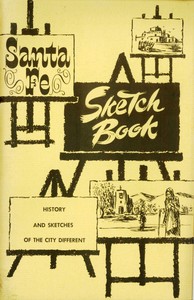
Santa Fe Sketch Book
HISTORY
AND SKETCHES
OF THE CITY DIFFERENT
Santa Fe Sketch Book
[Illustration: Sketches]
Published by Ewen Enterprises
Santa Fe Plaza
[Illustration: Santa Fe Plaza]
During the 1600's, the Santa Fe Plaza extended to the approximate
position of the present Cathedral.
All official, religious, and military functions of Santa Fe took place
in the Plaza, around which were the government buildings, the jail,
customs house and the residences of prominent citizens. The center of
the Plaza was a market place and the scene of social meetings, fiestas,
and cock fights and also the location of the public stock and flogging
post.
In 1884 Governor Martinez de Lejanza erected a wooden bullring in the
Plaza but it was torn down a few months later after it had served as an
ambush for the Ute Indians who attempted an attack on the Palace and the
Governor. It was in the Plaza that the Pueblo Indians revolted against
the Spanish rule in 1680; it was here they capitulated to General Don
Diego De Vargas in 1693. The Plaza was also the end of the Old Santa Fe
Trail from Missouri and El Camino Real from Chihuahua.
[Illustration: Artist on bench.]
The Cathedral of St. Francis
[Illustration: The Cathedral of St. Francis]
The Cathedral of St. Francis stands prominent at the east end of San
Francisco Street in Santa Fe. Long a dream of world famous Archbishop
John B. Lamy, the Cathedral became a reality (1869-1886). The bishop
himself chose the unusual stone and because certain pioneer Santa Fe
merchants were so helpful with time and money, he allowed a stone marked
with the Star of David to be placed in the center arch of the main
doorway.
As a commemoration of the Reconquest, and to honor the vow of De Vargas
in 1693, a yearly procession carries the wooden statue of the Saint La
Conquistadora to the Rosario Chapel, and back, from the Cathedral.
[Illustration: Spanish friar and soldiers]
[Illustration: Museum of Navajo Ceremonial Art]
Like Santa Fe is "different", so are its museums. The Museum of Navajo
Ceremonial Art, conceived and founded in 1937 by Miss Mary Cabot
Wheelright, serves to preserve the art, culture and religion of the
Navajo Indian race. Most famous are the sand paintings.
[Illustration: Museum of International Folk Art]
The Museum of International Folk Art displays, exhibits, holds lectures
and demonstrates folk art and crafts from many countries and regions of
the world.
This cluster of distinctive buildings are located off the old Santa Fe
Trail.
[Illustration: Laboratory of Anthropology]
Another unit of the museums of New Mexico is the Laboratory of
Anthropology. Primarily a research center, the museum houses a
collection of Indian pottery, textiles and jewelry.
The San Miguel Chapel
[Illustration: The San Miguel Chapel]
THE OLDEST CHURCH STILL IN USE IN THE U.S. IS THE SAN MIGUEL CHAPEL. One
can feel the original adobe altar, walls and floor of this structure
built in 1610 by the Tlaxcala Indians under the direction of the
Franciscan Padres.
Restored, and hanging in the church are many fine old paintings, Icons
and excellent wood carvings.
The oldest bell in USA is there for anyone to touch and ring. The
six-hundred-year old bell was brought from Spain having been cast in
1356. The casting contains silver and gold from the jewelry, rings and
necklaces of the faithful from the village of San Jose, Andalucia,
Spain. A Santa Fean, Senora Loreta Baca Ortiz, ordered the famous bell
to be brought to San Miguel Chapel in 1712.
[Illustration: Chapel bell]
Sena Plaza
[Illustration: Now a series of quaint shops, the original Sena Plaza
was the house of the Don Jose' Sena family. The family occupied this
vast structure with main house, coach house, stable, chicken house
and servants quarters; all around an interesting central patio.]
Sena Plaza Courtyard
[Illustration: Sena Plaza Courtyard]
[Illustration: Fine Arts Building of the Museum of New Mexico]
Note the inspiring flowing style of the FINE ARTS MUSEUM, on the Plaza
in Santa Fe. The massive facade has six of the ancient Franciscan
mission churches reproduced; all without destroying the unity of its
appearance. They are: Acoma, San Felipe, Cochiti, Laguna, Santa Ana and
Pecos.
A central patio has shady cloisters, carved corbels and primitive
pillars and vigas.
Other historical and architectural features include the ceilings,
floors, benches, carvings of the grills, the reproduction of the doors
of Santa Clara and the Needle's Eye, along with the great painting of
St. Francis--all truly a work of art to display great art treasure.
[Illustration: Museum Courtyard]
Cross of The Martyrs
[Illustration: High upon a hill overlooking Santa Fe is the CROSS OF
THE MARTYRS, erected in honor of the twenty-one Franciscan Padres
who died at the hands of the Indians on August 10, 1680.]
New Mexico State Capitol
[Illustration: Towering high over the State Capitol building complex
of Texas Territorian style is this unique tower.]
Canyon Road
[Illustration: Almost every house is historic, and each one houses
either a craftsman or a well known artist, or a shop; along this
world-known road that is called Canyon Road in Santa Fe. Originally
an Indian trail leading to the Pueblo of Pecos.]
El Zaguan on Canyon Road
[Illustration: El Zaguan]
El Zaguan the charming old hacienda with the long passageway from the
house-to-the-patio-to-the-garden. A garden laid out by Adolph Bandelier
with peony bushes and horse-chestnut trees over 100 years old.
Originally the James L. Johnson place in 1849, it became 24 rooms with a
private chapel and a "chocolate room".
Santa Fe Ski Basin
[Illustration: Within a mere 20 minutes from the Santa Fe Plaza you
ski at 11,000 feet altitude in dry crisp air on a carpet of powdered
snow which is often 5 to 10 feet deep. The Ski Basin is a "top" ski
center with all modern facilities.]
Santa Fe Opera
[Illustration: Totally opposite to the expected, in Santa Fe, is the
Internationally famous Opera under the stars in a fabulous mountain
setting. The setting, the costumes, the performers, the music--all
leave you spellbound with admiration ... and all this in Santa Fe!]
Miraculous Stairway
[Illustration: It is said that a carpenter, who must have been a
Saint, built the "Miraculous Stairway" at Our Lady of Light Chapel
in Santa Fe. The carpenter used no nails in this stairway with no
visible means of support--then he disappeared and has not been heard
from since.]
[Illustration: Our Lady of Light Chapel which houses the Miraculous
Stairway.]
El Cristo Rey
[Illustration: El Cristo Rey]
Over 200,000 hand-made mud bricks were used to build the imposing Cristo
Rey Church in Santa Fe. Housed within is the stone reredos, which were
originally commissioned by Gov. Marin del Valle in 1760.
Massive on the outside, the interior is elegant in extreme detail.
[Illustration: Courtyard of the Donaciano Vigil House]
This hidden courtyard has unusual charm acquired with age. It is part of
the original Donaciano Vigil house of the 1830's. Vigil was Secretary to
Gov. Manuel Armijo during the Mexican regime, as Secretary of New Mexico
under Gov. Kearney in 1846, and later as Civil Governor among other
prominent positions.
The Palace of the Governors
[Illustration: The Palace of the Governors]
Stately and historic, the Palace of the Governors on the Plaza in old
Santa Fe was part of extensive Casa Reales as constructed in 1610-12 as
the larger portion of a fortress and house of government for the Kingdom
of New Mexico under Spanish rule.
Now, officially the Museum of New Mexico, it houses a magnificent
collection of early Spanish and Indian artifacts and The Hall of the
Modern Indian, to the rear of the patio, has an entire Pueblo
reconstruction.
These venerable walls housed the governments of the Pueblo Indians from
1680 to the DeVargas Reconquest, the Spanish Empire 1610-1680 and
1693-1821; The Empire of Mexico 1821-1822; the Republic of Mexico
1823-1846; the U.S. Territory of New Mexico 1846-1900, and for a short
time in 1862 for the U.S. Confederate Army.
[Illustration: Under The Portal]
The wide, long, Portal of the Palace of the Governors where the Pueblo
Indians display and sell their crafts.
[Illustration: Chapel of Archbishop Lamy]
The Bishop's Chapel, north of Santa Fe, built for Archbishop John Lamy,
and featured in the book, "Death Comes for the Archbishop" by Willa
Cather.
Restful beauty immortalizing the man and his mission.
[Illustration: St. John's College]
St. John's College, in Santa Fe, the western campus of the parent 238
year old Annapolis, Md. College of great high learning. St. John's
offers a rare adventure in liberal education to ambitious young men and
women.
[Illustration: Santa Fe Preparatory School]
The headmaster of the Santa Fe Preparatory School explains that this
outstanding prep. school offers grades 7, 8, 9, 10 and later 11 and 12
for solid basic preparatory education for both boys and girls.
[Illustration: St. Michael's College]
Dynamic growing St. Michael's College on the south end of Santa Fe,
founded by the Brothers of the Christian Schools. St. Michael's is open
to male students seeking B.A., B.B.A. and B.S. Degrees, plus a
professional curricula in engineering, medicine, dentistry, law and
teaching.
[Illustration: Indian Dances]
The same original Indian Dances of religious and cultural significance
are held at various times of the year at the many Pueblos of New Mexico.
(Consult the local Chamber of Commerce for dates.)
Indian Pueblos of New Mexico
ACOMA--14 miles southwest of Laguna Pueblo
COCHITI--30 miles southwest of Santa Fe
ISLETA--13 miles south of Albuquerque
JEMEZ--30 miles northwest of Bernalillo
LAGUNA--50 miles west of Albuquerque
NAMBE--Five miles east of Pojoaque
SANDIA--14 miles north of Albuquerque
SAN FELIPE--Ten miles north of Bernalillo
SAN ILDEFONSO--Five miles west of Pojoaque
SAN JUAN--Five miles north of Espanola
SAN LORENZO (Picuris)--20 miles south of Taos
SANTA ANA--Eight miles northwest of Bernalillo
SANTA CLARA--Two miles south of Espanola
SANTO DOMINGO--31 miles southwest of Santa Fe
TAOS--Two and one-half miles north of Taos
TESUQUE--Ten miles north of Santa Fe
ZIA--16 miles northwest of Bernalillo
ZUNI--39 miles south of Gallup
[Illustration: Bread oven in pueblo]
[Illustration: NEARBY TESUQUE PUEBLO (Spanish for Town), north of
Santa Fe, is little changed since the 1600's. The adobe church,
adobe houses and Kiva, the round bake ovens--all could tell of the
great generations gone before, and the hundreds that danced the
ground hard and firm.]
Tesuque Pueblo
[Illustration: Tesuque]
[Illustration: Tesuque]
The Battle of The Glorieta Pass
[Illustration: Cavalryman]
[Illustration: Apache Canyon, scene of cavalry charge of the "Pikes
Peaker," March 1862.]
[Illustration: The old Pigeon ranch. A critical engagement took
place here on March 28, 1862.]
A series of Civil War skirmishes along Apache Canyon, March 27-28, 1862,
between Texas Mounted Volunteers and Union Troops, mostly Colorado
Volunteers, climaxed with a decisive battle at Pigeon's Ranch and the
burning of Confederate supply wagons at Canoncita, brought a swift end
to Southern hopes for taking over New Mexico. The battle saved the West
for the Union.
[Illustration: cannon]
Zozobra
[Illustration: WOW! After Zozobra burns (Old Man Gloom), the Fiesta
starts!]
Fiesta
[Illustration: Proclaimed, originally, by General DeVargas as a
celebration to show gratitude for successful reconquest of Santa Fe,
this great colorful Fiesta has been proclaimed every year and joyous
confusion happens every Fall.]
Rodeo de Santa Fe
[Illustration: No matter how you say it, rodeo, or the Spanish
Ro-day-O, rodeo days in Santa Fe are exciting for young and old for
all take part in this great western event.]
Hyde Park
[Illustration: As a Santa Fean you are literally only minutes away
from a rushing stream, tall timber and a cool breeze when you take
the trail up the Sangre de Cristo Mountains to Hyde State Park where
facilities are at hand for camping, nature trails, or just to
photograph nature in the raw. Up ahead is the National Forest and
mighty wild country if you venture off the road.]
The Pecos Wilderness
[Illustration: Trail riding]
[Illustration: Pecos Wilderness does still have all the wildness of
the old west, but with all the beauty and facilities for hunting,
camping, fishing--you name it!]
Historic Pecos Mission
[Illustration: Ruins]
[Illustration: One of the most magnificent ruins in New Mexico.
Located 26 miles southeast of Santa Fe, this mission was constructed
in 1617 and prospered until the 1800's. Repeated raids by the
Apaches and Comanches cut down the population until 1828 when the
last 17 survivors abandoned their ancestral home and went to Jemez
Pueblo to join their kinfolk there. The Pecos Pueblo and Mission
ruins are now a State Monument.]
[Illustration: The Penitentes]
Up Truchas town way look for weather beaten crosses along the road, or
out on the hills and you will know you are in Penitente country. These
very religious people followed Christ in a "true" way at each Easter
time.
[Illustration: The Sanctuario de Chimayo]
The El Santuario Mission church is not only a picturesque structure, but
it is also famed for its chamber of healing mud; a Lourdes of New
Mexico.
The famous Chimayo rugs and blankets are woven in this area.
Los Cerrillos
[Illustration: Los Cerrillos]
The sun-drenched ghost town of Los Cerrillos, (Little Hills) lies quiet
today, but it was host to many notables like Theodore Roosevelt and Lew
Wallace, a former Governor of N.M. and who also wrote "Ben Hur".
When gold was discovered in the 1800's Cerillos was a whangdoodle
western wide-open town. It hadn't changed much over the years to 1958
when Walt Disney came and filmed the "Nine Lives of Elfego Baca" using
the main Saloon which still stands today, in the same old way.
Camel Rock
[Illustration: Nature formed this "Camel Rock" located along the
highway north of Santa Fe. Children clamor over the sandstone
formation, and artists and photographers take its image home.]
Strange And Unusual
[Illustration: 2-wheeled cart]
[Illustration: artist]
[Illustration: Wherever you wander, along the narrow twisting
streets of old Santa Fe, you'll encounter interesting doorways.]
[Illustration: Doorway]
Santa Fe Trail
[Illustration: The Santa Fe Trail ends at the Plaza in old Santa Fe,
and a big bronze plaque proclaims the spot, but even today you can
back-track over the trail and still see the wagon wheel impressions
in many areas where those hearty pioneers came across country. They
came to trade and seek their fortune in Santa Fe, the enchanting
city even then, and as different then, as it is today.]
[Illustration: Old Santa Fe--End of Santa Fe Trail]
While oxen and covered wagons plied the Santa Fe Trail in the early
days, much of that trail is now paved and the road bears that same name.
[Illustration: And so, Adios Amigos and come often to the true Land
of Enchantment and the City Different of Santa Fe.]
Transcriber's Notes
--Retained publication information from the printed edition: this eBook
is public-domain in the country of publication.
--Provided additional bibliographic information based on copyright
research.
--Silently corrected a few palpable typos.
--In the text versions only, text in italics is delimited by
_underscores_.
End of Project Gutenberg's Santa Fe Sketch Book, by Lewis Edward Ewen