The Project Gutenberg eBook of Reject
This ebook is for the use of anyone anywhere in the United States and
most other parts of the world at no cost and with almost no restrictions
whatsoever. You may copy it, give it away or re-use it under the terms
of the Project Gutenberg License included with this ebook or online
at www.gutenberg.org. If you are not located in the United States,
you will have to check the laws of the country where you are located
before using this eBook.
Title: Reject
Author: John Johnson
Illustrator: Paul Orban
Release date: May 13, 2019 [eBook #59495]
Language: English
Credits: Produced by Greg Weeks, Mary Meehan and the Online
Distributed Proofreading Team at http://www.pgdp.net
*** START OF THE PROJECT GUTENBERG EBOOK REJECT ***
Produced by Greg Weeks, Mary Meehan and the Online
Distributed Proofreading Team at http://www.pgdp.net
REJECT
BY JOHN JOHNSON
_The officials had been napping the
day Donnie passed inspection.... How
else could you explain such an error
in his emotional conditioning?_
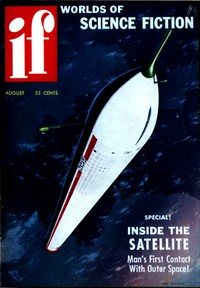
[Transcriber's Note: This etext was produced from
Worlds of If Science Fiction, August 1956.
Extensive research did not uncover any evidence that
the U.S. copyright on this publication was renewed.]
Donnie clenched his small fists and tried not to cry, but two
elliptical tears ran slowly down his cheeks. The sight of them made Mr.
Ames even madder.
"Look at him," he stormed, turning to Martha. "Just look at him. Every
damn time I try to reason with him, he starts to snivel like an animal,
instead of acting like a normal human being." Mr. Ames flicked his
cigar ashes toward a vacuum cup on the wall and looked down at the boy.
"Now stop that stupid crying and tell me what this is all about."
Donnie sniffled a couple of times and wiped his nose on the back of one
of his blue uniform sleeves.
"Well," Mr. Ames said, coldly.
The boy took a deep breath and raised his head. "I want you to spend
some time with me," he said. "I want you to--" he searched the elusive
shadows of memory until he found the word he wanted--"I want you to
_play_ with me. That's it. I want you to play with me once in a while."
Mr. Ames blinked his eyes and stepped back. "Play," he repeated. "What
do you mean _play_?"
Donnie hesitated. "You know," he said, finally, "take me on long walks
and sit down and play games and tell me stories once in a while."
"But you've got all the stories you need," Mr. Ames said, waving his
hand at the banks of audiotapes stacked neatly on the wall shelves.
"And your audio-prompter can tell them better than I can."
"Yes," Donnie said, "but that's a machine and I want--"
"What's wrong with a machine," Mr. Ames said, his face getting red.
"Some of our best things come from machines. Didn't they teach you that
at the Incubator?"
"Yes," the boy said, "but isn't there anything besides machines? I
can't play with machines, I want to play with you!" He began to sob
again.
Mr. Ames dashed his cigar to the floor. "I give up," he said. "By the
Red Balls of Jupiter, I give up!"
"Now, Henry," his wife said. "Remember, the boy's only seven."
"Don't 'Henry' me," Mr. Ames said, "And besides, what does being seven
have to do with it. When I was his age, I was an honor student in
physics. _He_ can't even pass algebra."
Donnie stared at the toes of his boots.
"I've given this kid everything," Mr. Ames went on. "He's going to
the best pre-nuclear school in the whole hemisphere. He's got his own
rocket kit. Why, he's even been on a study cruise to the moon! How
many kids his age have been to the moon already? I bet no other kid in
our project has been there. And what do I get as a reward." Mr. Ames
didn't wait for an answer. "Trouble. That's what I get, trouble. Why in
Galaxy he can't leave me alone like a normal child is more than I can
understand." He stopped for breath and lit a fresh cigar.
"Maybe the boy's sick," Martha said timidly.
Mr. Ames ignored her. "I've tried to be a good father to him," he said,
his voice self-righteous. "I'm giving him a chance to make something
out of himself. All I ask is that he be of service to the world, and
make me proud of him some day. But what does he do? Does he concentrate
on his career, like the rest of the kids? Hell, no, he wants to hang
around me, always underfoot, always asking stupid questions. Play!" Mr.
Ames snorted.
"It's not just play."
"Heh, what's that?" Mr. Ames jumped.
"I said it's not just play," Donnie repeated, bravely brushing away
his tears. "You don't give me any--" he searched again for the right
word--"any _companionship_. A boy needs companionship. Don't you
understand?"
"No, I don't," Mr. Ames said. "And I'm sure they didn't teach you
that in the Incubator either. Don't you realize you should be fully
coordinated by now. Instead, you want me to take time from my work--Why
it's preposterous. It's, it's--unscientific!"
"But, all I want--"
Mr. Ames held up his hand. "Enough of this," he said. "I refuse to
discuss it anymore. Now go to your room and get ready for your study
period."
The boy burst out crying again and ran out of the room.
Mr. Ames shook his head. "Definite neurotic tendencies," he muttered to
himself.
"What dear?" his wife said.
"Nothing, Martha," he answered. "Just talking to myself." He sat down
heavily on the couch and sighed. What was wrong with Donnie, anyway?
Where did he get those archaic ideas from? Surely he had been taught
that the whole purpose of the incubator system was to speed up learning
and growth processes so children wouldn't have to waste precious years
growing up, like they did in the old days. Why their new technological
age simply had no time to fool around with infantile desires. There
were too many things to do, too many knotty scientific problems to
solve. Emotions, Mr. Ames mumbled to himself, you never could trust
your damn emotions.
That night, after Donnie was in bed, Mr. Ames went to his study and
pulled out the boy's file. It explained what he was fitted for, what
abilities he had inherited, and what his primary training included.
Mr. Ames noted sadly that the boy's Scientific Quotient was 142, well
above normal, and that he would stand six feet tall and weigh close to
195 pounds when fully developed.
Mr. Ames, who was incubator-born himself, was completely sold on
the ingenious system the Federation of World Councils had devised.
No more hit-and-miss mass reproduction, where morons were gradually
out-breeding intelligent beings, but instead, selective artificial
insemination through which only the best strains were permitted to
reproduce. Each generation, the human race got healthier and smarter.
Insanity and inherited diseases were a thing of the past and nature's
primitive law--only the fittest shall survive--was now a glittering
reality. Why the Federated Incubators even took over the burden of
educating the children for the first five years. Parents no longer
had to be bothered caring for helpless, bawling brats. By the time
Incubates were placed on the available list, they were completely
self-sufficient and emotionally conditioned to fit into any family
group. Parents simply picked what they wanted. Mr. Ames, of course, had
selected a future nuclear-chemist.
It was a beautiful system, Mr. Ames told himself, and even more
important, it worked. But somehow, some way, there was something
radically wrong with their child.
"Definite neurotic symptoms," Mr. Ames murmured, half aloud. By
Jupiter, there was only one thing to do. He shut the folder firmly and
spun around to the trans-audio. A green light appeared on the panel
almost immediately.
"Your connection, please?" the automon said.
"Give me the local Incubator."
There was a pause, then a click. "Federated Health and Service,
coordinator speaking. May I help you?"
"Yes. This is Mr. Henry Ames, over at the Amarillo Group Project. I
have a complaint to make."
"Yes?" The coordinator, a woman, was carefully polite.
"It's about the child you sent us."
"Specimen please?"
"What? Oh, it's a boy, Class Triple A, breed, nuclear chemistry. We got
him about 18 months ago and--"
"What is your number please?"
"It's ... just a minute." Mr. Ames consulted the folder. "My number is
34-72-oh-41. And we've got a three-year guarantee," he added pointedly.
"Yes, sir. Just a minute sir." There was a whirring sound at the other
end of the circuit. After a short wait, the coordinator's voice came
through again.
"Well, sir," she said. "You have the select model in our scientific
line of seven-year-olds. According to our records, he checked out
perfectly on all phases of learning and aptitude. Have you tried memory
teaching?"
"Yes, I've tried memory teaching. He learns fine." Mr. Ames stopped.
"Look, you don't seem to understand. He's okay as far as performance
goes. He does everything we tell him and all that, but he's
still a real pain in the--I mean, he's developing very annoying
characteristics."
"Please go on, Mr. Ames." The coordinator's voice was warm and
sympathetic. "How does he annoy you?"
"Well, for one thing, he's getting pronounced possessive tendencies. He
almost seems to resent being left alone. Why, just this evening he told
me he wants us to _play_ with him!"
"Did you say _play_ with him?"
"That's right," Mr. Ames said, triumphantly. "And he says he needs
companionship, or something like that."
"Companionship," the coordinator repeated. "Oh, dear. This is more
serious than I thought. I'm afraid you definitely have a reject,
Mr. Ames. If he shows these tendencies at this early age, then the
situation will be intolerable later on."
"It's intolerable right now," Henry insisted. "Anyway, I thought you
people were supposed to clear up all this emotional unbalance in the
primary psych indoctrination."
"We usually do," the coordinator agreed, "but every once in a while,
one slips through inspection with faulty communal-perception. The
one you've got is obviously a throw-back." The coordinator coughed
apologetically. "It's really not the boy's fault, of course, but I'm
afraid we'll have to reclaim him."
"The sooner the better," Mr. Ames said. "This mess is upsetting my work
at the lab. When can I get a replacement?"
"We'll send a new model over when we pick up the reject. Will tomorrow
morning be convenient?"
"Sure. Fine. Just make sure this one is normal. You better check our
physio records too. I hear the people down the circle got one that
didn't look like them at all."
"Don't worry," the coordinator assured him. "You'll get a boy you can
be proud of this time. Will there be anything more now?"
"No, no, I guess not." An uneasy feeling slipped into Mr. Ames's
consciousness. "I just wondered," he said, suddenly. "What will happen
to Don--I mean, the reject you sent us. Will he be--uh--destroyed?"
The coordinator laughed. "Heavens, no, Mr. Ames," she said, lightly.
"He'll be sent to the Biological Reservation and allowed to live out
his life span with other rejects. He'll be much happier there. We're
not savages, you know."
"That's right," Mr. Ames said, his tone matching her brightness. "We're
not savages. Well, we'll be expecting the new one tomorrow, and thanks
for all your trouble."
"No trouble at all," the coordinator said, smoothly. "Feel free to call
on us any time."
*** END OF THE PROJECT GUTENBERG EBOOK REJECT ***
Updated editions will replace the previous one—the old editions will
be renamed.
Creating the works from print editions not protected by U.S. copyright
law means that no one owns a United States copyright in these works,
so the Foundation (and you!) can copy and distribute it in the United
States without permission and without paying copyright
royalties. Special rules, set forth in the General Terms of Use part
of this license, apply to copying and distributing Project
Gutenberg™ electronic works to protect the PROJECT GUTENBERG™
concept and trademark. Project Gutenberg is a registered trademark,
and may not be used if you charge for an eBook, except by following
the terms of the trademark license, including paying royalties for use
of the Project Gutenberg trademark. If you do not charge anything for
copies of this eBook, complying with the trademark license is very
easy. You may use this eBook for nearly any purpose such as creation
of derivative works, reports, performances and research. Project
Gutenberg eBooks may be modified and printed and given away—you may
do practically ANYTHING in the United States with eBooks not protected
by U.S. copyright law. Redistribution is subject to the trademark
license, especially commercial redistribution.
START: FULL LICENSE
THE FULL PROJECT GUTENBERG LICENSE
PLEASE READ THIS BEFORE YOU DISTRIBUTE OR USE THIS WORK
To protect the Project Gutenberg™ mission of promoting the free
distribution of electronic works, by using or distributing this work
(or any other work associated in any way with the phrase “Project
Gutenberg”), you agree to comply with all the terms of the Full
Project Gutenberg™ License available with this file or online at
www.gutenberg.org/license.
Section 1. General Terms of Use and Redistributing Project Gutenberg™
electronic works
1.A. By reading or using any part of this Project Gutenberg™
electronic work, you indicate that you have read, understand, agree to
and accept all the terms of this license and intellectual property
(trademark/copyright) agreement. If you do not agree to abide by all
the terms of this agreement, you must cease using and return or
destroy all copies of Project Gutenberg™ electronic works in your
possession. If you paid a fee for obtaining a copy of or access to a
Project Gutenberg™ electronic work and you do not agree to be bound
by the terms of this agreement, you may obtain a refund from the person
or entity to whom you paid the fee as set forth in paragraph 1.E.8.
1.B. “Project Gutenberg” is a registered trademark. It may only be
used on or associated in any way with an electronic work by people who
agree to be bound by the terms of this agreement. There are a few
things that you can do with most Project Gutenberg™ electronic works
even without complying with the full terms of this agreement. See
paragraph 1.C below. There are a lot of things you can do with Project
Gutenberg™ electronic works if you follow the terms of this
agreement and help preserve free future access to Project Gutenberg™
electronic works. See paragraph 1.E below.
1.C. The Project Gutenberg Literary Archive Foundation (“the
Foundation” or PGLAF), owns a compilation copyright in the collection
of Project Gutenberg™ electronic works. Nearly all the individual
works in the collection are in the public domain in the United
States. If an individual work is unprotected by copyright law in the
United States and you are located in the United States, we do not
claim a right to prevent you from copying, distributing, performing,
displaying or creating derivative works based on the work as long as
all references to Project Gutenberg are removed. Of course, we hope
that you will support the Project Gutenberg™ mission of promoting
free access to electronic works by freely sharing Project Gutenberg™
works in compliance with the terms of this agreement for keeping the
Project Gutenberg™ name associated with the work. You can easily
comply with the terms of this agreement by keeping this work in the
same format with its attached full Project Gutenberg™ License when
you share it without charge with others.
1.D. The copyright laws of the place where you are located also govern
what you can do with this work. Copyright laws in most countries are
in a constant state of change. If you are outside the United States,
check the laws of your country in addition to the terms of this
agreement before downloading, copying, displaying, performing,
distributing or creating derivative works based on this work or any
other Project Gutenberg™ work. The Foundation makes no
representations concerning the copyright status of any work in any
country other than the United States.
1.E. Unless you have removed all references to Project Gutenberg:
1.E.1. The following sentence, with active links to, or other
immediate access to, the full Project Gutenberg™ License must appear
prominently whenever any copy of a Project Gutenberg™ work (any work
on which the phrase “Project Gutenberg” appears, or with which the
phrase “Project Gutenberg” is associated) is accessed, displayed,
performed, viewed, copied or distributed:
This eBook is for the use of anyone anywhere in the United States and most
other parts of the world at no cost and with almost no restrictions
whatsoever. You may copy it, give it away or re-use it under the terms
of the Project Gutenberg License included with this eBook or online
at www.gutenberg.org. If you
are not located in the United States, you will have to check the laws
of the country where you are located before using this eBook.
1.E.2. If an individual Project Gutenberg™ electronic work is
derived from texts not protected by U.S. copyright law (does not
contain a notice indicating that it is posted with permission of the
copyright holder), the work can be copied and distributed to anyone in
the United States without paying any fees or charges. If you are
redistributing or providing access to a work with the phrase “Project
Gutenberg” associated with or appearing on the work, you must comply
either with the requirements of paragraphs 1.E.1 through 1.E.7 or
obtain permission for the use of the work and the Project Gutenberg™
trademark as set forth in paragraphs 1.E.8 or 1.E.9.
1.E.3. If an individual Project Gutenberg™ electronic work is posted
with the permission of the copyright holder, your use and distribution
must comply with both paragraphs 1.E.1 through 1.E.7 and any
additional terms imposed by the copyright holder. Additional terms
will be linked to the Project Gutenberg™ License for all works
posted with the permission of the copyright holder found at the
beginning of this work.
1.E.4. Do not unlink or detach or remove the full Project Gutenberg™
License terms from this work, or any files containing a part of this
work or any other work associated with Project Gutenberg™.
1.E.5. Do not copy, display, perform, distribute or redistribute this
electronic work, or any part of this electronic work, without
prominently displaying the sentence set forth in paragraph 1.E.1 with
active links or immediate access to the full terms of the Project
Gutenberg™ License.
1.E.6. You may convert to and distribute this work in any binary,
compressed, marked up, nonproprietary or proprietary form, including
any word processing or hypertext form. However, if you provide access
to or distribute copies of a Project Gutenberg™ work in a format
other than “Plain Vanilla ASCII” or other format used in the official
version posted on the official Project Gutenberg™ website
(www.gutenberg.org), you must, at no additional cost, fee or expense
to the user, provide a copy, a means of exporting a copy, or a means
of obtaining a copy upon request, of the work in its original “Plain
Vanilla ASCII” or other form. Any alternate format must include the
full Project Gutenberg™ License as specified in paragraph 1.E.1.
1.E.7. Do not charge a fee for access to, viewing, displaying,
performing, copying or distributing any Project Gutenberg™ works
unless you comply with paragraph 1.E.8 or 1.E.9.
1.E.8. You may charge a reasonable fee for copies of or providing
access to or distributing Project Gutenberg™ electronic works
provided that:
• You pay a royalty fee of 20% of the gross profits you derive from
the use of Project Gutenberg™ works calculated using the method
you already use to calculate your applicable taxes. The fee is owed
to the owner of the Project Gutenberg™ trademark, but he has
agreed to donate royalties under this paragraph to the Project
Gutenberg Literary Archive Foundation. Royalty payments must be paid
within 60 days following each date on which you prepare (or are
legally required to prepare) your periodic tax returns. Royalty
payments should be clearly marked as such and sent to the Project
Gutenberg Literary Archive Foundation at the address specified in
Section 4, “Information about donations to the Project Gutenberg
Literary Archive Foundation.”
• You provide a full refund of any money paid by a user who notifies
you in writing (or by e-mail) within 30 days of receipt that s/he
does not agree to the terms of the full Project Gutenberg™
License. You must require such a user to return or destroy all
copies of the works possessed in a physical medium and discontinue
all use of and all access to other copies of Project Gutenberg™
works.
• You provide, in accordance with paragraph 1.F.3, a full refund of
any money paid for a work or a replacement copy, if a defect in the
electronic work is discovered and reported to you within 90 days of
receipt of the work.
• You comply with all other terms of this agreement for free
distribution of Project Gutenberg™ works.
1.E.9. If you wish to charge a fee or distribute a Project
Gutenberg™ electronic work or group of works on different terms than
are set forth in this agreement, you must obtain permission in writing
from the Project Gutenberg Literary Archive Foundation, the manager of
the Project Gutenberg™ trademark. Contact the Foundation as set
forth in Section 3 below.
1.F.
1.F.1. Project Gutenberg volunteers and employees expend considerable
effort to identify, do copyright research on, transcribe and proofread
works not protected by U.S. copyright law in creating the Project
Gutenberg™ collection. Despite these efforts, Project Gutenberg™
electronic works, and the medium on which they may be stored, may
contain “Defects,” such as, but not limited to, incomplete, inaccurate
or corrupt data, transcription errors, a copyright or other
intellectual property infringement, a defective or damaged disk or
other medium, a computer virus, or computer codes that damage or
cannot be read by your equipment.
1.F.2. LIMITED WARRANTY, DISCLAIMER OF DAMAGES - Except for the “Right
of Replacement or Refund” described in paragraph 1.F.3, the Project
Gutenberg Literary Archive Foundation, the owner of the Project
Gutenberg™ trademark, and any other party distributing a Project
Gutenberg™ electronic work under this agreement, disclaim all
liability to you for damages, costs and expenses, including legal
fees. YOU AGREE THAT YOU HAVE NO REMEDIES FOR NEGLIGENCE, STRICT
LIABILITY, BREACH OF WARRANTY OR BREACH OF CONTRACT EXCEPT THOSE
PROVIDED IN PARAGRAPH 1.F.3. YOU AGREE THAT THE FOUNDATION, THE
TRADEMARK OWNER, AND ANY DISTRIBUTOR UNDER THIS AGREEMENT WILL NOT BE
LIABLE TO YOU FOR ACTUAL, DIRECT, INDIRECT, CONSEQUENTIAL, PUNITIVE OR
INCIDENTAL DAMAGES EVEN IF YOU GIVE NOTICE OF THE POSSIBILITY OF SUCH
DAMAGE.
1.F.3. LIMITED RIGHT OF REPLACEMENT OR REFUND - If you discover a
defect in this electronic work within 90 days of receiving it, you can
receive a refund of the money (if any) you paid for it by sending a
written explanation to the person you received the work from. If you
received the work on a physical medium, you must return the medium
with your written explanation. The person or entity that provided you
with the defective work may elect to provide a replacement copy in
lieu of a refund. If you received the work electronically, the person
or entity providing it to you may choose to give you a second
opportunity to receive the work electronically in lieu of a refund. If
the second copy is also defective, you may demand a refund in writing
without further opportunities to fix the problem.
1.F.4. Except for the limited right of replacement or refund set forth
in paragraph 1.F.3, this work is provided to you ‘AS-IS’, WITH NO
OTHER WARRANTIES OF ANY KIND, EXPRESS OR IMPLIED, INCLUDING BUT NOT
LIMITED TO WARRANTIES OF MERCHANTABILITY OR FITNESS FOR ANY PURPOSE.
1.F.5. Some states do not allow disclaimers of certain implied
warranties or the exclusion or limitation of certain types of
damages. If any disclaimer or limitation set forth in this agreement
violates the law of the state applicable to this agreement, the
agreement shall be interpreted to make the maximum disclaimer or
limitation permitted by the applicable state law. The invalidity or
unenforceability of any provision of this agreement shall not void the
remaining provisions.
1.F.6. INDEMNITY - You agree to indemnify and hold the Foundation, the
trademark owner, any agent or employee of the Foundation, anyone
providing copies of Project Gutenberg™ electronic works in
accordance with this agreement, and any volunteers associated with the
production, promotion and distribution of Project Gutenberg™
electronic works, harmless from all liability, costs and expenses,
including legal fees, that arise directly or indirectly from any of
the following which you do or cause to occur: (a) distribution of this
or any Project Gutenberg™ work, (b) alteration, modification, or
additions or deletions to any Project Gutenberg™ work, and (c) any
Defect you cause.
Section 2. Information about the Mission of Project Gutenberg™
Project Gutenberg™ is synonymous with the free distribution of
electronic works in formats readable by the widest variety of
computers including obsolete, old, middle-aged and new computers. It
exists because of the efforts of hundreds of volunteers and donations
from people in all walks of life.
Volunteers and financial support to provide volunteers with the
assistance they need are critical to reaching Project Gutenberg™’s
goals and ensuring that the Project Gutenberg™ collection will
remain freely available for generations to come. In 2001, the Project
Gutenberg Literary Archive Foundation was created to provide a secure
and permanent future for Project Gutenberg™ and future
generations. To learn more about the Project Gutenberg Literary
Archive Foundation and how your efforts and donations can help, see
Sections 3 and 4 and the Foundation information page at www.gutenberg.org.
Section 3. Information about the Project Gutenberg Literary Archive Foundation
The Project Gutenberg Literary Archive Foundation is a non-profit
501(c)(3) educational corporation organized under the laws of the
state of Mississippi and granted tax exempt status by the Internal
Revenue Service. The Foundation’s EIN or federal tax identification
number is 64-6221541. Contributions to the Project Gutenberg Literary
Archive Foundation are tax deductible to the full extent permitted by
U.S. federal laws and your state’s laws.
The Foundation’s business office is located at 809 North 1500 West,
Salt Lake City, UT 84116, (801) 596-1887. Email contact links and up
to date contact information can be found at the Foundation’s website
and official page at www.gutenberg.org/contact
Section 4. Information about Donations to the Project Gutenberg
Literary Archive Foundation
Project Gutenberg™ depends upon and cannot survive without widespread
public support and donations to carry out its mission of
increasing the number of public domain and licensed works that can be
freely distributed in machine-readable form accessible by the widest
array of equipment including outdated equipment. Many small donations
($1 to $5,000) are particularly important to maintaining tax exempt
status with the IRS.
The Foundation is committed to complying with the laws regulating
charities and charitable donations in all 50 states of the United
States. Compliance requirements are not uniform and it takes a
considerable effort, much paperwork and many fees to meet and keep up
with these requirements. We do not solicit donations in locations
where we have not received written confirmation of compliance. To SEND
DONATIONS or determine the status of compliance for any particular state
visit www.gutenberg.org/donate.
While we cannot and do not solicit contributions from states where we
have not met the solicitation requirements, we know of no prohibition
against accepting unsolicited donations from donors in such states who
approach us with offers to donate.
International donations are gratefully accepted, but we cannot make
any statements concerning tax treatment of donations received from
outside the United States. U.S. laws alone swamp our small staff.
Please check the Project Gutenberg web pages for current donation
methods and addresses. Donations are accepted in a number of other
ways including checks, online payments and credit card donations. To
donate, please visit: www.gutenberg.org/donate.
Section 5. General Information About Project Gutenberg™ electronic works
Professor Michael S. Hart was the originator of the Project
Gutenberg™ concept of a library of electronic works that could be
freely shared with anyone. For forty years, he produced and
distributed Project Gutenberg™ eBooks with only a loose network of
volunteer support.
Project Gutenberg™ eBooks are often created from several printed
editions, all of which are confirmed as not protected by copyright in
the U.S. unless a copyright notice is included. Thus, we do not
necessarily keep eBooks in compliance with any particular paper
edition.
Most people start at our website which has the main PG search
facility: www.gutenberg.org.
This website includes information about Project Gutenberg™,
including how to make donations to the Project Gutenberg Literary
Archive Foundation, how to help produce our new eBooks, and how to
subscribe to our email newsletter to hear about new eBooks.