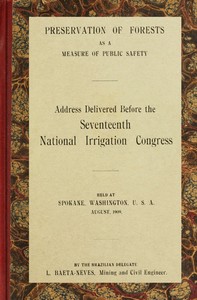
PRESERVATION OF FORESTS
AS A
MEASURE OF PUBLIC SAFETY
Address Delivered Before the
Seventeenth
National Irrigation Congress
HELD AT
SPOKANE, WASHINGTON, U. S. A.
AUGUST, 1909.
BY THE BRAZILIAN DELEGATE
L. BAETA-NEVES, Mining and Civil Engineer.
THE PRESERVATION OF FORESTS AS A MEASURE OF PUBLIC SAFETY.
Address before the 17th National Irrigation Congress, Spokane, Wash.,
August, 1909.
by
L. BAETA-NEVES
Mining and Civil Engineer; Graduate of the Ouro Prete Mining
School, Brazil; Chief of the Technical Department of the
Directory of Railway and Public Works in Minas Geraes, Brazil;
Member of the Historic and Geographic Institute of the same
state; Member of the National Geographic Society of Washington;
Knight of Columbus; Honorary Member of the Rotary Club of Los
Angeles, Cal.; Representative of the Brazilian Government
before the Scientific Congresses 16th Irrigation and 3rd Dry
Farming in America, and Vice-President and Corresponding
Secretary of this Congress; Special Delegate of Brazil before
the 17th National Irrigation Congress at Spokane, Wash., where,
by selection, he addressed the meeting on behalf of the Foreign
Representatives.
I really feel glad and exceedingly honored in coming again before this
Congress and my pleasure is great in telling you once more how much I
appreciate the warm welcome of the North American people, and how much
I have enjoyed the pleasant stay in this most hospitable city.
I come now with the same feelings and sentiment that I tried to
translate to you on the opening session of this most important meeting
full of very valuable lessons from any view point; on that day I had
the great honor of speaking to you on behalf of the foreign delegates
of this convention bringing greetings from the Brazilian Government and
from the different nations here represented. But now, allow me to say,
Americans, and distinguished representatives of foreign continents and
islands, that translating the good feelings and altruistic sentiment
of the people of the countries of Columbus, I am going to speak with
my whole soul, my whole heart, on behalf of the sacred rights of
humanity, addressing you on a subject very dear to me in which I have
been deeply interested since my childhood; a subject on which I have
learned a great deal from two men of universal reputation, who, for
the glory of the western hemisphere, were born under the purest sky
of America――I mean Roosevelt and Gifford Pinchot. I stand for the
forest, for the preservation of forests as a measure of public safety.
My paper is in part an extract of a report that I sent to Brazil to be
read this week at the request of the 4th International American Medical
Congress, held now at Rio De Janeiro “on the most efficacious means
of preventing and lessening the effects of periodical droughts.” In
that paper I wrote about the lessons of the Irrigation Congress, which
lessons we are already profiting by, having improved the Irrigation
projects of which I wrote the address printed in the proceedings of
the 16th National Irrigation Congress, last year. I am pleased to say
that in this report I emphasized also the great work which has been
done by the dry farming Congress, whose lessons are the best to teach
the people of the arid district of the world, how to use profitably
by the water, almost always so expensive and difficult to be obtained
in such districts. You will find on the last proceedings of the dry
farming Congress at Cheyenne, a paper of mine on the combination of
irrigation and dry fanning processes, which combination I think will
give the best results in rendering more fit to sustain life a region
subject to drought. To the medical Congress, I suggested that a branch
of the dry farming of America should be established in Brazil according
to the wishes of its indefatigable secretary my good friend Mr. John T.
Burns. Being requested by his excellency Governor Norris, of Montana to
work in Brazil, as a vice-president and corresponding secretary of the
Congress I feel exceedingly honored in giving my very best service to
my brothers of North America, assuring them that they can count upon my
great admiration for your country, where I am living for one year with
my family always in close touch with the American family and people.
Allow me to say, ladies and gentlemen, that keeping the same love for
my native land, in my heart, will have for ever a warm room for the
American people. But let me stop, ladies and gentlemen, of speaking of
my feeling that, in spite of my sincerity, I cannot express by words
as they come from the bottom of my heart; the whole session would be
too short for translating them and I must go back to the subject of my
paper. In my report to the International Medical Congress I wrote also
about the Cactus of Luther Burbank, of California, and incidentally I
called the attention of the Brazilian Engineers to the recent process
in which the English government is now interested, facilitating the
atmospheric precipitations for small water supply near the coast,
causing the deposit of dew as has been practiced in Gibraltar. I have
read something about this process on an interesting paper of Mr. George
Hurbard read this year on March 3rd, before the Royal Society of Arts,
London: I wrote too about the forests considering them like I am about
to do.
The importance of forests as protectors of mankind is an incontrovertible
fact, and there is no spirit, less observing as it may be, that has not
noticed, even slightly, some influence of the trees in benefitting life.
At different times I have treated this important subject that impressed
me so much, in the national and foreign press and in public addresses
here in America, several times discussing the influence of the trees
upon our life. Once speaking about the combined work of medicine and
engineering in the noble and humanitarian campaign to improve the means
of life on the surface of this planet, especially to preserve and
increase the vigor of the people, I said in part:
“Life progressively is becoming very difficult to be preserved in
good conditions because of the incessant exhaustion of elements that
are favorable to it on the surface of the earth, where a continuous
transformation is observed all over.
“The forests, the best protectors of our life, are going fast, and from
the modification that their disappearance is bringing to the climate
and to the natural conditions all over the earth, will come serious
troubles to the solution of the sanitary problems in the future.
“It is necessary to use intelligently so important elements of life,
without so barbarous destructions, because so far as the present
scientific knowledge is concerned, there is no doubt, at all, that
from the lack of the forest will come the greatest modifications
in the meteorological conditions of the earth, and you know, the
meteorological conditions――the weather――has the most positive
influence on our life. This influence does not appear only on the
health conditions, but, too, in the most complicate social phenomena.
“The old proverb――‘Man is the son of his environments’――is a translation
of a truth scientifically demonstrated, proving the weather’s influence.
It is true that it means the law of adaptation, but the environments of
man depend entirely upon the meteorological conditions. According to
this law we could, perhaps, live even under bad conditions of weather,
but such condition would bring an unhealthy condition of life, too.
“Professor Dexter, of the University of Illinois, studying the mental
and physiological influence of the meteorological conditions, in one
of his books, gives a comprehensive study of the question, proving the
weather’s influence on the organic and intellectual life, the emotions,
the literary sentiments, the individual conduct. He proves principally
that the change of meteorological conditions affects the health more
than anything else.
“Under bad meteorological conditions we never would have the necessary
reserve of energy for the complete activity of life.
“And good meteorological conditions can be guaranteed only by the
preservation of forests, that, unhappily for our future, does not
receive from the people the deserved attention.”
Since the colonial time many Brazilians have been considering the
forests from a sanitary viewpoint. The patriarch of our independence
José Bonifacio in 1815 wrote these phrases:
“What other productions of Mother Nature ought to deserve greater
attention from the philosophers and statemen than the forests and
trees? Trees, wood and timber: Only these words, well meditated upon
and understood, are enough to awaken our whole sensibility.”
Besides other reasons there is a powerful one that makes necessary
the protection of forest――its great influence upon health. Health is
all, and upon it reposes the happiness of people and the greatness and
prosperity of the countries.
On account of a rapid progress we must not sacrifice the forests as it
has been done in many new countries.
Any progress detrimental to the vital forces of nature, is negative,
ephemeral; if one generation profits by it, the following one fatally
will suffer its consequences.
This axiom, in my humble opinion, translates better the decline
and disappearance of some nations that figured in antiquity than
any explanation given by the modern philosophy for the fact; and
forethought advises to profit by the practical lesson contained within
it, preserving our natural resources in order not to sacrifice to a
temporary greatness the best means of preserving life, which means are
represented by the forest.
The trees are great regulators of many conditions of life, principally
facilitating the atmospheric precipitation and their profit. The
aqueous vapors penetrating the cool atmosphere of the forest at the
contact of the foliage of the trees, condense resolving into rain
or dew; and the water that falls on the soil, protected against
evaporation by the shade, having its surface-flow impeded and its
absorption facilitated by the roots, penetrates in greatest quantity
into the land, guaranteeing the permanency and abundance of the source
that it forms.
The rainfall without the protecting vegetation rapidly flows on
the surface soil forming the run-off, which takes from the earth
the fertilizing humus, excavating the mountain and producing the
destructive overflow in the valley.
In the countries where ice and snow do not appear the regimen of
the water courses in a great measure depends upon the vegetation
that covers the head of the streams; and such an influence is as
great as the porosity of the soil is small in the generative basin
of the sources. If there is yet controversy which is progressively
disappearing with more serious study about some forests’ influences,
there is not, all over the earth, any one who can scientifically
contest this truth that history and geography, the facts of the past
and the observation of the present so clearly confirm. The Nile, which
comes from the heart of Africa, born among the virgin forests where
fire and men never have penetrated, keeps today, in an average, the
same flow that it had when it fertilized Egypt at the time of the
Pharaohs.
The effects of forests do not appear in confined zones. Their
influence is not bounded by a certain region, and the calamity coming
from their devastation passes over the individual property affecting
the public welfare. This is an incontestible truth that science
demonstrates and facts corroborate. Therefore there is no reason why
protection of forest must be concerned to a certain extension, not
affecting the private lands.
The individual right ought not to affect the high interests of
the Union which ought to save its own future, guaranteeing by the
preservation of the natural resources of the country, the general
well-being of the present and future generations.
This rational theory, applied to the case of forests, each day
gains assent in this country being already accepted in the higher
tribunals in favor of the legislation protecting such resources, which
legislation is earnestly advocated by President Roosevelt, accordingly
it was adopted on March 10, 1903 by the supreme court of Maine, and
on April 6th of the same year, the supreme court of the United States
sustained it, confirming the opinion of the court of errors and appeals
of New Jersey.
To the glory of us Brazilians this principle is the confirmation of a
doctrine of which I spoke last here at Albuquerque, promulgated in 1892
by the eminent Brazilian, Dr. Francisco Saturnino Rodrigues de Brito,
who wrote:
“The argument against such laws has no reason for being, because the
owner of the land is only a steward of the soil that was entrusted to
him by the past generations; he is the depository of lands as he is a
depository of capital, and thus, as it has a social origin, territorial
property must have a social application, in attending to collective
interest; and these require the individual effort of each man to
preserve and improve on the planet the necessary means of living, among
which are the preservation and replantation of forests, that may keep
the necessary moisture for regular rainfall and the normal distribution
of water, detaining it among their roots and not permitting the
destructive overflows that take from the soil the fertilizing humus.
The argument has no reason for being, also, because the interest of
the family itself requires providence against the prodigal member who
steals from his own children the inheritance from the past, giving to
this improvident and egotistical father only the income of it; and as
it happens with the inheritance, legislative enactment must regulate
the question of lands for the interest of the social community that has
a great attainment from the Past, and comprehending the Present and the
Future.”
The arguments of President Roosevelt are very similar to those of the
illustrious Brazilian engineer and the same thing can be said in regard
to the reasons presented by the Supreme Court of the United States as
quoted by the American President:
“The State, as quasi-sovereign and representative of the interest of
the public, has a standing in court to protect the atmosphere, the
water and forests either in its territory, irrespective of the ascent
or descent of the private owner of the land most immediately concerned.”
I am deeply convinced that the conscientious scruples of a great many
of our eminent legislators and loyal men in accepting this doctrine
lie only in the fact that they are always busy with something else,
never dedicating themselves to any serious study of the forests in
their relations to life and the progress of countries; they have never
considered that, on account of such relation, the sacred rights of
humanity, the life of our children and future generations require a
direct and immediate protection for the trees, which protection is
undoubtedly a measure of public safety. And really such a protection
is as important as any other measure that may prevent the invasion and
spread of some epidemic disease.
To the 4th Latin-American Congress I moved that all possible effort
should be made to have Brazil and all nations represented at the
congress accept the proposition that is found in my address of forests
last year, which proposition I write now as follows:
“_Preservation of forests in many ways necessary, must be considered as
a measure of public safety and it is of urgent necessity to maintain
the permanency and abundance not only of the stream flow, but, of the
underground waters._”[1]
This proposition, ladies and gentlemen, will do some good for our
forests when thoroughly accepted in the countries where the question
of right of property has been an obstacle to the protection laws for
saving the trees on the private lands.
I make an appeal to you, gentlemen, of all different nations here
represented to bring with you the ideas contained in this paper whose
value lies only on the strong conviction with which I wrote it.
Let us be united all over the world in this great and noblest campaign
for the life of mankind, for the life of our own children, the water,
the pure air, the shade of relief of fatigue, the timber, in resume,
the life itself. Let us profit by the great lessons of Gifford Pinchot,
accepting the wise advice of greatest men of the past and present
generations. And may this alarm-cry arouse the energies of the present
for the solution of the great problem of the future.
MEANS ADVISED TO PREVENT THE CUTTING OF FORESTS IN BRAZIL.
After the approbation of the proposition contained in the first part
of my address considering the protection of the forests as a measure
of public safety, we must have some restriction from the states in
regard to the use of the generative land of courses, establishing the
protective areas, even approximately, according to the good sense,
putting them under a provisory police of the tax collectors and the
patriotism of the people, until we can get the resources for a most
effective police.
We must get annually from the Federal Congress some appropriation,
however small, to start the National Forestry Reservation at the
head of the great and navigable rivers, progressively enlarging such
reservation until it has a sufficient extension.
I think that in general the forests would be preserved if the people
knew how to use them systematically if efficient means of preservation
of timber could be obtained, in order to use the softer and light
wood as good material, avoiding, as said by the illustrious engineer,
Joaquim Julio Proenca, the devastation of the virgin forests for
hardwoods to be employed in construction of certain importance,
principally railroads; if we could plant good species, growing fast
to be used as fuel and good timber, for instance, the eucalyptus as
is being done in California, and was advised in Minas Geraes by the
distinguished botanist engineer, Alvaro da Silveira, and if we could
stop or diminish the clearing of forests or old process of burning the
forests for fuel and agricultural purposes by divulging the scientific
processes of cultivation, and profit by using green wood as a fuel
in great factories, using dry stoves heated by the furnace gases, as
established by the deceased President Joao Pinheiro in his factory at
Caeté, Minas Geraes, Brazil.
From these considerations we have many suggestions how to protect the
trees, but, certainly, the suggested measures and those profitable ones
found in many forestry codes in our states, must not be taken only
by the Union, whose service, as I said before, must be as simple and
economic as possible in order to be stable.
The Federal Government in accordance with the states must help the
development of the instruction on forestry, establishing special
forestry gardens, however small, connected with botanical branch in
the engineering courses, for better knowledge and trial of species
of rapid growth, suitable for construction and railroad ties; must
promote replantation of resistant trees such as eucalyptus in the
arid region, principally where the sources permanently or temporarily
appear; must promote the employing of light and white soft timber by
giving premiums to the inventor of the best and most economic process
for its preservation, and finally, must make every possible propaganda
by publication of short and practical papers and so on among farmers on
the influence and value of the forests.
[1] In my book on the water supply and sewers of Caxambu,
Minas Geraes, Brazil, I explained the influence of the forests
upon the underground water in a chapter under the title
“Preservation of the sources.”
* * * * *
Transcriber’s Notes:
――Text in italics is enclosed by underscores (_italics_).
――Obvious printer’s, punctuation, and spelling inaccuracies were
silently corrected.
――Archaic and variable spelling has been preserved.
――Variations in hyphenation and compound words have been preserved.