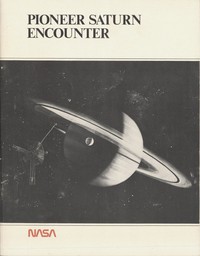
PIONEER SATURN ENCOUNTER
[Illustration: NASA]
CONTENTS
Foreword 1
Introduction 3
Pioneer Saturn 4
Saturn Images 8
Science Highlights 21
Outward Bound 28
FOREWORD
The Pioneer 10 and 11 spacecraft, launched in 1972 and 1973,
respectively, were well named: they made the first crossings of the
asteroid belt and were the first to encounter Jupiter and its intense
radiation belts. Pioneer 11’s trajectory, bent into a hairpin curve by
Jupiter’s powerful gravitational field, allowed it to recross the solar
system to make the first flyby of Saturn almost a billion miles from
Earth where it came within 13,300 miles of the cloud tops.
Assembled in this publication is a selection of the pictures returned by
Pioneer 11 of Saturn and its largest moon, Titan. These images are of
great beauty as well as of great scientific interest, serving to whet
our appetite for the more detailed observations to be made by Voyager in
1980 and 1981. Tracking of both Pioneers will continue for many more
years, providing fundamental data on the nature of interplanetary space
in the depths of the solar system. The results of these outer-planet
Pioneer missions have far exceeded our hopes and expectations of a
decade ago when the program was initiated.
Robert A. Frosch, Administrator
National Aeronautics and Space Administration
September 1979
NASA
National Aeronautics and Space Administration
Ames Research Center
Moffett Field. California 94035
[Illustration: Artist’s drawing of Saturn and its rings showing the
Pioneer Saturn spacecraft passing under the rings and nearing
closest approach to the planet. Actual pictures could not be
obtained at this time because of the high speed of the spacecraft.]
INTRODUCTION
We have entered into a new era of space exploration. Missions undertaken
during the lunar exploration of the 1960’s typically lasted a matter of
days with commands issued and carried out in near real time. Now, a
decade later, planetary voyages may last for many years as the spiraling
trajectories of the spacecraft make periodic intersections with the
orbits of the planets. Communicating with us across the vastness of
space, these spacecraft report to us their experiences as they traverse
the outer reaches of the solar system.
Among these deep space travelers, Pioneers 10 and 11 are appropriately
named, for they truly are pioneering the exploration of the outer solar
system. Launched in 1972 and in 1973, respectively, they were the first
spacecraft to fly by Jupiter (in 1973 and 1974). At Jupiter, Pioneer
11’s trajectory was carefully targeted to swing it toward Saturn for an
encounter in September 1979. We see some of the early results in this
publication.
Other spacecraft are following along the trail blazed by Pioneer Saturn.
Voyager 1 passed by Jupiter in March 1979 and will reach Saturn in
November 1980. Voyager 2 has also passed beyond Jupiter and will
encounter Saturn in August 1981, with the further possibility of
traveling on to Uranus (a 1986 encounter). Under development are the
Galileo orbiter and atmospheric entry probe, destined to journey to
Jupiter where the orbiter will return more detailed information,
including high-resolution pictures of the Galilean satellites, and the
probe will penetrate deep below the Jovian clouds.
In the coming years, each of these follow-on missions will enrich our
understanding of the solar system, greatly supplementing the
observations of Pioneers 10 and 11. But one thing will never change. The
Pioneers were first.
Thomas A. Mutch
Associate Administrator for Space Science
National Aeronautics and Space Administration
PIONEER SATURN
[Illustration: Pioneer Saturn spacecraft.]
Pioneer Saturn has given us our first close view of the spectacular
ringed planet Saturn and its system of moons. The spacecraft began its
journey to the giant planets Jupiter and Saturn on April 5, 1973, as
Pioneer 11. It reached Jupiter on December 2, 1974, passing within
42,760 km of the Jovian cloud tops and taking the only existing pictures
of Jupiter’s polar regions. Jupiter’s massive gravitational field was
used to swing Pioneer 11 back across the solar system toward Saturn.
Additional maneuvers were executed in 1975 and 1976 to place the
spacecraft on a suitable trajectory, with the final aimpoint selected in
1977.
From the many possible targeting options for the first Saturn flyby, two
aimpoints were considered, both of which would result in a
near-equatorial flyby that would give the best mapping of the
high-energy particles and the magnetic field near the planet. The
difference between these two aimpoints, which came to be known as the
“inside” and “outside” options, was their relationship to Saturn’s
unique ring system first discovered by Galileo in 1610. The “outside”
option was finally selected because it was considered to be of less risk
to the spacecraft and more valuable in planning the subsequent encounter
of Saturn by Voyager 2, which will reach Saturn in 1981. Final targeting
was completed during early 1978, when a series of timed rocket thrusts
locked Pioneer into the desired trajectory.
[Illustration: Pioneer Saturn voyage.]
[Illustration: Encounter trajectory.]
On September 1, 1979, the spacecraft, now designated Pioneer Saturn,
reached Saturn after 6 years in flight. It passed through the ring plane
outside the edge of Saturn’s A-ring and then swung in under the rings
from 2,000 to 10,000 km below them. At the point of closest approach, it
attained a speed of 114,100 km/h (71,900 mi/h) and came within 21,400 km
of the planet’s cloud tops. While it was approaching, encountering, and
leaving Saturn, the spacecraft took the first closeup pictures of the
planet, showing 20 to 30 times more detail than the best pictures taken
from Earth, and made the first close measurements of its rings and
several of its moons, including the largest moon, the planet-sized
Titan. Titan, along with Mars, has been considered by many scientists to
be the most likely place to find life in the solar system.
Pioneer Saturn unraveled many mysteries. It determined that Saturn has a
magnetic field and trapped radiation belts, measured the mass of Saturn
and some of its moons, and studied the character of Saturn’s interior.
It confirmed the presence and determined the magnitude of an internal
heat source for Saturn. Its instruments studied the temperature
distribution, composition, and other properties of the clouds and
atmospheres of Saturn and Titan, and took photometric and polarization
measurements of Iapetus, Rhea, Dione, and Tethys. Pioneer may also have
discovered a previously unknown moon of Saturn. The spacecraft measured
the mass, structure, and other characteristics of Saturn’s rings, and
passed safely through the outer E-ring, which posed a potential hazard
for Pioneer. It also discovered new rings. One of these rings, called
the F-ring by the Pioneer team, lies just outside the A-ring. The gap
between the F-ring and the A-ring has been tentatively designated the
Pioneer Division. The other new ring has been called the G-ring, which
lies well outside the F-ring.
Pioneer carries a scientific payload of 11 operating instruments;
another instrument, the asteroid/meteoroid detector, was turned off in
1975. Two other experiments, celestial mechanics and S-band occultation
of Saturn, use the spacecraft radio to obtain data. Pioneer Saturn is a
spinning spacecraft, which gives its instruments a full-circle scan 7.8
times a minute. It uses a nuclear source for electric power because the
sunlight at Jupiter and beyond is too weak for a solar-powered system.
Two booms project from the spacecraft to deploy the nuclear power source
about 3 meters from the sensitive spacecraft instrumentation. A third
boom positions the magnetometer sensor about 6 meters from the
spacecraft. Six thrusters provide velocity, attitude, and spin-rate
control. A dish antenna is located along the spin axis and looks back at
Earth throughout the mission, adjusting its view by changes in
spacecraft attitude as the spacecraft and Earth move in their orbits
around the sun.
Tracking facilities of NASA’s Deep Space Network, located at Goldstone,
California, and in Spain and Australia, supported Pioneer Saturn during
interplanetary flight and encounter. Pioneer’s radio signals, traveling
at the speed of light, took 85 minutes to reach Earth from Saturn, a
round-trip time of almost 3 hours, somewhat complicating ground control
of the spacecraft. Almost 10,000 commands were sent to the spacecraft in
the 2-week period before closest approach. Continued communications
should be possible through at least the mid 1980’s.
After the spacecraft passed Saturn, it headed out of the solar system,
traveling in the direction the solar system moves with respect to the
local stars in our galaxy and in approximately an opposite direction
from its sister spacecraft, Pioneer 10. Both spacecraft have plaques
attached to them which contain a message from Earth for any intelligent
species that may intercept the spacecraft during their endless journeys
through interstellar space.
Pioneer Saturn Scientific Instruments
Instrument Principal Investigator Experiment Objective
Helium vector Edward J. Smith Magnetic fields
magnetometer Jet Propulsion Laboratory
Fluxgate Mario Acuña Magnetic fields
magnetometer Goddard Space Flight Center
Plasma analyzer John H. Wolfe Solar plasma
Ames Research Center
Charged particle John A. Simpson Charged particle
University of Chicago composition
Cosmic ray telescope Frank B. McDonald Cosmic ray energy
Goddard Space Flight Center spectra
Geiger tube James A. Van Allen Charged particles
telescope University of Iowa
Trapped radiation R. Walker Fillius Trapped radiation
detector University of California,
San Diego
Asteroid/meteoroid Robert K. Soberman Asteroid/meteoroid
detector[1] General Electric Co. and astronomy
Philadelphia Drexel
University
Meteoroid detector William H. Kinard Meteoroid detection
Langley Research Center
Radio transmitter John D. Anderson Celestial mechanics
and DSN Jet Propulsion Laboratory
Ultraviolet Darrell L. Judge Ultraviolet
photometer University of Southern photometry
California Los Angeles
Imaging Tom Gehrels Photo imaging and
photopolarimeter University of Arizona, Tucson polarimetry
Infrared radiometer Andrew Ingersoll Infrared thermal
California Institute of structure
Technology
Radio transmitter Arvydas J. Kliore S-band occultation
and DSN Jet Propulsion Laboratory
[1]Not currently operational.
SATURN IMAGES
Saturn, called the wonder of the heavens by early astronomers, has been
studied from Earth for many centuries. When Galileo first focused his
telescope on Saturn in 1610, he realized that the appearance of the
planet was unusual, but he never knew its real character because the
power of his homemade telescope was far too low. He thought he was
looking at three globes, one large and two small, which seemed to change
slowly in appearance. In 1655, Huygens, after years of observing the
planet, finally realized that these projections were actually a flat
ring slightly separated from the main globe.
[Illustration: First sketch of Saturn (Galileo, 1610).]
[Illustration: First sketch showing a division in the rings
(Cassini, 1675).]
In 1675, Cassini found the first breach in the supposedly solid, rigid,
and opaque ring when he discovered that it was divided into two parts by
a dark line, now known as Cassini’s Division. In later years he also
detected some of Saturn’s moons.
[Illustration: First successful photograph of Saturn (Andrew Common,
1883). (Discovering the Universe, Colin A. Ronan, Copyright 1971 by
Colin A. Ronan, Basic Books, Inc., Publishers, New York.)]
The earliest successful photograph of Saturn was taken in 1883 by Andrew
Common. In 1895, James Keeler suggested that the rings are in fact a
swarm of particles in near-independent orbits. These rings, until the
recent discoveries of faint ring systems around Jupiter and Uranus, were
considered unique in the solar system.
Since Galileo first used his homemade telescope to view Saturn, there
have been many observers. There have also been major advances in
telescopes; a resulting modern view of Saturn is shown on the next page.
The corresponding sketch shows the nomenclature of the brightest rings.
Now the planet has been seen for the first time not from Earth, but in
much closer views by an instrument on a spacecraft, the imaging
photopolarimeter on Pioneer Saturn. The instrument separately measures
the strengths of the red and blue components of sunlight scattered from
the clouds of Saturn and converts this information into numbers. The
data are transmitted to Earth as part of the spacecraft telemetry. The
signals are then converted by computer into shades of gray on
photographic film, and the two components plus a synthesized green image
can be recombined into a color image that approximates the planet’s true
color. Some of the resulting images are shown on the pages following the
Earth-based view. These pictures were produced by a scientific team from
the University of Arizona.
These images, while helping to unravel some of the mystery surrounding
the planet, have created even more interest regarding it. We are really
just beginning to know Saturn. It is up to future spacecraft to more
completely reveal her secrets and solve her mysteries.
[Illustration: High-quality contemporary Earth-based view of Saturn
(Photo: Catalina Observatory, University of Arizona).]
[Illustration: Nomenclature of bright rings.]
OUTER (A) RING
CASSINI DIVISION
MIDDLE (B) RING
CREPE (C) RING
[Illustration: Pioneer Saturn image of Saturn and its rings from a
distance of 8,400,000 km (August 22, 1979, 10 days before closest
approach). Resolution has not yet reached Earth-based quality. Faint
banding is visible on the disk of the planet. The silhouette of the
rings can be seen in front of the planet. Slightly above this
silhouette is the shadow of the rings on the disk. Beyond the disk,
structure can be seen in the rings. The rings have a distinctly
different appearance in this and subsequent images than in
Earth-based pictures because they are illuminated from below rather
than from above as we view them from Earth. The A-ring and C-ring
are bright, and between them the B-ring is dark. The Cassini
Division at the inner edge of the A-ring is also bright, but is
blended with the ring at this distance.]
[Illustration: Pioneer Saturn image of Saturn and its rings from a
distance of 5,500,000 km (August 26, 1979, 6 days before closest
approach). Resolution of features is beginning to be approximately
equal to that of Earth-based pictures. Belts on the planet are
becoming more distinct, and considerable structure can be seen in
the rings. The small blue spot at the bottom of the planet is due to
incomplete data and will be corrected by further processing. A notch
appears at the top left of the planet, which may be a data
transmission problem or the shadow of one of Saturn’s moons.]
[Illustration: Pioneer Saturn image of Saturn and its rings from a
distance of 2,800,000 km (August 29, 1979, 72 hours before closest
approach). The Cassini Division at the inner edge of the A-ring is
clearly resolved and is bright. The A-ring is dark outside the
Cassini Division because it has more particulate matter there. Polar
belts are becoming more visible on the face of the planet.
Irregularities that appear in the ring silhouette and shadow are due
to stepping anomalies in the imaging photopolarimeter and will be
removed in further processing. The small round image that appears
above the planet is the moon Titan.]
[Illustration: These pictures of Saturn and its rings were taken by
Pioneer Saturn from a distance of 2,500,000 km (August 29, 1979, 58
hours before closest approach). The imaging photopolarimeter gathers
data using the red and blue components of the light reflected from
Saturn. These two views are from the two color components (upper,
blue; lower, red). The banded structure on the planet is
particularly evident in the upper image. Because the spacecraft is
nearing the planet, the rings are partially outside the field of
view of the instrument. The speck of light below the planet is
Saturn’s moon Rhea, which is 1450 km in diameter, about one-half the
size of Earth’s moon.]
[Illustration: Saturn and its rings: red components.]
[Illustration: This image was produced by combining the two images
on the facing page, adding a synthesized green component, and
adjusting the intensity of each to obtain an approximation to
Saturn’s true color. (The same process was used in all of the
Pioneer color images of Saturn shown here.) Although not evident on
this reproduction, scientists believe that, from detailed study of
both the uncombined and the combined images, they can begin to see
evidence of jet streams in Saturn’s upper atmosphere. The slight
blue edge is an artifact from the computer-enhancement procedure.]
[Illustration: Pioneer Saturn view showing the structure of Saturn’s
ring system in detail never before seen. The image was taken from a
distance of 943,000 km (August 31, 1979, about 44 hours before
encounter). The moon Tethys, seen at the top of the image, is 1200
km in diameter. There is a very faint unidentified Saturnian moon at
the lower right, just off the tip of the bright A-ring (may not be
visible in this print). The newly defined F-ring appears faintly
just outside the bright edge of the A-ring. The region between the
A-ring and the F-ring has been tentatively named the Pioneer
Division. This print has been processed to enhance detail of the
main rings.]
[Illustration: A color print of a version of the same image as shown
on the facing page. The blue dot at the outer edge of the C-ring is
an artifact. This image has not been computer processed to the same
extent as the facing image. Tethys, for example, is only faintly
visible, and the F-ring cannot be seen.]
[Illustration: Close-up image from Pioneer Saturn of Saturn from a
distance of 400,000 km (September 1, 1979, a few hours before
closest approach). Inset shows the location of the image on the
planet. The part of the disk shown is about 25,000 by 70,000 km. The
sawtooth pattern is an artifact. The vertical stripe on the disk is
due to a gain change in the instrument. The image has not had its
final corrections for shape. The rings and their shadows cut
diagonal swaths across the image with the upper swath being the
shadow. The rings, seen from the unlit side, are visible in the
foreground. The ring shadow shows clearly that Saturn’s rings have
two major divisions: the Cassini Division dividing the outer A-ring
from the middle B-ring, and a second division (previously
controversial) dividing the B-ring from the inner C-ring. These
divisions show as parallel pinstripes in the broad black band of the
rings’ shadow, with the upper stripe being the Cassini Division.
Some shearing in the bands and belts on Saturn’s disk is beginning
to appear, although the low contrast on the planet (due to its
high-altitude haze) does not make this highly evident.]
[Illustration: Post-encounter image of Saturn from a distance of
850,000 km (September 2, 1979, 15 hours after encounter). As
planned, during the encounter Saturn’s gravitational field turned
the spacecraft’s trajectory behind the planet and out toward the
edge of the solar system at approximately a right angle to the
inbound trajectory. Thus, the planet is now illuminated from the
side, and the view is of a crescent Saturn with the terminator on
the right of the picture. The rings appear dim when compared with
the previous inbound pictures because of the different angle between
the sun, the rings, and the spacecraft. When this picture was taken,
the spacecraft, as seen from Earth, was about to pass behind the
sun, and solar activity was interfering with spacecraft
communications. The image quality, therefore, is not as good as for
pictures taken inbound. With this farewell image from Pioneer,
Saturn waits for the Voyager spacecraft in 1980 and 1981.]
[Illustration: This image of cloud-covered Titan is one of the
“firsts” for the Pioneer Saturn mission. Titan is the largest of
Saturn’s moons. Because of its great distance from Earth, however,
Titan can be seen only as a point of light in Earth-based pictures.
The Pioneer trajectory could not be adjusted to allow passage close
to Titan, and imaging of the planet from the spacecraft was at the
outer range of capability of the imaging instrument. Thus, the fuzzy
edges and contrast variations on the moon should not be construed as
surface features.
Titan was imaged in the spirit of exploration and discovery. With
this image, which is now a part of recorded history, our visual
information on Titan is materially increased, but is still only
roughly equal to Galileo’s information on Saturn itself in 1610 at
the time that he prepared his first sketch. Better images of Titan
will be obtained by the Voyager spacecraft.]
SCIENCE HIGHLIGHTS
Pioneer Saturn has already greatly expanded our knowledge of Saturn, its
rings and moons. We now know that Saturn, in many ways, represents an
intermediate case between Jupiter, the largest planet in the solar
system, and Earth. The composition of Saturn’s interior is essentially
the same as Jupiter’s, differing only in the size and extent of the
various internal layers. Measurements for Saturn are consistent with a
central core of molten heavy elements (probably mostly iron) which is
the approximate size of the entire Earth, but about three times more
massive. Surrounding the central core is an outer core of highly
compressed hot, liquefied volatiles such as methane, ammonia, and water.
This outer core is equivalent to approximately nine Earth masses. These
core regions, however, represent a very small fraction of the planet,
which is composed primarily of the very lightest gases, hydrogen and
helium, and is almost 100 times the mass of the Earth. Because of the
high pressure in Saturn’s interior, the hydrogen is transformed to its
liquid metallic state. Above this metallic hydrogen shell are liquid
molecular hydrogen and Saturn’s gaseous atmosphere and clouds, which
make up the rest of the planet.
Electrical currents set up within the metallic hydrogen shell produce
Saturn’s magnetic field, which was measured by Pioneer. In spite of
Saturn’s large size, the magnetic field at the cloud tops is only
slightly weaker than the field at the Earth’s surface. Saturn is unique
in that its magnetic axis is nearly aligned with its rotation axis,
unlike Earth and Jupiter.
Saturn’s magnetic field is also much more regular in shape than the
fields of the other planets. At large distances from Saturn, the
magnetic field is deformed by the inward pressure of the solar wind.
Near the noon meridian (close to the inbound Pioneer trajectory), the
solar wind causes a compression of the field; in the dawn meridian
(close to the outbound trajectory), the field is swept back and
presumably forms a long magnetic tail. In both cases, Pioneer Saturn
crossed the outer boundary of the magnetic field several times as the
field moved in and out, responding to changing solar wind pressure.
Pioneer also observed inward and outward boundaries.
The magnetic envelope surrounding Saturn is intermediate in size and
energetic particle population between those of the Earth and Jupiter,
the only two other planets known to be strongly magnetized. The three
other planets investigated thus far (Venus, Mars, and Mercury) and
Earth’s moon have little or no magnetism. Virtually all our knowledge of
Saturn’s magnetic environment has been obtained by Pioneer. The
spacecraft found rings of particulate material and several small moons
near the rings, which strongly affect Saturn’s trapped radiation. These
features provide important diagnostic capabilities. A unique finding is
the nearly total absence of radiation belt particles at distances closer
to the planet than the outer edge of the visible rings.
The inner region of the thick magnetic envelope of Saturn, called the
magnetosphere, contains trapped high-energy electrons and protons, with
some evidence for heavier nuclei. The overall form of the magnetosphere
is simple and compact, more similar to that of Earth than of Jupiter.
The unique measuring capabilities of the Pioneer Saturn radiation
detectors led directly to the discovery of a diffuse new ring of
particulate matter in the region from about 10 to 15 planetary radii (1
Saturn radius = 60,000 km) from Saturn. This ring has been tentatively
designated as the G-ring. The G-ring clearly causes particle absorption
near the equatorial region. Moreover, Pioneer discovered another region
inside 7 or 8 planetary radii in which the radiation belt particles were
subjected to a strong loss or absorption, presumably caused by the
presence of an extensive cloud of plasma corotating with the planet.
Inside about 10 planetary radii, the trapped radiation shows a high
degree of axial symmetry around Saturn and is consistent with the
centered dipole magnetic field observed by Pioneer. Saturn’s rings
annihilate all trapped radiation at the outer edge of the A-ring,
leaving a shielded region close to the planet in which the radiation
intensity is the lowest so far encountered in this mission. This
shielding prevents the further buildup of electron intensities at lower
altitudes, which otherwise would have been present and would have made
Saturn a strong radio source observable from Earth.
Pioneer found that several of Saturn’s moons absorb trapped particles
from the radiation belts, producing prominent dips in the intensity. The
effectiveness of absorption at the moons Tethys and Enceladus is
particularly astonishing, and supports the idea that radiation belt
particles are drifting inward slowly across the moons’ orbits.
A precipitous decrease in particle intensity, lasting only for about 12
seconds, was observed over a wide range of energies for both protons and
electrons at a distance near 2.53 Saturn radii, 23 minutes after Pioneer
crossed the Saturn ring plane inbound. At about the same time, an
anomaly was also observed in the magnetic field measurements. These
phenomena have been tentatively interpreted as indicating the presence
of a nearby massive body absorbing the trapped radiation and perturbing
Saturn’s magnetic field. The estimated radius of this object lies in the
range of 100 to 300 km, based on the effectiveness with which it
absorbed the high-energy radiation. The total radiation dose received at
Saturn was equivalent to only 2 minutes in the Jovian radiation belts
because Saturn’s radiation belts were so much weaker.
In addition to images of Saturn, the brightness, color, and polarization
of the reflected light were also measured by the imaging
photopolarimeter on Pioneer Saturn. These measurements are used to study
the cloud layers of Saturn and Titan and to model the vertical structure
of the atmospheres of these two bodies. In the scans that made the
images, the banded structures of Saturn and of the rings were obtained
in fine detail. These are essential in studying the atmosphere, rings,
and moons. A new Saturnian ring, which has been tentatively designated
the F-ring, was discovered in the images. It is narrower than 500 km in
width, but is important because it forms an outside barrier to the
bright A- and B-rings. The gap between the F- and A-rings has been
designated the Pioneer Division by the Pioneer team. A small moon, which
either was previously unknown or had been previously discovered from
Earth but lost again, was found in the Pioneer Saturn images. After its
initial discovery, this new moon continued on its 17-hour orbit around
the planet and passed near Pioneer as the spacecraft entered the ring
system. It is quite conceivable that this moon is the same one that
perturbed the radiation belt particles and produced the anomaly in the
magnetic field measurements.
Infrared observations obtained during the Saturn flyby revealed the
temperatures in the atmospheres of Saturn and the rings and in the
atmosphere of Titan. It was found that Saturn has a temperature of about
100 K (about 280°F below zero) and, according to these observations, has
an internal heat source of enough strength that the planet emits
approximately 2.5 times as much energy as it absorbs from the sun. The
equatorial yellowish band observable in many of the images was found to
be several degrees colder than the planet at other latitudes and is
probably a zone of high clouds resembling similar zones on Jupiter. As
expected, the rings were extremely cold, 65 to 75 K (about 330°F below
zero), at the time of encounter. The temperature differences between the
illuminated and unilluminated sides of the rings, and the rate of
cooling as the ring particles go into Saturn’s shadow, suggest that the
ring particles are at least several centimeters in diameter and the
rings themselves are many particle diameters thick. The very minor
perturbation to Pioneer’s trajectory, as it passed under the visible
rings, indicates that the rings probably consist of ices.
As Pioneer passed through Saturn’s ring system, very sensitive meteoroid
detectors observed the impact of five particles on the spacecraft,
particles that were about 10 micrometers (0.0005 inch) in diameter. Two
impacts occurred while the spacecraft was above the rings and three
while the spacecraft was below the rings. No impacts were detected going
through the ring plane, but the Pioneer instrument cannot detect
individual impacts that occur less than 77 minutes apart. This
characteristic would have prevented detection of ring particles because
of the impacts detected just before both ring plane crossings. It is
uncertain whether the micrometeoroids detected by Pioneer Saturn were
stray ring particles deflected out of Saturn’s ring plane or whether
they were particles from interplanetary space drawn inward toward Saturn
by its strong gravitational field.
Close to the point of closest approach to Saturn, the spacecraft’s radio
transmissions were affected by Saturn’s ionosphere. The manner in which
the radio signals were absorbed indicates that Saturn has an extensive
ionosphere composed of ionized atomic hydrogen with a temperature of
about 1250 K in its upper regions. This high temperature requires an
extensive energy source other than the sun. This phenomenon was also
observed at Jupiter.
Pioneer measured ultraviolet glow throughout the Saturnian system. This
ultraviolet glow is due to the scattering of the light from the sun by
atomic hydrogen. The observations of ultraviolet emission from an
extensive cloud of hydrogen gas surrounding Saturn’s visible rings are
especially interesting. The rings themselves are presumably the source
of this hydrogen. On the planet’s disk, the ultraviolet observations
show significant latitude variations, suggesting the possibility of
aurora near Saturn’s polar regions. A similar extensive cloud of
hydrogen was also seen partially surrounding Titan’s orbit.
These very preliminary findings by Pioneer Saturn represent only a small
fraction of what will ultimately be learned about Saturn and its
environment as the spacecraft data are analyzed in greater detail over
the weeks and months ahead.
[Illustration: Schematic of the solar wind interaction with Saturn’s
magnetosphere. The solar wind arrives from the direction of the sun,
is deflected at Saturn’s bow shock, and flows around Saturn in the
magnetosheath (orange region), as indicated by the arrows. The sizes
of the magnetosheath and radiation belts change in response to the
external solar-wind pressure, becoming smaller when the external
pressure is larger and vice versa.]
[Illustration: Diagram of Saturn’s inner trapped radiation belts.
The energetic particle fluxes generally become more intense closer
to Saturn. Decreases in particle flux at the locations of Saturn’s
moons are due to the sweeping up of the energetic particles caused
by particles striking the moons and being absorbed by them. Also,
there are decreases in particle flux at the outer edge of the rings,
where the energetic particles are also absorbed, so that a region
free of trapped radiation is created from the outer edge of the
rings to Saturn.]
[Illustration: Infrared radiometer image of Saturn and its rings.
Brightness in the image is related to temperature, with the
brightest areas at about 100 K (about -280°F). The left version
shows contrast in the colder regions (the rings). The right version
shows contrast in the warmer regions (the planet). The image
contains many separate scans from top to bottom. Each scan is
displaced to the right from the one before by the motion of the
spacecraft. The spacecraft was below the ring plane during most of
the 3-hour observation period and was much closer to the planet at
the end of the period (right of image) than at the start (left of
image). Thus, the images are quite distorted. The small-scale
pattern is instrument noise. In the left image, the warm infrared
radiation from the planet is seen through Cassini’s Division between
the A- and B-rings. The brightness level in the right image implies
that Saturn emits heat at a rate that is 2.5 times the rate that it
absorbs energy from the sun.]
OUTWARD BOUND
[Illustration: After increasing our knowledge of the Saturnian
system manyfold, the spacecraft is now outward bound. It carries a
message, engraved on a plaque, from Earth to any inhabitants of
another star system who might discover the spacecraft. With its
journey far from over, Pioneer Saturn travels on—to the outer
reaches of space.]
The Pioneer Project is managed by the Ames Research Center for the
National Aeronautics and Space Administration. The spacecraft was built
by TRW Systems, Redondo Beach, California.
National Aeronautics and Space Administration
Ames Research Center
Moffett Field, California 94035
Official Business
Penalty for Private Use, $300
Postage and Fees Paid
National Aeronautics and Space Administration
NASA-451
[Illustration: NASA]
Transcriber’s Notes
—Retained publication information from the printed edition: this eBook
is public-domain in the country of publication.
—Silently corrected a few palpable typos.
—Added a Table of Contents.
—In the text versions only, text in italics is delimited by
_underscores_.
More by United States. National Aeronautics and Space Administration