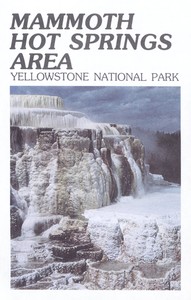
_MAMMOTH HOT SPRINGS AREA_
YELLOWSTONE NATIONAL PARK
_WELCOME to the Mammoth Hot Spring Terraces, one of Yellowstone’s
fascinating natural features! There are several ways to enjoy the
terraces—hike the boardwalks or drive the Upper Terrace Loop road, for
example. You may wish to drive to the Upper Terrace Loop, drop off
members of your party, let them hike down the boardwalk and pick them up
at the lower parking area. The maps in this pamphlet will help you
decide how you might best enjoy the terraces._
_The Mammoth Terraces and Hot Springs were officially discovered by a
U.S. Geological Survey party led by Dr. Ferdinand Hayden in 1871.
However, some local knowledge of the Hot Spring Terraces and their
activity had existed previous to that time._
_The Mammoth Hot Springs have interested people since the establishment
of Yellowstone National Park, not only for their striking beauty but
also their changeability. These remarkable springs are noted for their
rapid deposition, unpredictable shifts, and random rejuvenation. Here
the active forces of geology often make measurable changes from one day
to the next, and it is possible that significant changes have occurred
since this booklet was printed._
_INGREDIENTS FOR HOT SPRINGS ACTIVITY_
Hot water is the life of the terraces. Without it terrace growth ceases;
the formations weather gray and black, and begin to crumble. Typically
the many hot springs gush forth at random, flow a short way, then
disappear into a crack or fissure farther down slope.
In searching around the Mammoth area old dormant terrace mounds can be
found in several places. Although a frequent shifting seems to take
place, the records over the past several years indicate that the total
flow of water has remained fairly constant at some 500 gallons per
minute.
Ground water is the source of the outflow at Mammoth Hot Springs. It is
mostly seepage fed by rain and snow falling high on the slopes of
Terrace Mountain and areas as far south as Norris Geyser Basin. This
cold ground water is heated before it emerges to the surface by rising
heat from the magma chamber which once fueled the violent volcanos of
Yellowstone’s past. See the diagram on the reverse of this leaflet. The
water temperature in these springs reaches the vicinity of 170 F (73 C.)
Yet still another ingredient is needed for growth of the terraces—that
is, a basic building material. The raw material here is calcium
carbonate. It is abundant beneath Terrace Mountain as thick layers of
sedimentary limestone. Related layers of limestone are visible as
outcrops on the face of Mt. Everts across the narrow valley to the east.
[Illustration: Different temperature zones in the water channels
paint ribbons of algal color.]
As the ground water seeps slowly downward into the limestone it comes in
contact with hot gases rising from the magma chamber which are heavily
charged with carbon dioxide. Some of the carbon dioxide is readily
absorbed to form a carbonic acid solution. Ordinarily water can only
slowly dissolve limestone, but the hot, acidic solution rapidly
dissolves great quantities of it. Saturated with lime, the carbonated
water continues to seep along the rock layers until it gushes forth as
the Mammoth Hot Springs.
Once exposed to the open air some of the carbon dioxide escapes from the
solution, thus reducing the acidic level. As this happens, the lime, no
longer able to remain in solution, is deposited as travertine in the
shape and form of a terrace.
Looking at the terraces you can visualize the amount of limestone
excavated. Geologists estimate that the Mammoth Hot Springs water
carries more than two tons of dissolved limestone to the ground surface
each day.
_CHANGE ON THE MAMMOTH TERRACE_
The Mammoth Terraces are continuously changing. Had you visited the area
in the 1930’s, you would have found Blue Spring, Cleopatra, and Angel
Terraces to be the feature attractions. Today they stand as gray,
lifeless ruins, and newly named springs have succeeded them. Throughout
the 1970’s Jupiter and Minerva Springs and parts of Highland Terrace
have flowed freely, building delicate and colorful terraces. These clear
pools, rimmed by scallops of algae-tinted travertine, have created
spectacles known around the world for their beauty. The tiered pools
form as a result of the peculiar way in which the carbon dioxide escapes
from the cooling water. In tranquil pools evaporation is slow. Where
water is agitated the gas escapes quickly. At these points travertine is
deposited rapidly. The rim of deposition grows upward to form a higher
dam, which further accents the two zones. The travertine rim continues
to grow until water pressure bursts the dam. Then the process begins
again at a prominent riffle in the new channel.
_COLOR IN THE HOT SPRINGS_
Travertine is deposited as a white mineral, yet whenever hot water
glistens on its surface the formation is brilliant with color. The
oranges, yellows, greens and browns are from a great number of tiny
living bacteria and algae. Approximately sixty-five species of thermal
algae live in the waters of Mammoth Hot Springs and reflect varying
conditions of such environmental factors as temperature, acidity,
sunlight and carbon dioxide concentrations. White and bright yellow
thermal bacteria predominate in the hottest section of the runoff
channels near the springs. Farther along where the water has cooled a
bit, the orange, brown and green algaes are most abundant. Different
combinations of temperature and carbon dioxide paint mosaics of algal
color across the terraces.
Most of the color comes from the group known as the blue-green algae,
which display more colors than their name suggests. These thermal algae
are extremely primitive and have probably changed little from those
growing in hot springs at the very dawn of life on earth. Amid any
Yellowstone thermal basin on a steamy day it is easy to imagine a
volcanic region on a primitive earth where hot spring waters bubbled up
through colored strands of these same types of algae and bacteria.
_MAJOR FEATURES OF THE LOWER TERRACES_
_OPAL TERRACE_
Opal Spring flows at the base of Capitol Hill across the road from
Liberty Cap. After years of dormancy, this spring became active in 1926
and began depositing up to a foot of travertine per year. In 1947 a
tennis court was removed to allow natural expansion of the terrace.
Further growth threatened the historic home next to Opal. Designed by
Robert C. Reamer and built in 1908, the house is an example of Prairie
Style architecture. Among Reamer’s other designs are the Old Faithful
Inn and the Roosevelt Arch. Sandbags and an earthen wall today protect
the house. It is the mission of the National Park Service to protect
both historical and natural resources, which come in conflict at Opal
Terrace. Should the spring be restrained or the historic house removed?
_LIBERTY CAP_
This feature marks the north end of the Mammoth Hot Springs. It was
named in 1871 by the Hayden Survey party because of its marked
resemblance to the caps worn by colonial patriots during the
Revolutionary War. It stands today as an extinct hot spring cone. Its
outer surface has been cool and dry for many years and supports a plant
community much different from that found at the active hot springs. Near
the top are patches of orange lichen which are the pioneers at work
breaking the rock into soil, paving the way for other plants to follow
at some future time. PLEASE STAY ON THE TRAIL as weathering has loosened
rock fragments which may fall at any time.
_MINERVA SPRING_
Minerva Spring is centrally located within the lower terrace group and
is easily accessible by trail from the various parking areas. This
spring is a favorite not only because of its wide range of bright
colors, but also for its ornate travertine formations. Since the 1890’s
when the first records were kept on the activity of the Mammoth Hot
Springs, Minerva has gone through a series of active and inactive
periods. For several years in the early 1900’s it was completely dry,
but by 1951 it was again reported that “Minerva is very active and
certainly it is the most beautiful spring.” During the 1970’s spring
activity has increased in some of the other features regenerating algae
mats which now rival those found at Minerva.
_JUPITER SPRING_
Jupiter Spring is situated just south of Minerva. It was named in the
1880’s because of its imposing and towering formation. Jupiter was a
Roman god of the elements: the thunderbolt was his sign and the rainbow
his messenger. If you listen quietly you may hear the hot water
thundering down the terraces of this feature. The rainbow of algae
covering its terraces is obvious.
_AUTO TOUR OF THE UPPER TERRACE_
The entrance to the Mammoth Terrace Drive is one and one-half miles
south of the Mammoth Visitor Center on the road to Norris. This scenic
auto tour winds for one and one-half miles among several active thermal
springs and has convenient parking pull-outs along the route where you
can stop and become better acquainted with the features. The drive is a
one-way loop road and due to several sharp turns it is necessary to
exclude towing units, buses and motor homes in excess of 25 feet in
length. Remember that thin crust and very hot water make caution
especially important when you are near thermal features.
[Illustration: _MAMMOTH HOT SPRINGS AREA
Lower Terraces_]
CANARY SPRING
MAIN TERRACE
NEW BLUE SPRING
JUPITER TERRACE
NAIAD SPRING
MINERVA TERRACE
RESERVOIR SPRING
CAVERN SPRING
DEVIL’S THUMB
LIBERTY CAP
OPAL TERRACE
UPPER TERRACE DRIVE
NORRIS AND UPPER TERRACE DRIVE
MAMMOTH VILLAGE
_LOWER TERRACE OVERLOOK_
This viewpoint offers an excellent overview of the springs and pools of
the Lower Terraces. The large blue pool ahead and to the right is Canary
Spring. The pools visible to the left are the New Blue Springs complex.
The names of these features suggest colors which are inconsistent with
what we see today. The color of both features has changed from when they
were originally named. Changes in environmental conditions may account
for this: perhaps a change in water temperature.
The trail to the left goes around New Blue Spring and on down over the
terraces to Minerva Spring. Near that point the trail branches to the
right to Jupiter Spring and past Minerva itself, or left to Liberty Cap.
Both routes lead to parking areas along the lower road.
Beyond the terraces the red-roofed buildings on the right are those of
historic Fort Yellowstone, built and occupied by the U.S. Cavalry during
their tour of duty here from 1886 to 1918.
The ecological community in this section of the upper terraces is worth
noting. The high content of decayed travertine produces a porous soil
which dries out quickly. Consequently, vegetation is sparse and is
limited to those species which are tolerant of such conditions. Several
variations may be seen in the plant communities at other points along
the tour road. What environmental conditions can you detect that might
be influencing these differences?
_NEW HIGHLAND SPRING_
Activity began at New Highland Spring in 1952. The continuous heavy flow
of mineral laden water has caused a very rapid development of this
beautiful terrace. Prior to that time a luxuriant growth of trees,
shrubs and flowers covered this hillside. The tree skeletons being
engulfed by travertine stand as monuments to the former conditions.
To the right of New Highland still stands a portion of dense vegetative
cover growing on a north facing slope. Most noticeable upon close
inspection is the amount of undergrowth, which includes a heavy growth
of mosses. What soil and moisture conditions are reflected here? Why
would this area be so different?
_ORANGE MOUND SPRING_
The bright orange of this formation is a clue to the temperature of its
water. Also, the rate of flow and the rate of deposition are very slow.
It could follow then that since we have no record of this spring ever
being very active, this small mound could be considerably older than
those that are much larger.
_BATH LAKE_
Just ahead of you is a short but very steep hill. At the bottom of this
hill on the right is Bath Lake, named by some of the local residents in
the 1880’s. Being a quiet pool, deposition of travertine is at a slow
rate and the water remains highly mineralized with limestone. According
to the old records Bath Lake was entirely dry in 1926 and remained that
way until the 1959 earthquake. Although the name of this feature derives
from the soldiers’ habit of swimming in it, we now know that this
activity damages the bacteria and algae which are part of what the park
exists to preserve. Bathing in thermal features is also unsafe and
unlawful.
_WHITE ELEPHANT BACK TERRACE_
This long white ridge is unusual for a hot spring terrace and adds a
touch of fantasy to the area. Someone has said that it resembles a
string of circus elephants marching over the Mammoth Terraces. Take the
time to view it from different angles to see what you think!
The final section of the Upper Terrace Drive goes through a wooded area.
Mule deer are frequently seen here, especially during the late afternoon
and evening.
Forest vegetation along this section is dense even though it a
south-facing slope. The thermal features in this vicinity are old and
have been inactive for many years. This has allowed for a more complete
decomposition of the travertine and an accumulation of a heavier, richer
soil. Its moisture-holding properties far exceed those of the soil found
at the Lower Terrace Overlook.
_ANGEL TERRACE_
At the bottom of the hill on the left are the ruins of Angel Terrace.
Visitors during the 1920’s and 30’s saw it as a beautiful algae-tinted
feature. Today it is beginning to crumble and young pioneer plants are
taking root in the thin soil over its surface.
Alteration and change are constantly occurring in the thermal basins and
add to the mystery of this fascinating land. They bring not destruction
and loss, but rather new birth and gain. Who knows what interesting
ornate new features may develop by next year, or in five years. You are
encouraged to return again and again to enjoy this ever-changing scene.
For your safety and the protection of the fragile features, PLEASE STAY
ON THE TRAILS. Pets are not permitted on the trails, for their
protection and yours.
_EMERGENCY PHONE 344-7381_
[Illustration: _MAMMOTH HOT SPRINGS AREA_ YELLOWSTONE NATIONAL PARK]
WHITE ELEPHANT BACK TERRACE
BATH LAKE
ORANGE SPRING MOUND
NEW HIGHLAND SPRING
ANGEL TERRACE
CUPID SPRING
LOWER TERRACE OVERLOOK
NEW BLUE SPRINGS
CANARY SPRINGS
JUPITER SPRINGS
MINERVA SPRING
PALETTE SPRING
OPAL TERRACE
CAVERN SPRINGS
RESERVOIR SPRINGS
LIBERTY CAP
(ONE WAY)
NO TRAILERS OR BUSSES
NORRIS 21 MILES
TRAILS IN RED
PICNIC TABLES
BEAVER PONDS TRAIL (6 mile loop)
PHOTO SHOP
SERVICE STATION
GENERAL STORE
PHONE
RESTAURANT
MAMMOTH MOTOR INN AND CABINS
VISITOR CENTER
CHAPEL
TOWER ROOSEVELT 18 MILES
HORSE RENTAL
OLD ROAD TO GARDINER (ONE WAY, GRAVEL)
ICE VENDOR
POST OFFICE
CLINIC
ADMIN. BLDG.
CAMPGROUND
PHONE
NORTH ENTRANCE 5 MILES
Water falling on areas south of Mammoth Hot Springs seeps into
limestone strata.
water + carbon dioxide → mild carbonic acid; this dissolves limestone
Carbon dioxide gas rises from magma.
magma
Hot mineral springs flow from cracks.
fault zone
Gas (mainly carbon dioxide) escapes—limestone (travertine) forms
Board walk
The Yellowstone Association
[Illustration: NATIONAL PARK SERVICE • Department of the Interior]
This guide was published for your use by The Yellowstone Association for
Natural Science, History & Education, Inc. in cooperation with the
National Park Service, U.S. Department of the Interior.
The Yellowstone Association is a non-profit organization dedicated to
service to the park and its visitors. Your donation will be used for
this purpose.
For information about other pamphlets, books, and maps pertaining to
Yellowstone National Park or Association membership and educational
activities, write to P.O. Box 117, Yellowstone National Park, Wyoming
82190.
printed on recycled paper
Transcriber’s Notes
—Silently corrected a few typos.
—Retained publication information from the printed edition: this eBook
is public-domain in the country of publication.
—In the text versions only, text in italics is delimited by
_underscores_.