The Project Gutenberg eBook of London
This ebook is for the use of anyone anywhere in the United States and
most other parts of the world at no cost and with almost no restrictions
whatsoever. You may copy it, give it away or re-use it under the terms
of the Project Gutenberg License included with this ebook or online
at www.gutenberg.org. If you are not located in the United States,
you will have to check the laws of the country where you are located
before using this eBook.
Title: London
Author: G. K. Chesterton
Photographer: Alvin Langdon Coburn
Release date: May 7, 2020 [eBook #62048]
Most recently updated: October 18, 2024
Language: English
Credits: Produced by Tim Lindell, Chuck Greif and the Online
Distributed Proofreading Team at https://www.pgdp.net (This
file was produced from images generously made available
by The Internet Archive/Canadian Libraries)
*** START OF THE PROJECT GUTENBERG EBOOK LONDON ***
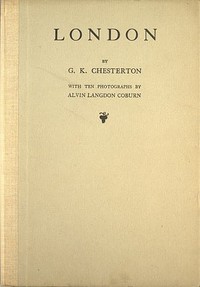
LONDON
[Illustration]
LONDON
BY
G. K. CHESTERTON
WITH TEN PHOTOGRAPHS BY
ALVIN LANGDON COBURN
[Illustration]
LONDON: PRIVATELY PRINTED FOR
ALVIN LANGDON COBURN AND
EDMUND D. BROOKS & THEIR FRIENDS
1914
LONDON
There is an old London story that has never lost its loveliness for me.
It was about a stout old lady from the country, who travelled round and
round the Underground Railway in a circle, because at each station she
tried to get out backwards, and at each station the guard pitched her in
again, under the impression that she was trying to get in. It is a
beautiful story; doing honour alike to the patience of the female sex
and the prompt courtesy of the male; it is a song without words. But
there is another and milder version (perhaps we might dare to say a more
probable version) of the same story. It describes an aged farmer and his
daughter travelling the same sad circle, and failing to alight anywhere,
partly because of the _impedimenta_ of country parcels, but partly also
because they were almost satisfied with the staring names of the places
set up on the Underground Railway. They thought the “Mansion House” was
rather a dark place for the Lord Mayor to live in. They could detect no
bridges through the twilight of “Westminster Bridge,” nor any promising
park in “St. James’ Park Station.” They could only suppose that they
were in the crypts of “The Temple”; or buried under the foundations of
“The Tower.”
Nevertheless, I am not quite so certain that this cockney tale against
countrymen scores so much as is supposed. The rustic saw the names at
least; and nine times out of ten the names are nobler than the things.
Let us suppose him as starting westward from the Mansion House, where he
commiserated the dim captivity of the Lord Mayor. He would come to
another equally gloomy vault in which he would read the word
“Blackfriars.” It is not a specially cheery word; but it goes back, I
imagine, to that great movement, at once dogmatic and democratic, which
gave to its followers the fierce and fine name of the “Dogs of God.” But
at the worst, the mere name of Blackfriars Station is more dignified
than the Blackfriars Road. He would pass on to the Temple; and surely
the mere word “Temple” is more essential and eternal than either the
rich lawyers in its courts, or the poor vagabonds on its Embankment. He
will go on to Charing Cross, where the noblest of English knights and
kings set up a cross to his dead queen. But unless his rustic erudition
informs him of the fact, he will gain little by getting out of the
train, and going to the larger station. Neither porters carrying luggage
nor trippers carrying babies, will encourage any conversation about the
original sacredness of the spot. He will stop next at a yet more sacred
spot, the station called Westminster Bridge, from which he can visit, as
Macaulay says, “the place where five generations of statesmen have
striven, and the place where they sleep together.” By walking across the
street from this station he can enter the House of Commons. But, if he
is wise, he will stop in the train. He will then arrive at St. James’
Park; and (as Mr. Max Beerbohm has truly remarked) he will not meet St.
James there.
Yet these mere names that he has seen on a dingy wall, like
advertisements, are really the foundation stones of London; and it is
right that they should (as it were) be underground. The mere fact that
these five names, in a row along the riverside, all bear witness to an
ancient religion would tell the rustic in the railway train (supposing
him to be of elaborate culture and lightning deduction) the great part
of the history of London. The old Temple Church still stands, full of
the tombs of those great and doubtful heroes who signed themselves with
the sign of Christ, but who came, rightly or wrongly, to be stamped by
their neighbours with the seal of Antichrist. The old Charing Cross is
gone; but its very absence is as much of a historical monument as
itself. For the Puritans pulled it down merely for being a cross; though
(as it says in a humorous song of the period) Charing Cross had always
refrained from uttering a word against the authority of the Parliament.
But these old things, though fundamental, are fragmentary; and whether
as ruins or merely as records, will tell the stranger little of what
London has been and is, as distinct from Paris or Berlin or Chicago.
London is a mediaeval town, as these names testify; but its soul has
been sunk deeper under other things than any other town that remembers
mediaevalism at all. It is very hard indeed to find London in London.
There is a story (one among many) that there was a settlement before the
Romans came, which occupied about the same space that is now occupied by
Cannon Street Station. In any case, it is probable that the seed of the
city was sown somewhere about that slope of the riverside. The Romans
made it a great town but hardly their greatest town, and the barbarism
of the ninth century left it bare. Its second or third foundation as a
predominant city belongs, like many such things, to the genius and
tenacity of Alfred. He did not indeed hold it as a capital of England,
but rather as an outpost of Wessex. From his point of view, London was a
suburb of Wantage. But he saw the practical importance of its position
towards the river mouth; and he held it tight. The Norman Conquest
clinched the condition, which was roughly symbolized by the Tower of
London, which for many centuries was a trophy captured and recaptured by
opposite factions. But, in the main, London had one political character
from first to last. It was always, for good or evil, on the side of the
Parliament and against the King. Six hundred years ago, it was the
citizens of London who had to stand the charge of the strongest of the
Plantagenets in his youth, on the downs round Lewes. Four hundred years
afterwards, it was the citizens of London who held the high places of
Buckinghamshire, when the army of Charles I threatened London from
Oxford. Later still, the Londoners stood solidly against James II and
splendidly against George III. Whether Parliament was worth such
fidelity, whether the merchants of the Thames were wise to tie
themselves so entirely to the grandees of the counties, is no subject
for this place. But that the tradition of the town was sincere and
continuous cannot be doubted. To this day the Lord Mayor of London is
probably proud that the King of England can only enter London by his
leave. That fact is as close a summary of the purely political history
of London as one could want. It exactly expresses the victory of the
merchants over the central power. It is often observed that the French
think the Lord Mayor of London more important than the King. They are an
acute people.
This rather surly love of liberty (or rather of independence) is written
in the straggling map of London, and proclaimed in its patchwork
architecture. There is in it something that every Englishman feels in
himself, though he does not always feel it to be good; something of the
amateur; something of the eccentric. The nearest phrase is the negative
one of “unofficial.” London is so English, that it can hardly be called
even the capital of England. It is not even the county town of the
county in which it stands. That title, I believe, belongs to Brentford,
which legend credits with two kings at once, like Lacedaemon. It is
just London. As his French friend said about Browning, its centre is not
in the middle. The Parliament sits in London, but not in the City, of
London; the City of London is not under the London County Council; and
in spite of the opinion of General Choke, the Sovereign does not live in
the Tower. Crowded and noisy as it is, there is something shy about
London: it is full of secrets and anomalies; and it does not like to be
asked what it is for. In this, there is not a little of its history as a
sort of half-rebel through so many centuries. Hence it is a city of side
streets that only lead into side streets; a city of short cuts--that
take a long time. There have been recent changes in the other direction,
of course; but the very name of one of them, unintentionally illustrates
something not native to the place. A more broad and sweeping
thoroughfare, in the Continental manner, was opened between the Strand
and Holborn, and called Kingsway. The phrase will serve for a symbol.
Through all those creative and characteristic epochs, there was no
King’s Way through London. There was nothing Napoleonic; no roads that
could be properly decorated with his victories, or properly cleared with
his cannon. It had something of the licence and privilege of that
Alsatia that was its sore; the little impenetrable kingdom of rascals
that revelled down in Whitefriars, where now rascals of a more mournful
kind write Imperialist newspapers. One might call mediaeval London a
rabbit warren; save that the Trainbands who took their pikes, and
’prentices who caught up their clubs at a bell or a beacon, were
certainly anything but rabbits.
I have said that this eccentricity, amounting to secrecy, remains in the
very building of London. Some of the finest glimpses of it are got as if
through the crack of a door. Our fathers gained freedom of vision
through the gap in a fence; just as they often gained freedom of speech
through a flaw in an Act of Parliament. In their glorious visions of
height or distance, there is always something of the keyhole; just as in
their glorious fights for law or liberty, there was always something of
the quibble. There is no finer effect than St. Paul’s from the foot of
its hill in delicate and native weather; for the English climate (I may
remark) is the finest in the world. I assume, of course, that the
spectator is a serious mystic (that is, a materialist also) and
appreciates the bodily beauty of heights, which should always be seen
from below. The Devil takes us to the top of an exceeding high
mountain, and makes us dizzy; but God lets us look at the mountain. Yet
this mountain made by man can only be seen in London by “sighting;” by
getting it between two houses, as a pilot steers between two rocks. Get
the sighting wrong and you will see only a public-house, or (what is
much worse) a shop full of newspapers. Had either a French or a Prussian
temple commanded such an eminence, the whole hill would have been swept
bare as with a sabre and studded with statues and gardens, that it might
be seen from afar. Only I should not like it so much. But then I was
born in London.
PLATES
LIST OF ILLUSTRATIONS
I. THE MANSION HOUSE.
II. THE TOWER.
III. THE TEMPLE.
IV. THE EMBANKMENT.
V. WESTMINSTER BRIDGE.
VI. PARLIAMENT FROM THE RIVER.
VII. BIG BEN.
VIII. ST. PAUL’S FROM BANKSIDE.
IX. THE THAMES.
X. “ST. PAUL’S FROM THE FOOT OF ITS HILL.”
[Illustration: I]
[Illustration: II]
[Illustration: III]
[Illustration: IV]
[Illustration: V]
[Illustration: VI]
[Illustration: VII]
[Illustration: VIII]
[Illustration: IX]
[Illustration: X]
CHISWICK PRESS: CHAS. WHITTINGHAM AND CO.
TOOKS COURT, CHANCERY LANE, LONDON.
THE ILLUSTRATIONS WERE PRINTED BY THE
MEZZOGRAVURE COMPANY, LONDON.
*** END OF THE PROJECT GUTENBERG EBOOK LONDON ***
Updated editions will replace the previous one—the old editions will
be renamed.
Creating the works from print editions not protected by U.S. copyright
law means that no one owns a United States copyright in these works,
so the Foundation (and you!) can copy and distribute it in the United
States without permission and without paying copyright
royalties. Special rules, set forth in the General Terms of Use part
of this license, apply to copying and distributing Project
Gutenberg™ electronic works to protect the PROJECT GUTENBERG™
concept and trademark. Project Gutenberg is a registered trademark,
and may not be used if you charge for an eBook, except by following
the terms of the trademark license, including paying royalties for use
of the Project Gutenberg trademark. If you do not charge anything for
copies of this eBook, complying with the trademark license is very
easy. You may use this eBook for nearly any purpose such as creation
of derivative works, reports, performances and research. Project
Gutenberg eBooks may be modified and printed and given away—you may
do practically ANYTHING in the United States with eBooks not protected
by U.S. copyright law. Redistribution is subject to the trademark
license, especially commercial redistribution.
START: FULL LICENSE
THE FULL PROJECT GUTENBERG LICENSE
PLEASE READ THIS BEFORE YOU DISTRIBUTE OR USE THIS WORK
To protect the Project Gutenberg™ mission of promoting the free
distribution of electronic works, by using or distributing this work
(or any other work associated in any way with the phrase “Project
Gutenberg”), you agree to comply with all the terms of the Full
Project Gutenberg™ License available with this file or online at
www.gutenberg.org/license.
Section 1. General Terms of Use and Redistributing Project Gutenberg™
electronic works
1.A. By reading or using any part of this Project Gutenberg™
electronic work, you indicate that you have read, understand, agree to
and accept all the terms of this license and intellectual property
(trademark/copyright) agreement. If you do not agree to abide by all
the terms of this agreement, you must cease using and return or
destroy all copies of Project Gutenberg™ electronic works in your
possession. If you paid a fee for obtaining a copy of or access to a
Project Gutenberg™ electronic work and you do not agree to be bound
by the terms of this agreement, you may obtain a refund from the person
or entity to whom you paid the fee as set forth in paragraph 1.E.8.
1.B. “Project Gutenberg” is a registered trademark. It may only be
used on or associated in any way with an electronic work by people who
agree to be bound by the terms of this agreement. There are a few
things that you can do with most Project Gutenberg™ electronic works
even without complying with the full terms of this agreement. See
paragraph 1.C below. There are a lot of things you can do with Project
Gutenberg™ electronic works if you follow the terms of this
agreement and help preserve free future access to Project Gutenberg™
electronic works. See paragraph 1.E below.
1.C. The Project Gutenberg Literary Archive Foundation (“the
Foundation” or PGLAF), owns a compilation copyright in the collection
of Project Gutenberg™ electronic works. Nearly all the individual
works in the collection are in the public domain in the United
States. If an individual work is unprotected by copyright law in the
United States and you are located in the United States, we do not
claim a right to prevent you from copying, distributing, performing,
displaying or creating derivative works based on the work as long as
all references to Project Gutenberg are removed. Of course, we hope
that you will support the Project Gutenberg™ mission of promoting
free access to electronic works by freely sharing Project Gutenberg™
works in compliance with the terms of this agreement for keeping the
Project Gutenberg™ name associated with the work. You can easily
comply with the terms of this agreement by keeping this work in the
same format with its attached full Project Gutenberg™ License when
you share it without charge with others.
1.D. The copyright laws of the place where you are located also govern
what you can do with this work. Copyright laws in most countries are
in a constant state of change. If you are outside the United States,
check the laws of your country in addition to the terms of this
agreement before downloading, copying, displaying, performing,
distributing or creating derivative works based on this work or any
other Project Gutenberg™ work. The Foundation makes no
representations concerning the copyright status of any work in any
country other than the United States.
1.E. Unless you have removed all references to Project Gutenberg:
1.E.1. The following sentence, with active links to, or other
immediate access to, the full Project Gutenberg™ License must appear
prominently whenever any copy of a Project Gutenberg™ work (any work
on which the phrase “Project Gutenberg” appears, or with which the
phrase “Project Gutenberg” is associated) is accessed, displayed,
performed, viewed, copied or distributed:
This eBook is for the use of anyone anywhere in the United States and most
other parts of the world at no cost and with almost no restrictions
whatsoever. You may copy it, give it away or re-use it under the terms
of the Project Gutenberg License included with this eBook or online
at www.gutenberg.org. If you
are not located in the United States, you will have to check the laws
of the country where you are located before using this eBook.
1.E.2. If an individual Project Gutenberg™ electronic work is
derived from texts not protected by U.S. copyright law (does not
contain a notice indicating that it is posted with permission of the
copyright holder), the work can be copied and distributed to anyone in
the United States without paying any fees or charges. If you are
redistributing or providing access to a work with the phrase “Project
Gutenberg” associated with or appearing on the work, you must comply
either with the requirements of paragraphs 1.E.1 through 1.E.7 or
obtain permission for the use of the work and the Project Gutenberg™
trademark as set forth in paragraphs 1.E.8 or 1.E.9.
1.E.3. If an individual Project Gutenberg™ electronic work is posted
with the permission of the copyright holder, your use and distribution
must comply with both paragraphs 1.E.1 through 1.E.7 and any
additional terms imposed by the copyright holder. Additional terms
will be linked to the Project Gutenberg™ License for all works
posted with the permission of the copyright holder found at the
beginning of this work.
1.E.4. Do not unlink or detach or remove the full Project Gutenberg™
License terms from this work, or any files containing a part of this
work or any other work associated with Project Gutenberg™.
1.E.5. Do not copy, display, perform, distribute or redistribute this
electronic work, or any part of this electronic work, without
prominently displaying the sentence set forth in paragraph 1.E.1 with
active links or immediate access to the full terms of the Project
Gutenberg™ License.
1.E.6. You may convert to and distribute this work in any binary,
compressed, marked up, nonproprietary or proprietary form, including
any word processing or hypertext form. However, if you provide access
to or distribute copies of a Project Gutenberg™ work in a format
other than “Plain Vanilla ASCII” or other format used in the official
version posted on the official Project Gutenberg™ website
(www.gutenberg.org), you must, at no additional cost, fee or expense
to the user, provide a copy, a means of exporting a copy, or a means
of obtaining a copy upon request, of the work in its original “Plain
Vanilla ASCII” or other form. Any alternate format must include the
full Project Gutenberg™ License as specified in paragraph 1.E.1.
1.E.7. Do not charge a fee for access to, viewing, displaying,
performing, copying or distributing any Project Gutenberg™ works
unless you comply with paragraph 1.E.8 or 1.E.9.
1.E.8. You may charge a reasonable fee for copies of or providing
access to or distributing Project Gutenberg™ electronic works
provided that:
• You pay a royalty fee of 20% of the gross profits you derive from
the use of Project Gutenberg™ works calculated using the method
you already use to calculate your applicable taxes. The fee is owed
to the owner of the Project Gutenberg™ trademark, but he has
agreed to donate royalties under this paragraph to the Project
Gutenberg Literary Archive Foundation. Royalty payments must be paid
within 60 days following each date on which you prepare (or are
legally required to prepare) your periodic tax returns. Royalty
payments should be clearly marked as such and sent to the Project
Gutenberg Literary Archive Foundation at the address specified in
Section 4, “Information about donations to the Project Gutenberg
Literary Archive Foundation.”
• You provide a full refund of any money paid by a user who notifies
you in writing (or by e-mail) within 30 days of receipt that s/he
does not agree to the terms of the full Project Gutenberg™
License. You must require such a user to return or destroy all
copies of the works possessed in a physical medium and discontinue
all use of and all access to other copies of Project Gutenberg™
works.
• You provide, in accordance with paragraph 1.F.3, a full refund of
any money paid for a work or a replacement copy, if a defect in the
electronic work is discovered and reported to you within 90 days of
receipt of the work.
• You comply with all other terms of this agreement for free
distribution of Project Gutenberg™ works.
1.E.9. If you wish to charge a fee or distribute a Project
Gutenberg™ electronic work or group of works on different terms than
are set forth in this agreement, you must obtain permission in writing
from the Project Gutenberg Literary Archive Foundation, the manager of
the Project Gutenberg™ trademark. Contact the Foundation as set
forth in Section 3 below.
1.F.
1.F.1. Project Gutenberg volunteers and employees expend considerable
effort to identify, do copyright research on, transcribe and proofread
works not protected by U.S. copyright law in creating the Project
Gutenberg™ collection. Despite these efforts, Project Gutenberg™
electronic works, and the medium on which they may be stored, may
contain “Defects,” such as, but not limited to, incomplete, inaccurate
or corrupt data, transcription errors, a copyright or other
intellectual property infringement, a defective or damaged disk or
other medium, a computer virus, or computer codes that damage or
cannot be read by your equipment.
1.F.2. LIMITED WARRANTY, DISCLAIMER OF DAMAGES - Except for the “Right
of Replacement or Refund” described in paragraph 1.F.3, the Project
Gutenberg Literary Archive Foundation, the owner of the Project
Gutenberg™ trademark, and any other party distributing a Project
Gutenberg™ electronic work under this agreement, disclaim all
liability to you for damages, costs and expenses, including legal
fees. YOU AGREE THAT YOU HAVE NO REMEDIES FOR NEGLIGENCE, STRICT
LIABILITY, BREACH OF WARRANTY OR BREACH OF CONTRACT EXCEPT THOSE
PROVIDED IN PARAGRAPH 1.F.3. YOU AGREE THAT THE FOUNDATION, THE
TRADEMARK OWNER, AND ANY DISTRIBUTOR UNDER THIS AGREEMENT WILL NOT BE
LIABLE TO YOU FOR ACTUAL, DIRECT, INDIRECT, CONSEQUENTIAL, PUNITIVE OR
INCIDENTAL DAMAGES EVEN IF YOU GIVE NOTICE OF THE POSSIBILITY OF SUCH
DAMAGE.
1.F.3. LIMITED RIGHT OF REPLACEMENT OR REFUND - If you discover a
defect in this electronic work within 90 days of receiving it, you can
receive a refund of the money (if any) you paid for it by sending a
written explanation to the person you received the work from. If you
received the work on a physical medium, you must return the medium
with your written explanation. The person or entity that provided you
with the defective work may elect to provide a replacement copy in
lieu of a refund. If you received the work electronically, the person
or entity providing it to you may choose to give you a second
opportunity to receive the work electronically in lieu of a refund. If
the second copy is also defective, you may demand a refund in writing
without further opportunities to fix the problem.
1.F.4. Except for the limited right of replacement or refund set forth
in paragraph 1.F.3, this work is provided to you ‘AS-IS’, WITH NO
OTHER WARRANTIES OF ANY KIND, EXPRESS OR IMPLIED, INCLUDING BUT NOT
LIMITED TO WARRANTIES OF MERCHANTABILITY OR FITNESS FOR ANY PURPOSE.
1.F.5. Some states do not allow disclaimers of certain implied
warranties or the exclusion or limitation of certain types of
damages. If any disclaimer or limitation set forth in this agreement
violates the law of the state applicable to this agreement, the
agreement shall be interpreted to make the maximum disclaimer or
limitation permitted by the applicable state law. The invalidity or
unenforceability of any provision of this agreement shall not void the
remaining provisions.
1.F.6. INDEMNITY - You agree to indemnify and hold the Foundation, the
trademark owner, any agent or employee of the Foundation, anyone
providing copies of Project Gutenberg™ electronic works in
accordance with this agreement, and any volunteers associated with the
production, promotion and distribution of Project Gutenberg™
electronic works, harmless from all liability, costs and expenses,
including legal fees, that arise directly or indirectly from any of
the following which you do or cause to occur: (a) distribution of this
or any Project Gutenberg™ work, (b) alteration, modification, or
additions or deletions to any Project Gutenberg™ work, and (c) any
Defect you cause.
Section 2. Information about the Mission of Project Gutenberg™
Project Gutenberg™ is synonymous with the free distribution of
electronic works in formats readable by the widest variety of
computers including obsolete, old, middle-aged and new computers. It
exists because of the efforts of hundreds of volunteers and donations
from people in all walks of life.
Volunteers and financial support to provide volunteers with the
assistance they need are critical to reaching Project Gutenberg™’s
goals and ensuring that the Project Gutenberg™ collection will
remain freely available for generations to come. In 2001, the Project
Gutenberg Literary Archive Foundation was created to provide a secure
and permanent future for Project Gutenberg™ and future
generations. To learn more about the Project Gutenberg Literary
Archive Foundation and how your efforts and donations can help, see
Sections 3 and 4 and the Foundation information page at www.gutenberg.org.
Section 3. Information about the Project Gutenberg Literary Archive Foundation
The Project Gutenberg Literary Archive Foundation is a non-profit
501(c)(3) educational corporation organized under the laws of the
state of Mississippi and granted tax exempt status by the Internal
Revenue Service. The Foundation’s EIN or federal tax identification
number is 64-6221541. Contributions to the Project Gutenberg Literary
Archive Foundation are tax deductible to the full extent permitted by
U.S. federal laws and your state’s laws.
The Foundation’s business office is located at 809 North 1500 West,
Salt Lake City, UT 84116, (801) 596-1887. Email contact links and up
to date contact information can be found at the Foundation’s website
and official page at www.gutenberg.org/contact
Section 4. Information about Donations to the Project Gutenberg
Literary Archive Foundation
Project Gutenberg™ depends upon and cannot survive without widespread
public support and donations to carry out its mission of
increasing the number of public domain and licensed works that can be
freely distributed in machine-readable form accessible by the widest
array of equipment including outdated equipment. Many small donations
($1 to $5,000) are particularly important to maintaining tax exempt
status with the IRS.
The Foundation is committed to complying with the laws regulating
charities and charitable donations in all 50 states of the United
States. Compliance requirements are not uniform and it takes a
considerable effort, much paperwork and many fees to meet and keep up
with these requirements. We do not solicit donations in locations
where we have not received written confirmation of compliance. To SEND
DONATIONS or determine the status of compliance for any particular state
visit www.gutenberg.org/donate.
While we cannot and do not solicit contributions from states where we
have not met the solicitation requirements, we know of no prohibition
against accepting unsolicited donations from donors in such states who
approach us with offers to donate.
International donations are gratefully accepted, but we cannot make
any statements concerning tax treatment of donations received from
outside the United States. U.S. laws alone swamp our small staff.
Please check the Project Gutenberg web pages for current donation
methods and addresses. Donations are accepted in a number of other
ways including checks, online payments and credit card donations. To
donate, please visit: www.gutenberg.org/donate.
Section 5. General Information About Project Gutenberg™ electronic works
Professor Michael S. Hart was the originator of the Project
Gutenberg™ concept of a library of electronic works that could be
freely shared with anyone. For forty years, he produced and
distributed Project Gutenberg™ eBooks with only a loose network of
volunteer support.
Project Gutenberg™ eBooks are often created from several printed
editions, all of which are confirmed as not protected by copyright in
the U.S. unless a copyright notice is included. Thus, we do not
necessarily keep eBooks in compliance with any particular paper
edition.
Most people start at our website which has the main PG search
facility: www.gutenberg.org.
This website includes information about Project Gutenberg™,
including how to make donations to the Project Gutenberg Literary
Archive Foundation, how to help produce our new eBooks, and how to
subscribe to our email newsletter to hear about new eBooks.