Kadjaman
By H. de Vere Stacpoole
Author of “‘Glued,’” “‘It Is Paris,’” etc.
Tuan Marop, down there in Borneo, was capable of cutting
out more than his right eye if it offended him. Perhaps
Kray was right in guessing that Tuan was akin to those who
have saved us in the past from backsliding into beasts.
Kray’s little son was playing with the big Siberian pup in the
doorway. From where I sat I could see the child and the dog, and
beyond them and framed by the door opening the pine-clad mountains
cutting the blue sky of summer, and beyond these Omstjall, the snow
peak and grandfather of the glacier that takes its name.
Kray has given up hunting these five years and is now manager of the
Sellagman Salmon Canning Company, at least he looks after the fishing
and the canning and gets two thousand dollars a year for the job,
while I expect the real manager, the man who looks after the New York
office and the prospectuses and so forth, gets ten—maybe more. I don’t
know, neither does Kray, neither does he care. He says he has hunted
everything in his time but the dollar, and that a free life in the
open air is all he wants now that he has done with hunting and got
married. He was sixty-seven years old when he married and didn’t look
more than fifty, so he says; he doesn’t look more than fifty to-day,
at a little distance.
He has hunted everywhere and shot everything and he started his
business at twenty so that when he married he had been at the job
nearly fifty years. That is a long time, for a year in the wilds is
longer than a year in a city and the risks are greater.
Said Kray, looking at the child and the pup: “Olaff takes after his
mother, don’t he? Same flax-colored hair coming. First I thought he
was going to be darker, but it’s coming true enough. Scandinavian
flax, there’s no other color like it. Gets on with the pup, don’t he?
I saw the old dog lickin’ them both yesterday same as if Olaff was
hers, too. I’ve sent her off to the Skagga _fjord_ till the autumn.”
“The big Siberian dog I saw here last?”
“Yes, the mother of that pup. I’ve sent her off till the autumn. Olaff
will be bigger then.”
“But why did you send her off—because she was treating Olaff as if he
were her pup?”
“Well, not exactly,” said Kray, “and yet maybe that was a bit of the
reason. But mainly I expect it was something that happened years ago
that rattled me; thirty years ago it was when I was with Becconi in
Borneo on the exploring job. He was after minerals and if he’d stuck
to them in his drinks as well as his prospectin’ he’d have pulled
through; but the whisky did him. I’d been out East with a chap called
Milner hunting, and we struck Sarawak coast. Milner was going home
from there, and I was paid off with a bonus. I could have gone back
with him to England, and maybe would only for this chap Becconi who
happened along while we were waiting at Bintulu for a boat.
“Boats in those days weren’t plentiful along the coast, and you didn’t
often know where they were going when they came, but as long as they
took you somewhere else it didn’t much matter. That’s how we were
placed at Bintulu when out of the sea haze one day a little
paddle-wheel boat came snortin’ and tied up to the rotten old wharf
where the Sea Dyak children used to sit fishing when they weren’t
playing headhunting with wooden _parangs_.
“The _Tanjong Data_ was the name of the boat, and she was bound for
Rejang and Kuching and ports beyond with a mixed cargo and a big
monkey for the Dutch government that had been caught somewheres to the
north of the Tubao River. The _Tanjong_ had blown a cylinder cover off
or something, and she lay at Bintulu a week for repairs and while she
was repairing and taking more cargo I was often on board talking to
the captain and Becconi, who had come by her and was sticking on board
till the last minute, seeing that his cabin was a sight more
comfortable than shore quarters. The monkey interested me a lot, for
in all my shooting I’d never come across the big monkeys much, and
this chap was big. He must have weighed all of two hundred pounds, and
he was turning gray with age. He was what the Dyaks call a Mayas
Kassa, which means an orang-utan, with a face like a full moon. I’m
not joking. There are three kinds of orang-utans; the Mayas Kassa, the
Mayas Rabei, and the Mayas Tjaping, but the Kassa takes the bun for
beauty. I never did see such a face. It was like nothing so much as a
full moon broadened out, same as you see it when the moon’s rising
through a bank of mist and in the middle of it two eyes and a nose, to
say nothing of the mouth. That was what the monkey was like, and they
had him in a cage close to the engine-room hatch, and he’d sit there
the day long, scratching himself and talking to himself, his eyes
traveling about round the decks as if he was watching something
passing, and sometimes he’d look up at you, but he’d never meet your
eye square, at least not for longer than the flick of a snapshot
shutter.
“Taking him altogether he was near five feet in height and his chest
looked as thick as a tree as he sat there scratching the fur on it,
his hands were as big as hams; and I reckon he could have taken two
ordinary men and knocked their heads together same as if they’d been
two rag dolls.
“Becconi took a lot of interest in the chap, too, and we’d sit under
the double awning they’d rigged aft of the funnel and have our drinks
and watch Kadjaman, for that was his name, given him because he was
caught at Kadjaman, which is north of Fort Bellaja near the Tubao
River. Becconi, when he had the whisky in him, would stand up for
Kadjaman having a soul of his own, same as a man; but if the whisky
was out, and maybe a touch of liver on him, he’d be the other way
about. I used to use the monkey on him for fun, or to see the state of
his health, and then Kadjaman would sit watching us and pretending not
to.
“We didn’t know that he’d been at work of nights, when the whole of
Bintulu and the chaps on board were snoring. He’d worked on the cage
bars, loosening them by degrees and little by little, so that the time
might come when one big pluck could rip them out.
“No, sir, we didn’t know that or we couldn’t have sat there sucking
our cheroots and bug juice and talking about monkeys having souls.
II.
“Now I must tell you that Milner had a servant, Tuan Marop by name,
and Tuan had his child with him, a little chap of six or so, named
Ting. Mrs. Tuan had been dead over a year, and he’d brought Ting down
to Bintulu to leave him there while he accompanied Milner on his
expedition. Ting and Kadjaman had struck up a friendship of sorts. The
child would talk to the brute in the Dyak lingo and Kadjaman would
scratch himself and talk back in orang-utan. I tell you it was
talking.
“You’ve seen a child talking to a dog—you’ve heard Olaff talking to
that pup; well that was the sort of thing, only Ting wasn’t a soft
little chap like Olaff. Ting was a Dyak, Sarabas Dyak, with a hundred
generations of head hunters behind him, and what he was saying to
Kadjaman didn’t seem a popsy-wopsy talk from what I could gather,
though I didn’t know a word of his lingo.
“I asked Becconi to ask Tuan to listen and report, and Tuan said Ting
wasn’t talking Dyak, but the monkey language. Seemed to think it a
joke, but he was in dead earnest all the same. There is a monkey
language as sure as there’s anything else in this world, and what they
say to each other, Lord only knows, but they say a lot, and Ting
seemed to have picked it up same as children do with foreign
languages. Tuan said that the Dyak children, now and again and once in
a hundred years, so to speak, could pick out what the monkeys were
saying when they held their jamborees in the forest, but he’d never
seen or heard of a child talking to a monkey before like Ting did, for
the reason that the Dyaks didn’t keep monkeys in cages and so the
children hadn’t a chance. He seemed proud of the fact, same as if Ting
had taken a prize at college.
“So things went on like that till the _Tanjong Data_ had done
tinkering at her cylinder covers, and the day before leaving came,
with the docks all of a clatter with fruit cases for down coast and
rolls of matting and boxes of tobacco and Lord knows what else and the
niggers all bug house with being driven and getting in each other’s
way.
“Then, coming along four o’clock in the evening, when things had
settled down and the breeze was rising, Becconi and I were sitting in
deck chairs talking and saying good-by to Milner and the captain. Tuan
had brought us up some tea which the steward had made for us, and Ting
was playing near the gangway by himself. All of a sudden, swish! the
bars of the cage went, and Kadjaman was out.
“I was sitting with my back to the cage, and when I turned I saw
Kadjaman on the deck, a cage bar in his fist, and the bar was in the
act of dashing a nigger’s brains out. It was all as sudden as that. I
didn’t wait to see more. It was every man for himself, and I had no
charter to clear the decks of the _Tanjong Data_ of orang-utans armed
with five-foot iron bars; besides I hadn’t my gun with me. I guess if
I’d had a popgun even, I wouldn’t have taken a nose dive into the
Bintulu River like I did. A man’s courage lies in his gun often
enough—unless he’s fronting a moral duty, which I wasn’t. I just dived
and got to the other bank and watched.
“Every one had skipped from that deck either overboard or through the
saloon hatch and there was Kadjaman with his bar in his fist, a free
man, so to say, soul or no soul. He was pretty busy, too. He wanted
more blood, it seemed, but he was afraid of going below for it, afraid
of traps, so he smashed away at the saloon skylight cover, beating the
brass rods of it to knots. Then he beat the starboard rail; in fact,
he gave that steamer the biggest thrashing of her life. Maybe it was
his having been kept in a cage six months that was coming out, or
maybe it was just his own nature; but he did take it out of that old
hooker. He near beat the cockroaches out of her, and you can fancy
that the chaps hidden in the cabin had a lively time expecting him
down the saloon companionway.
“However, all of a sudden, he let up. I could see him standing
sniffing the air as if he smelt danger. He stood like that for half a
tick and then he stooped down and picked up something from the deck
and threw it over his arm like a sack. Same moment he made a jump for
the gangway and next he was on the bank.
“I saw now what he was carrying—and heard it, too—it was Ting. The
child had been playing on the deck as I told you and hadn’t got below
with the others. Maybe he’d sat admiring the ways of his friend, but
that’s as may be; the fact was he was now shouting murder or what
sounded like it in Dyak and Tuan was responding.
“Tuan had found a creese down below, and, before the monkey had made
twenty yards, he was on deck and after him to recover his property.
Becconi and Milner, who’d armed themselves, were after Tuan to lend a
hand, and there was I stuck on the opposite bank only able to look on.
“On the flat Kadjaman was nowhere, but once he’d got among the trees
he was the whole of the circus and the elephant.
“Just by the river there, the undergrowth’s so thick you can’t go more
than a yard in a precious long minute. You should see it; wait-a-bit
thorns three inches long, python _lianas_ that twine about and knot
themselves just like snakes, ground tangle that gets you just by the
ankle. That’s what the goin’s like, and Kadjaman was up in the
branches. I don’t know how he got along with Ting, swinging himself
from branch to branch. I expect Ting clung to him for safety and so
saved trouble and gave him the free use of both arms.
“Anyhow he got away—got clear away, leaving Tuan lamenting and the
rest of them pretty well spent. Then they came back, and I met them,
having swum the river, and we went back on board, and you should have
seen that deck—the rail bent and skylight hashed and lashed so’s to
look like nothing, and a dead nigger on the planks with a hundred
thousand flies on his head like a buzzing turban.
“Tuan had come back with us. He’d altered in color a bit, but
otherwise he seemed same as ordinary. He knew quite well there was no
use chasing any more after Kadjaman, yet all the same he got his
discharge from Milner that night, and he went off with a blowgun. That
was all the weapons he wanted, so he said, but he didn’t catch
Kadjaman.
III.
“Next morning the _Tanjong Data_ started with Milner on board, leaving
us in that God-forsaken place face to face with the mosquitoes. Havana
mosquitoes are bad, but these chaps laid over them, striped brutes
like tigers. Then there were the Sanut _tingal pala_ ants; these chaps
bite you and hang on with their teeth like bulldogs; if you pull them
off they leave their heads behind. A cheerful place, with nothing to
listen to but the rainy noise of the palm leaves, shaken by the wind
and the howling of Dyak songs from the village, and nothing to see but
the Bintulu coming down to the sea between banks of trees that seemed
crowding one another into the river.
“There are parts of the Bintulu where no man could make a landing on
the banks, by reason of the tangle of growth, vines and whatnots; but
at Bintulu it’s been cleared, though in those days it was bad enough
within half a mile of the town.
“Becconi wasn’t going to start for three days, so I had my work cut
out killing time and mosquitoes. I’d sit sometimes by the river
watching the gunfish by the hour. You’d see them prospecting along the
bank, and then when they’d marked down an insect sitting on a leaf,
they’d take aim and spit, letting fly a jet of water aimed sure as a
rifle bullet. Then I’d sometimes watch the Dyak girls going about, the
rummiest sight, in their brass arm rings and leg wear, and sometimes
I’d sit and talk to Tuan, for Becconi had taken him on as a servant.
“He didn’t talk English bad, and at first I tried to comfort him about
Ting, till I found out he wasn’t needing any. It wasn’t that he hadn’t
been fond of the child, but it was just that he seemed to reckon Ting
dead. Not corpsed, but dead to him and his tribe. I had some talks
with Tuan on the business then and afterward, and he told me that the
big monkeys took off Dyak children now and then and sometimes the
children were got back after they’d been living a year or two with the
monks, and that they weren’t any use; they weren’t humans any more.
Tuan, though he didn’t know anything much more than the difference
between the two ends of a blowgun, said all men had been monkeys once,
but so long ago that man had forgotten, and if a child was to go and
live in the trees with the monkeys he’d revert to the old times in a
year or two, and not twenty or fifty years would fetch him back.
“I thought he was talking through his hat, but out in India, since
then, I’ve seen the truth of what he said. You’ve heard of wolf
children? Wolves are always carrying off children; some they eat and
some they don’t, and the ones they don’t they bring up as wolves, and
the children take to it and go on all fours and, after a year or less
they’re fixed, can’t ever get back to be men. Why, they had a wolf
child in the Secundra Missionary Asylum and kept it there till it grew
up to a man over thirty. It died somewhere about ’95, and it never
learned to speak, couldn’t do more than run about on all fours and
snarl. Rum, isn’t it?
“Meanwhile Becconi was getting the lads together for his expedition,
and he wasn’t finding it an easy matter, for in those days Sea Dyaks
weren’t anxious for payment much except in human heads, and even heads
were sometimes pretty much at a discount. The head-hunting chaps have
got a bad name, but they weren’t so black as they were painted. They
weren’t always rushing about, either, hunting for heads. It was mostly
when they were in love and wanted to give a girl a present that they
went hunting, or when they had a down on a chap and wanted to do him
in. Becconi’s crowd that he managed to collect at last were head
hunters to a man, but I’d sooner trust myself alone with any one of
them than with a New York tough—a long sight.
“We started on a Saturday at dawn, crossing the Bintulu and striking
toward the Tatan River. I’ve said Becconi was after minerals and so he
was, but his main proposition was gold. Down along south of the
eastern ports he’d heard stories of a gold river somewhere in Sarawak
north of the Rejang, and he carried the idea in his head, and I
suppose that was what made him strike south from the Bintulu.
“We had with us Tuan and half a dozen of the Sea Dyaks and provisions
for a month, and we hadn’t more than crossed the river and gone a few
yards when the trees closed behind us, shutting out the sound of the
village and cutting us off from the morning sun as a closed door
might. I’ve never got used to the jungle, that’s to say the real
thing, and it’s my opinion it is not the place for a man. It’s a kind
of old glass house where the beginnings of life come from, and it’s my
opinion it has outlived its uses and would be as well done away with.
Maybe I’m prejudiced, having done near all my hunting in the open.
Anyhow, that Saturday morning I wasn’t in any too high spirits. If I
could have broke my contract and turned back I wouldn’t, though, bad
as I wanted to, because I’d taken a liking to Becconi, and I had my
misgivings as to his pulling through without a white man’s help.
“I’ve hinted he drank. We took a good stock of liquor with us, but it
went under my eye. That was one of my conditions, and I knew if he was
left alone with it the jungle would soon have done with him.
“We struck a big stretch of soggy ground where Nipah palms grew and
nothing else. I’m just going to give you a sniff of that hell place
they call the jungle in Borneo, and I can’t begin it better than by
saying we hadn’t gone more than five hundred yards from the river when
we struck this swamp. It wasn’t a true swamp, either. It was solid
enough in bits, and you’d be going along saying, ‘It’s all right now,’
when your foot would go, sucked down, and you’d pull it out with a
pound of black mud like treacle sticking to your boot. We went along
mostly clinging to the palms that grew along the solid tracts and gave
us a lead. Then, when we’d passed the swamp we found ourselves before
the Big Thorn. That’s what the Dyaks called it, a big patch of
wait-a-bit thorn we had to cut our way through, and it took us the
whole day to do that.
“Then when we camped on a bit of high ground the black ants raised
objections, and the black ants of Borneo sting like wasps.
“I give you that as a sample of twenty-four hours in the jungle. You
didn’t get swamp all the time nor wait-a-bit thorn all the time, but
you got lots of other things not much better, and it was always that
infernal glass-house damp heat and smell. It’s the smell that gets
you, not a bad smell, mind you, but just the smell of a glass
house—only more so.
“Then at the end of a week we struck a rival prospector. It was the
rummiest meeting. He was a chap by name of Havenmouth. He’d shoved
east with an expedition from Maka, crossing the Balinean River, and
he’d found the gold. But he was dying. I never did see such a
skeleton. The jungle fever or something like that had done for him,
and he said he’d been living on quinine and whisky, but that he didn’t
care as he’d found the gold. It was in a little stream to the
nor’east. He said there was dead loads of it, even though the stream
was so small.
“He said that little stream must have been washing its gold for ages
to make us rich. There he lay with his hands like a skeleton’s and his
face like a skull painted with fever, handing us out all that talk;
and then he showed us a sample of gold grains he’d taken from the
stream.
“Sure enough some of them were as big as split bullets. Then he died
with a whoop, and we buried him. But the bother was, he died before he
could give us the exact location by compass. He hadn’t got it written
down, for we searched him and his effects; he’d been carrying it in
his head. He’d given us the gold grains, though.
“Well, that was the worst present a man ever got. Havenmouth had said:
‘It isn’t more than twenty miles way back there,’ and that was the
string that tied us to the circle, for we went wandering round like
the Egyptians in the wilderness, round and round, hunting for that
darned stream for months and months. You wouldn’t believe it, unless
you’d been there, how that thing held us. I’m not overset on money,
but it held me, same as when you draw a chalk line round a hen and put
her nose to it, she’s held.
“We struck streams, all sorts of little tributaries of the Rejang and
the Tatan, and we struck mud turtles and spitting fish and water
lizards and snakes, but we struck no gold. Becconi was so full of the
business that he forgot his wanting to drink. And so it went on for
more than three months, till one day the madness lifted from us, and
we saw that we were done. We’d got to get back to Bintulu and get back
prompt, for we were near done for grub.
“I’d managed to shoot a good deal, and we had the remains of
Havenmouth’s store. Still, all the same, we’d got to get back; and
over the fire that night, when we’d come to the decision to clear out,
Becconi had his first drink for a long time. We were sitting there
smoking and talking when all of a sudden from the dark outside the
firelight comes a whistle and Tuan gives a jump where he sat. Then he
whistles between his fingers as if in answer and out of the dark comes
a chap crawling along with his hair over his eyes. He creeps up to
Tuan, and they begin to talk. Then Tuan comes to us and tells us the
news. One of the Dyaks, a fish trapper that had done a journey up the
Tatan on some business of his own had come on Kadjaman’s house.
“That’s what Tuan told us with a straight face, but we didn’t laugh,
for we knew what he meant. The orangs build houses of sorts away up in
the trees. They haven’t walls or roofs or lavatory accommodation;
they’re just platforms built between two branches and furnished with
bundles of brushwood and leaves. This fishing Dyak was a blood
relation of Tuan’s. He knew Ting, and he knew of the carrying off, and
a month before, going along through the forest by the river and
chancing to look up he saw Kadjaman’s platform away up in a tree.
“He wouldn’t have took any more notice, monkey houses being common,
only for a face looking down at him out of the leaves. He saw at once
it was Ting’s face, and he called out, thinking the child might come
down. Instead of that Ting went up the remainder of the tree like a
flash and hid on the platform.
“He marked the place and then he’d set out to hunt for Tuan and us.
He’d seen us start from Bintulu and he knew the direction we’d gone;
but how he found us after a month’s hunt—well, search me! But find us
he did.
“Tuan having got the yarn, said it was necessary for him, now that he
had the indication, to drop everything else and get his child back. He
said he couldn’t lead us any longer till he had that matter settled,
and Becconi agreed that it was only right and proper to get the child
back and said he’d wait there with the whisky while Tuan and myself
made the journey and fetched the goods. The place was only a day’s
journey from where we were. I agreed. I judged he couldn’t kill
himself with the whisky in two days and that if he did it’d maybe be a
mercy for him, and taking my gun I followed Tuan and the fisher Dyak,
striking in the direction of the Tatan.
“It was less than a day’s journey, and when we got there it wasn’t
above ten o’clock in the morning, and there, like as if a chap had
hoisted a mattress and stuck it between two of the branches, away up
in a big tree, we saw Kadjaman’s house; but there wasn’t a sign of the
owner nor of Ting. We didn’t go to knock at the door. We all sat down
in the undergrowth which hid us while giving us a view of the premises
above, and there we waited. I didn’t know what Tuan proposed to do to
get the child back, but I did know one thing, he was going to get it
back now he’d found the address. I reckoned he’d kill Kadjaman and
then climb for the child; but I was wrong as it turned out.
“I nodded off to sleep, for I was bone tired with the journey, and I’d
been dozing maybe an hour when Tuan joggled me awake. I looked up and
there was Ting crawling along a branch twenty foot up, following in
the track of a big monk that was Kadjaman’s twin brother if it wasn’t
himself. You could see at a glance that the child had joined up with
the monkey folk in the three months he’d been with them.
“But I wasn’t bothering about that, I was watching Tuan. Tuan had his
blowgun with him. It was a better weapon and twice as deadly as a
Colt’s automatic. It was death itself, for the dart was poisoned. Tuan
was standing up and leaning back with the gun to his lips. Up above,
against the sprinkling light through the leaves, Kadjaman made a
target as big as a barn door and not more than twenty-five feet off
and Tuan with that infernal gun could hit the middle of a sixpence
somewhere about the same distance. So there didn’t seem much chance
for the monkey, did there?
“Well, all of a sudden I heard the ‘phut’ of the blowgun, and right on
it Ting, up in the branches, let a squeal out of him and I saw he’d
been hit, hit right in the neck where the big vein is and where the
poison of the dart would act quickest.
“Then he came tumbling, kicking, and catching at twigs, bang into the
bushes, dead as Pharaoh’s aunt. Tuan gave the body a stir with his
foot to see if it was dead all right, and finding it so was satisfied.
He didn’t bother about Kadjaman, though he could have killed him easy
enough. He’d got his son back, anyhow, and stopped him from going
lower than he’d gone. You see he wasn’t a chap to believe in _Tarzan
of the Apes_ or _Mowgli_, seeing that he knew what the jungle is and
what monkeys are, and what men can become.
“Tuan wasn’t a popsy-wopsy father by no means, but I’ve often thought
it’s chaps like Tuan, stuck by nature in the door in old days, that’s
stopped humans from backsliding into beasts—but maybe I’m wrong.”
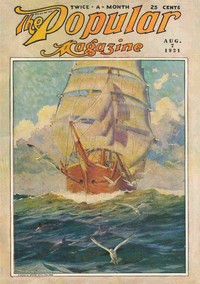
[Transcriber’s Note: This story appeared in the August 7, 1921 issue
of The Popular magazine.]