_HORSE TALES._
[Illustration]
[Illustration: SALLY.]
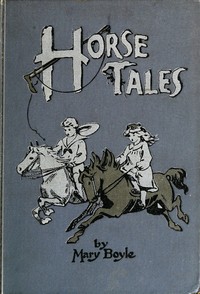
HORSE TALES
BY MARY BOYLE.
[Illustration]
PEN-AND-INK ILLUSTRATIONS
BY ISABEL WATKIN.
_LONDON_: _NEW YORK_:
ERNEST NISTER. E. P. DUTTON & CO.
1359.
[Illustration]
Horse Tales.
SALLY.
If you take a short-horned cow, a limping calf, a few sheep, a swarm of
fowls, a pig with a litter of eight, and an everyday lazy kind of horse,
you have John Dobbin’s well-stocked farm.
One morning John woke up at five, bustled round the hen coop, gave an
extra feed to the pigs, milked the cow, fed the limping calf, and then
went into the stables.
“Now, Sally, old girl,” he said, making some fuss as he fed his old
mare, “just keep your eye on things a bit. I’m goin’ round to Farmer
Peckett. He’s in bed, bad with rheumatism, an’ I shan’t be back afore
dinner.” So saying he took the halter from Sally’s neck, and let her
roam about at will.
Sally left to herself felt glumpy.
“Now where’s the master gone off this morning,” thought she. “Farmer
Peckett. I know no Farmer Peckett. It’s very queer his leaving us all
alone. Something might go wrong while he’s away, and he can see to
things a lot better than me. Just look! There’s that calf a limping
among the lettuces. And that knock-kneed hen with her chirrupy brood
scratching the carrots up as if she was seeking to-morrow. I do believe
those bees mean to swarm, and no master here. I’ve watched him swarm ’em
many a time, but I couldn’t manage it.”
[Illustration: _Hen with her Chirrupy Brood._]
“If you’re not off about your business, you old gimmer,” as a long-nosed
sheep looked through the hedge—“I’ll, I’ll— Now what do you want?”
called out Sally, turning from the patient ewe to a fat, wheezy donkey
coming up the garden path. “What brings you here this morning, Neddy?”
“He-haw!” said Neddy, rolling his tongue round and round, and giving a
three-cornered look out of his left eye. “Thought I’d just see how you
were getting on, Sal! But you do look prime.”
“Just be off about your business.”
“Beg your pardon, my lady. But if you have no objections I’ll just march
myself off into the stable. I know Farmer Dobbin supplies you with good
fodder.” And away went Neddy “he-hawing” for all he was worth, and
frightening the chicks out of their poor little senses.
While Sally was looking after him, and marvelling at his cool
impertinence, up came a tinker. “Pans to mend, kettles to mend, scraps
of old iron,” he cried.
“What, Sally!” he called out cheerfully to her.
“He-haw!” bellowed Neddy.
“Where’s John Dobbin? Are ye carryin’ on the farm by yourself, Sally?
Well, you’re a fine steed to place in front of any man’s castle! I’ll
speak a word for ye when I see the general again. He’s sure to be
wanting a new charger to carry him off to the wars soon. But I see
you’re figgity, Sally, so I’ll bid you good-day. Pans to mend! Kettles
to mend! Scraps of old iron!”
“Mercy on us!” wailed the frightened creature, the perspiration dropping
from her nose end. “How thankful I am to think he’s gone! If he’d walked
into the kitchen, and master out, he’d have smoked up all his new baccy.
When will it be twelve o’clock? Oh, but I don’t like looking after
things. I will be glad when master comes home.” Because she felt
relieved of anxiety a warm feeling spread all over Sally, and her poor
old heart felt happy. Even Neddy’s ugly “he-hawing” failed to rouse her
ire. So she fell to trotting about the garden in a silly kind of way.
While Sally was frisking about in a happy-go-lucky fashion, up came a
sailor.
“Morning,” he said, “fine time o’ year this.”
Sally looked sad.
[Illustration]
“No one at home, eh? Where’s John Dobbin? Hasn’t left any message, eh!
Stand out of the way and I’ll go into the house, and sit down till John
comes. Bravo! my beauty,” stroking the limping calf, “you’re a fine
mixed lot of customers I can see. Master John will be at the market I’ll
be bound. It’s twenty year since John and me met. Won’t we have a fine
time of it now. I hear he’s never married, n’more have I. Wait till he
comes in, we’ll be spinning yarns till bed-time.”
All this time Sally was pawing at the cobbles with her hoof. “Well,
you’re a cool hand to be sure,” thought she. “And he’s helping himself
to my master’s baccy. Well, if that doesn’t beat all. I’ve got him in
the kitchen at any rate, and if he isn’t quite quiet, he looks honest.
I’d best be off and see how Neddy’s getting on, for he’s a first-class
scamp if you like.” And away she trotted, seeing on the road that the
bees were hard at work, for you will understand how this lazy old horse
was most particular that everyone else but herself should be working.
She did not like to see anything idle. If you notice, animals that have
lived a long time with people learn to know their ways. And it may sound
funny to you children, but I have often seen animals try and imitate
their owners. So if any of you have a pet you must be careful and behave
kindly before it, for then, at least, you will be setting a good
example. And I would advise you to have nothing to do with a boy whose
dog fears him, or with a girl who is not kind to her dollies.
“Now, where is Neddy?” said the weary mare, “for not a speck of him can
I find. There’s every bit of fodder munched up—rakes and spades kicked
about—yes, he’s been here sure enough. And there’s the brand new bucket
stamped on. Whatever will Master say? This is keeping an eye on things
till master comes back, isn’t it! Oh! dear me. I’ve got a run-a-gate
donkey somewhere and a Jack Tar in the kitchen smoking my master’s
baccy.”
“Bow-wow-wow!”
“What’s the matter now?” As Sally turned round she saw a sheep dog. “Oh?
Ben, it’s you,” she cried. “I’m nearly worried out of my wits. For
goodness’ sake do stop here, Ben, and keep guard till master comes back.
There’s the bow-legged toppin’d hen wants keeping in her place, and that
limping calf ought to be tethered. And Neddy ought to be sent home
instead of stamping the fodder about and kicking the new bucket,
and—there’s that sailor chap in the kitchen smoking my master’s baccy!
Mercy on us! what’s that?” as a band struck up a gay tune. “It’s a
travelling circus—no, it isn’t. My word, the whole village is up and our
sailor gentleman is dancing a hornpipe! Thank goodness—there’s master
coming! Whoever would have thought of things happening like this!”
“What cheer, John!” cried the sailor, extending his hand and running
forward to meet his old friend. “How are ye, my hearty? What, don’t you
know me, John? My old chum! Why, I’m Sam—surely!”
“It can’t be, but it is!” and the farmer’s voice became husky. “I’ve
thought ye dead this many a year. So you’ve actually returned, Sammy!”
“To settle in the old country, and to pitch my tent alongside o’ yours,
John.”
“Look here, you sailor man,” cried Sally, “master belongs to me. We run
this farm between us, we do, and we want no hornpipy sailor to join us.”
“And where does this band come from?” asked the farmer. The musicians,
let me say, were trumpeting and drumming for all they were worth.
“Well, I brought it with me from Jarmouth. Look here, my hearties,” he
called out, “change the tune to ‘Auld lang Syne’ and we will all join in
the chorus.”
Which everybody did. Even Neddy sat on his haunches and “he-hawed” his
loudest, of course, lolling his tongue round as usual, and throwing
three-cornered glances in all directions. The limping calf was touched
and was suddenly seized with a racing fit; and the chickens, no doubt
thinking that the end of the world had come, turned somersaults and
fought battles in all directions.
Poor Sally groaned aloud. “Ah! this is the end of everything,” she said.
“I’ve cared for, and worked for master for many a year, and now what
between the sailor, the band, the chickens, the bees and Neddy—well!”
[Illustration]
“I think the whole stock has taken leave of their senses,” said Farmer
John. “Why, Sally, lass,” he said, looking upon his woe-begone horse,
and patting her on the shoulder, “do you think, old girl, that I have
forgotten thee? No, no! Now, my good people,” flinging a coin to the
musicians, “I thank you for your music, and good-day to ye. Don’t you
see that you are frightening my animals. Neighbours,” he cried,
addressing the crowd, “good-day to ye also, and Sam, my man—quick march
into the house. Adieu!” he cried to the departing crowd. “This sort of
thing don’t quite suit country folk—now do it, Sally?”
And as he led the horse by the halter he whispered in her ear: “Now you
needn’t go and be jealous, old girl. Sam shan’t put your nose out.
You’ve been a good old servant to me, and you’re missis here, so keep
your temper.”
Sally stamped her feet.
“He says he’s come to retire with you, master,” she began, only John had
walked away. “And oh!” winnied Sally, only John did not hear her, “after
I’ve been missis ever so long, it’s hard to be supplanted by a hornpipy
sailor!”
LELE.
“Have bought a first-class mount,” read out the vicar, from a telegram
which he had just received. “There,” he said to his wife, “it’s done
now—so Towser will have to go.”
“What, part with Towser? Poor old Towser,” spoke up Mrs. Dene.
“He’s so slow, and I have been indulgent too long already. Now, don’t
make a fuss, my dear. I daresay you have grown fond of him, and so you
will be of the new horse when it comes.”
That settled it.
Next morning soon after breakfast, the groom led a fine spirited mount
up to the hall door. Up jumped the vicar from his seat.
[Illustration]
“Ah! Lucy Lu! Now are you not pleased with my new purchase?” he cried.
“You are sure that horse is quiet, John?”
“Read the warranty.”
“He doesn’t look steady like dear old Towser.”
“Please don’t bracket them together. They are two entirely different
animals. This new horse is well bred, and but six years old; while
Towser has not many good points and is aged.”
“You won’t send Towser away—now will you, John? for I’m sure this new
horse will not suit. He’s got such a wicked eye.”
“My dear, what silly things you say. I can see you don’t like my new
purchase, and I do,” said the vicar, emphatically.
* * * * *
“Morning, Hopkins.”
“Morning, sir.”
“Well, this appears to be a grand creature,” stroking the mane.
“Yes, sir,” said the groom.
“I somehow fancied Grahame would choose well. He has a splendid head.
Fine bone. Stands well. Splendid flank—got many good points, I
notice—he’s not quite as sedate looking as our old pony.”
“Indeed he’s not, sir.”
“Well, we shall see. I’ll take him for a ride.”
And as his master rode away, “He’s a real bad’un that little horse is,”
said Hopkins. “A reg’lar bad’un. Bought at a grand Repository, and quiet
and sound, warranty says—a real varmint,” says I.
Now as Lele was stepping along, would it not be as well to tell you
something of him, children? To begin with, he had been sold several
times, changed masters more than once for something worse than
disobedience. He was up to all kinds of tricks, could buck, kick, jib,
in fact he could perform all manner of naughty tricks—yes, do all except
do as he was bid.
So he looked this way and that, snorted, gave a bit of a jerk, just to
rouse his new master, and than sighed. “Well, it’s come to a nice thing
now,” he grunted, “me—a well-set-up sprightly hunter, knocked down at a
sale for thirty pounds! Sold to an old parson. Humph! I’ve seen lots of
parsons in the hunting field, but never thought I’d like to live with
one. Now I know I shan’t. Wish I hadn’t thrown Lord Jim. Bless me!
Changed my walk in life entirely, and however I shall take to being a
goody-goody horse I don’t know. Suppose I shall have to eat second-rate
oats till I grow old and wheezy.”
A gentleman who was riding along the road stopped to speak to the vicar.
“Hallo!” said Lele to the stranger’s mare. “How do! Fine morning.”
“Very,” said the sedate little grey mare.
[Illustration]
“Not much doing here. Slow sort of place I should say, eh?”
“I don’t know what you mean? Have you just come to this neighbourhood?”
“Came last night. Slow train. Block in the line. A miserable journey.”
“Do you think you will like the neighbourhood?”
“No.”
“Oh! you rude creature, I shan’t talk to you any more! Where do you come
from, and whatever is the vicar doing with you?”
Lele took no notice. Presently he said:
“Does nobody hunt here?”
“Hunt? My master doesn’t, but people he knows do. I’m sure your master
doesn’t.”
Lele groaned. “Well, however I’m going to suit goodness knows. I shall
die of yawning and rust out before a month is over.”
“As I was saying,” said the vicar to his friend, “I think he is a
perfect little horse. He is quiet, as you see, and I’m not likely to
kill him with work. I just go my usual round, but I do like a well-bred
horse. He’ll have a very easy time of it with me.” Lele groaned louder
than ever.
“We have not stiff hills in this neighbourhood.”
Lele grew restive.
“And life is much the same all the year round.”
“Shall I bolt?” fumed Lele.
“I ride for an hour in the mor—”
“Look here, I can’t stand this. In all the homes I’ve had there’s been
something to do. There’s been steeplechasing in Spring—hunting—”
“Why, the hounds are out,” called Mr. Dobson. He was riding a little way
in front and could see over the hedge. “See! there’s the whip making for
Cranstone Hill! Is he used to following the hounds?”
“I don’t know—he does appear restive. Whoa-a then!”
“Do you hunt, Mr. Grey?”
“Oh, yes, but I haven’t indulged in such things for years.”
“Then you’d better get off—I wouldn’t trust that horse.” But the vicar
had no time to get off, and another thing he did not mean to. He meant
to stop on.
“It’s my opinion my master is not so simple as he looks,” thought Lele.
“He’s been used to spurs he has. What a dig he did give me then. I shall
have to try to unsettle him—for he is rather a heavy load to carry, and
I mean to follow the hounds—”
“Tally ho!” rang out in the clear morning air as Lele bucked.
The vicar stuck on.
He shied.
His master didn’t care.
He jibbed.
But he might have exploded if he liked, nothing short of an earthquake
would have disturbed the vicar.
[Illustration]
“I say, hold hard there,” yelled Mr. Dobson, “he’ll kill you.”
“No, he won’t.”
“You’d better get off.”
“Not if I know it.”
“You won’t, then, eh!” struck in Lele—“then here goes—” And, like a
flash, over the hedge he went—in short, I may tell you he had galloped a
field over, cleared a gate, forded a stream, broken through a copse, and
then, Tally ho! he was with the hounds, close alongside the whip, and in
a few minutes stood with his master, who was perspiring and mopping his
face with his handkerchief, abashed at the attention his presence called
forth, and stammering his thanks to the master of the hounds who handed
him the brush.
“Allow me to congratulate you, good sir,” he said.
“Now, just look here,” interrupted Lele—only nobody noticed him—“that
brush belongs to me. I followed the hounds, and as I couldn’t throw the
vicar off, of course I had to bring him—much against his will—a fact, I
assure you. Just stick that brush behind my ear, please. Why, Kiddy, is
that you?”
“Lily!”
“Goodness me! Wonders will never cease, I own a vicar now—you know I was
bundled off to a Repository after I had thrown Lord Jim.”
“He’s here.”
“Never!”
“But he is, sir! Here he comes riding that limping crocodile of a
nag—don’t think he is benefited by the change—do you, Lele?” But before
Lele could answer Lord Jim had discovered his late horse. He made up to
the vicar as they were going home.
“Excuse me, sir,” he began, and then, “allow me to congratulate you on
your horse.”
“What, another!” said the vicar.
“I have just sold him.”
“That accounts for my possession—fact is I have just bought him.”
And then it all came out—Lord Jim repented parting with Lele, and
although the good vicar said nothing, he thought, “Well, he’s certainly
a bargain, but my parish will miss me if, every time I want a little
trot out, my horse takes it into his head to follow the hounds.”
And how it came about I cannot tell you, children, but before the vicar
got home he decided to let Lord Jim have his favourite back again.
“I repented it directly after. But you do look so stupid being thrown in
the hunting field—it was the first time, you know.”
The vicar nodded—and Mrs. Grey chuckled when he came home, safe but very
much shaken.
“He’s far too much for you, John.”
“Yes, my dear, you are right.”
“Old Towser?”
“Shall remain.”
[Illustration]
“And Lele?”
“Again belongs to Lord Jim.”
“It was a clear walk over that,” mused Lele as he crunched the
well-grown oats in Lord Jim’s stables that night. “I never met my match
till his reverence mounted me—I might have behaved ugly, but I’m pleased
to think I didn’t throw the old gentleman. There’s ever so many runs in
prospect, you say?”
“Five,” said Biddy.
“And I’m entered for next Spring steeplechases, so Tally ho! But I
know—I’ll never throw Lord Jim again!”
[Illustration]
SIMON.
Simon lay on the grass, thinking. He flicked a fly that was tickling.
Although he was a most worthy horse, he was often troubled with very
grand notions about himself and very poor thoughts concerning his
neighbours.
Day had not yet begun at Tower Tighe Farm. The stars had faded away, and
the great warm sun was waking up the nestlings, waking them up to cry
for food, and disturb folk generally, for everything was very quiet and
still at Tower Tighe.
The owner, John Fairfax, was a spare man, very thin, with a grey
straggly beard, and bright blue eyes. He possessed fierce-looking brows,
and a very long nose. His wife was a fat little lady, who bustled about
a great deal, and went round the farm saying kind things to everybody,
and to Tony the fox-terrier in particular, for Tony was a thorough
little scamp. He told old Simon one day, that missis was a deary, and
behaved fine when she wasn’t walking. Then she was just like a lop-sided
hour glass, so fat all round—save at the waist, which was thin, and she
wobbled like a tee-totum.
[Illustration: SIMON.]
“If everything and everybody would only wake up,” moaned Simon, chafing
at the stillness about him.
“Wake up. Arn’t I here,” called Spangles, the Rooster, as he proclaimed
to the world “Cock-a-doodle-doo!”
“I’m glad to hear you say so,” snapped Simon.
“Top of the morning to you, sir,” said Spangles. “Don’t get crabby with
your neighbours. Hi! there,” he called out, as he saw Tony racing after
a rabbit.
“Never mind that nimble scratcher,” neighed Simon. “Come here and I will
tell you something. I am going to the Mill—are you ready to join me?”
As Simon mentioned “Mill,” Tony stopped.
“Rats live there,” he said to himself, “rats.”
“We can talk,” said Simon, seriously.
“Indeed,” said the sagacious dog.
And when they were on the high road bound for the Mill, Simon began:
“Tony, I’ve been considering.”
“Indeed!”
“You’re a decent little fellow.”
Tony blinked.
“I’ve been bothering about this a long time.”
“Never thought you bothered about anything. You’re such a quiet old
chap, Si. But hurry up! Do! There’s a shrew waltzing along the road, and
I’m getting impatient. Do be quick; I can’t go marching by your side in
this procession-like fashion for ever and a day, now can I?”
[Illustration]
“Well,” began Simon, which told of an ache at his heart, “Master Harry’s
coming home. He’s been away for years and years. He was one of the
liveliest lads you’d meet in a day’s march. But he had one big fault.
When he wasn’t romping he was learning lessons. And how those lessons
did spoil him, they took all the fun out of him. Master says they put
sense into his head, but what does anyone want with sense, answer me
that? and you know it isn’t proper for a lively lad to be thoughtful.
Well, as I was saying, he was a fine sturdy chap was Master Harry—that’s
years before you were born, nipper.”
“Humph!” said Tony.
“Well, now he is coming home, at least he has written a letter to say
so. He says that he has grown rich, and has been to foreign places, and
is bringing a horse and a dog—you hear that Tony, a horse and a dog.”
Simon said this so seriously that Tony looked up.
“I’m the only horse here, and you are the only dog here, and Tower Tighe
is but a small farm.”
“A regular scrap of a place.”
“Well, it appears to me that our whole life will be changed.”
“It will be jollier for both of us, if you mean that,” said Tony. “There
will be a friend for you and a companion for me, for if you just ask
yourself, Simon, we ain’t—er—quite companions, now are we?”
“You’re such a featherhead, how could you expect to be a what-d’ye-say
to me. You never could think of things in the right way.”
“Bah! you’re always repining, and I think life’s far too scrappy to
waste it in grumbling. When you take growing-up time off—teething,
distemper, and lots of things come to you whether you want ’em or you
don’t; then there’s meal times, sleeping, and sometimes you have to take
physic—O! my, life’s very short, when you take off all these things.
Just see what a glorious morning it is! Whoop, there! I see a rat?”
And off trotted Tony in full pursuit of a rodent which had made for his
hole, leaving the little dog to fume and fret and bark himself hoarse
all to no purpose.
“That’s Tony to a nicety. There never was such a scamp in this world.
But he’s a good-tempered little creature for all that. He’s so nice and
frisky. I try, but I suppose I’m growing old. Now, if I was to try to be
unselfish and funny, I wonder how I’d feel—Bah! but I will!”
Now as the cart was laden Farmer John sprang up, and the horse that
started pulling him was Simon certainly, but what a changed creature was
he. He fairly charged the hills instead of crawling up them, and then he
took the high road as if he had springs in his hoofs, and his dinner was
awaiting him at home.
[Illustration: _Tony racing after a Rabbit._]
“Why, Giles,” said the farmer on nearing home, “what’s all this fuss
about? Why is the garden gate open, and why is all this fuss going on
here?”
“Why, young Mr. Harry’s come home! Oh! master, master, an’ he’s growed a
man, and he’s that big an’ strong an’ grand, he’d make two of me,
master!”
“What!” said the farmer, springing from his seat. “Well, I’m blest—Hal?
Why, old Simon, you must have smelt him—for I’ve never seen you skip up
the road like that. Oh! Hal! Hal! my lad—why, you are a man indeed! My
bonny lad—” as a stalwart fellow came forward to greet him.
“Father!” cried his son, and the two men clasped hands.
Presently the old man spoke.
“Why, it’s thee, it’s thee, Harry!” and tears crept into the farmer’s
voice.
You see it was ten years since Harry Fairfax had left home, a stripling,
and now he had returned a sunburnt hearty man with a strong mellow
voice, and eyes that were bright and merry and kind.
“Hasn’t he grown big, father?” said Mrs. Fairfax, mopping her eyes with
a big roller towel she was busy folding when her son arrived. Then she
flicked a stray bit of down which had blown upon his coat sleeve,
flicked it away, and stroked the arm with a proud feeling of possession.
“Do come into the house, Harry dear, and get a rest while I see to a bit
of dinner. Father, I do believe this is the happiest day of my life.”
“Just wait till I bait Blackie, mother,” said her son, “I’ll be with you
in a minute, but I want to attend to my beauty first. Ah! she’s a grand
little lady, mother!”
“Just the same as you always were, Hal, somebody first and yourself
afterwards. What a famous little mount she is though! Wherever did you
pick her up?”
“In Texas.”
“Well, she is a dear little mare.”
“She is a thorough little Arab. I broke her in myself, and it’s one of
my best investments, father.”
Here Blackie thought fit to express her thanks to her master for his
kind remarks about her, and Farmer Fairfax stepped aside to allow her to
show off her capers.
“There’s a second stall in the stable, Harry,” said his father. “Bring
her along; my boy; Simon will be very pleased to have a bright little
friend like Blackie.”
[Illustration: _“I hope you feel at home now, Pat,” said the little
Terrier._]
As indeed he was.
At first he was shy, fearfully shy, for he was not used to being stared
at, and Blackie had such beautiful eyes which opened in wonder at the
ungainly specimen before her.
“Good-day, sir,” she began, “I suppose I am to share this place with
you!”
“Well, ye—s,” stammered Simon.
“Pleasant country this.”
“Very.”
“Been here a long time?”
“Always.”
“What a rusty old creature he is,” Blackie was thinking. “I believe he’s
blushing.”
“Where did she come from?” thought Simon. Presently he stammered:
“Do you like o—a—t—s?”
But before the answer was given Tony and Pat came tumbling in,
breathless with running.
“I hope you feel at home now, Pat?” said the little terrier.
“Stunnin’.”
“And you like your quarters? I say, Pat, you’re the best fellow I ever
saw in my life. Such a racer—such a catcher—” and for answer, Pat, who
was tired out, had laid down to rest, snored “stunnin’.”
SNOWIE AND BOB.
Snowie and Bob were quiet.
It was the end of the season at Burney, and already many of the ponies
had left the sands to earn a winter living with the farmers round about.
“Or do odd jobs,” Jenkins said, anything, in fact, till summer came
round again, and they might go back to Burney and help to earn money by
riding children up and down the sands at so much an hour or less.
“I wonder if I shall go to my coughy old gentleman this winter,” began
Snowie. “I’ve been with him two winters already, and although he is
awfully wheezy, and limpy, he’s easier to manage than wriggly children.
Still I am sorry the summer is over. What say you, Bob?”
[Illustration: _Riding Children up and down on the Sands._]
“Well, yes,” answered the brown pony.
“Sometimes I wonder where they put seaside children in winter,”
continued Snowie. “Do they keep them in bed till the warm weather comes
back again—or how?”
“Bed indeed! A cast iron bed wouldn’t hold the lads I have to
carry—wobbly imps.”
“Well, we shall have to say good-bye, Bob. By the way, where do you put
up in the winter?”
“Oh! I suppose I shall have to earn my living with Carrots. You see, I
carry a boy, an only son, who lives near the moors, to school every
morning. Then I bring him back at nights. He lives on the moors and
sometimes a stiff time we have of it, what between blizzards and frosts,
and snowdrifts.”
“Then you get some fun?”
“Yes, now and again we do. Carrots is brimful of mischief when lessons
are over. I help him a bit now and then myself.”
“Our poor old master doesn’t look merry,” remarked Snowie, after a
while. “He’s not been well this summer. His limbs are getting stiff; I’m
afraid it’s been but a poor season for him.”
“Here they are, sir,” said Jenkins, walking towards the ponies. “As fine
a pair as you would wish to see. They’re good-tempered little creatures,
and thorough game. Rising seven, clean limbs, wind and eyesight, and
right sorry I’m to part with ’em. They’re the best couple I ever had.
That’s a fact. And if my health hadn’t broke down, and I’m giving up the
business, nothing in the world would have made me sell ’em.”
“They’re certainly a fine couple,” said the gentleman, patting first one
of them and then the other. He was evidently impressed, for presently he
said, “If your price is all right, I am sure they’ll suit my boy and
girl.” And do you know it only took a few minutes to settle the bargain?
You could see that old Jenkins was pleased, the way he clinked the gold
before dropping it into his bag. “I feel sure you’ll be good to ’em,
sir,” he said, as the gentleman was walking away. “It’s been a quick,
satisfactory bargain, but I knows you’ll not regret it.” And before
Snowie had got over the fright—for she had been listening with all the
ears she had got—and Bob had realised what had taken place, old Jenkins
had tossed off his coat, and was grooming them down in a spluttering,
whistly wheezing way, and muttering away to himself something in this
manner:
[Illustration]
“Shoo! Snowie, my lass, come, yer going to leave yer old master and live
with quality now. I know ye’ll behave yerself. It’s Bob what’s botherin’
me.” Here he began towselling the brown pony. “Mind when yer gets to yer
new sitewation ye behave yerself, yer little varmint. No monkey tricks
there, my man. No sly ways. You’ve both worked well for me, and I’ve
done the best I can for yer both. I’ve sold yer to Squire Morton, and
given yer first-class characters. So don’t go and disgrace yer old
master—good-bye!”
And that was the way old Jenkins dismissed them.
They were taken to the station, bundled into a horse van, and presently
arrived at Humshaugh, a quiet little countrified station, where a
red-faced porter helped them out of the van, then gave them in charge of
a groom who had come to meet them. “Why, Bob,” he cried on sighting the
little brown pony, “whoever would have thought of seeing you again.”
“It’s David, ’pon my word it is,” cried Bob, stamping his feet and
swishing his tail round and round like a windmill.
[Illustration: SNOWIE AND BOB.]
“You seem to know the pony,” said the porter.
“Yes, we have met before. It’s funny that the Squire should pick up Bob
of all ponies in the world. So this little white creature is Snowie I
suppose?” Snowie blinked hard. She was too shy to answer “Yes.” It was
such a big social leap for her to take jumping direct from Burney Sands
to Humshaugh Park that it took all her breath away.
“Bob,” she ventured, as they were trotting along the road, “do you think
we shall like the change?”
“Is my mane straight?”
“I wonder what our old master is going to retire on. I hope he has
plenty to keep him.”
“You will see I shall get new shoes to-morrow morning.”
“Bob, are you listening to what I am saying!”
“I have oats for dinner, corn for breakfast, beans for supper, and—”
“Oh! he’s quite stupid,” sighed Snowie, “pride has completely turned his
head.” Then she heaved a very big sigh. Bob took no notice of that.
Suddenly he cried, “You must forget you ever ply’d for hire on Burney
Sands, Snowie. Never, never remind me of it. You’re to mix with quality
now, my dear.”
“By the way, that groom knew you, Bob.”
“Rather, I shouldn’t have known him though. He was in the stable where I
was born. You understand? I always told you that I belonged to quality
folks, Snowie.”
Snowie heaved another big sigh. “His head is completely turned,” she
said. “Bob can’t stand prosperity. I shall have to keep my eye on him, I
know I shall.”
[Illustration]
They had reached the Hall at last, and were taken round to the stable.
Bob took it all in at a glance. “Snowie,” he said, in an awed voice,
“Snowie, we’re going to retire here.” Presently the sound of children’s
voices burst upon them.
“Oh! David, you have brought the ponies. Father, they have come. We have
been looking for you for an hour at least. What beauties! Which is for
me, father?” cried Lawrence.
“And me, father,” cried Betty.
“The brown pony is for you, my child, and Lawrence is to have the white
one. So you like them, my dears?”
“Like them? Oh, we love them, father! Wherever did you find such
treasures? Thanks, thanks, a thousand times thanks, you dear kind
father.” And the children threw their arms around his neck and kissed
him again most heartily.
“There now, that is all right,” said Squire Morton, putting his collar
straight. “Now mount. Never mind a saddle. David shall come and show
your mother how you can ride your new possessions.”
And leaping upon their backs Lawrence and Betty trotted away, using the
primitive reins that hung loosely round their ponies’ necks, and
behaving like experienced equestrians.
“See, mother, what a lovely little creature mine is,” cried Betty.
“And mine,” cried Lawrence. “She is as white as milk and her name is
Snowie.”
“How pleased the children are, John,” said their mother, “you could not
have found a more suitable birthday gift.”
Whereat the Squire laughed.
“Just have a ride about the park, children, and then let David lead them
away. It is tea-time now, and to-morrow morning you must both be up
early and have a canter before breakfast.”
Afterwards when they were together in the stable and were made
comfortable for the night, “Snowie,” said Bob, “before I go to sleep I
should like t’fess. I told you a big fib as we were coming along from
the station.”
“Oh,” said the sedate little mare, looking much shocked.
“Yes, I did. It was such a sudden change. And things have fashioned
themselves so funnily I couldn’t stand it.”
“I understand,” said Snowie.
“You remember, David?”
“The groom here, yes.”
“I said he was groom in the stables where I was born.”
“I know you did.”
“Well, I said a very big fib.”
“Oh, Bob!”
“David knew me when I trundled a rag and bone cart along the streets of
London in company with my first owner, Mistress Sally Brimstone.”
“Yes, Bob. Rag and bone cart. Sally Brimstone? I can’t understand it!”
cried Snowie, aghast.
[Illustration]
“No, but I can. Old Sally sold me to old Jenkins for thirty shillings.
That’s where I came from, Snowie. Fact!”
“But you always told me you were gently reared.”
“I’m afraid I always told you fibs. Now I’m going to turn over a new
leaf in this new situation. From henceforth I shall speak the truth.”
“Bob.”
“Yes.”
“If I were you I would just hold my tongue and from henceforth say
nothing at all!”
“Oh!”
And so let us leave them, children.
_Printed in Bavaria._
------------------------------------------------------------------------
TRANSCRIBER’S NOTES
1. Silently corrected typographical errors and variations in spelling.
2. Archaic, non-standard, and uncertain spellings retained as printed.
3. Enclosed italics font in _underscores_.