UNITED STATES
DEPARTMENT OF THE INTERIOR
HUBERT WORK, SECRETARY
NATIONAL PARK SERVICE
STEPHEN T. MATHER, DIRECTOR
FOSSIL FORESTS OF THE YELLOWSTONE NATIONAL PARK
UNITED STATES
GOVERNMENT PRINTING OFFICE
WASHINGTON
1928
88781°—28——2
THE NATIONAL PARKS AT A GLANCE.
[Number, 19; total area, 11,817 square miles.]
National parks Location. Area in Distinctive characteristics.
in order of square
creation. miles.
Hot Springs Middle 1½ 46 hot springs possessing
1832 Arkansas. curative properties—Many hotels
and boarding houses—20
bath-houses under public
control.
Yellowstone Northwestern 3,348 More geysers than in all rest
1872 Wyoming. of world together—Boiling
springs—Mud volcanoes—Petrified
forests—Grand Canyon of the
Yellowstone, remarkable for
gorgeous coloring—Large
lakes—Many large streams and
waterfalls—Vast wilderness,
greatest wild bird and animal
preserve in world—Exceptional
trout fishing.
Sequoia Middle 604 The Big Tree National
1890 eastern Park—Scores of sequoia trees 20
California. to 30 feet in diameter,
thousands over 10 feet in
diameter—Towering mountain
ranges—Mount Whitney, highest
peak in continental United
States—Startling
precipices—Cave of considerable
size.
Yosemite Middle 1,125 Valley of world-famed
1890 eastern beauty—Lofty cliffs—Romantic
California. vistas—Many waterfalls of
extraordinary height—3 groves
of big trees—High
Sierra—Waterwheel falls—Good
trout fishing.
General Grant Middle 4 Created to preserve the
1890 eastern celebrated General Grant Tree,
California. 35 feet in diameter—6 miles
from Sequoia National Park.
Mount Rainier West central 325 Largest accessible single peak
1890 Washington. glacier system—28 glaciers,
some of large size—48 square
miles of glacier, 50 to 500
feet thick—Wonderful sub-alpine
wild-flower fields.
Crater Lake Southwestern 249 Lake of extraordinary blue in
1902 Oregon. crater of extinct volcano—Sides
1,000 feet high—Interesting
lava formations—Fine fishing.
Wind Cave South Dakota. 17 Cavern having many miles of
1903 galleries and numerous chambers
containing peculiar formations.
Platt Southern 1⅓ Many sulphur and other springs
1901 Oklahoma. possessing medicinal value.
Sullys Hill North Dakota. 1⅕ Small park with woods, streams,
1904 and a lake—Is an important
wild-animal preserve.
Mesa Verde Southwestern 77 Most notable and best preserved
1906 Colorado. prehistoric cliff dwellings in
United States, if not in the
world.
Glacier Northwestern 1,534 Rugged mountain region of
1910 Montana. unsurpassed Alpine
character—250 glacier-fed lakes
of romantic beauty—60 small
glaciers—Precipices thousands
of feet deep—Almost sensational
scenery of marked
individuality—Fine trout
fishing.
Rocky Mountain North middle 378 Heart of the Rockies—Snowy
1915 Colorado. range, peaks 11,000 to 14,250
feet altitude—Remarkable
records of glacial period.
Hawaii Hawaii. 242 Three separate areas—Kilauea
1916 and Mauna Loa on Hawaii,
Haleakala on Maui.
Lassen Volcanic Northern 124 Only active volcano in United
1916 California. States proper—Lassen Peak,
10,465 feet—Cinder Cone, 6,879
feet—Hot springs—Mud geysers.
Mount McKinley South 2,645 Highest mountain in North
1917 central America—Rises higher above
Alaska. surrounding country than any
other mountain in the world.
Grand Canyon North 1,009 The greatest example of erosion
1919 central and the most sublime spectacle
Arizona. in the world.
Lafayette Maine coast. 12 The group of granite mountains
1919 upon Mount Desert Island.
Zion Southwestern 120 Magnificent gorge (Zion
1919 Utah. Canyon), depth from 1,500 to
2,500 feet, with precipitous
walls—Of great beauty and
scenic interest.
THE FOSSIL FORESTS OF THE YELLOWSTONE NATIONAL PARK.
By F. H. Knowlton,
_United States Geological Survey._
INTRODUCTION.
Isolated pieces of fossil wood are of comparatively common and
widespread occurrence, especially in the more recent geological deposits
of the West. Not infrequently scattered logs, stumps, and roots of
petrified or lignitized trees are brought to light, but only
exceptionally are they so massed and aggregated as to be worthy of the
designation of fossil forests. Examples of such are the celebrated
fossil forests of relatively late geological age near Cairo, Egypt, the
huge prostrate trunks in the Napa Valley near Calistoga, Cal., and the
geologically much older and far more extensive forests now widely known
as the Petrified Forest National Monument in Apache County, Ariz. But in
many respects the most remarkable fossil forests known are those now to
be described in the Yellowstone National Park. In the forests first
mentioned the trunks and logs were all prostrated before fossilization,
and it is perhaps not quite correct to designate such aggregations as
veritable fossil forests, though they usually are so called. In the
fossil forests of Arizona, for example, which are scattered over many
square miles of what is now almost desert, all the trunks show evidence
of having been transported from a distance before they were turned to
stone. Most of them are not even in the position in which they were
originally entombed, but have been eroded from slightly higher horizons
and have rolled in the greatest profusion to lower levels. As one views
these Arizona forests from a little distance, with their hundreds, even
thousands, of segments of logs, it is difficult to realize that they are
really turned to stone and are now exhumed from the earth. The
appearance they present (see fig. 1) is not unlike a “log drive” that
has been stranded by the receding waters and left until the bark had
disappeared and many logs had fallen into partial decay. Trunks of many
sizes and lengths are now mingled and scattered about in the wildest
profusion, and the surface of the ground is carpeted with fragments of
wood that have been splintered and broken from them. In the Yellowstone
National Park, however, most of the trees were entombed in the upright
position in which they grew, by the outpouring of various volcanic
materials, and as the softer rock surrounding them is gradually worn
away they are left standing erect on the steep hillsides, just as they
stood when they were living: in fact, it is difficult at a little
distance to distinguish some of these fossil trunks from the
lichen-covered stumps of kindred living species. Such an aggregation of
fossil trunks is therefore well entitled to be called a true fossil
forest. It should not be supposed, however, that these trees still
retain their limbs and smaller branches, for the mass of volcanic
material falling on them stripped them down to bare, upright trunks.
[Illustration: Fig. 1.—Fossil Logs in Petrified Forest National
Monument, Apache County, Arizona.]
[Illustration: Fig. 2.—Upright fossil trunk in Gallatin Mountains,
Montana.
Courtesy of E. C. Alderson.]
The fossil forests of the Yellowstone National Park cover an extensive
area in the northern portion of the park, being especially abundant
along the west side of Lamar River for about 20 miles above its junction
with the Yellowstone. Here the land rises rather abruptly to a height of
approximately 2,000 feet above the valley floor. It is known locally as
Specimen Ridge, and forms an approach to Amethyst Mountain. There is
also a small fossil forest containing a number of standing trunks near
Tower Falls, and near the eastern border of the park along Lamar River
in the vicinity of Cache, Calfee, and Miller Creeks, there are many more
or less isolated trunks and stumps of fossil trees, but so far as known
none of these are equal in interest to the fossil forest on the slopes
of Specimen Ridge.
[Illustration: Fig. 3.—Upright trunk and “hoodoo” in Gallatin
Mountains, Montana.
Courtesy of E. C. Alderson.]
The fossil forests are reached over a road from the Mammoth Hot Springs,
or from Camp Roosevelt near Tower Falls, and they are in their way quite
as wonderful and worthy of attention as many of the other features for
which the Yellowstone National Park is so justly celebrated.
Recently another extensive fossil forest has been found on the divide
between the Gallatin and Yellowstone Rivers in the Gallatin Range of
mountains, in Park and Gallatin Counties, Mont. This forest, which lies
just outside the boundary of the Yellowstone National Park, is said to
cover 35,000 acres and to contain some wonderfully well preserved
upright trunks, many of them very large, equaling or perhaps even
surpassing in size some of those within the limits of the park. Two of
the best preserved of these trunks are shown in figures 2 and 3, which
are here reproduced by the kindness of Mr. E. C. Alderson, of Bozeman,
Mont.
In the beds of the streams and gulches coming down into the Lamar River
from Specimen Ridge and the fossil forests one may observe numerous
pieces of fossil wood, which may be traced for a long distance down the
Lamar and Yellowstone Rivers. The farther these pieces of wood have been
transported downstream, the more they have been worn and rounded, until
ultimately they become smooth, rounded “pebbles” of the stream bed. The
pieces of wood become more numerous and fresher in appearance upstream
toward the bluffs, until at the foot of the cliffs in some places there
are hundreds, perhaps thousands of tons that have but recently fallen
from the walls above. One traversing the valley of the Lamar River may
see at many places numerous upright fossil trunks in the faces of nearly
vertical walls. These trunks are not all at a particular level but occur
at irregular heights: in fact a section cut down through these 2,000
feet of beds would disclose a succession of fossil forests (see fig. 4).
That is to say, after the first forest grew and was entombed, there was
a time without volcanic outburst—a period long enough to permit a second
forest to grow above the first. This in turn was covered by volcanic
material and preserved, to be followed again by a period of quiet, and
these more or less regular alternations of volcanism and forest growth
continued throughout the time the beds were in process of formation.
GEOLOGIC RELATIONS.
While these fossil forests were growing and being entombed, much of the
area now within the limits of the park, as well as large adjacent areas,
was the scene of tremendous geologic activities. After the Cretaceous
period (see diagram p. 28), there was a time of great volcanic activity,
which appears to have lasted until perhaps the beginning of the glacial
epoch. There were many active volcanoes just west, north, and west of
the park, and some in the park itself. From these volcanoes vast
quantities of material were poured out, building up in places whole
mountain ranges. Thus the major portion of the great Absaroka Range,
just east of the park, as it appears to-day, was built up of volcanic
material.
[Illustration: Fig. 4.—Ideal section through 2,000 feet of beds of
Specimen Ridge, showing succession of buried forest. After Holmes.]
Mr. Arnold Hague gives the following graphic account of this and
adjacent areas:
From one end to the other the Absarokas present a high, imposing
plateau, with elevations ranging from 10,000 to over 12,000 feet above
sea level. The entire mass is made up almost exclusively of Tertiary
igneous rocks. * * * Degradation of the mass has taken place on a
grand scale. Vast quantities of volcanic ejectmenta have been removed
from the summit, but no reliable data exist by which the amount can be
estimated even approximately. All the higher portions have been
sculptured by glacial ice. Enormous amphitheaters have been carved out
of the loose agglomerates, and peaks, pinnacles, and relics of great
table-lands testify in some measure to the forces of erosion. The
plateau is scored by a complete network of deep valleys and gorges,
which dissect it in every direction, and lay bare the structure of the
vast volcanic pile.[1]
Within the park there is evidence of similar volcanic activity, and it
is clear that the basin between the encircling ranges was filled to its
present elevation by volcanic flows, which formed the present park
plateau. The area within which the fossil forests are now found was
apparently in the beginning an irregular but relatively flat basin, on
the floor of which after a time there grew the first forest. Then there
came from some of the volcanoes, probably those to the north, an
outpouring of ashes, mud flows, and other material which entirely buried
the forest, but so gradually that the trees were simply submerged by the
incoming material, few of them being prostrated. On the raised floor of
the basin, after a time, the next forest came into existence, only to be
in turn engulfed as the first had been, and so on through the period
represented by the 2,000 feet or more of similar beds. The series of
entombed forests affords a means of making at least a rough estimate of
the time required for the upbuilding of what is now Specimen Ridge and
its extensions. (See p. 27.)
During the time this 2,000 feet of material was being accumulated, and
since then to the present day, there has been relatively little warping
of the earth’s crust at this point; that is, the beds were then, and
still are, practically horizontal, so that the fossil forests, as they
are being gradually uncovered, still stand upright.
When the volcanic activities had finally ceased, the ever-working
disintegrating forces of nature began to tear and wear down this
accumulated material, eroding the beds on a grand scale. Deep canyons
and gulches have been trenched, and vast quantities of the softer
materials have been carried away by the streams and again deposited on
lower levels or transported to great and unknown distances.
As the material in which the fossil forests are now entombed consist of
ashes, mud flows, breccia, and the like, not all the beds are of the
same texture end hardness, so that erosion has acted unevenly on them
and has produced many peculiar rock forms. The grotesque so-called
“hoodoos” have been carved out in this manner. The fossil trunks, being
usually harder than the surrounding matrix in which they are embedded,
have more firmly resisted erosion and now project to different heights
above the general level. In exposed beds that are nearly or quite
horizontal, disintegration has acted at nearly equal pace on the trunks
and on the matrix, so that the trunks are nearly or quite on a level
with the surrounding surface. On steep hillsides, however, from which
all loose material is easily and quickly removed, some of the fossil
trunks stand up to a height of 20 or 30 feet. If the beds had been
tilted at a considerable angle, these trunks could project from the
surface for only a short distance before their weight would break them
off, showing again the remarkably stable conditions that have continued
since the trunks were covered up.
AMETHYST MOUNTAIN.
The fossil forest that was first brought to scientific attention is on
the northern slope of Amethyst Mountain, opposite the mouth of Soda
Butte Creek, 12 miles southeast of Camp Roosevelt. The following
account, by Dr. William H. Holmes, the discoverer of these fossil
forests, shows the impression first made by them:
As we ride up the trail that meanders the smooth river bottom [Lamar
River] we have but to turn our attention to the cliffs on the right
hand to discover a multitude of the bleached trunks of the ancient
forests. In the steeper middle portion of the mountain face, rows of
upright trunks stand out on the ledges like the columns of a ruined
temple. On the more gentle slopes farther down, but where it is still
too steep to support vegetation, save a few pines, the petrified
trunks fairly cover the surface, and were at first supposed by us to
be shattered remains of a recent forest.[2]
These trunks may easily be seen from the road along the Lamar River,
about a mile away. They stand upright—as Holmes has said, like the
pillars of some ruined temple—and a closer view shows that there is a
succession of these forests, one above another. In the foothills and
several hundred feet above the valley there is a perpendicular wall of
volcanic breccia, which in some places attains a height of nearly 100
feet. The fossil trunks may be seen in this wall in many places, all of
them standing upright, in the position in which they grew. Some of these
trunks, which are 2 to 4 feet in diameter and 20 to 40 feet high, are so
far weathered out of the rock as to appear just ready to fall: others
are only slightly exposed: niches mark the places from which others have
already fallen: and the foot of the cliff is piled high with fragments
of various sizes.
Above this cliff fossil trunks appear in great numbers and in regular
succession. As they are all perfectly silicified, they are more
resistant than the surrounding matrix and consequently stand above it.
Most of them are only a few inches above the surface, but occasionally
one rises as high as 5 or 6 feet. The largest trunk observed in the park
is found in this locality. It is a little over 10 feet in diameter, a
measurement that includes a part of the bark. It is very much broken
down, especially in the interior, probably having been so disintegrated
before it was fossilized. It projects about 6 feet above the surface.
At many places about Amethyst Mountain there are numerous fragments of
fossil wood and many hollow trunks. The material in which they had been
embedded has been eroded away, and they lie around in somewhat the same
attitudes that are shown by all the trunks in the Arizona fossil
forests, but there is little doubt that they were originally erect and
have simply fallen by their own weight because of the removal of the
material around them.
Many of the trunks here, as well as elsewhere in the park, had decayed
in the center before they were fossilized, and some of the hollow
interiors are filled with clusters and rosettes of beautiful crystals of
amethyst, which doubtless suggested the name given to the adjacent
mountain. Much of this finely preserved wood, as well as the trunks
containing the crystals of amethyst, was broken up and carried away by
collectors of minerals and curiosities before the Government control in
the park was made sufficiently rigid to insure proper protection.
SPECIMEN RIDGE.
In many respects the most remarkable of the fossil forests is on the
northwest end of Specimen Ridge, about a mile southeast of Junction
Butte and about opposite the mouth of Slough Creek. So far as known,
this forest was first brought to scientific attention by Mr. E. C.
Alderson, of Bozeman, Mont., and the writer, who discovered it in
August, 1887. It is found on the higher part of the ridge, and covers
several acres. The trees are exposed at various heights on the very
steep hillsides, and one remarkable feature of the forest is that most
of them project well above the surface.
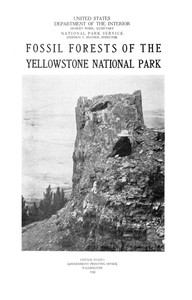
One of the largest and best preserved trees stands at the very summit of
the slope (see title page). This trunk, which is that of a giant
redwood, is 26½ feet in circumference without the bark and about 12 feet
in height. The portion of this huge trunk preserved is the base, and it
exhibits to a considerable degree the swelling or buttressing so well
known in the living redwood. The roots, which are as large as the trunks
of ordinary trees, are now embedded in solid rock.
[Illustration: Fig. 5.—Upright trunks in Specimen Ridge fossil
forest.]
On the steep hillside a short distance below the big tree just mentioned
are the two trunks shown in figure 5. They are about 2 feet in diameter
and 25 feet high, and stand some 20 feet apart, and we may imagine them
to have formed the doorposts of the “ancient temple” of which Holmes
speaks. Both these trunks are without the bark. On the left of the
figure is one of the huge irregular masses of rock that has been carved
out by erosion.
[Illustration: Fig. 6.—Trunk of fossil pine showing bark. Specimen
Ridge fossil forest.]
In figure 6 is shown another trunk about 3 feet in diameter and nearly
30 feet high. In several places along the trunk the thick bark may be
noted. This tree is a pine, as are the two last described, and slightly
below and behind it are two living pine trees, which are about the size
it must have been when living. Another trunk, some 12 feet in height, is
shown in figure 7, and in figure 8 there may be noted a standing trunk
and above it another that has recently fallen.
[Illustration: Fig. 7.—Trunk showing bark. Specimen Ridge fossil
forest.]
[Illustration: Fig. 8.—Upright and prostrate trunks, Specimen Ridge
fossil forest.]
The height attained by the trees of this fossil forest can not be
ascertained with certainty, since the tallest trunk now standing is only
about 30 feet high, but every one observed is obviously broken off, and
does not show even the presence of limbs. Perhaps the nearest approach
to a measure of the height is afforded by a trunk (shown in fig. 10)
that happened to have been prostrated before fossilization. This trunk,
which is 4 feet in diameter, is exposed for a length of about 40 feet,
and as it shows no apparent diminution in size within this distance it
is safe to assume that the tree could hardly have been less than 100
feet high and very probably may have been higher. This trunk is
wonderfully preserved. As may be seen from the illustration, it has
broken up by splitting along the grain of the wood into great numbers of
little pieces, which closely resemble pieces of “kindling wood” split
from a clear-grained block. In fact, at a distance of a few yards it
would be impossible to distinguish this fossil “kindling wood” from that
split from a living tree.
[Illustration: Fig. 10.—Prostrate trunk of fossil redwood, Specimen
Ridge fossil forest.]
The large redwood trunk already mentioned (title-page) as being nearly
10 feet in diameter may be compared with its living relative of the
Pacific coast in order to calculate its probable height. The living
redwood is usually 10 to 15 feet in diameter and ranges in height from
200 to 310 feet, and as the two are so very closely related there is no
reason to suppose that the fossil trunk was of less height, but by a
moderate estimate it may be accredited with a minimum height of 200
feet.
[Illustration: MAP OF YELLOWSTONE NATIONAL PARK
Norris O Denotes Ranger Station
←Direction of Travel
Distances given are between main points by road
NOTE THE MILE-POST SIGNS]
TOWER FALLS.
The most accessible fossil forest, marked "Petrified Trees" on the map,
is west of the Tower Falls Ranger Station and Camp Roosevelt on the road
from the Grand Canyon to Mammoth Hot Springs, by way of Mount Washburn.
It is on the middle slope of a hill that rises about 1,000 feet above
the little valley and may be reached by a branch road from the main loop
road. As the traveler approaches the forest he will observe a number of
trunks standing upright among the stumps and trunks of living trees, and
so much resembling them that a near view is necessary to convince him
that they are really fossil trunks. Only two rise to a considerable
height above the surface. The larger one is about 15 feet high and 13
feet in circumference (fig. 11): the other is a little smaller. As the
roots are not exposed, it is impossible to determine the position of the
part in view or the original diameter of the trees, as the bark is
nowhere preserved.
[Illustration: Fig. 11.—Fossil trunk near Tower Falls.
Photograph by F. J. Haynes.]
Above these standing trunks lie many others, which the disintegrating
forces of nature break up into small fragments and keep at about the
same level as that of their surrounding matrix. Some of these trunks
rise only a few inches from the surface: others are nearly covered by
shifting débris. Their diameter ranges from 1 to 14 feet, and they are
so perfectly preserved that the rings of growth can easily be counted.
The internal structure is also in most trunks nearly as perfect as when
the trees were living.
CACHE CREEK.
The forest that is next in size to the one a mile southeast of Junction
Butte is on Cache Creek, about 7 miles above its mouth. It is on the
south bank of the creek and covers several acres. The trunks are
scattered from bottom to top of the slopes through a height of probably
800 feet. Most of the trunks are upright, but only a few project more
than 2 or 3 feet above the surface. The largest one observed was 6 feet
in height and 4 feet in diameter. Most of these trunks appear to the
naked eye to be conifers, but a number are obviously dicotyledons—that
is, they were deciduous-leaved trees. The conifers, however, were the
predominant element in this as in the other fossil forests.
The slopes of the Thunderer, the mountain so prominently in view from
Soda Butte on the south, also bear numerous fossil trunks. Most of them
are upright, but only a very few project more than 2 feet above the
surface. No remarkably large trunks were observed at this locality, the
average diameter being perhaps less than 2 feet.
OTHER LOCALITIES.
Mount Norris, which is hardly to be separated from the Thunderer, also
bears a small fossil forest. The trees are of about the same size and
character as those in the larger mountain. Fossil forests of greater or
less extent, composed mainly of upright trunks, are exposed also on
Baronett Peak, Bison Peak, Abiathar Peak, Crescent Hill, and Miller
Creek. In fact, there is hardly a square mile of the area of the
northeastern portion of the park that is without its fossil forest,
scattered trunks, or erratic fragments.
The vast area east of the Yellowstone Lake and the region still farther
east, beyond the limits of the park, have not been thoroughly explored,
but enough is known to make it certain that these areas contain more or
less fossil wood. The stream beds in these areas in many places contain
fragments of fossil wood, which indicates that trunks of trees must be
near at hand.
THE PROCESS OF FOSSILIZATION.
The manner in which these forests were fossilized may next be
considered. Though the whole history of the process is not fully
understood, it was undoubtedly dependent on or at least greatly
facilitated by the presence of volcanic and hydrothermal activity, which
was doubtless then, as it is to some extent now, a marked feature of the
park region. At least a hint of the probable process is afforded by the
action now going on in the hot spring areas. Many of those areas are
closely surrounded by forests, and unless the action of the springs is
very violent the trees may be growing only a short distance away.
Occasionally a hot spring may break out near the edge of a forest, the
first effect being, of course, to kill the trees. In a few years, by the
action of the ordinary processes of decay, a tree so killed may have
lost its bark and most of its smaller branches. The hot water which
constantly or intermittently surrounds the tree contains a considerable
amount of silica in solution, and as this hot silica-charged water is
drawn up into the wood by capillarity the silica may be deposited in the
cells of the wood after the water cools or evaporates. The first result
will be a more or less complete cast of the interior of the cells and
vessels of the wood. This much of the process has actually been
observed, but as decay is more rapid than silicification, the wood
crumbles to dust before petrifaction is complete. If the trunk could be
surrounded by ashes or mud and thus protected from atmospheric action,
it might in time be completely turned to stone.
The fossil forests are surrounded by a matrix that is known as an acidic
lava—that is, a siliceous lava—which contains abundant silica in
solution. The first part of the process of silicification may well have
been that above described as taking place in the hot spring areas at the
present day—that is, the silica would be deposited in all the cells and
vessels of the wood, making an accurate cast of all open spaces. Then,
while the slow process of decay went on, as each particle of organic
matter was removed its place was taken by the silica, until, finally,
all the wood substance had disappeared and its place atom by atom had
been taken by silica.
By this or a similar process the wood has been preserved or fossilized
with remarkable fidelity: in fact, thin sections or slices of the fossil
wood may be studied under the higher powers of the microscope with
almost or quite as much completeness and satisfaction as if they were
sections cut from a piece of living wood. Each cell and vessel, with its
characteristic pits and markings, is preserved exactly as it grew. Some
of the wood, however, was evidently more or less decayed before it was
fossilized, or else decay worked faster than replacement, so that in
some fragments the structure is not so clearly preserved. Many of the
trunks were subjected to pressure before replacement was complete, and
this has crushed or distorted the cells. On the whole, however, the wood
is exceptionally well preserved, as may be seen in figures 12, 13, 14,
and 15. These are all magnified 100 diameters and were photographed
directly from the thin sections—that is, they are photomicrographs—and
have not been retouched in any manner. Figure 12 shows a transverse
section of the wood of the large redwood trunk that has been so often
mentioned (see title page). The section is cut through one of the growth
rings, which consists of 12 or 15 rows of very thick-walled cells. The
large, regular thin-walled cells, which begin abruptly above the growth
ring, belong to the spring wood—that is, the wood first formed after
growth starts in spring, when the supply of nourishment is abundant. If
there is sufficient moisture and all conditions are favorable this
vigorous growth of wood cells may continue without interruption until
the approach of cold or dry weather, but not infrequently there may be a
brief shortage of moisture, and this is reflected in the formation of a
few rows of thicker-walled cells. Such a condition may be observed in
the present specimen, in which a slight, partial ring may be seen at
some distance above the main ring.
[Illustration: Fig. 12.—Thin section of wood of fossil redwood
(Sequoia magnifica), showing growth ring. Section transverse.
Magnified 100 diameters.]
[Illustration: Fig. 13.—Thin section of wood of fossil pine
(Pityoxylon amethystinum), showing growth ring and resin tube.
Section transverse. Magnified 100 diameters.]
[Illustration: Fig. 14.—Thin section of wood of fossil pine
(Pityoxylon aldersoni), showing medullary rays and resin tube.
Section tangential. Magnified 100 diameters.]
[Illustration: Fig. 15.—Thin section of wood of fossil laurel
(Laurinoxylon pulchrum), showing wood cells, tubes, and rays.
Section longitudinal. Magnified 100 diameters.]
The very perfect preservation of the wood of one of the pines
(_Pityoxylon amethystinum_) is shown in figure 13, a view of a section
cut through a part of a growth ring and into the spring and summer wood,
the rings in this species being so broad that it is impossible to show a
complete one. The opening near the bottom of the figure shows one of the
large resin ducts, which, in the living wood, is filled with the “pitch”
that so readily exudes when a branch is cut or broken. A longitudinal
section of the other species of pine (_Pityoxylon aldersoni_) is shown
in figure 14. The many little rows of superimposed cells in the midst of
the long wood cells are the cut-off ends of what are known as medullary
rays—that is, the little plates of cells that connect pith and bark. One
of the resin cells cut in the long direction is shown near the center of
the figure; the contents are much darker than that of the wood cells.
The very great difference between the sections of coniferous wood just
described and the wood of a deciduous tree is brought out in figure 15,
which is a longitudinal section of a laurel (_Laurinoxylon pulchrum_).
In this the wood cells are relatively much smaller and shorter, and the
medullary rays are in several irregular rows. The large dotted duct near
the middle of the figure is a feature not present in coniferous trees.
SPECIES REPRESENTED.
An enumeration of the kinds of trees that are represented by the woods
in the fossil forests of the Yellowstone National Park will naturally be
demanded. A superficial or macroscopic examination of these trunks would
not permit a close decision as to the kind of wood: in fact, it would
hardly be possible to do more than separate them by this means into
coniferous and dicotyledonous trees. But by studying thin sections under
the microscope it is possible to distinguish the different kinds with
reasonable accuracy. As the result of such study the following species
have been detected:
Magnificent redwood (Sequoia magnifica).
Alderson’s pine (Pityoxylon aldersoni).
Amethyst pine (Pityoxylon amethystinum).
Laurel (Laurinoxylon pulchrum).
Aromatic bay (Perseoxylon aromaticum),
Hayden’s sycamore (Plantaninium haydeni).
Knowlton’s sycamore (Plantaninium knowltoni).
Felix’s buckthorn (Rhamnacinium radiatum).
Lamar oak (Quercinium lamarense).
Knowlton’s oak (Quercinium knowltoni).
Although only three kinds of coniferous trees have thus far been found
in the fossil forests of the park, fully 95 per cent of all the trunks
belong to these three species. The preponderance of conifers is probably
due to the facts that they were presumably more abundant in the
beginning, and that, in general, coniferous wood decays less rapidly
than that of most of deciduous-leaved trees. But the conditions were so
favorable for preserving any wood that it is perhaps strange that not
more trunks of deciduous-leaved trees have been found there. As it is,
however, a greater number are known from the park than from any other
region. Thus, the Arizona fossil forests embraced only two species of
deciduous-leaved trees: the Calistoga (California) wood only one
species, and the forest at Cairo, Egypt, only four species.
The 10 species of trees represented in the fossil forests of the park
are by no means the only fossil plants that have been found. The
fine-grained ashes and volcanic mud in which the forests were entombed
contain also great numbers of impressions of plants, many of them very
perfectly preserved. Most of these are impressions of foliage, such as
fronds and leaves, but they include also roots, stems, branches,
fruiting organs, and even what is believed to be the petals of a large
magnolia flower. About 150 different kinds of fossil plants have been
found in the park, 80 in the same beds with the forests, and most of the
others in slightly higher and younger beds. The list embraces 10 ferns,
among them a fine chain fern (Woodwardia), several aspleniums, and a
beautiful little climbing fern (Lygodium). The horse-tails (Equisetum)
are represented by 4 species. The conifers include no less than 6
species of pines (Pinus), a yew (Taxodium), and 2 sequoias. These have
been identified either from the foliage or the cones, and it is more
than likely that some of the specimens may represent organs that
belonged to trees represented by the fossil trunks, but as they have
never been found connected they have been described separately. The
monocotyledons, or plants with parallel-veined leaves, are represented
by only a few forms, such as a single large grass (Phragmites), a few
sedges (Cyperacites), a smilax, and a curious broad-leaved banana-like
plant (Musophyllum). The dicotyledons, or deciduous-leaved plants, make
up the bulk of the flora and include walnuts (Juglans), hickory nuts
(Hicoria), bay berries (Myrica), poplars (Populus), willows (Salix),
birches (Betula), hazel nuts (Corylus), beech nuts (Fagus), chestnuts
(Castanea), oaks (Quercus), elms (Ulmus), figs (Ficus), breadfruits
(Artocarpus), magnolias (Magnolia), laurels (Laurus), bays (Persea),
cinnamons (Cinnamomum), sycamores (Plantanus), acacias (Acacia), sumachs
(Rhus), bittersweet (Celastrus), maples (Acer), soap berries (Sapindus),
buckthorns (Rhammus), grapes (Cissus), basswood (Tilia), aralias
(Aralia), dogwoods (Cornus), persimmons (Diospyros), ash (Fraxinus), and
a number of others without vernacular names.
COMPARISON WITH LIVING FORESTS.
A brief comparison of the fossil forests with the forests now living in
the Yellowstone National Park may be of some interest. The present
forests are prevailingly coniferous, the most abundant and widely
distributed tree being the lodgepole pine (_Pinus murrayana_), which
forms dense forests over much of the plateau region. It is distinguished
by having the leaves in clusters of two. It is a tree with a slender
trunk, usually 70 or 80 feet high, though in exceptionally favorable
localities it may reach a height of 150 feet. Its diameter rarely
exceeds 2 or 3 feet. The areas ravaged by forest fires are usually
reforested by this pine alone, and the young trees come up so close
together as to form thickets that can scarcely be penetrated.
There are two other pines in the park, both white pines, allied to the
common white pine of the Eastern States, and like it both have the
leaves in clusters of 5. One, known as the Rocky Mountain white pine
(_Pinus flexilis_) is a small tree, only 40 or 50 feet in height, and
usually grows singly or in small groves. The other, called the Western
white pine (_Pinus albicaulis_), is still smaller, being usually 20 to
30 feet high, and has a short trunk some 2 to 4 feet in diameter. It
grows on high slopes and exposed ridges.
Perhaps next in abundance to the lodgepole pine is the white or
Engelmann spruce (_Picea engelmanni_), a tall, handsome tree with
disagreeable smelling foliage. Another rather abundant tree is the
Douglas spruce, or red fir (_Pseudotsuga mucronata_), which, where best
developed on the Pacific coast, attains a height of 200 feet, though in
the drier interior it is rarely over 80 or 100 feet high. There are also
two species of fir, the white fir (_Abies grandis_) and the Balsam fir
(_Abies lasiocarpa_), and a single juniper (_Juniperus communis
siberica_), which is often scarcely more than a shrub.
The deciduous-leaved trees are almost a negligible element in the
present park flora, being confined to an occasional cottonwood (_Populus
angustifolia_) at the lower elevations, along the Yellowstone River, and
small groves of the quaking aspen (_Populus tremuloides_). Along the
streams and in wet places there are many species of willow (Salix) and
several alders (Alnus), and in mountain bogs and valleys there is a
small birch (_Betula glandulosa_). There are, of course, many small
shrubs, such as gooseberries, currants, and roses.
AGE OF THE FOSSIL FORESTS.
The question is often asked, How old are the fossil forests? It is, of
course, impossible to fix their age exactly in years, though it is easy
enough to place them in the geologic time scale. The stratified rocks
that make up the crust of the earth, from the oldest we know to the most
recent, have been divided by geologists into a number of major divisions
or systems, each—except perhaps the oldest—containing the remains of
certain kinds of plants and animals. The accompanying diagram (fig. 16),
shows these major time divisions, arranged in their proper sequence from
the lowest to the highest. The star (*) in this geologic time scale
indicates the age of the rocks in which the fossil forests were
entombed. It shows that they were buried during the Tertiary period.
This period is divided into four epochs, the oldest called Eocene,
having been succeeded in turn by the Oligocene, the Miocene, and the
Pliocene, which just precedes the Pleistocene or glacial epoch. The
forests of the Yellowstone National Park are found in the Miocene series
of the Tertiary. As compared with the eons of geologic time that
preceded it the Miocene is relatively very recent, though, if the
various estimates of the age of the earth that have been made by
geologists are anywhere near correct it may well have been a million
years ago. It must be remembered, however, that this estimate involves
more or less speculation based on a number of factors which may or may
not have been correctly interpreted.
A study of the fossil trees themselves gives at least a rough
approximation as to the length of time it may have taken to accumulate
the beds in which they are now buried. As already mentioned, there is a
succession of forests, one above another, through a thickness of 2,000
feet of strata. The unit of the measure of the time is the time taken by
each forest to grow. Pine trees of the types represented in the fossil
trunks require 200 or 300 years to reach maturity, and redwoods may
require from 500 to 1,000 years. Twelve or more of these forest levels
have been found. By multiplying this number by the minimum age of the
trees (200 years) we shall have 2,400 years, and by multiplying it by
the maximum age of the redwood (1,000 years) we shall have 12,000 years
as the possible time during which these forests flourished. It is
possible that the truth lies somewhere between these extremes.
Fig. 16.—Geologic divisions.
Era. Period. Epoch.
Cenozoic. Quaternary. Recent.
Pleistocene
(glacial).
*Tertiary. Pliocene.
*Miocene.
Oligocene.
Eocene.
Mesozoic. Cretaceous.
Jurassic.
Triassic.
Paleozoic. Carboniferous.
Devonian.
Silurian.
Ordovician.
Proterozoic. Cambrian.
Algonkian.
Archean.
CLIMATE DURING THE LIFE OF THE FOSSIL TREES.
A final word may be added regarding the probable climate of the region
during the lifetime of these fossil forests. It is obvious that the
present flora of the Yellowstone National Park has comparatively little
relation to the Tertiary flora and can not be considered the descendant
of it. It is also clear that the climatic conditions must have greatly
changed since Tertiary time. The Tertiary flora appears to have come
from the south, but the present flora is evidently of more northern
origin. The climate during Tertiary time, as indicated by the
vegetation, was temperate or warm-temperate, not unlike that of Virginia
or the Carolinas at the present time, and the presence of numerous
species of figs, a supposed bread-fruit tree, cinnamons, bays, and other
southern plants indicates that it may have been almost subtropical.
However, the conditions that were favorable to this seemingly
subtropical growth may have been different from the conditions now
necessary for the growth of similar vegetation. It may be that these
supposed subtropical plants were at that time so constituted as to grow
in a temperate land, and that they may have become tropical in recent
times. Following this general line of thought it may be said that
although the Tertiary vegetation of the Yellowstone National Park would
now be regarded as indicating a temperate or even warmer climate, the
actual climate may not have been subtropical. It is certain, however,
that the conditions were very different from those now prevailing in the
park.
PUBLICATIONS ON YELLOWSTONE NATIONAL PARK.
DISTRIBUTED FREE BY THE NATIONAL PARK SERVICE.
The following publication may be obtained free on written application to
the Director of the National Park Service:
Circular of General Information, Yellowstone National Park (issued
yearly). This pamphlet contains general information of interest to
the tourist.
SOLD BY THE SUPERINTENDENT OF DOCUMENTS.[3]
The following publications may be obtained from the Superintendent of
Documents, Government Printing Office, Washington, D. C., at the prices
given. Remittances should be made by money order or in cash:
National Park Portfolio, by Robert Sterling Yard. 270 pages, including
310 illustrations. Bound securely in cloth, $1.
Contains nine chapters, each descriptive of a national park and one
larger chapter devoted to other national parks and monuments.
Geological History of Yellowstone National Park, by Arnold Hague, 22
pages, including 10 illustrations, 10 cents.
This pamphlet contains a general résumé of the geologic forces that
have been active in the Yellowstone National Park.
Geysers of the Yellowstone National Park, by Walter Harvey Weed, 32
pages, including 23 illustrations, 10 cents.
In this pamphlet is a description of the forces which have produced
the geysers, and the geysers of the Yellowstone are compared with
those in Iceland and New Zealand.
Fossil Forests of the Yellowstone National Park, by F. H. Knowlton, 30
pages, including 15 illustrations, 10 cents. (This publication.)
This pamphlet contains descriptions of the fossil forests of the
Yellowstone National Park and an account of their origin.
Fishes of the Yellowstone National Park, by W. C. Kendall (Bureau of
Fisheries Document 818.) 28 pages, including 17 illustrations, 5
cents.
Contains descriptions of the species and lists of streams where found.
MAP.[3]
A topographic map of the park may be purchased from the Director of the
Geological Survey, Washington, D. C., at the price given. Remittances
should be made by cash or money order.
Map of Yellowstone National Park. size 28½ by 32 inches; scale, 2 miles
to the inch. Price, 25 cents.
The roads, trails, and names are put in black, the streams and lakes
in blue, and the relief is indicated by brown contour lines.
FOOTNOTES
[1]Hague, Arnold, Early Tertiary Volcanoes of the Absaroka Range: Geol.
Soc. Wash., Presidential Address, 1899, p. 4.
[2]Holmes, W. H., Twelfth Ann. Rept. U. S. Geol. and Geogr. Surv. Terr.,
1878 (1883) p. 48.
[3]May be purchased by personal application at the information office in
the park, at Mammoth Hot Springs, but that office can not fill mail
orders.
Transcriber’s Notes
—Silently corrected a few typos.
—Retained publication information from the printed edition: this eBook
is public-domain in the country of publication.
—In the text versions only, text in italics is delimited by
_underscores_.