Produced by Stephen Hutcheson and the Online Distributed
Proofreading Team at http://www.pgdp.net
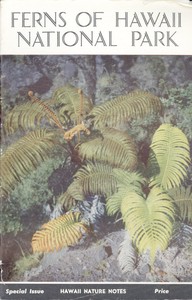
[Illustration: COVER
_Amaumau ferns in the Kilauea Section, Hawaii National Park_]
DEDICATION
_To_ Mr. Eugene Horner, _Member of the Board of Directors of the_
Hawaii Natural History Association, _whose interest in Hawaiian ferns
has extended over more than a half a century, and whose enthusiasm and
willing assistance in collecting and identifying ferns has been of
invaluable help, this booklet is dedicated_.
PRINTED BY
14ND PUBLICATIONS & PRINTING OFFICE
PEARL HARBOR, T. H.
1952
HAWAII NATURE NOTES
THE PUBLICATION OF THE
NATURALIST DIVISION, HAWAII NATIONAL PARK
AND THE HAWAII NATURAL HISTORY ASSOCIATION
VOL. V JUNE 1952 NO. 1
Ferns of Hawaii National Park
_by_
DOUGLASS H. HUBBARD
Park Naturalist[1]
[Illustration: HAWAII·NATURAL·HISTORY·ASSOCIATION]
SPECIAL ISSUE • PRICE 50 CENTS
[1]_Mr. Hubbard is now Associate Park Naturalist at Yosemite National
Park_
[Illustration: G. O. Fagerlund
_Stately tree ferns border a road in Hawaii National Park_]
INTRODUCTION
Ferns are among the most interesting plants in the plant world.
Varieties in Hawaii range from dainty filmy ferns less than one inch in
length to stately tree ferns over 40 feet high, and inhabit areas
varying from dry, barren lava flows to impenetrable rain jungles.
More primitive than flowering plants, ferns reproduce by means of small,
dust-like bodies called spores. These spores are often carried in the
air, and are so lightweight that they can be blown for thousands of
miles by winds. The ferns of Hawaii, or their ancestors, apparently
reached these islands with the help of winds, except for those
introduced recently by man.
HAWAII NATIONAL PARK
Hawaii National Park belongs to the American people. When it was set
aside by Congress in 1916 the three volcanoes, Haleakala, Mauna Loa, and
Kilauea were of principal interest. It has become increasingly apparent
that the beautiful forests of native trees, the birds which depend upon
Hawaiian plants for survival, and the magnificent fern jungles are of
equal importance and more in need of protection. Outside of the park,
trees such as the _koa_ (Hawaiian mahogany) and the _ohia_ are being cut
for lumber, and tree ferns, upon whose trunks orchids are grown, are
rapidly being taken for this expanding industry. The National Park
Service has been given the responsibility of keeping its areas in as
nearly an original condition as possible—a little bit of America,
unspoiled. Hawaii National Park—your park—is among the most outstanding
of these. Please help us keep it this way.
THIS BOOKLET
This booklet is not intended to be a comprehensive treatment of all the
ferns—some 70 species—which have been found to date in Hawaii National
Park. Rather it is an illustrated guide to the more abundant species
which may be seen by the visitor without wandering far from the beaten
path. Abundance has been used as the basis for arrangement, instead of
scientific classification, and illustrations take the place of technical
descriptions. The more serious observers are referred to the selected
bibliography near the end of this publication.
Some disagreement exists today among botanists as to the proper
scientific names for certain Hawaiian plant species, and many ferns have
been undergoing reclassification. For this reason all of the scientific
names that could be found for the various ferns in this booklet have
been listed on pages 37, 38 and 39.
A brief code has been included to indicate the type of habitat in which
the ferns normally may be found: D=dry, M=moist, D&M=dry and moist.
Numbers in bold-face type are used for that particular fern throughout
the publication. The page numbers refer to the location of the text and
the scientific name for that species.
One inch squares are used for background scale in many of the
illustrations.
All photographs are by the author unless otherwise credited.
TREE FERNS
The five species of Hawaiian tree ferns recognized by botanists will
appear quite similar to most visitors. The illustrations below show
several of the differences. Most common of the tree ferns are the two
species called HAPUU (10, 11) which do not have the coarse bristles of
the HAPU III (9) which sometimes grow to a height of 35 feet, including
the fronds. The fourth species, the MEU (12), is not common, and is
found only on the island of Hawaii. A fifth species is frequent in the
highlands of Kauai.
The reproductive bodies of the tree ferns are borne in small, bead-like
capsules on the margins of the leaf segments (see illustration below).
These capsules, which open by means of small lids, may be responsible
for the generic name of the ferns, _Cibotium_, from a Greek word meaning
a small vessel.
The buds of these ferns are covered with the silky PULU, discussed
below. According to Hillebrand (5, p. 546) ferns of the genus _Cibotium_
range over Mexico and Central America, the Philippine Islands, Sumatra,
South China and India. It is an interesting speculation as to which of
these places provided the spores which gave the Hawaiian tree ferns
their beginning.
Much of what appears to be the trunk on these and many other ferns is in
reality a useful mass of aerial roots which absorb moisture and protect
the tree trunk from damage. These roots also offer a fertile place for
seeds of many other plants to take root and grow. So common is it to
find ohia trees growing on tree fern trunks that the ferns are often
called _mother of ohia_. Unappreciative of the support given them in
their early growth the trees often send roots to earth which become so
large that the fern finally is killed. Much starch is present in the
trunks of tree ferns. This was resorted to by the Hawaiians for food in
time of famine. Young fronds of the tree ferns are used in preparing
several exotic dishes today, and many Park ferns have suffered severely
by having the new growth removed for this purpose.
[Illustration: Multi-branched fronds characterize tree-ferns]
[Illustration: Frond segments, segment closeups, and frond stalk
sections of MEU (12) (left), HAPU III (9) (center), and HAPUU (11)
tree ferns.]
PULU
The young fronds of certain ferns, especially tree ferns, are covered
with a bronze-colored silky floss called “pulu.” Used by the ancient
Hawaiians as an absorbent, for surgical dressings, and even in embalming
their dead, pulu became an item of export importance to the mainland
from the 1860’s to 1884. During this period some 4,271,119 pounds were
shipped, according to Degener (2). It was used primarily for stuffing
mattresses, pillows, and upholstery. Carl P. Russell in his _One-Hundred
Years in Yosemite_ (1947, p. 102) quotes Caroline M. Churchill, a
visitor to Leidig’s, a Yosemite hostelry established in 1869: “At this
place the beds are cleanly and wholesome, although consisting of pulu
mattresses placed upon slat bedsteads.”
The remains of the old pulu factory may be seen today in Kilauea section
about 1.8 miles below Makaopuhi Crater on the trail to Napau Crater.
Here the pulu was dried and baled before being taken seaward over the
pali to Keauhou Landing for loading onto mainland-bound vessels.
Although a high percentage of pulu was gathered from Kilauea ferns, the
industry fortunately terminated about 1885, and no more ferns were cut
for the small amount of pulu obtained from each. The hike to the pulu
factory is not strenuous, and is one of the most interesting in Hawaii
National Park.
[Illustration: {_Pulu._}]
AMAUMAU AND AMAU
The most abundant ferns growing beneath the larger tree ferns are
AMAUMAU (40) and the AMAU (41). Found frequently in both the Kilauea and
Haleakala sections of the Park, the amaumau is usually larger than the
less common amau and the fronds are not as hairy. The easiest method of
identification, however, is by comparing the undersides of the frond
segments (see illustration). The amaumau is smooth while the amau is
prominently veined. Usually smaller than the true tree ferns, and known
only from the Hawaiian Islands, ferns of this genus may reach heights as
great as 12 feet. A comparison of the photographs of these ferns with
the tree ferns will show that the entire frond of the AMAU or AMAUMAU
resembles a single segment of the many-branched frond of the tree fern.
The AMAUMAU fern has a high resistance to heat and drought, and may
often be seen growing on the Kau Desert near Kilauea crater. It is one
of the first plants to take root on new lava flows, in company with the
ohia tree. The illustration below shows a specimen growing on the 1877
lava which forms the floor of Keanakokoi crater.
Fowler (4, p. 16) states that the Hawaiians prepared a red dye used on
KAPA cloth from the outer part of the trunk of the amaumau. Leaves of
the amau provided a lining and thatching for houses, and the young
leaves and pith of the stems were occasionally cooked for food.
[Illustration: {Amaumau _growing on lava._}]
[Illustration: {_Underside of frond segments of_ AMAUMAU _and_
AMAU.}]
[Illustration: _In the rain forest near the old Pulu Factory. At
least six different kind of ferns may be seen in this photograph._]
[Illustration: Wawaeiole or Clubmoss. D&M, (58-61) (pages 36 and
39)]
[Illustration: Uluhe or False Staghorn. D&M, (4) (pages 32 and 37)]
[Illustration: Palaa. D, (14) (pages 32 and 37)]
[Illustration: Pamoho. M, (48) (pages 35 and 38)]
[Illustration: _Pamoho at the mouth of the Thurston Lava Tube_]
[Illustration: Palapalai o kaumaapua. M, (34) (pages 34 and 38)]
[Illustration: Loulu. M, (19) (pages 33 and 37)]
[Illustration: Laukahi or Cliffbrake. D, (20) (pages 33 and 37)]
[Illustration: Lance fern or DORYOPTERIS. D, (21) (pages 33 and 37)]
[Illustration: Owalii or Maidenhair Spleenwort. D, (47) (pages 35
and 38)]
[Illustration: Kilau or Bracken. D, (15) (pages 33 and 37)]
[Illustration: Pipi. D, (63) (pages 36 and 39)]
[Illustration: Moa. M, (62) (pages 36 and 39)]
[Illustration: Werner Stoy
_Dry-land ferns and grasses form the ground cover at this overlook
above the Koolau Gap, with Hanakauhi, “Maker of the Mist”, in the
distance. Haleakala Section, Hawaii National Park._]
[Illustration: Nianiau or Sword Ferns. From the left, Narrow
Swordfern (25), Scaly Swordfern (26), and Common Swordfern (24).]
[Illustration: Adder’s Tongue. (Pages 32 and 37)
_Ophioglossum pendulum_ (3)]
[Illustration: _Ophioglossum petiolatum_ (1) left
_Ophioglossum nudicaule_ (2)]
[Illustration: Common _epiphytes_, or air plants]
1. Kihi. M, (54) (pages 36 and 38)
2. Pai. M, (55) (pages 36 and 38)
3. Ekaha akolea. M, (51) (pages 36 and 38)
4. Grammitis hookeri. M, (52) (pages 36 and 38)
5. Amphoradenium sarmentosum. M, (56) (pages 36 and 38)
6. Wahini noho mauna. M, (57) (pages 36 and 38)
7. Palailaulii. M, (5) (pages 32 and 37)
8. Palaihinahina. M, (6) (pages 32 and 37)
9. Ohiaku. M, (7) (pages 32 and 37)
10. Kilau. M, (8) (pages 32 and 37)
[Illustration: {Epiphytes, #7-9}]
[Illustration: {Epiphyte, #10}]
[Illustration: _Amaumau ferns form beautiful patterns as they send
out new fronds. Kilauea Section, Hawaii National Park._]
[Illustration: Ekaha or Birdnest Fern. M, (42) (pages 35 and 38).
The dark areas on undersurfaces are spores.]
[Illustration: _Cyclosorus sandwicensis._ M, (36) (pages 35 and 38)]
[Illustration: The Elephant-Tongue ferns: From the left,
_Elaphoglossum reticulatum_, small form (31), _E. aemulum_ (28), _E.
gorgoneum_ (29), _E. reticulatum_, large form (28), and _E. hirtum_
(30) (pages 34 and 38). All are called “EKAHA.” The dark surfaces
are spores.]
[Illustration: Palapalai. D&M, (13) (pages 32 and 37)]
[Illustration: Iwaiwa. D, (49) (pages 35 and 38)]
[Illustration: _Asplenium contiguum._ M, (43) (pages 35 and 38)]
[Illustration: _Asplenium Macraei._ M, (46) (pages 35 and 38).
Iwaiwa o kane. D, (44) (pages 35 and 38)]
[Illustration: Piipiilau manamana. M, (45) (pages 35 and 38)]
[Illustration: Owalii or Cretan Brake. D&M, (16) (pages 33 and 37)]
[Illustration: Waimakanui. D, (17) (pages 33 and 37)]
[Illustration: Kaapeape. D, (27) (pages 34 and 37)]
[Illustration: Laukahi. D, (32) (pages 34 and 38)]
[Illustration: Above and below: Ae or _pellucid polypody_. D&M, (50)
(pages 36 and 38)]
[Illustration: Ae.]
[Illustration: Kolokolo. M, (53) (pages 36 and 38)]
[Illustration: Iwaiwa or Maidenhair. M, (23) (pages 34 and 37)]
[Illustration: Akolea. M, (38) (pages 35 and 38)]
[Illustration: Hoio. M, (39) (pages 35 and 38)]
[Illustration: Kikaweo. M, (35) (page 38)]
[Illustration: _Cyclosorus dentatus._ M, (37) (pages 35 and 38)]
[Illustration: Silver Fern. D, (22) (pages 33 and 37)]
(1-3) ADDER’S TONGUE
Sharp-eyed observers may find in cracks near Halemaumau and along the
Chain of Craters Road the adder’s tongue, a small, delicate plant with a
“head” which resembles a pointed tongue. Fowler (4) found the LAUKAHI
growing on trees near Keanakakoi and Makaopuhi craters. Hawaiians are
said to have prepared a cough remedy from the LAUKAHI. Near the 6,000
foot level on the slopes of Haleakala may be found a species of
_Ophioglossum_ according to Hillebrand (5).
(4) ULUHE OR FALSE STAGHORN
An attractive native fern which often becomes a pest by choking out
other plants is the ULUHE, common in openings throughout the eastern
half of the park. This fern often forms thickets so dense as to be
virtually impenetrable. Seeds of native plants which germinate beneath
these thickets may not be able to penetrate to sunlight. A fire hazard
is also presented by the dried fronds. An infusion was prepared from the
ULUHE, which the Hawaiians drank as an emetic, according to Fowler (4,
p. 10). Hillebrand (5, p. 545) states that this fern is “common on all
islands from 600 feet above the sea (Hilo district) to 3,000 feet....
The species occurs in most tropical countries of both hemispheres and in
many islands of the Pacific.”
(5-8) THE FILMY FERNS
Sharp eyes will be needed to detect the filmy ferns, since they normally
are found on tree trunks and rocks in the jungles, and may easily be
confused with the mosses with which they commonly grow. Compare the size
of the dainty PALAILAULII, which is about one inch long, with the tree
ferns, which often reach a height of 40 feet.
(13) PALAPALAI
An attractive fern with lace-like fronds, the PALAPALAI prefers the
outskirts of woods and open places. It is abundant in Kipuka Puaulu in
the Kilauea Section. The PALAPALAI is common in moderately wet areas
and, according to Hillebrand (5, p. 625) is found on all inhabited
Hawaiian Islands, as well as in India, Ceylon, Malaysia, Japan and
Formosa.
(14) PALAA
The PALAA was called the most common of all Hawaiian ferns by Hillebrand
(5, p. 627). In addition to Hawaii, he states that it is spread over all
tropical Polynesia and Asia, extending as far east as Madagascar and
north to Japan. Thriving in dry areas as well as moist, the PALAA is
common near Hilina Pali and in the vicinity of steam cracks around
Kilauea. It is one of the most abundant ferns along the Steaming Bluffs.
A red dye was extracted from the leaves by the old Hawaiians.
(15) KILAU OR BRACKEN
One of the most common ferns in dry areas in the Park is the KILAU, or
bracken fern. It often may be seen growing among tall grass, and is
abundant in the vicinity of Kipuka Puaulu and Kipuka Nene. It extends to
about the 9,000-foot level on the slopes of Mauna Loa.
(16) OWALII OR CRETAN BRAKE
Fairly common in the Kilauea Section, this fern may be found in Kipuka
Puaulu, along the Sandalwood Trail, and in the vicinity of the Thurston
Lava Tube. Note the dark rows of spores along the outer edges of the
leaves.
(17) WAIMAKANUI
Although not listed as a common fern, the WAIMAKANUI may be seen in open
areas in Kipuka Puaulu, as may the other ferns on the same page. It is
the same genus as the OWALII, described above.
(19) LOULU
This attractive fern is common near the entrance to the Thurston Lava
Tube. Found in moist localities at 3,000 to 5,000 feet elevation in the
Kilauea section, it normally grows as a short-stemmed plant, but may
reach heights of more than three feet. Hillebrand (5, p. 550) states
that it occurs also on Maui and Kauai at these elevations.
(20) LAUKAHI OR CLIFFBRAKE
Found in both sections of Hawaii National Park, the laukahi is found
most frequently in dry areas. In the Kilauea section it has been found
at elevations ranging up to 9,500 feet. The segments of the fronds,
known technically as PINNAE, are blue-gray in color and are often shaped
like a clover leaf, particularly when the fern is growing in shade. The
PINNAE are usually rolled up lengthwise, hiding the reproductive
structures. Hillebrand (5, p. 633) lists this species as occurring on
Maui, Hawaii and Kauai, and over the High Andes from Chile to Mexico.
(21) DORYOPTERIS OR LANCE FERN
Native only to the Hawaiian Islands but having no Hawaiian name, the
lance fern is common from Hilina Pali to the seacoast and throughout the
Kau Desert. The plants are small, tufted, and from six to fifteen inches
high. They often are abundant around the bases of lava outcroppings.
(22) SILVERFERN
A non-native plant which escaped from garden cultivation, the silverfern
often grows in large clumps in dry washes in the Hilina Pali area, and
extends out onto the Kau Desert. Also called “goldfern” these plants
derive their name from a waxy gold or silver-colored powder on the
underside of the fronds.
(23) IWAIWA OR MAIDENHAIR
Maidenhair fern, often used in floral decoration, is a plant familiar to
many. Preferring shady, moist places it is common in the vicinity of
Hilina Pali. The black glossy stalks provided ornamentation for Hawaiian
baskets and hats. The native species apparently is being replaced by a
non-native which was introduced about 50 years ago.
(24-26) NIANIAU OR SWORD FERN
The sword fern is a familiar plant in tropical and sub-tropical areas. A
common house fern, its scientific name, _Nephrolepis_, means
“kidney-scale” in Greek. The fern was so named because the spore dots on
the underside of the leaflets are protected by a kidney-shaped tissue
called an _indusium_. In the Haleakala section, _Puu Nianiau_, the hill
below the lodge, received its name from these ferns, which are also
called “OKUPUKUPU.” They are common in humid regions of the park,
particularly in the vicinity of steam cracks near Kilauea. The three
species illustrated have been found in the Park. Several large stands
may be seen in Kipuka Puaulu (Bird Park).
(27) KAAPEAPE
The KAAPEAPE may be recognized by the three pointed terminal leaflet and
remaining leaflets which are shaped like spear points. A species found
in India and China as well as the Hawaiian Islands, the kaapeape is
fairly common in Kipuka Puaulu. Note the irregular spore dots, often
abundant on the undersides of the leaves.
(28-31) EKAHA OR MAUI’S PADDLE
Common throughout forested areas in the park are the plants known
scientifically as _Elaphoglossum_, (Greek for “elephant-tongue”). They
are usually found growing as _epiphytes_ or air plants on the trunks of
trees. The resemblance to a paddle was recognized by the Hawaiians as
the name HOEA MAUI or “Maui’s paddle” indicates. In contrast to this
smooth, shiny species is the fuzzy EKAHA. According to Hillebrand, (5,
p. 549) these plants are found on all the inhabited Hawaiian Islands and
in tropical America, Tahiti, India, tropical Africa, Madeira and the
Azores. Six species of _Elaphoglossum_ have been found in the Kilauea
section.
(32) LAUKAHI
The LAUKAHI is a fairly common, low fern in the vicinity of Kipuka
Puaulu, but is considered rare in other portions of the Park. Fagerlund
(3, p. 19) lists it as having been collected in a lava tube at 8,800
feet on Mauna Loa.
(34) PALAPALAI O KAUMAAPUA
One of the most interesting things about this fern is the fact that the
frond tapers in both directions—toward the tip and toward the base. This
may be seen in the illustration. This species is fairly abundant in the
crater near the Thurston Lava Tube.
(36) CYCLOSORUS SANDWICENSIS
Although this fern is a native Hawaiian species, no Hawaiian name for it
could be found. It prefers shade and moist areas and is fairly common in
the Thurston Lava Tube and Kilauea Iki trails.
(37) CYCLOSORUS DENTATUS
The fern known technically as _Cyclosorus dentatus_ is not native to
Hawaii, but apparently was considered common on Oahu after 1900,
according to Wagner (6, p. 110). It may be found in moist areas in and
near the Park.
(38) AKOLEA
One of the most dainty of ferns, the AKOLEA is found in wet areas in the
vicinity of the Thurston Lava Tube. It is a common fern on the Kulani
Trail, just outside of the Park.
(39) HOIO
Common in moist areas in the Kilauea section, the HOIO prefers shade.
The fronds are large, often 3 to 4 feet long. Below the branches the
midribs are dark brown and smooth, but clothed with dark scales at their
bases. Spore dots are abundant.
(42) EKAHA OR BIRDNEST FERN
Of all Hawaiian fern species, few are more beautiful than the birdnest
fern, whose fronds often reach a length of six feet. Although it has not
been described from the Park, it has been included because it is
abundant in the Puna District, and probably will be found in the
Kalapana Extension of the Park. It normally grows in trees, but it may
also attach itself to rocks. When this happens the young birdnest ferns
are often called “rock ferns.” The dark areas on the underside of the
leaves in the illustration are spores.
(43-46, 49) ASPLENIUM
Among the most attractive, the _Asplenium_ ferns are also among the most
diversified Hawaiian plants as far as appearance is concerned. Showing
wide variety in choice of habitat they range from moist jungles to arid
lava flows. A number of the species may be recognized by the similarity
in shape of the leaf segments, and the long, parallel rows of spores,
but all do not show these characteristics. Nine species have been found
in the Kilauea Section of the Park.
(47) OWALII OR MAIDENHAIR SPLEENWORT
The maidenhair spleenwort has adapted itself to a dry existence. It is
abundant on barren lava flows where few other plants grow, and ranges up
to an elevation of about 10,000 feet.
(48) PAMOHO
A fern which lives in moist shady craters and lava tubes, the PAMOHO may
be seen growing on the cliff at the mouth of the Thurston Lava Tube.
(50) AE OR PELLUCID POLYPODY
A common plant throughout the open forests of the Kilauea Section, this
fern may be seen growing in abundance at the bases of ohia trees.
Superficially resembling a sword fern, the sharp twists to the leaf
segments differentiate it from them. An interesting thing about this
species is that it has also adapted itself to a life as an epiphyte, or
air plant, in the rain forests, at which time it develops a heavy
root-stock and has a much different appearance, as may be seen in the
illustrations.
(51-57) KIHI AND RELATIVES
The six ferns illustrated were formerly grouped under the genus
_Polypodium_, but several have recently been reclassified and placed in
new genera. The plants illustrated normally grow as _epiphytes_, or air
plants on tree trunks and rocks in the rain forests of the Kilauea
Section. That the Hawaiians recognized them as distinct plants is
indicated in the fact that they were given different Hawaiian names.
(58-61) WAWAEIOLE OR CLUBMOSS
Clubmosses are sometimes called “living fossils.” Many deposits of the
continental United States are formed from giant relatives of these
plants. The name “clubmoss” is derived from the spore-bearing bodies,
which are club-shaped. Most abundant is the nodding clubmoss but at
least three other species may be found in the Kilauea and Haleakala
sections.
Degener (2) reports that the Hawaiians used the wawaeiole (“rat’s foot”)
as a relief for rheumatism, the sufferer bathing in water in which the
plants had been boiled for about three hours.
(62-63) MOA OR PIPI
The _Psilotum_ is a primitive plant, of which two species are found in
the Hawaiian Islands. One is the MOA, which usually grows on the ground
and has stems which fork many times near the ends. The second, the PIPI,
often grows upon the trunks of trees and ferns. This species normally
grows perpendicular to the trunk, then curves abruptly earthward like
the tail of a horse. Degener (2, p. 18) states that the MOA was used by
the Hawaiians in making a medicine for treatment of a fungus disease, as
an emetic, and that the spores were used as a powder to relieve chafing
from the malo, or loincloth.
SCIENTIFIC NAMES OF FERNS DESCRIBED HEREIN
(Numbers follow common names in the captions. Because of numerous recent
studies of ferns, various name changes have been necessary, and on some
names there is still disagreement. The following list adopts mainly the
nomenclature of the GENERA FILICUM by Prof. Edwin B. Copeland, 1947. The
indented names are ones which have been used for the same plants in the
past.)
FAMILY OPHIOGLOSSACEAE
(1) _Ophioglossum petiolatum_ Hooker
(2) _Ophioglossum nudicaule_ Linnaeus fils
(3) _Ophioglossum pendulum_ esp. _falcatum_ (Presl) Clausen (LAUKAHI)
_O. falcatum_ (Presl) Fowler
_O. pendulum_ L.
_Ophioderma falcatum_ Degener
FAMILY GLEICHENIACEAE
(4) _Dicranopteris emarginata_ (Brackenridge) Robinson (ULUHE)
_D. sandwicensis_ Degener
_Gleichenia emarginata_ (Brackenridge) Robinson
FAMILY HYMENOPHYLLACEAE
(5) _Hymenophyllum obtusum_ Hooker and Arnott (PALAILAULII)
_Sphaerocionium obtusum_ (H.&A.) Copeland
(6) _Hymenophyllum lanceolatum_ Hooker and Arnott (PALAIHINAHINA)
_Sphaerocionium lanceolatum_ (H.&A.) Copeland
(7) _Hymenophyllum recurvum_ Gaudichaud (OHIAKU)
_Mecodium recurvum_ (Gaud.) Copeland
(8) _Trichomanes davallioides_ Gaudichaud (KILAU)
_Vandenboschia davallioides_ (Gaud.) Copeland
FAMILY PTERIDACEAE
(9) _Cibotium Chamissoi_ Kaulfuss (HAPU III)
_C. Menziesii_ Hooker
(10) _Cibotium splendens_ (Gaudichaud) Krajina (HAPUU)
_C. Chamissoi_ Kaulfuss
(11) _Cibotium glaucum_ (Smith) Hooker and Arnott (HAPUU)
(12) _Cibotium hawaiiense_ Nakai and Ogura (MEU)
_Cibotium St. Johnii_ Krajina
(13) _Microlepia setosa_ (Smith) Alston (PALAPALAI)
_M. strigosa_ (Thunberg) Presl
(14) _Sphenomeris chusana_ (Linnaeus) Copeland (PALAA)
_Stenoloma chinensis_ (L.) Beddome
_Odontosoria chinensis_ (L.) J. Smith
_Microlepia tenuifolia_ Mettenius
(15) _Pteridium aquilinum_ (L.) Kuhn (KILAU, BRACKEN)
_Pteris aquilina_ L.
(16) _Pteris cretica_ Linnaeus (OWALII)
(17) _Pteris excelsa_ Gaudichaud (WAIMAKANUI)
(18) _Pteris vittata_ Linnaeus (KILAUOPUEO)
_Pteris longifolia_ L.
(19) _Coniogramme pilosa_ (Brackenridge) Hieronymus (LOULU)
_Gymnogramme javanica_ Hillebrand
(20) _Pellaea ternifolia_ (Cavanilles) Link (LAUKAHI)
(21) _Doryopteris decora_ Brackenridge (LANCE FERN)
(22) _Pityrogramma calomelanos_ (Linnaeus) Link (SILVER FERN)
_Ceropteris ochracea_ (Presl) Robinson
(23) _Adiantum cuneatum_ Langsdorff and Fischer (IWAIWA, MAIDENHAIR)
FAMILY DAVALLIACEAE
(24) _Nephrolepis exaltata_ (Linnaeus) Schott (NIANIAU, COMMON
SWORDFERN)
(25) _Nephrolepis cordifolia_ (Linnaeus) Presl (NARROW SWORDFERN)
(26) _Nephrolepis hirsutula_ (Forster) Presl (SCALY SWORDFERN)
FAMILY ASPIDIACEAE
(27) _Cyrtomium caryotideum_ (Wallich) Presl (KAAPEAPE)
_Aspidium caryotideum_ Wallich
_Phanerophlebia caryotidea_ (Wall.) Copeland
(28) _Elaphoglossum aemulum_ (Kaulfuss) Brackenridge (EKAHA)
_E. conforme_ (Swartz) Schott
_Acrostichum conforme_ Swartz
(29) _Elaphoglossum gorgoneum_ (Kaulfuss) Brackenridge (EKAHA)
(30) _Elaphoglossum hirtum_ (Swartz) C. Christensen (EKAHA)
_Acrostichum squamosum_ Hillebrand
(31) _Elaphoglossum reticulatum_ (Kaulfuss) Gaudichaud (EKAHA)
(32) _Dryopteris paleacea_ (Swartz) C. Christensen (LAUKAHI)
_Aspidium filix-mas_ var. _parallelogrammum_ Kuntze
(33) _Dryopteris glabra_ (Brackenridge) O. Kuntze (KILAU)
_Aspidium glabrum_ (Brack.) Mettenius
(34) _Lastrea globulifera_ Brackenridge (PALAPALAI O KAUMAAPUA)
_Aspidium globuliferum_ (Brack.) Mann
(35) _Cyclosorus cyatheoides_ (Kaulfuss) Farwell (KIKAWEO)
_Dryopteris cyatheoides_ (Kaulf.) O. Kuntze
_Aspidium cyatheoides_ Kaulf.
(36) _Cyclosorus sandwicensis_ (Brackenridge) Copeland
_Dryopteris stegnogrammoides_ (Baker) C. Christensen
_Phegopteris polycarpa_ (Hooker & Arnott) C. Chr.
(37) _Cyclosorus dentatus_ (Forskal) Ching
_Dryopteris dentata_ (Forsk.) O. Kuntze
(38) _Athyrium microphyllum_ (Smith) Alston (AKOLEA)
_A. Poiretianum_ (Gaudichaud) Presl
_Asplenium aspidioides_ Hillebrand
_A. multisectum_ Brackenridge
(39) _Athyrium sandwichianum_ Presl (HOIO)
_Diplazium sandwichianum_ (Presl) Diels
_Asplenium sandwichianum_ (Presl) Hooker
FAMILY BLENCHNACEAE
(40) _Sadleria cyatheoides_ Kaulfuss (AMAUMAU)
(41) _Sadleria pallida_ Hooker & Arnott (AMAU)
_S. Hillebrandii_ Robinson
FAMILY ASPLENIACEAE
(42) _Asplenium nidus_ Linnaeus (EKAHA, BIRDNEST FERN)
_Neottopteris nidus_ (L.) J. Smith
_Thamnopteris nidus_ Presl
(43) _Asplenium contiguum_ Kaulfuss
(44) _Asplenium rhipidoneuron_ Robinson (IWAIWA O KANE)
_A. furcatum_ Hillebrand
(45) _Asplenium lobulatum_ Mettenius (PIIPIILAU MANAMANA)
_A. pseudofalcatum_ Hillebrand
(46) _Asplenium Macraei_ Hooker and Greville
_A. erectum_ Hillebrand
(47) _Asplenium trichomanes_ Linnaeus (OWALII)
_A. densum_ Brackenridge
(48) _Asplenium unilaterale_ Lamarck (PAMOHO)
_A. resectum_ Smith
(49) _Asplenium adiantum-nigrum_ Linnaeus (IWAIWA)
FAMILY POLYPODIACEAE
(50) _Polypodium pellucidum_ Kaulfuss (AE)
(The variety of exposed places is var. _vulcanicum_ Skotts.)
(51) _Pleopeltis Thunbergiana Kaulfuss_ (EKAHA AKOLEA)
_Polypodium lineare_ Thunberg
FAMILY GRAMMITIDACEAE
(52) _Grammitis Hookeri_ (Brackenridge) Copeland
_Polypodium Hookeri_ Brackenridge
(53) _Grammitis tenella_ Kaulfuss (KOLOKOLO)
_Polypodium pseudogrammitis_ Gaudichaud
(54) _Xiphopteris Saffordii_ (Maxon) Copeland (KIHI)
_Polypodium Saffordii_ Maxon
_P. serrulatum_ Hillebrand
(55) _Amphoradenium hymenophylloides_ (Kaulfuss) Copeland (PAI)
_Polypodium hymenophylloides_ Kaulfuss
(56) _Amphoradenium sarmentosum_ (Brackenridge) Copeland
_Polypodium sarmentosum_ Brackenridge
(57) _Amphoradenium tamariscinum_ (Kaulfuss) Copeland (WAHINI NOHO
MAUNA)
_Polypodium tamariscinum_ Kaulfuss
FAMILY LYCOPODIACEAE
(58) _Lycopodium cernuum Linnaeus_ (WAWAEIOLE)
(59) _Lycopodium phyllanthum_ Hooker & Arnott (WAWAEIOLE)
_Lycopodium pachystachyon_ Spring
(60) _Lycopodium polytrichoides_ Kaulfuss (WAWAEIOLE)
(61) _Lycopodium venustulum_ Gaudichaud (WAWAEIOLE)
FAMILY PSILOTACEAE
(62) _Psilotum complanatum Swartz_ (MOA)
(63) _Psilotum nudum_ (Linnaeus) Beauvois (PIPI)
_Psilotum triquetrum_ Swartz
SELECTED BIBLIOGRAPHY
(1) Copeland, Edwin B. _Genera Filicum._ Waltham, Mass., 1947.
(2) Degener, Otto. _Plants of Hawaii National Park._ Honolulu, 1930.
(3) Fagerlund, Gunnar, and Arthur L. Mitchell. _A Checklist of the
Plants Hawaii National Park, Kilauea-Mauna Loa Section._
Hawaii National Park, 1944.
(4) Fowler, Robert. “Annotated List of Ferns of the Kilauea-Mauna Loa
Section of Hawaii National Park.” _American Fern Journal_,
Vol. 30, No. 1, 1940.
(5) Hillebrand, W. F. _Flora of the Hawaiian Islands._ New York, 1888.
(6) Wagner, W. H., Jr. “Ferns Naturalized in Hawaii.” _Occasional
Papers of Bernice P. Bishop Museum_, Vol. XX, No. 8.
Honolulu, 1950.
INDEX
A
Adder’s tongue 17, 32, 37
_Adiantum_ 29, 34, 37
Ae 28, 36, 38
Akolea 29, 35, 38
Amau 7
Amaumau 7, 20-21
_Amphoradenium_ 18, 36, 38
_Asplenium_ 10, 13, 24, 35, 38
_Athyrium_ 29, 35, 38
B
Bird nest fern 22, 35, 38
Bracken 13, 33, 37
C
_Ceropteris_ 31, 33, 37
_Cibotium_ 4, 5, 37
Cliffbrake 12, 33, 38
Clubmoss 8, 36, 39
_Coniogramme_ 11, 33, 37
Cretan brake 26, 33, 37
_Cyclosorus_ 22, 31, 35, 38
_Cyrtomium_ 27, 34, 37
D
_Dicranopteris_ 9, 32, 37
_Diplazium_ 30, 35, 38
Doryopteris 12, 33, 37
_Dryopteris_ 27, 34, 38
E
Ekaha 22, 23, 34, 38
Ekaha akolea 18, 36, 38
_Elaphoglossum_ 23, 34, 38
Epiphytes 18
F
False staghorn 9, 32, 37
G
_Gleichenia_ 9, 32, 37
Gold fern 31, 33, 37
_Grammitis_ 18, 36, 38
H
Hapu iii 4, 5, 37
Hapuu 4, 5, 37
Haleakala 3, 15
Hawaii National Park 3
Hoi 30, 35, 38
_Hymenophyllum_ 18, 32, 37
I
Indusium 34
Iwaiwa 24, 35, 38
Iwaiwa O Kane 25, 35, 38
K
Kaapeape 27, 34, 37
Kapa cloth 7
Keanakakoi Crater 7
Kihi 18, 36, 38
Kikaweo 30, 38
Kilau 13, 18, 32, 33, 37
Kilauea 3
Kipuka Puaulu 33, 34
Koa 3
Kolokolo 28, 36, 38
L
Lance fern 12, 33, 37
Laukahi 12, 27, 33, 34, 37, 38
Loulu 11, 33, 38
_Lycopodium_ 8, 36, 39
M
Maidenhair 29, 34, 37
Maidenhair spleenwort 13, 35, 38
Makaopuhi Crater 6, 32
Maui’s paddle 23, 34, 38
Mauna Loa 3
Meu 4, 5, 37
_Microlepia_ 23, 32, 37
Moa 14, 36, 39
Mother of ohia 4
N
Napau Crate 6
National Park Service 3
_Neottopteris_ 22, 35, 38
_Nephrolepis_ 16, 34, 37
_Nianiau_ 16, 34, 37
O
_Odontosoria_ 14, 32, 37
Ohiaku 18, 32, 37
_Ophioderma_ 17, 32, 37
_Ophioglossum_ 17, 32, 37
Owalii 13, 26, 33, 35, 37, 38
P
Pai 18, 36, 38
Palaa 9, 14, 32, 37
Palaihinahina 18, 32, 37
Palailaulii 18, 32, 37
Palapalai 11, 23, 32, 34, 37, 38
Pamoho 10, 35, 38
_Pellaea_ 12, 33, 38
Pellucid polpody 28, 36, 38
Piipiilau manamana 25, 35, 38
Pinnae 33
Pipi 14, 36, 39
_Pityrogramma_ 31, 33, 37
_Polypodium_ 18, 28, 36, 38
_Psilotum_ 14, 36, 39
_Pteridium_ 13, 33, 37
_Pteris_ 26, 33, 37
Pulu 4, 6
Pulu Factory 6, 8
S
_Sadleria_ 7, 20-21
Silverfern 31, 33, 37
_Spenomeris_ 14, 32, 37
Spores 3
Staghorn, false 9, 32, 37
_Stenoloma_ 14, 32, 37
Sword fern 16, 34, 37
T
Thurston Lava Tube 10, 33, 34
Tree fern 2, 4, 5, 37
_Trichomanes_ 18, 32, 37
U
Uluhe 9, 32, 37
W
Wahini noho mauna 18, 36, 38
Waimakanui 26, 33, 37
Wawaeiole 8, 36, 39
X
_Xiphopteris_ 18, 36, 38
THE PURPOSES OF THE
HAWAII NATURAL HISTORY ASSOCIATION
Hawaii National Park, Hawaii
Formed for the purpose of cooperating with the National Park Service by
assisting the Naturalist Department of Hawaii National Park in the
development of a better public understanding of the volcanology,
geology, plant life, history, and related interests in Hawaii National
Park and surrounding areas, the Association aids in the development of
the Hawaii National Park Museum and library, offers publications, motion
and still colored pictures of volcanoes and natural history of this area
for sale to park visitors, and cooperates in the publication of Hawaii
Nature Notes.
Revenue derived from the activities of the Hawaii Natural History
Association is devoted entirely to the purposes outlined above. Any
person interested in furthering these purposes may become a member upon
payment of one dollar. Gifts and donations are accepted for museum or
library development, or general use.
Transcriber’s Notes
—Silently corrected a few typos.
—Added captions (derived from the text, and enclosed in {brackets}) to
several illustrations.
—Retained publication information from the printed edition: this eBook
is public-domain in the country of publication.
—In the text versions only, text in italics is delimited by
_underscores_.