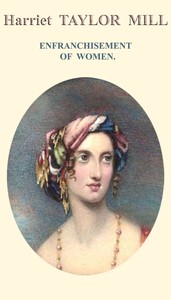
To the reader
This digitized version reproduces the full version of the Essay.
Obvious typographical errors have been corrected. Bold are denoted
by equals signs
Please note that two pages of advertising have not been reproduced.
ENFRANCHISEMENT OF WOMEN.
AN ESSAY BY
MRS. JOHN STUART MILL.
REPRINTED FROM THE
WESTMINSTER AND FOREIGN QUARTERLY REVIEW,
FOR JULY, 1851.
NEW YORK:
Office of “THE REVOLUTION”
NO. 37 PARK ROW (ROOM 17)
1868
ENFRANCHISEMENT OF WOMEN:
BY MRS. JOHN STUART MILL.
REPRINTED FROM THE
"WESTMINSTER AND FOREIGN QUARTERLY REVIEW,"
FOR JULY, 1851.
Most of our readers will probably learn from these pages, for the
first time, that there has arisen in the United States, and in
the most civilized and enlightened portion of them, an organized
agitation on a new question,--new, not to thinkers, nor to any one
by whom the principles of free and popular government are felt, as
well as acknowledged, but new, and even unheard of, as a subject for
public meetings and practical political action. This question is, the
enfranchisement of women; their admission, in law, and in fact, to
equality in all rights, political, civil and social, with the male
citizens of the community.
It will add to the surprise with which many will receive this
intelligence, that the agitation which has commenced is not a pleading
by male writers and orators _for_ women, those who are professedly
to be benefited remaining either indifferent or ostensibly hostile;
it is a political movement, practical in its objects, carried on in
a form which denotes an intention to persevere. And it is a movement
not merely _for_ women, but _by_ them. Its first public manifestation
appears to have been a convention of women, held in the State of New
York, July, 1848. Of this meeting we have seen no report. On the 23d
and 24th of October last, a succession of public meetings was held
at Worcester, in Massachusetts, under the name of a "Women's Rights
Convention," of which the president was a woman, and nearly all the
chief speakers women; numerously reinforced, however, by men, among
whom were some of the most distinguished leaders in the kindred cause
of negro emancipation. A general and four special committees were
nominated, for the purpose of carrying on the undertaking until the
next annual meeting.
According to the report in the _New York Tribune_, above a thousand
persons were present throughout, and, "if a larger place could
have been had, many thousands more would have attended." The place
was described as "crowded, from the beginning, with attentive and
interested listeners." In regard to the quality of the speaking, the
proceedings bear an advantageous comparison with those of any popular
movement with which we are acquainted, either in this country or in
America. Very rarely, in the oratory of public meetings, is the part of
verbiage and declamation so small, that of calm good sense and reason
so considerable. The result of the convention was, in every respect,
encouraging to those by whom it was summoned; and it is probably
destined to inaugurate one of the most important of the movements
towards political and social reform, which are the best characteristic
of the present age.
That the promoters of this new agitation take their stand on
principles, and do not fear to declare these in their widest extent,
without time-serving or compromise, will be seen from the resolutions
adopted by the convention, part of which we transcribe:
_Resolved_, That every human being, of full age, and resident for a
proper length of time on the soil of the nation, who is required to
obey the law, is entitled to a voice in its enactment; that every
such person, whose property or labor is taxed for the support of
the government, is entitled to a direct share in such government.
Therefore,
_Resolved_, That women are entitled to the right of suffrage, and to
be considered eligible to office; and that every party, which claims
to represent the humanity, the civilization, and the progress of the
age, is bound to inscribe on its banners, equality before the law,
without distinction of sex or color.
_Resolved_, That civil and political rights acknowledge no sex,
and therefore the word "male" should be stricken from every state
constitution.
_Resolved_, That, since the prospect of honorable and useful
employment in after life is the best stimulus to the use of
educational advantages, and since the best education is that we give
ourselves, in the struggles, employments and discipline of life;
therefore it is impossible that women should make full use of the
instruction already accorded to them, or that their career should do
justice to their faculties, until the avenues to the various civil
and professional employments are thrown open to them.
_Resolved_, That every effort to educate women, without according to
them their rights, and arousing their conscience by the weight of
their responsibilities, is futile, and a waste of labor.
_Resolved_, That the laws of property, as affecting married persons,
demand a thorough revisal, so that all rights be equal between them;
that the wife have, during life, an equal control over the property
gained by their mutual toil and sacrifices, and be heir to her
husband precisely to that extent that he is heir to her, and entitled
at her death to dispose by will of the same share of the joint
property as he is.
The following is a brief summary of the principal demands:
1. _Education_ in primary and high schools, universities, medical,
legal and theological institutions.
2. _Partnership_ in the labors and gains, risks and remunerations, of
productive industry.
3. _A coëqual share_ in the formation and administration of
laws,--municipal, state and national,--through legislative
assemblies, courts, and executive offices.
It would be difficult to put so much true, just and reasonable meaning
into a style so little calculated to recommend it as that of some
of the resolutions. But whatever objection may be made to some of
the expressions, none, in our opinion, can be made to the demands
themselves. As a question of justice, the case seems to us too clear
for dispute. As one of expediency, the more thoroughly it is examined,
the stronger it will appear.
That women have as good a claim as men have, in point of personal
right, to the suffrage, or to a place in the jury-box, it would be
difficult for anyone to deny. It cannot certainly be denied by the
United States of America, as a people or as a community. Their
democratic institutions rest avowedly on the inherent right of every
one to a voice in the government. Their Declaration of Independence,
framed by the men who are still their great constitutional
authorities,--that document which has been from the first, and is now,
the acknowledged basis of their polity,--commences with this express
statement:
"We hold these truths to be self-evident: that all men are created
equal; that they are endowed by their Creator with certain
inalienable rights; that among these are life, liberty, and the
pursuit of happiness; that, to secure these rights, governments are
instituted among men, deriving their just powers from the consent of
the governed."
We do not imagine that any American democrat will evade the force of
these expressions by the dishonest or ignorant subterfuge, that "men,"
in this memorable document, does not stand for human beings, but for
one sex only; that "life, liberty and the pursuit of happiness," are
"inalienable rights" of only one moiety of the human species; and that
"the governed," whose consent is affirmed to be the only source of
just power, are meant for that half of mankind only, who, in relation
to the other, have hitherto assumed the character of _governors_. The
contradiction between principle and practice cannot be explained away.
A like dereliction of the fundamental maxims of their political creed
has been committed by the Americans in the flagrant instance of the
negroes; of this they are learning to recognize the turpitude. After a
struggle which, by many of its incidents, deserves the name of heroic,
the abolitionists are now so strong in numbers and influence, that they
hold the balance of parties in the United States. It was fitting that
the men whose names will remain associated with the extirpation from
the democratic soil of America of the aristocracy of color, should
be among the originators, for America and for the rest of the world,
of the first collective protest against the aristocracy of sex; a
distinction as accidental as that of color, and fully as irrelevant to
all questions of government.
Not only to the democracy of America the claim of women to civil and
political equality makes an irresistible appeal, but also to those
radicals and chartists in the British islands, and democrats on the
continent, who claim what is called universal suffrage as an inherent
right, unjustly and oppressively withheld from them. For with what
truth or rationality could the suffrage be termed universal, while half
the human species remain excluded from it? To declare that a voice in
the government is the right of all, and demand it only for a part,--the
part, namely, to which the claimant himself belongs,--is to renounce
even the appearance of principle. The chartist who denies the suffrage
to women is a chartist only because he is not a lord; he is one of
those levellers who would level only down to themselves.
Even those who do not look upon a voice in the government as a matter
of personal right, nor profess principles which require that it should
be extended to all, have usually traditional maxims of political
justice, with which it is impossible to reconcile the exclusion of all
women from the common rights of citizenship. It is an axiom of English
freedom, that taxation and representation should be coëxtensive. Even
under the laws which give the wife's property to the husband, there
are many unmarried women who pay taxes. It is one of the fundamental
doctrines of the British constitution, that all persons should be tried
by their peers; yet women, whenever tried, are tried by male judges and
a male jury. To foreigners, the law accords the privilege of claiming
that half the jury should be composed of themselves; not so to women.
Apart from maxims of detail, which represent local and national, rather
than universal ideas, it is an acknowledged dictate of justice, to
make no degrading distinctions without necessity. In all things, the
presumption ought to be on the side of equality. A reason must be given
why anything should be permitted to one person, and interdicted to
another. But when that which is interdicted includes nearly everything
which those to whom it is permitted most prize, and to be deprived of
which they feel to be most insulting; when not only political liberty,
but personal freedom of action, is the prerogative of a caste; when
even, in the exercise of industry, almost all employments which task
the higher faculties in an important field, which lead to distinction,
riches, or even pecuniary independence, are fenced round as the
exclusive domain of the predominant section, scarcely any doors being
left open to the dependent class, except such as all who can enter
elsewhere disdainfully pass by; the miserable expediencies which are
advanced as excuses for so grossly partial a dispensation would not be
sufficient, even if they were real, to render it other than a flagrant
injustice. While, far from being expedient, we are firmly convinced
that the division of mankind into two castes, one born to rule over
the other, is, in this case, as in all cases, an unqualified mischief;
a source of perversion and demoralization, both to the favored class
and to those at whose expense they are favored; producing none of the
good which it is the custom to ascribe to it, and forming a bar, almost
insuperable, while it lasts, to any really vital improvement, either in
the character or in the social condition of the human race.
These propositions it is now our purpose to maintain. But, before
entering on them, we would endeavor to dispel the preliminary
objections which, in the minds of persons to whom the subject is
new, are apt to prevent a real and conscientious examination of it.
The chief of these obstacles is that most formidable one--custom.
Women never have had equal rights with men. The claim in their
behalf, of the common rights of mankind, is looked upon as barred
by universal practice. This strongest of prejudices, the prejudice
against what is new and unknown, has, indeed, in an age of changes
like the present, lost much of its force; if it had not, there would
be little hope of prevailing against it. Over three fourths of the
habitable world, even at this day, the answer, "It has always been
so," closes all discussion. But it is the boast of modern Europeans,
and of their American kindred, that they know and do many things
which their forefathers neither knew nor did; and it is, perhaps, the
most unquestionable point of superiority in the present, above former
ages, that habit is not now the tyrant it formerly was over opinions
and modes of action, and that the worship of custom is a declining
idolatry. An uncustomary thought, on a subject which touches the
greater interests of life, still startles when first presented; but
if it can be kept before the mind until the impression of strangeness
wears off, it obtains a hearing, and as rational a consideration as the
intellect of the hearer is accustomed to bestow on any other subject.
In the present case, the prejudice of custom is doubtless on the
unjust side. Great thinkers, indeed, at different times, from Plato to
Condorcet, besides some of the most eminent names of the present age,
have made emphatic protests in favor of the equality of women. And
there have been voluntary societies, religious or secular, of which
the Society of Friends is the most known, by whom that principle was
recognized. But there has been no political community or nation in
which, by law, and usage, women have not been in a state of political
and civil inferiority. In the ancient world, the same fact was alleged,
with equal truth, in behalf of slavery. It might have been alleged in
favor of the mitigated form of slavery, serfdom, all through the middle
ages. It was urged against freedom of industry, freedom of conscience,
freedom of the press; none of these liberties were thought compatible
with a well-ordered state, until they had proved their possibility
by actually existing as facts. That an institution or a practice is
customary, is no presumption of its goodness, when any other sufficient
cause can be assigned for its existence. There is no difficulty in
understanding why the subjection of women has been a custom. No other
explanation is needed than physical force.
That those who were physically weaker should have been made legally
inferior, is quite conformable to the mode in which the world has been
governed. Until very lately, the rule of physical strength was the
general law of human affairs. Throughout history, the nations, races,
classes, which found themselves the strongest, either in muscles,
in riches, or in military discipline, have conquered and held in
subjection the rest. If, even in the most improved nations, the law
of the sword is at last discountenanced as unworthy, it is only since
the calumniated eighteenth century. Wars of conquest have only ceased
since democratic revolutions began. The world is very young, and has
but just begun to cast off injustice. It is only now getting rid of
negro slavery. It is only now getting rid of monarchical despotism.
It is only now getting rid of hereditary feudal nobility. It is only
now getting rid of disabilities on the ground of religion. It is
only beginning to treat any _men_ as citizens, except the rich and a
favored portion of the middle class. Can we wonder that it has not
yet done as much for women? As society was constituted until the last
few generations, inequality was its very basis; association grounded
on equal rights scarcely existed; to be equals was to be enemies; two
persons could hardly coöperate in anything, or meet in any amicable
relation, without the law's appointing that one of them should be the
superior of the other. Mankind have outgrown this state, and all things
now tend to substitute, as the general principle of human relations,
a just equality instead of the dominion of the strongest. But, of
all relations, that between men and women being the nearest and most
intimate, and connected with the greatest number of strong emotions,
was sure to be the last to throw off the old rule and receive the new;
for, in proportion to the strength of a feeling, is the tenacity with
which it clings to the forms and circumstances with which it has even
accidentally become associated.
When a prejudice which has any hold on the feelings finds itself
reduced to the unpleasant necessity of assigning reasons, it thinks it
has done enough when it has reässerted the very point in dispute, in
phrases which appeal to the preëxisting feeling. Thus, many persons
think they have sufficiently justified the restrictions on women's
field of action when they have said that the pursuits from which women
are excluded are _unfeminine_, and that the _proper sphere_ of women is
not politics or publicity, but private and domestic life.
We deny the right of any portion of the species to decide for another
portion, or any individual for another individual, what is and what is
not their "proper sphere." The proper sphere for all human beings is
the largest and highest which they are able to attain to. What this is,
cannot be ascertained without complete liberty of choice. The speakers
at the convention in America have, therefore, done wisely and right in
refusing to entertain the question of the peculiar aptitudes either of
women or of men, or the limits within which this or that occupation may
be supposed to be more adapted to the one or to the other. They justly
maintain that these questions can only be satisfactorily answered by
perfect freedom. Let every occupation be open to all, without favor
or discouragement to any, and employments will fall into the hands of
those men or women who are found by experience to be most capable of
worthily exercising them. There need be no fear that women will take
out of the hands of men any occupation which men perform better than
they. Each individual will prove his or her capacities, in the only
way in which capacities can be proved, by trial; and the world will
have the benefit of the best faculties of all its inhabitants. But to
interfere beforehand by an arbitrary limit, and declare that whatever
be the genius, talent, energy, or force of mind, of an individual of a
certain sex or class, those faculties shall not be exerted, or shall
be exerted only in some few of the many modes in which others are
permitted to use theirs, is not only an injustice to the individual,
and a detriment to society, which loses what it can ill spare, but is
also the most effectual mode of providing that, in the sex or class so
fettered, the qualities which are not permitted to be exercised shall
not exist.
We shall follow the very proper example of the convention, in not
entering into the question of the alleged differences in physical or
mental qualities between the sexes; not because we have nothing to say,
but because we have too much: to discuss this one point tolerably would
need all the space we have to bestow on the entire subject[1]. But if
those who assert that the "proper sphere" for women is the domestic
mean by this that they have not shown themselves qualified for any
other, the assertion evinces great ignorance of life and of history.
Women have shown fitness for the highest social functions exactly in
proportion as they have been admitted to them. By a curious anomaly,
though ineligible to even the lowest offices of state, they are in
some countries admitted to the highest of all, the regal; and if there
is any one function for which they have shown a decided vocation,
it is that of reigning. Not to go back to ancient history, we look
in vain for abler or firmer rulers than Elizabeth; than Isabella of
Castile; than Maria Theresa; than Catharine of Russia; than Blanche,
mother of Louis IX. of France; than Jeanne d'Albret, mother of Henri
Quatre. There are few kings on record who contended with more difficult
circumstances, or overcame them more triumphantly, than these. Even in
semi-barbarous Asia, princesses who have never been seen by men other
than those of their own family, or ever spoken with them unless from
behind a curtain, have, as regents, during the minority of their sons,
exhibited many of the most brilliant examples of just and vigorous
administration. In the middle ages, when the distance between the upper
and lower ranks was greater than even between women and men, and the
women of the privileged class, however subject to tyranny from men of
the same class, were at a less distance below them than any one else
was, and often in their absence represented them in their functions and
authority, numbers of heroic chatelaines, like Jeanne de Montfort,
or the great Countess of Derby, as late even as the time of Charles
I., distinguished themselves, not only by their political, but their
military capacity. In the centuries immediately before and after the
Reformation, ladies of royal houses, as diplomatists, as governors of
provinces, or as the confidential advisers of kings, equalled the first
statesmen of their time; and the treaty of Cambray, which gave peace
to Europe, was negotiated, in conferences where no other person was
present, by the aunt of the Emperor Charles the Fifth, and the mother
of Francis the First.
[1] An excellent passage on this part of the subject, from one of
Sydney Smith's contributions to the _Edinburgh Review_, we will not
refrain from quoting: "A great deal has been said of the original
difference of capacity between men and women as if women were more
quick and men more judicious; as if women were more remarkable for
delicacy of association, and men for stronger powers of attention.
All this, we confess, appears to us very fanciful. That there is a
difference in the understandings of the men and the women we every
day meet with, everybody, we suppose, must perceive; but there is
none, surely, which may not be accounted for by the difference of
circumstances in which they have been placed, without referring to
any conjectural difference of original conformation of mind. As
long as boys and girls run about in the dirt, and trundle hoops
together, they are both precisely alike. If you catch up one half
of these creatures, and train them to a particular set of actions
and opinions, and the other half to a perfectly opposite set, of
course their understandings will differ, as one or the other sort
of occupations has called this or that talent into action. There is
surely no occasion to go into any deeper or more abstruse reasoning,
in order to explain so very simple a phenomenon."--_Sydney Smith's
Works_, vol. i., p. 200.
Concerning the fitness, then, of women for politics, there can be no
question: but the dispute is more likely to turn upon the fitness of
politics for women. When the reasons alleged for excluding women from
active life in all its higher departments are stripped of their garb of
declamatory phrases, and reduced to the simple expression of a meaning,
they seem to be mainly three: the incompatibility of active life with
maternity, and with the cares of a household; secondly, its alleged
hardening effect on the character; and, thirdly, the inexpediency of
making an addition to the already excessive pressure of competition in
every kind of professional or lucrative employment.
The first, the maternity argument, is usually laid most stress upon;
although (it needs hardly be said) this reason, if it be one, can apply
only to mothers. It is neither necessary nor just to make imperative
on women that they shall be either mothers or nothing; or, that if
they had been mothers once, they shall be nothing else during the
whole remainder of their lives. Neither women nor men need any law to
exclude them from an occupation, if they have undertaken another which
is incompatible with it. No one proposes to exclude the male sex from
parliament because a man may be a soldier or sailor in active service,
or a merchant whose business requires all his time and energies. Nine
tenths of the occupations of men exclude them _de facto_ from public
life, as effectually as if they were excluded by law; but that is no
reason for making laws to exclude even the nine tenths, much less the
remaining tenth. The reason of the case is the same for women as for
men. There is no need to make provision by law that a woman shall not
carry on the active details of a household, or of the education of
children, and at the same time practise a profession or be elected to
parliament. Where incompatibility is real, it will take care of itself;
but there is gross injustice in making the incompatibility a pretence
for the exclusion of those in whose case it does not exist. And
these, if they were free to choose, would be a very large proportion.
The maternity argument deserts its supporters in the case of single
women, a large and increasing class of the population--a fact which,
it is not irrelevant to remark, by tending to diminish the excessive
competition of numbers, is calculated to assist greatly the prosperity
of all. There is no inherent reason or necessity that all women should
voluntarily choose to devote their lives to one animal function and
its consequences. Numbers of women are wives and mothers only because
there is no other career open to them, no other occupation for their
feelings or their activities. Every improvement in their education and
enlargement of their faculties, everything which renders them more
qualified for any other mode of life, increases the number of those
to whom it is an injury and an oppression to be denied the choice. To
say that women must be excluded from active life because maternity
disqualifies them for it, is in fact to say that every other career
should be forbidden them, in order that maternity may be their only
resource.
But, secondly, it is urged, that to give the same freedom of occupation
to women as to men, would be an injurious addition to the crowd of
competitors, by whom the avenues to almost all kinds of employment are
choked up, and its remuneration depressed. This argument, it is to be
observed, does not reach the political question. It gives no excuse
for withholding from women the rights of citizenship. The suffrage,
the jury-box, admission to the legislature and to office, it does not
touch. It bears only on the industrial branch of the subject. Allowing
it, then, in an economical point of view, its full force,--assuming
that to lay open to women the employments now monopolized by men
would tend, like the breaking down of other monopolies, to lower
the rate of remuneration in those employments,--let us consider what
is the amount of this evil consequence, and what the compensation
for it. The worst ever asserted, much worse than is at all likely to
be realized, is, that if women competed with men, a man and a woman
could not together earn more than is now earned by the man alone. Let
us make this supposition, the most unfavorable supposition possible:
the joint income of the two would be the same as before, while the
woman would be raised from the position of a servant to that of a
partner. Even if every woman, as matters now stand, had a claim on
some man for support, how infinitely preferable is it that part of
the income should be of the woman's earning, even if the aggregate
sum were but little increased by it, rather than that she should be
compelled to stand aside in order that men may be the sole earners,
and the sole dispensers of what is earned! Even under the present
laws respecting the property of women,[2] a woman who contributes
materially to the support of the family cannot be treated in the same
contemptuously tyrannical manner as one who, however she may toil as a
domestic drudge, is a dependent on the man for subsistence. As for the
depression of wages by increase of competition, remedies will be found
for it in time. Palliatives might be applied immediately; for instance,
a more rigid exclusion of children from industrial employment, during
the years in which they ought to be working only to strengthen their
bodies and minds for after life. Children are necessarily dependent,
and under the power of others; and their labor, being not for
themselves, but for the gain of their parents, is a proper subject
for legislative regulation. With respect to the future, we neither
believe that improvident multiplication, and the consequent excessive
difficulty of gaining a subsistence, will always continue, nor that
the division of mankind into capitalists and hired laborers, and the
regulation of the reward of laborers mainly by demand and supply, will
be forever, or even much longer, the rule of the world. But so long as
competition is the general law of human life, it is tyranny to shut
out one half of the competitors. All who have attained the age of
self-government have an equal claim to be permitted to sell whatever
kind of useful labor they are capable of, for the price which it will
bring.
[2] The truly horrible effects of the present state of the law among
the lowest of the working population is exhibited in those cases
of hideous mal-treatment of their wives by working men, with which
every newspaper, every police report, teems. Wretches unfit to have
the smallest authority over any living thing have a helpless woman
for their household slave. These excesses could not exist if women
both earned and had the right to possess a part of the income of the
family.
The third objection to the admission of women to political or
professional life, its alleged hardening tendency, belongs to an age
now past, and is scarcely to be comprehended by people of the present
time. There are still, however, persons who say that the world and
its avocations render men selfish and unfeeling; that the struggles,
rivalries and collisions of business and of politics, make them harsh
and unamiable; that if half the species must unavoidably be given up to
these things, it is the more necessary that the other half should be
kept free from them; that to preserve women from the bad influences of
the world is the only chance of preventing men from being wholly given
up to them.
There would have been plausibility in this argument when the world
was still in the age of violence; when life was full of physical
conflict, and every man had to redress his injuries, or those of
others, by the sword or by the strength of his arm. Women, like
priests, by being exempted from such responsibilities, and from some
part of the accompanying dangers, may have been enabled to exercise
a beneficial influence. But in the present condition of human life,
we do not know where those hardening influences are to be found, to
which men are subject, and from which women are at present exempt.
Individuals now-a-days are seldom called upon to fight hand to hand,
even with peaceful weapons; personal enmities and rivalries count for
little in worldly transactions; the general pressure of circumstances,
not the adverse will of individuals, is the obstacle men now have to
make head against. That pressure, when excessive, breaks the spirit,
and cramps and sours the feelings, but not less of women than of
men, since they suffer certainly not less from its evils. There are
still quarrels and dislikes, but the sources of them are changed. The
feudal chief once found his bitterest enemy in his powerful neighbor,
the minister or courtier in his rival for place; but opposition of
interest in active life, as a cause of personal animosity, is out of
date; the enmities of the present day arise not from great things, but
small,--from what people say of one another, more than from what they
do; and if there are hatred, malice, and all uncharitableness, they
are to be found among women fully as much as among men. In the present
state of civilization, the notion of guarding women from the hardening
influences of the world could only be realized by secluding them from
society altogether. The common duties of common life, as at present
constituted, are incompatible with any other softness in women than
weakness. Surely weak minds in weak bodies must ere long cease to be
even supposed to be either attractive or amiable.
But, in truth, none of these arguments and considerations touch the
foundations of the subject. The real question is, whether it is right
and expedient that one half of the human race should pass through life
in a state of forced subordination to the other half. If the best
state of human society is that of being divided into two parts, one
consisting of persons with a will and a substantive existence, the
other of humble companions to these persons, attached each of them to
one, for the purpose of bringing up _his_ children, and making _his_
home pleasant to him; if this is the place assigned to women, it is
but kindness to educate them for this; to make them believe that the
greatest good fortune which can befall them is to be chosen by some
man for this purpose; and that every other career which the world
deems happy or honorable is closed to them by the law, not of social
institutions, but of nature and destiny.
When, however, we ask, why the existence of one half the species should
be merely ancillary to that of the other,--why each woman should be a
mere appendage to a man, allowed to have no interests of her own, that
there may be nothing to compete in her mind with his interests and his
pleasure,--the only reason which can be given is, that men like it. It
is agreeable to them that men should live for their own sake, women
for the sake of men; and the qualities and conduct in subjects which
are agreeable to rulers they succeed for a long time in making the
subjects themselves consider as their appropriate virtues. Helvetius
has met with much obloquy for asserting that persons usually mean by
virtues the qualities which are useful or convenient to themselves.
How truly this is said of mankind in general, and how wonderfully the
ideas of virtue, set afloat by the powerful, are caught and imbibed
by those under their dominion, is exemplified by the manner in which
the world were once persuaded that the supreme virtue of subjects was
loyalty to kings, and are still persuaded that the paramount virtue of
womanhood is loyalty to men. Under a nominal recognition of a moral
code common to both, in practice self-will and self-assertion form the
type of what are designated as manly virtues, while abnegation of self,
patience, resignation, and submission to power, unless when resistance
is commanded by other interests than their own, have been stamped by
general consent as preëminently the duties and graces required of
women. The meaning being, merely, that power makes itself the centre of
moral obligation, and that a man likes to have his own will, but does
not like that his domestic companion should have a will different from
his.
We are far from pretending that in modern and civilized times no
reciprocity of obligation is acknowledged on the part of the stronger.
Such an assertion would be very wide of the truth. But even this
reciprocity, which has disarmed tyranny, at least in the higher and
middle classes, of its most revolting features, yet when combined with
the original evil of the dependent condition of women, has introduced
in its turn serious evils.
In the beginning, and among tribes which are still in a primitive
condition, women were and are the slaves of men for the purposes of
toil. All the hard bodily labor devolves on them. The Australian savage
is idle, while women painfully dig up the roots on which he lives. An
American Indian, when he has killed a deer, leaves it, and sends a
woman to carry it home. In a state somewhat more advanced, as in Asia,
women were and are the slaves of men for the purposes of sensuality.
In Europe, there early succeeded a third and milder dominion, secured
not by blows, nor by locks and bars, but by sedulous inculcation on the
mind; feelings also of kindness, and ideas of duty, such as a superior
owes to inferiors under his protection, became more and more involved
in the relation. But it did not, for many ages, become a relation of
companionship, even between unequals; the lives of the two persons were
apart. The wife was part of the furniture of home, of the resting-place
to which the man returned from business or pleasure. His occupations
were, as they still are, among men; his pleasures and excitements
also were, for the most part, among men--among his equals. He was a
patriarch and a despot within four walls, and irresponsible power had
its effect, greater or less according to his disposition, in rendering
him domineering, exacting, self-worshipping, when not capriciously or
brutally tyrannical. But if the moral part of his nature suffered, it
was not necessarily so, in the same degree, with the intellectual or
the active portion. He might have as much vigor of mind and energy of
character as his nature enabled him, and as the circumstances of his
times allowed. He might write the "Paradise Lost," or win the battle
of Marengo. This was the condition of the Greeks and Romans, and of
the moderns until a recent date. Their relations with their domestic
subordinates occupied a mere corner, though a cherished one, of their
lives. Their education as men, the formation of their character and
faculties, depended mainly on a different class of influences.
It is otherwise now. The progress of improvement has imposed on
all possessors of power, and of domestic power among the rest, an
increased and increasing sense of correlative obligation. No man now
thinks that his wife has no claim upon his actions, but such as he may
accord to her. All men, of any conscience, believe that their duty to
their wives is one of the most binding of their obligations. Nor is
it supposed to consist solely in protection, which, in the present
state of civilization, women have almost ceased to need; it involves
care for their happiness and consideration of their wishes, with a
not unfrequent sacrifice of their own to them. The power of husbands
has reached the stage which the power of kings had arrived at, when
opinion did not yet question the rightfulness of arbitrary power, but
in theory, and to a certain extent in practice, condemned the selfish
use of it. This improvement in the moral sentiments of mankind, and
increased sense of the consideration due by every man to those who
have no one but himself to look to, has tended to make home more and
more the centre of interest, and domestic circumstances and society
a larger and larger part of life, and of its pursuits and pleasures.
The tendency has been strengthened by the changes of tastes and
manners which have so remarkably distinguished the last two or three
generations. In days not far distant, men found their excitement and
filled up their time in violent bodily exercises, noisy merriment,
and intemperance. They have now, in all but the very poorest classes,
lost their inclination for these things, and for the coarser pleasures
generally; they have now scarcely any tastes but those which they
have in common with women, and, for the first time in the world, men
and women are really companions. A most beneficial change, if the
companionship were between equals; but being between unequals, it
produces, what good observers have noticed, though without perceiving
its cause, a progressive deterioration among men in what had hitherto
been considered the masculine excellences. Those who are so careful
that women should not become men, do not see that men are becoming what
they have decided that women should be--are falling into the feebleness
which they have so long cultivated in their companions. Those who are
associated in their lives tend to become assimilated in character. In
the present closeness of association between the sexes, men cannot
retain manliness unless women acquire it.
There is hardly any situation more unfavorable to the maintenance of
elevation of character or force of intellect, than to live in the
society, and seek by preference the sympathy, of inferiors in mental
endowments. Why is it that we constantly see in life so much of
intellectual and moral promise followed by such inadequate performance,
but because the aspirant has compared himself only with those below
himself, and has not sought improvement or stimulus from measuring
himself with his equals or superiors? In the present state of social
life, this is becoming the general condition of men. They care less
and less for any sympathies, and are less and less under any personal
influences, but those of the domestic roof. Not to be misunderstood,
it is necessary that we should distinctly disclaim the belief that
women are even now inferior in intellect to men. There are women who
are the equals in intellect of any men who ever lived; and, comparing
ordinary women with ordinary men, the varied though petty details
which compose the occupation of women call forth probably as much of
mental ability as the uniform routine of the pursuits which are the
habitual occupation of a large majority of men. It is from nothing in
the faculties themselves, but from the petty subjects and interests
on which alone they are exercised, that the companionship of women,
such as their present circumstances make them, so often exercises a
dissolvent influence on high faculties and aspirations in men. If one
of the two has no knowledge and no care about the great ideas and
purposes which dignify life, or about any of its practical concerns
save personal interests and personal vanities, her conscious, and
still more her unconscious influence, will, except in rare cases,
reduce to a secondary place in his mind, if not entirely extinguish,
those interests which she cannot or does not share. Our argument here
brings us into collision with what may be termed the moderate reformers
of the education of women; a sort of persons who cross the path of
improvement on all great questions; those who would maintain the old
bad principles, mitigating their consequences. These say, that women
should be, not slaves nor servants, but companions, and educated for
that office (they do not say that men should be educated to be the
companions of women). But since uncultivated women are not suitable
companions for cultivated men, and a man who feels interest in things
above and beyond the family circle wishes that his companion should
sympathize with him in that interest, they therefore say, let women
improve their understanding and taste, acquire general knowledge,
cultivate poetry, art, even coquet with science, and some stretch their
liberality so far as to say, inform themselves on politics; not as
pursuits, but sufficiently to feel an interest in the subjects, and
to be capable of holding a conversation on them with the husband, or
at least of understanding and imbibing his wisdom. Very agreeable to
him, no doubt, but unfortunately the reverse of improving. It is from
having intellectual communion only with those to whom they can lay
down the law, that so few men continue to advance in wisdom beyond the
first stages. The most eminent men cease to improve if they associate
only with disciples. When they have overtopped those who immediately
surround them, if they wish for further growth, they must seek for
others of their own stature to consort with. The mental companionship
which is improving is communion between active minds, not mere contact
between an active mind and a passive. This inestimable advantage is
even now enjoyed when a strong-minded man and a strong-minded woman
are, by a rare chance, united; and would be had far oftener, if
education took the same pains to form strong-minded women which it
takes to prevent them from being formed. The modern, and what are
regarded as the improved and enlightened modes of education of women,
abjure, as far as words go, an education of mere show, and profess
to aim at solid instruction, but mean by that expression superficial
information on solid subjects. Except accomplishments, which are now
generally regarded as to be taught well, if taught at all, nothing is
taught to women thoroughly. Small portions only of what it is attempted
to teach thoroughly to boys are the whole of what it is intended
or desired to teach to women. What makes intelligent beings is the
power of thought; the stimuli which call forth that power are the
interest and dignity of thought itself, and a field for its practical
application. Both motives are cut off from those who are told from
infancy that thought, and all its greater applications, are other
people's business, while theirs is to make themselves agreeable to
other people. High mental powers in women will be but an exceptional
accident, until every career is open to them, and until they, as well
as men, are educated for themselves and for the world,--not one sex for
the other.
In what we have said on the effect of the inferior position of women,
combined with the present constitution of married life, we have thus
far had in view only the most favorable cases, those in which there
is some real approach to that union and blending of characters and
of lives which the theory of the relation contemplates as its ideal
standard. But if we look to the great majority of cases, the effect
of women's legal inferiority on the character both of women and of
men must be painted in far darker colors. We do not speak here of the
grosser brutalities, nor of the man's power to seize on the woman's
earnings, or compel her to live with him against her will. We do not
address ourselves to any one who requires to have it proved that
these things should be remedied. We suppose average cases, in which
there is neither complete union nor complete disunion of feelings and
of character; and we affirm that in such cases the influence of the
dependence on the woman's side is demoralizing to the character of both.
The common opinion is, that, whatever may be the case with the
intellectual, the moral influence of women over men is almost always
salutary. It is, we are often told, the great counteractive of
selfishness. However the case may be as to personal influence, the
influence of the position tends eminently to promote selfishness.
The most insignificant of men, the man who can obtain influence or
consideration nowhere else, finds one place where he is chief and head.
There is one person, often greatly his superior in understanding, who
is obliged to consult him, and whom he is not obliged to consult. He
is judge, magistrate, ruler, over their joint concerns; arbiter of
all differences between them. The justice or conscience to which her
appeal must be made is his justice and conscience; it is his to hold
the balance and adjust the scales between his own claims or wishes
and those of another. He is now the only tribunal, in civilized life,
in which the same person is judge and party. A generous mind, in such
a situation, makes the balance incline against its own side, and
gives the other not less, but more than a fair equality; and thus the
weaker side may be enabled to turn the very fact of dependence into an
instrument of power, and, in default of justice, take an ungenerous
advantage of generosity; rendering the unjust power, to those who
make an unselfish use of it, a torment and a burthen. But how is it
when average men are invested with this power, without reciprocity
and without responsibility? Give such a man the idea that he is
first in law and in opinion,--that to will is his part, and hers to
submit; it is absurd to suppose that this idea merely glides over his
mind, without sinking into it, or having any effect on his feelings
and practice. The propensity to make himself the first object of
consideration, and others at most the second, is not so rare as to be
wanting where everything seems purposely arranged for permitting its
indulgence. If there is any self-will in the man, he becomes either the
conscious or unconscious despot of his household. The wife, indeed,
often succeeds in gaining her objects, but it is by some of the many
various forms of indirectness and management.
Thus the position is corrupting equally to both; in the one it produces
the vices of power, in the other those of artifice. Women, in their
present physical and moral state, having stronger impulses, would
naturally be franker and more direct than men; yet all the old saws
and traditions represent them as artful and dissembling. Why? Because
their only way to their objects is by indirect paths. In all countries
where women have strong wishes and active minds, this consequence is
inevitable; and if it is less conspicuous in England than in some other
places, it is because English women, saving occasional exceptions, have
ceased to have either strong wishes or active minds.
We are not now speaking of cases in which there is anything deserving
the name of strong affection on both sides. That, where it exists, is
too powerful a principle not to modify greatly the bad influences of
the situation; it seldom, however, destroys them entirely. Much oftener
the bad influences are too strong for the affection, and destroy it.
The highest order of durable and happy attachments would be a hundred
times more frequent than they are, if the affection which the two sexes
sought from one another were that genuine friendship which only exists
between equals in privileges as in faculties. But with regard to what
is commonly called affection in married life,--the habitual and almost
mechanical feeling of kindliness and pleasure in each other's society,
which generally grows up between persons who constantly live together,
unless there is actual dislike,--there is nothing in this to contradict
or qualify the mischievous influence of the unequal relation. Such
feelings often exist between a sultan and his favorites, between a
master and his servants; they are merely examples of the pliability of
human nature, which accommodates itself, in some degree, even to the
worst circumstances, and the commonest nature always the most easily.
With respect to the influence personally exercised by women over men,
it, no doubt, renders them less harsh and brutal; in ruder times, it
was often the only softening influence to which they were accessible.
But the assertion that the wife's influence renders the man less
selfish contains, as things now are, fully as much error as truth.
Selfishness towards the wife herself, and towards those in whom she
is interested, the children, though favored by their dependence, the
wife's influence no doubt tends to counteract. But the general effect
on him of her character, so long as her interests are concentrated
in the family, tends but to substitute for individual selfishness a
family selfishness, wearing an amiable guise, and putting on the mask
of duty. How rarely is the wife's influence on the side of public
virtue! how rarely does it do otherwise than discourage any effort of
principle by which the private interests or worldly vanities of the
family can be expected to suffer! Public spirit, sense of duty towards
the public good, is, of all virtues, as women are now educated and
situated, the most rarely to be found among them; they have seldom
even, what in men is often a partial substitute for public spirit, a
sense of personal honor connected with any public duty. Many a man,
whom no money or personal flattery would have bought, has bartered
his political opinions against a title or invitations for his wife;
and a still greater number are made mere hunters after the puerile
vanities of society, because their wives value them. As for opinions,
in Catholic countries, the wife's influence is another name for that
of the priest; he gives her, in the hopes and emotions connected with
a future life, a consolation for the sufferings and disappointments
which are her ordinary lot in this. Elsewhere, her weight is thrown
into the scale either of the most commonplace, or of the most outwardly
prosperous opinions, either those by which censure will be escaped, or
by which worldly advancement is likeliest to be procured. In England
the wife's influence is usually on the illiberal and anti-popular side;
this is generally the gaining side for personal interest and vanity;
and what to her is the democracy or liberalism in which she has no
part--which leaves her the Pariah it found her? The man himself, when
he marries, usually declines into conservatism; begins to sympathize
with the holders of power more than with the victims, and thinks it
his part to be on the side of authority. As to mental progress, except
those vulgarer attainments by which vanity or ambition are promoted,
there is generally an end to it in a man who marries a woman mentally
his inferior; unless, indeed, he is unhappy in marriage, or becomes
indifferent. From a man of twenty-five or thirty, after he is married,
an experienced observer seldom expects any further progress in mind or
feelings. It is rare that the progress already made is maintained. Any
spark of the _mens divinior_, which might otherwise have spread and
become a flame, seldom survives for any length of time unextinguished.
For a mind which learns to be satisfied with what it already is, which
does not incessantly look forward to a degree of improvement not yet
reached, becomes relaxed, self-indulgent, and loses the spring and
tension which maintain it even at the point already attained. And there
is no fact in human nature to which experience bears more invariable
testimony than to this; that all social or sympathetic influences which
do not raise up pull down; if they do not tend to stimulate and exalt
the mind, they tend to vulgarize it.
For the interest, therefore, not only of women, but of men, and of
human improvement, in the widest sense, the emancipation of women,
which the modern world often boasts of having effected, and for
which credit is sometimes given to civilization, and sometimes to
Christianity, cannot stop where it is. If it were either necessary or
just that one portion of mankind should remain mentally and spiritually
only half developed, the development of the other portion ought to have
been made, as far as possible, independent of their influence. Instead
of this, they have become the most intimate, and, it may now be said,
the only intimate associates of those to whom yet they are sedulously
kept inferior; and have been raised just high enough to drag the others
down to themselves.
We have left behind a host of vulgar objections, either as not worthy
of an answer, or as answered by the general course of our remarks.
A few words, however, must be said on one plea, which, in England,
is made much use of, for giving an unselfish air to the upholding
of selfish privileges, and which, with unobserving, unreflecting
people, passes for much more than it is worth. Women, it is said, do
not desire, do not seek, what is called their emancipation. On the
contrary, they generally disown such claims when made in their behalf,
and fall with _acharnement_ upon any one of themselves who identifies
herself with their common cause.
Supposing the fact to be true in the fullest extent ever asserted, if
it proves that European women ought to remain as they are, it proves
exactly the same with respect to Asiatic women; for they, too, instead
of murmuring at their seclusion, and at the restraint imposed upon
them, pride themselves on it, and are astonished at the effrontery
of women who receive visits from male acquaintances, and are seen
in the streets unveiled. Habits of submission make men, as well as
women, servile-minded. The vast population of Asia do not desire or
value--probably would not accept--political liberty, nor the savages
of the forest civilization; which does not prove that either of
those things is undesirable for them, or that they will not, at some
future time, enjoy it. Custom hardens human beings to any kind of
degradation, by deadening the part of their nature which would resist
it. And the case of women is, in this respect, even, a peculiar one,
for no other inferior caste that we have heard of have been taught
to regard their degradation as their honor. The argument, however,
implies a secret consciousness that the alleged preference of women
for their dependent state is merely apparent, and arises from their
being allowed no choice; for, if the preference be natural, there can
be no necessity for enforcing it by law. To make laws compelling people
to follow their inclination, has not hitherto been thought necessary
by any legislator. The plea that women do not desire any change is
the same that has been urged, times out of mind, against the proposal
of abolishing any social evil,--"there is no complaint;" which is
generally not true, and, when true, only so because there is not that
hope of success, without which complaint seldom makes itself audible
to unwilling ears. How does the objector know that women do not desire
equality and freedom? He never knew a woman who did not, or would not,
desire it for herself individually. It would be very simple to suppose
that, if they do desire it, they will say so. Their position is like
that of the tenants or laborers who vote against their own political
interests to please their landlords or employers; with the unique
addition that submission is inculcated on them from childhood, as the
peculiar attraction and grace of their character. They are taught to
think that, to repel actively even an admitted injustice, done to
themselves, is somewhat unfeminine, and had better be left to some male
friend or protector. To be accused of rebelling against anything which
admits of being called an ordinance of society, they are taught to
regard as an imputation of a serious offence, to say the least, against
the proprieties of their sex. It requires unusual moral courage, as
well as disinterestedness, in a woman, to express opinions favorable
to women's enfranchisement, until, at least, there is some prospect
of obtaining it. The comfort of her individual life, and her social
consideration, usually depend on the good will of those who hold the
undue power; and to possessors of power any complaint, however bitter,
of the misuse of it, is a less flagrant act of insubordination than
to protest against the power itself. The professions of women in this
matter remind us of the state offenders of old, who, on the point of
execution, used to protest their love and devotion to the sovereign by
whose unjust mandate they suffered. Griselda herself might be matched
from the speeches put by Shakspeare into the mouths of male victims
of kingly caprice and tyranny; the Duke of Buckingham, for example,
in "Henry the Eighth," and even Wolsey. The literary class of women,
especially in England, are ostentatious in disclaiming the desire for
equality of citizenship, and proclaiming their complete satisfaction
with the place which society assigns to them; exercising in this, as
in many other respects, a most noxious influence over the feelings and
opinions of men, who unsuspectingly accept the servilities of toadyism
as concessions to the force of truth, not considering that it is the
personal interest of these women to profess whatever opinions they
expect will be agreeable to men. It is not among men of talent, sprung
from the people, and patronized and flattered by the aristocracy, that
we look for the leaders of a democratic movement. Successful literary
women are just as unlikely to prefer the cause of women to their own
social consideration. They depend on men's opinion for their literary
as well as for their feminine successes; and such is their bad opinion
of men, that they believe that there is not more than one in ten
thousand who does not dislike and fear strength, sincerity, or high
spirit, in a woman. They are, therefore, anxious to earn pardon and
toleration, for whatever of these qualities their writings may exhibit
on other subjects, by a studied display of submission on this: that
they may give no occasion for vulgar men to say--what nothing will
prevent vulgar men from saying--that learning makes women unfeminine,
and that literary ladies are likely to be bad wives.
WOMAN
SUFFRAGE ASSOCIATION
OF MISSOURI.
MRS. FRANCIS MINOR, _President_.
MRS. BEVERLY ALLEN, _Vice-President_.
MRS. WM. T. HAZARD, _Corresponding Secretary_.
MRS. GEO. D. HALL, _Recording Secretary_.
MRS. NATHAN STEVENS, _Treasurer_.
St. Louis, Missouri.
To the General Assembly of the State of Missouri:
GENTLEMEN:
The undersigned men and women of Missouri, believing that all
citizens who are taxed for the support of the Government and subject
to its laws, should have a voice in the making of those laws, and
the selection of their rulers; that, as the possession of the ballot
ennobles and elevates the character of man, so, in like manner, it
would ennoble and elevate that of woman, by giving her a direct and
personal interest in the affairs of Government; and, further, believing
that the spirit of the age, as well as every consideration of justice
and equity, require that the ballot should be extended to woman, do
unite in praying that an amendment to the Constitution may be proposed,
striking out the word "male," and extending to women the right of
suffrage.
And, as in duty bound, your petitioners will ever pray.
Copies of Petition, and Information furnished upon addressing either of
above named officers.
Formation of Auxiliary Associations in every county requested.
Petitions when completely signed to be returned to the head office.