DIVORCE
_versus_
DEMOCRACY
BY
G. K. CHESTERTON
_Reprinted from “Nash’s Magazine”_
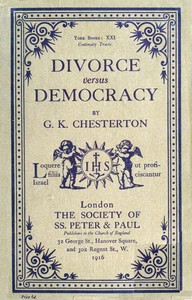
[Illustration: IHS
Loqure ut profifiliis
ciscantur
Israel]
London
THE SOCIETY OF
SS. PETER & PAUL
_Publishers to the Church of England_
32 George St., Hanover Square,
and 302 Regent St., W.
1916
Preface
I have been asked to put forward in pamphlet form this rather hasty
essay as it appeared in “Nash’s Magazine”; and I do so by the kind
permission of the editor. The rather chaotic quality of its journalism
it is now impossible to alter. The convictions upon which it is based
are unaltered and unalterable. Indeed, in so far as circumstances have
since affected them, they are greatly strengthened. In so far as there
was something sporadic and seemingly irrelevant in the writing, it was
partly because I was contending against an evil that was diffused and
indefinable, at once tentative and ubiquitous. Since then that disease
has come to a head and burst; primarily in the North of Europe. By that
historic habit which generally makes one European people the
standard-bearer of a social tendency, which made the Empire a Roman
Empire and the Revolution a French Revolution, the North Germans have
become the peculiar champions of that modern change which would make the
State infinitely superior to the Family. It is even asserted that
Prussian political authority is now encouraging the abandonment of
common morality for the support of population; and even if this horrible
thing be untrue, it is highly significant that it can be plausibly said
of Prussia, and certainly of no other Christian State. And in the new
light of action it is possible to trace more clearly the trend towards
divorce, as also that trend towards the other pagan institution of
slavery, which would certainly have accompanied it. But the enslaving
force in Europe struck too early; and the whole movement has been
brought to a standstill.
The same circumstances have given an importance to a formula of my own
which I still think rather important. It may be summarised as the
patriotism of the household. In the experience of nationality we do not
admit that any excess of despair can come into the same logical world as
desertion. No amount of tragedy need amount to treason. The Christian
view of marriage conceives of the home as self-governing in a manner
analogous to an independent state; that is, that it may include internal
reform and even internal rebellion; but because of the bond, not against
it. In this way it is itself a sort of standing reformer of the State;
for the State is judged by whether its arrangements bear helpfully or
bear hardly on the human fulness and fertility of the free family. Thus
the Wicked Ten in Rome were condemned and cast down because their public
powers permitted a wrong against the purity of a private family. Thus
the mediæval revolt against the Poll Tax began by the authority of an
official insulting the authority of a father. Men do not now, any more
than then, become sinless by receiving a post in a bureaucracy; and if
the domestic affairs of the poor were once put into the hands of mere
lawyers and inspectors, the poor would soon find themselves in positions
from which there is no exit save by the sword of Virginius and the
hammer of Wat Tyler. As for the section of the rich who are still
seeking a servile solution, they, of course, are still seeking the
extension of divorce. It is only “_divide et impera_”; and they want the
division of sex for the division of labour. The very same economic
calculation which makes them encourage tyranny in the shop makes them
encourage licence in the family. But now the free families of five great
nations have risen against them; and their plot has failed.
G. K. CHESTERTON
Divorce _versus_ Democracy
On this question of divorce I do not profess to be impartial, for I have
never perceived any intelligent meaning in the word. I merely (and most
modestly) profess to be right. I also profess to be representative: that
is, democratic. Now, one may believe in democracy or disbelieve in it.
It would be grossly unfair to conceal the fact that there are
difficulties on both sides. The difficulty of believing in democracy is
that it is so hard to believe--like God and most other good things. The
difficulty of disbelieving in democracy is that there is nothing else to
believe in. I mean there is nothing else on earth or in earthly
politics. Unless an aristocracy is selected by gods, it must be selected
by men. It may be negatively and passively permitted, but either heaven
or humanity must permit it; otherwise it has no more moral authority
than a lucky pickpocket. It is baby talk to talk about “Supermen” or
“Nature’s Aristocracy” or “The Wise Few.” “The Wise Few” must be either
those whom others think wise--who are often fools; or those who think
themselves wise--who are always fools.
Well, if one happens to believe in democracy as I do, as a large trust
in the active and passive judgment of the human conscience, one can have
no hesitation, no “impartiality,” about one’s view of divorce; and
especially about one’s view of the extension of divorce among the
democracy. A democrat in any sense must regard that extension as the
last and vilest of the insults offered by the modern rich to the modern
poor. The rich do largely believe in divorce; the poor do mainly believe
in fidelity. But the modern rich are powerful and the modern poor are
powerless. Therefore for years and decades past the rich have been
preaching their own virtues. Now that they have begun to preach their
vices too, I think it is time to kick.
There is one enormous and elementary objection to the popularising of
divorce, which comes before any consideration of the nature of marriage.
It is like an alphabet in letters too large to be seen. It is this: That
even if the democracy approved of divorce as strongly and deeply as the
democracy does (in fact) disapprove of it--any man of common sense must
know that nowadays the thing will be worked probably against the
democracy, but quite certainly by the plutocracy. People seem to forget
that in a society where power goes with wealth and where wealth is in an
extreme state of inequality, extending the powers of the law means
something entirely different from extending the powers of the public.
They seem to forget that there is a great deal of difference between
what laws define and what laws do. A poor woman in a poor public-house
was broken with a ruinous fine for giving a child a sip of shandy-gaff.
Nobody supposed that the law verbally stigmatised the action for being
done by a poor person in a poor public-house. But most certainly nobody
will dare to pretend that a rich man giving a boy a sip of champagne
would have been punished so heavily--or punished at all. I have seen the
thing done frequently in country houses; and my host and hostess would
have been very much surprised if I had gone outside and telephoned for
the police. The law theoretically condemns any one who tries to
frustrate the police or even fails to assist them. Yet the rich
motorists are allowed to keep up an organised service of anti-police
detectives--wearing a conspicuous uniform--for the avowed purpose of
showing motorists how to avoid capture. No one supposes again that the
law says in so many words that the right to organise for the evasion of
laws is a privilege of the rich but not of the poor. But take the same
practical test. What would the police say, what would the world say, if
men stood about the streets in green and yellow uniforms, notoriously
for the purpose of warning pickpockets of the presence of a
plain-clothes officer? What would the world say if recognised officials
in peaked caps watched by night to warn a burglar that the police were
waiting for him? Yet there is no distinction of principle between the
evasion of that police-trap and the other police-trap--the police-trap
which prevents a motorist from killing a child like a chicken; which
prevents the most frivolous kind of murder, the most piteous kind of
sudden death.
Well, the Poor Man’s Divorce Law will be applied exactly as all these
others are applied. Everybody must know that it would mean in practice
that well-dressed men, doctors, magistrates, and inspectors, would have
more power over the family lives of ill-dressed men, navvies, plumbers,
and potmen. Nobody can have the impudence to pretend that it would mean
that navvies, plumbers, and potmen would (either individually or
collectively) have more power over the family lives of doctors,
magistrates, and inspectors. Nobody dare assert that because divorce is
a State affair, therefore the poor citizen will have any power, direct
or indirect, to divorce a duchess from a duke or a banker from a
banker’s wife. But no one will call it inconceivable that the power of
rich families over poor families, which is already great, the power of
the duke as landlord, the power of the banker as money-lender, might be
considerably increased by arming magistrates with more powers of
interference in private life. For the dukes and bankers often are
magistrates, always the friends and relatives of magistrates. The
navvies are not. The navvy will be the subject of the new experiments;
certainly never the experimentalist. It is the poor man who will show to
the imaginative eye of science all those horrors which, according to
newspaper correspondents, cry aloud for divorce--drunkenness, madness,
cruelty, incurable disease. If he is slow in working for his master, he
will be “defective.” If he is worn out by working for his master, he
will be “degenerate.” If he, at some particular opportunity, prefers to
work for himself to working for his master, he will be obviously insane.
If he never has any opportunity of working for any masters he will be
“unemployable.” All the bitter embarrassments and entanglements
incidental to extreme poverty will be used to break conjugal happiness,
as they are already used to break parental authority. Marriage will be
called a failure wherever it is a struggle; just as parents in modern
England are sent to prison for neglecting the children whom they cannot
afford to feed.
I will take but one instance of the enormity and silliness which is
really implied in these proposals for the extension of divorce. Take the
case quoted by many contributors to the discussion in the papers--the
case of what is called “cruelty.” Now what is the real meaning of this
as regards the prosperous and as regards the struggling classes of the
community? Let us take the prosperous classes first. Every one knows
that those who are really to be described as gentlemen all profess a
particular tradition, partly chivalrous, partly merely modern and
refined--a tradition against “laying hands upon a woman, save in a way
of kindness.” I do not mean that a gentleman hates the cowing of a woman
by brute force: any one must hate that. I mean he has a ritual, taboo
kind of feeling about the laying on of a finger. If a gentleman (real or
imitation) has struck his wife ever so lightly, he feels he has done one
of those things that thrill the thoughts with the notion of a
border-line; something like saying the Lord’s Prayer backwards, touching
a hot kettle, reversing the crucifix, or “breaking the pledge.” The
wife may forgive the husband more easily for this than for many things;
but the husband will find it hard to forgive himself. It is a purely
class sentiment, like the poor folks’ dislike of hospitals. What is the
effect of this class sentiment on divorce among the higher classes?
The first effect, of course, is greatly to assist those faked divorces
so common among the fashionable. I mean that where there is a collusion,
a small pat or push can be remembered, exaggerated, or invented; and yet
seem to the solemn judges a very solemn thing in people of their own
social class. But outside these cases, the test is not wholly
inappropriate as applied to the richer classes. For, all gentlemen
feeling or affecting this special horror, it does really look bad if a
gentleman has broken through it; it does look like madness or a personal
hatred and persecution. It may even look like worse things. If a man
with luxurious habits, in artistic surroundings, is cruel to his wife,
it may be connected with some perversion of sex cruelty, such as was
alleged (I know not how truly) in the case of the millionaire Thaw. We
need not deny that such cases are cases for separation, if not for
divorce.
But this test of technical cruelty, which is rough and ready as applied
to the rich, is absolutely mad and meaningless as applied to the poor. A
poor woman does not judge her husband as a bully by whether he has ever
hit out. One might as well say that a schoolboy judges whether another
schoolboy is a bully by whether he has ever hit out. The poor wife, like
the schoolboy, judges him as a bully by whether he is a bully. She knows
that while wife-beating may really be a crime, wife-hitting is sometimes
very like just self-defence. No one knows better than she does that her
husband often has a great deal to put up with; sometimes she means him
to; sometimes she is justified. She comes and tells all this to
magistrates again and again; in police court after police court women
with black eyes try to explain the thing to judges with no eyes. In
street after street women turn in anger on the hapless knight-errant who
has interrupted an instantaneous misunderstanding. In these people’s
lives the rooms are crowded, the tempers are torn to rags, the natural
exits are forbidden. In such societies it is as abominable to punish or
divorce people for a blow as it would be to punish or divorce a
gentleman for slamming the door. Yet who can doubt, if ever divorce is
applied to the populace, it would be applied in the spirit which takes
the blow quite seriously? If any one doubts it, he does not know what
world he is living in.
It is common to meet nowadays men who talk of what they call Free Love
as if it were something like Free Silver--a new and ingenious political
scheme. They seem to forget that it is as easy to judge what it would be
like as to judge of what legal marriage would be like. “Free Love” has
been going on in every town and village since the beginning of the
world; and the first fact that every man of the world knows about it is
plain enough. It never does produce any of the wild purity and perfect
freedom its friends attribute to it. If any paper had the pluck to head
a column “Is Concubinage a Failure?” instead of “Is Marriage a Failure?”
the answer “Yes” would be given by the personal memory of many men, and
by the historic memory of all. Modern people perpetually quote some wild
expression of monks in the wilderness (when a whole civilisation was
maddened by remorse) about the perilous quality of Woman, about how she
was a spectre and a serpent and a destroying fire. Probably the
establishment of nuns, situated a few miles off, described Man also as a
serpent and a spectre; but their works have not come down to us.
Now all this old-world wit against Benedick the married man was sensible
enough. But so was the bachelorhood of the old monks, who said it,
sensible enough. It is perfectly true that to entangle yourself with
another soul in the most tender and tragic degree is to make, in all
rational possibility, a martyr or a fool of yourself. Most of the modern
denunciations of marriage might have been copied direct from the maddest
of the monkish diaries. The attack on marriage is an argument for
celibacy. It is not an argument for divorce. For that entanglement which
celibacy avowedly avoids, divorce merely reduplicates and repeats. It
may have been a sort of solemn comfort to a gentleman of Africa to
reflect that he had no wife. It cannot be anything but a discomfort to a
gentleman of America to wonder which wife he really has. If progress
means, as in the ludicrous definition of Herbert Spencer, “an advance
from the simple to the complex,” then certainly divorce is a part of
progress. Nothing can be conceived more complex than the condition of a
man who has settled down finally four or five times. Nothing can be
conceived more complex than the position of a profligate who has not
only had ten _liaisons_, but ten legal _liaisons_. There is a real sense
in which free love might free men. But freer divorce would catch them in
the most complicated net ever woven in this wicked world.
The tragedy of love is in love, not in marriage. There is no unhappy
marriage that might not be an equally unhappy concubinage, or a far more
unhappy seduction. Whether the tie be legal or no, matters something to
the faithless party; it matters nothing to the faithful one. The pathos
reposes upon the perfectly simple fact that if any one deliberately
provokes either passions or affections, he is responsible for them as
long as they go on, as the man is responsible for letting loose a flood
or setting fire to a city. His remedy is not to provoke them, like the
hermit. His punishment, when he deserves punishment, is to spend the
rest of his life in trying to undo any ill he has done. His escape is
despair--which is called, in this connection, divorce. For every healthy
man feels one fundamental fact in his soul. He feels that he must have
a life, and not a series of lives. He would rather the human drama were
a tragedy than that it were a series of Music-hall Turns and Potted
Plays. A man wishes to save the souls of all the men that he has been:
of the dirty little schoolboy; of the doubtful and morbid youth; of the
lover; of the husband. Re-incarnation has always seemed to me a cold
creed; because each incarnation must forget the other. It would be worse
still if this short human life were broken up into yet shorter lives,
each of which was in its turn forgotten.
If you are a democrat who likes also to be an honest man--if (in other
words) you want to know what the people want and not merely what you can
somehow induce them to ask for--then there is no doubt at all that this
is what they want. You can only realise it by looking for human nature
elsewhere than in election reports; but when you have once looked for it
you see it and you never forget it. From the fact that every one thinks
it natural that young men and women should carve names on trees, to the
fact that every one thinks it unnatural that old men and women should be
separated in workhouses, millions and millions of daily details prove
that people do regard the relation as normally permanent; not as a
vision, but as a vow.
Now for the exceptions, true or false. I would note a strange and even
silly oversight in the discussion of such exceptions, which has haunted
most arguments for further divorce. The ordinary emancipated prig or
poet who urges this side of the question always talks to one tune.
“Marriage may be the best for most men,” he says, “but there are
exceptional natures that demand a more undulating experience; constancy
will do for the common herd, but there are complex natures and complex
cases where no one could recommend constancy. I do not ask (at the
present Stage of Progress) for the abolition of marriage; I hereby ask
that it may be remitted in such individual and extreme examples.”
Now it is perfectly astounding to me that any one who has walked about
this world should make such a blunder about the breed we call mankind.
Surely it is plain enough that if you ask for dreadful exceptions, you
will get them--too many of them. Let me take once again a rough parable.
Suppose I advertised in the papers that I had a place for any one who
was too stupid to be a clerk. Probably I should receive no replies;
possibly one. Possibly also (nay, probably) it would be from the one man
who was not stupid at all. But suppose I had advertised that I had a
place for any one who was too clever to be a clerk. My office would be
instantly besieged by all the most hopeless fools in the four kingdoms.
To advertise for exceptions is simply to advertise for egoists. To
advertise for egoists is to advertise for idiots. It is exactly the bore
who does think that his case is interesting. It is precisely the really
common person who does think that his case is uncommon. It is always the
dull man who does think himself rather wild. To ask solely for strange
experiences of the soul is simply to let loose all the imbecile asylums
about one’s ears. Whatever other theory is right, this theory of the
exceptions is obviously wrong--or (what matters more to our modern
atheists) is obviously unbusinesslike. It is, moreover, to any one with
popular political sympathies, a very deep and subtle sort of treason. By
thus putting a premium on the exceptional we grossly deceive the
unconsciousness of the normal. It seems strangely forgotten that the
indifference of a nation is sacred as well as its differences. Even
public apathy is a kind of public opinion--and in many cases a very
sensible kind. If I ask everybody to vote about Mineral Meals and do not
get a single ballot-paper returned, I may say that the citizens have not
voted. But they have.
The principle held by the populace, against which this plutocratic
conspiracy is being engineered, is simply the principle expressed in the
Prayer Book in the words “for better, for worse.” It is the principle
that all noble things have to be paid for, even if you only pay for them
with a promise. One does not take one’s interest out of England as one
takes it out of Consols. A man is not an Englishman unless he can endure
even the decay and death of England. And just as every citizen is a
potential soldier, so every wife or husband is a potential hospital
nurse--or even asylum attendant. For though we should all approve of
certain tragedies being mitigated by a celibate separation--yet the more
real love and honour there has been in the marriage, the less real
mitigation there will be in the parting. But this sound public instinct
both about patriotism and marriage also insists that the first vow or
obligation shall be mitigated, not merely erased and forgotten. Many a
good woman has loved and refused a doubtful man, with the proviso that
she would marry no one else; the old institution of marriage has the
same feeling about the tragedy that is post-matrimonial. The thing
remains real; it binds one to something. If I am exiled from England I
will go and live on an island somewhere and be as jolly as I can. I will
not become a patriot of any other land.
[Illustration]
End of Project Gutenberg's Divorce versus Democracy, by G. K. Chesterton