COCKE LORELLES BOTE.
One Hundred and One Copies Printed,
One of which is on Vellum.
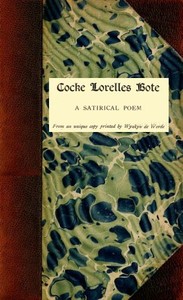
Cocke Lorelles Bote
A SATIRICAL POEM
_From an unique copy printed by Wynkyn de Worde_
“Come begin;
And you the judges bear a wary eye.”
_Hamlet._
ABERDEEN
J. & J. P. EDMOND & SPARK
MDCCCLXXXIV.
PREFACE.
The singularly interesting fragment of early English literature known as
Cocke Lorelles Bote, is a satirical poem of four hundred and fourteen
lines, in which various classes of society, chiefly of the lower order,
are passed under review in rapid succession. The glimpse we obtain of
each class is only momentary, but the author with some well chosen
phrase, in that short time sketches their failings.
The original from which this poem is reprinted, is in black-letter, and
is preserved in the Garrick Collection, British Museum. It is
considered unique, but unfortunately it is imperfect at the beginning.
It was printed in London, by Wynkyn de Worde, and bears no date, but may
safely be ascribed to the early part of the reign of Henry the Eighth.
The idea of the “Bote,” in which so many different characters are
gathered together, is supposed to have been taken from Sebastian
Brandt’s “Shyp of Folys,” which was translated into English by Alexander
Barclay, and printed by Pynson at the beginning of the sixteenth
century. What gives weight to this suggestion, is the fact that the
wood-cuts with which the original of Cocke Lorell is illustrated, are
similar to those used in the “Ship of Folys.”
The hero of the poem was the leader of a notorious band of robbers which
infested the metropolis, and was probably alive at the time of its
publication. He is mentioned by Samuel Rowlands in “Martin Mark-all,
Beadle of Bridewell, his Defence and Answere to the Belman of London,”
printed in 1610, who describes him in these terms:--“After him,
succeeded by general councell, one Cocke Lorrell, the most notorious
knave that ever lived: by trade he was a tinker, often carrying a panne
and a hammer for show: but when he came to a good booty, he would cast
his profession in a ditch, and play the padder,[1] and then would away,
and as hee past through the toune, crie, ‘Ha you any worke for a
tinker?’ To write of his knaveries it would aske a long time: I referre
you to the old manuscript remayning on record in Maunder’s Hall.[2]
This was he that reduced and brought in forme the Catalogue of
Vagabonds, or Quarterne of Knaves, called the five and twentie Orders of
Knaves: but because it is extant, and in every mans shop, I passe them
over.... This Cocke Lorrell continued among them longer than any of his
predecessors before him, or after him, for he ruled almost two and
twentie yeares, until the yeare An. Dom. 1533, and about the five and
twenty yeare of K. Henry the Eight.”
The “Catalogue of Vagabonds” to which Rowlands alludes in the above
extract as having been written by Cocke Lorell, is a tract printed by
John Awdely in 1565, and of which a second edition was issued by the
same printer in 1575. It is not improbable that Awdely may have himself
been the compiler of the “Catalogue.” A copy of the edition of 1575 is
in the Bodleian Library, the quaint title of which is as follows:--“The
Fraternitye of Vacabondes. As wel of ruflyng Vacabondes, as of beggerly,
of Women as of Men, of Gyrles as of Boyes, with their proper names and
qualities. With a description of the crafty company of Cousoners and
Shifters. Whereunto also is adioyned the XXV Orders of Knaues, otherwyse
called a Quartern of Knaues Confirmed for euer by Cocke Lorell.
_The Vprightman speaketh._
Our Brotherhood of Vacabondes,
If you would know where dwell;
In graues end Barge which seldome standes,
The talke wyll shew ryght well.
_Cocke Lorell aunswereth._
Some orders of my Knaues also
In that Barge shall ye fynde;
For no where shall ye walke I trow,
But ye shall see their kynde.
Imprinted at London by John Awdely, dwellynge in little Britayne Streete
withoute Aldersgate, 1575.”
Dr. Bliss describes the above mentioned tract at length, in the “British
Bibliographer,” Vol. II., p. 12, and makes further allusion to it in his
edition of Earle’s “Microcosmography,” p. 256, published in 1811.
One of the earliest, if not the earliest, printed mention of the Bote
occurs in Thomas Feylde’s “A contrauersye bytwene a louer and a Jaye.
[Colophon.] Imprynted at London in Fletestrete at the sygne of the
Sonne by Wynkyn de Worde.” The Lover in the preceding verses
apostrophizes Nature regarding his passion for his mistress, at which
the Jay thus expostulates:--
“Thoughe nature moue,
And bydde the loue,
Yet wysdome wolde proue,
Or it be hote,
Whan fortune sowre
Dothe on the lowre,
Thou getest an ore
In cocke lorels bote.”
The next mention of Cocke Lorell is in a black-letter poem, preserved in
the Bodleian Library, without date or printer’s name, entitled “Doctour
Double Ale.”
“I hold you a grota
Ye wyll rede by rota,
That ye wete a cota
In cocke lorels bota.”
The Rev. Charles H. Hartshorne, in “Ancient Metrical Tales,” reprinted
“Doctour Double Ale,” but rendered the last line _cocke losels bota_.
In pointing out this error, Mr. Collier says, that in John Heywood’s
“Epigrams upon three hundred proverbs,” printed in 1566, mention is made
of Cocke Lorelles Bote, under the heading of
“A BUSY BODY
He will have an ore in every man’s barge,
Even in cocke lorels barge, he berth that charge.”
Later on we find that the rascal is not forgotten, for Ben Jonson in his
masque of the “Gypsies Metamorphosed,” has introduced him as feasting
the Evil One, in a song which continued popular for some considerable
time, and was frequently printed as a broadside, copies of which are in
the Pepysian and Ashmolean Collections.
The first verse is as follows:--
“Cock Lorrell would need have the devil his guest,
And bid him once into the Peak to dinner,
Where never the fiend had such a feast
Provided him yet at the charge of a sinner.”
In 1807, the Rev. William Beloe, in his “Anecdotes of Literature and
Scarce Works,” Vol. I., p. 393, called attention to the following tract,
but unfortunately he changed the title to “Cocke Lorells Vote,” in place
of “Bote.” That this was a misprint may be inferred from the fact, that
in another place in the same work, he makes reference to a passage in
Bishop Percy’s Reliques, where the correct title is given.
Dibdin, who appears never to have seen the work, but says he was
“indebted to Mr. H. Ellis of the British Museum” for specimens “of this
singular performance” has fallen into the droll blunder of writing “of
the licentious and _predatory character_ of its AUTHOR, ... one Cock
Lorell,” whose “popularity has, I believe, escaped the notice of our
chroniclers.”[3]
The poem was presented to the members of the Roxburghe Club in 1817, by
the Rev. Henry Drury, but the impression was limited to thirty-five
copies, two of which were printed on vellum.
It was again printed at Edinburgh for Stanley and Blake in 1817, from a
transcript made by the Rev. Joseph Stevenson, with an introductory
notice by Mr. James Maidment. This reprint has become almost as rare as
the Roxburghe Club edition, only forty copies having been taken.
The Percy Society, in 1843, issued an edition of the “Bote” to its
members, with a preface by Dr. E. F. Rimbault. The rarity of the two
first mentioned reprints, and the form, apart altogether from the
comparative scarcity of the last, has led to the reprinting once more of
this poem. The writer begs to acknowledge his obligations to both Mr.
Maidment’s and Dr. Rimbault’s editions as supplying the material for the
foregoing notice. While aware that there is little that is new which can
be said about Cocke Lorell, he trusts that this edition may be
favourably received, if for no other reasons than these, that while it
avoids the many inaccuracies of the Edinburgh edition, it omits the
modern punctuation which has been introduced into the Percy Society’s
reprint.
The present impression is limited to one hundred and one copies, one of
which is printed on vellum.
J. P. EDMOND.
COCKE LORELLES BOTE.
* * * * * * *
She had a desyre ofte to be wedde B. i. _a._
And also to lye in an other mannes bedde
Lytell rought she therfore
She is as softe as a lamme yf one do her meue
And lyke to yᵉ deuyll wan a mā dothe her greue
So well is she sette
O good condycyon to her housbonde
Yf he call her calat she calleth hȳ knaue agayne
She shyll not dye in his dette
By Saynt Jone sayd Cocke than
These be fayre vertues in a woman
Thou shalte be my launder
To wasshe and kepe clene all my gere
Our two beddes togyder shall be sette
Without ony lette
The nexte that came was a coryar
And a cobeler his brother
As ryche as a newe shorne shepe
They offred Cocke a blechynge pot
Other Jewelles they had not
Scant shoes to theyr fete
The coryer dresseth so well his lether
That it wolde drynke water in fayre weder
Therfore he hath many a crystes curse
And tho cobeler for his cloutynge
The people blesseth hym with euyll cheuynge
To knytte faste in his purse
A shomaker came to these other two
Bytwene them two was moche a do
For a pyese of lether
They togged with theyr teth and gnewe it there B. i. _b._
And pulde as it had been grehondes at a hare
It was a shepes skyne of a wether
And than they tanned it whan they had done
To make lether to hym with mennes shone
And all for theyr auayle
For as sone as the hemme is tore
The sho is lost for euer more
And it is lytell meruayle
A tanner for euyll tannyng of leder
They foure with sorowe Cocke dyde set togyder
And neuer a good without fayle
Than came one wᵗ two bolddogges at his tayle
And that was a bocher without fayle
All be gored in reed blode
In his hande he bare a flap for flyes
His hosen gresy vpon his thyes
That place for magottes was very good
On his necke he bare a cole tre logge
He had as moche pyte as a dogge
And he were ones wrothe
He loked perysshe and also rowe
A man wolde take hym for a shrewe I trowe
And of his company be lothe
Than came a gonge fermourer
Other wyse called a masser scourer
With hym a canyell raker
Theyr presence made Cocke and his mē to spewe
For as swete was theyr brethe as henkā or rewe
To wasshe them they laked water
On these Irysshe copel I wyll not tare B. ii. _a._
Cocke dyde set thē there as knaues sholde be
Amonge the slouenly sorte
Than came two false towlers in nexte
He set them by pykers of the best
For there sholde they abyde
But before yᵗ they were plonged in the ryuer
To searche theyr bodyes fayre and clere
Therof they had good sporte
A myller dustypoll than dyde come
A Ioly felowe with a golden thome
On his necke a sacke was
Many sayd that he with reprefe
Of all craftes was nexte a thefe B. ii. _b._
In that Cocke founde no lacke
He sayd that he touled twys for forgetynge
And stele floure and put chauke therin
Be sherewe hym that taught hym that
Cocke bad hym grynde cherystones and peson
To make his men brede for a season
By cause whete was very dere
Than came a pardoner with his boke
His quaterage of euery man he toke
But Cocke wolde theyr names here
The pardoner sayd I will rede my roll
And ye shall here the names poll by poll
There of ye nede not fere
Here is fyrst Cocke Lorell the knyght
And symkyn emery mayntenaūce agayne ryght
With slyngethryfte fleshemonger
Also fabyane flaterer
And fesly claterer
With adam auerus flayle swenger
And fraūces flaperoche of stewys captayne late
With gylys vnyeste mayer of newgate
And lewes vnlusty the lesynge monger
Here also baude baudyn boller
And his brother copyn coler
With mathew marchaunte of shoters hyll
Crystofer catchepoll a crystes course gaderer
And wat welbelyne of ludgate Iayler
With laurence lorell of clerken well
Here is gylys Iogeler of ayebery
And hym sougelder of lothe bery B. iii. _a._
With wallys the wrangler
Pers potter of brydge water
Saunder fely the mustarde maker
With Ielyan Iangeler
Here is Ienkyne berwarde of Barwycke
And tom tombler of warwyke
With Phyllyp fletcher of fernam
Here is wyll wyly the myl peker
And patrycke peuysshe heerbeter
With lusty hary hange man
Also mathewe tothe drawer of London
And sybly sole mylke wyfe of Islyngton
With davy drawelache of rokyngame
Here is maryone marchauntes at all gate B. iii. _b._
Her husbōde dwelleth at yᵉ sygne of yᵉ cokeldes pate
Nexte house to Robyn renawaye
Also hycke crokenec the rope maker
And steuen mesyll mouthe muskyll taker
With Iacke basket seler of alwelay
Here is george of podynge lane carpenter
And patrycke peuysshe a conynge dyrte dauber
Worshypfull wardayn of slouens In
There is maryn peke small fremason
And pers peuterer that knocketh a basyn
With gogle eyed tomson shepster of lyn
Here is glyed wolby of gylforde squyere
Andrewe of habyngedon apell byer
With alys esy a gay tale teller
Also peter paten maker
With gregory loue good of rayston mayer
And hary halter seler at tyborn the ayer
Here is kate with the croked fote
That is colsys doughter the dronken koke
A lusty pye baker
Here is saunder sadeler of froge strete corner
With Ielyan Ioly at sygne of the bokeler
And mores moule taker
Also annys angry with the croked buttocke
That dwelled at yᵉ sygne of yᵉ dogges hede in yᵉ pot
By her crafte a breche maker
Cocke sayd pardoner now ho and sease
Thou makeste me wery holde thy pease
A thynge tell thou to me
What profyte is to take thy pardon B. iv. _a._
Shewe vs what mede is to come
To be in this fraternyte
Syr this pardon is newe founde
By syde London brydge in a holy grounde
Late called the stewes banke
Ye knowe well all that there was
Some relygyous women in that place
To whome men offred many a franke
And bycause they were so kynde and lyberall
A merueylous auenture there is be fall
Yf ye lyst to here how
There came suche a winde fro wynchester
That blewe these women ouer the ryuer
In wherye as I wyll you tell
Some at saynt Kateryns stroke a grounde
And many in holborne were founde
Some at saynt Gyles I trowe
Also in aue maria aly and at westmenster
And some in shordyche drewe theder
With grete lamentacyon
And by cause they haue lost that fayre place
They wyll bylde at colman hedge in space
A nother noble mansyon
Fayrer and euer the halfe strete was
For euery house newe paued is with gras
Shall be full of fayre floures
The walles shallbe of hauthorne I wote well
And hanged wᵗ whyte motly yᵗ swete doth smell
Grene shall be the coloures
And as for this olde place these wenches holy B. iv. _b._
They wyll not haue it called the stewys for foly
But maketh it a strabery banke
And there is yet a chapell saue
Of whiche ye all the pardon haue
The saynt is of symme trollanke
I wyll reherse here in generall
The indulgences that ye haue shall
Is these that foloweth with more
At the oure of deth whan ye haue nede
Ye shall be assoyled of euery good dede
That you haue done before
And ye shall be parte taker of as many good dedde
As is done euery nyght a bedde
And also ferthermore
At euery tauerne in the yere
A solempne dyryge is songe there
With a grete drynkynge
At all ale houses trewely
Ye shall be prayed for hertely
With a Ioyefull wepynge
And the pope darlaye hath graūted in his byll
That euery brother may do what he wyll
Whyle that they be wakynge
And the pardone gyueth you that hath the pose
On your owne sleue to wype your nose
Without rebuke takynge
Also pope nycoll graunteth you all in this texte
The coughe and the colyke the gout and the flyxe
With the holsome tothe ache
Also it is graunted by our bulles of lede B. v. _a._
That whan ony brother is dede
To the chyrche dogges shall cary hym
A ryche pal to ly on yᵉ corse late fro rome is come
Made of an olde payre of blewe medly popley hosone
For yᵉ worshyppe of all yᵉ brethrene
Theyr knylles shall be rōge in yᵉ myddes of tēse hosone B. v. _b._
And theyr masse songe at shoters hill amonge the elmes
With grete deuocyon in dede
And many thynges elles shall be done
The resydewe I wyll reherse soone
For drynke fyrst must I nede
Than Cocke cast a syde his hede
And sawe the stretes all ouer sprede
That to his bote wolde come
Of all craftes there were one or other
I wyll shewe how many or I passe ferther
And reken them one by one
The fyrst was golde smythes and grote clyppers
Multyplyers and clothe thyckers
Called fullers euerychone
There is taylers tauerners and drapers
Potycaryes ale brewers and bakers
Mercers fletchers and sporyers
Boke prynters peynters bowers
Myllers carters and botyll makers
Waxechaundelers clothers and grocers
Wolle men vynteners and flesshemongers
Salters Iowelers and habardashers
Drouers cokes and pulters
Yermongers pybakers and waferers
Fruyters chese mongers and mynstrelles
Talowe chaundelers hostelers and glouers
Owchers skynners and cutlers
Blade smythes fosters and sadelers
Coryers cordwayners and cobelers
Gyrdelers forborers and webbers B. vi. _a._
Quylte makers shermen and armorers
Borlers tapstry workemakers and dyers
Brouderers strayners and carpyte makers
Sponers torners and hatters
Lyne webbers setters with lyne drapers
Roke makers coper smythes and lorymers
Brydel bytters blacke smythes and ferrars
Bokell smythes horse leches and gold beters
Fyners plommers and penters
Bedmakers fedbed makers and wyre drawers
Founders laten workers and broche makers
Pauyers bell makers and brasyers
Pynners nedelers and glasyers
Bokeler makers dyers and lether sellers
Whyte tanners galyors and shethers
Masones male makers and merbelers
Tylers brycke leyers harde hewers
Parys plasterers daubers and lyme borners
Carpenters coupers and ioyners
Pype makers wode mōgers and orgyn makers
Coferers carde makers and caruers
Shyppe wryghtes whele wryghtes and sowers
Harpe makers leches and vpholsterers
Porters fesycyens and corsers
Parchemente makers skynners and plowers
Barbers boke bynders and lymners
Repers faners and horners
Pouche makers belowfarmes and cage sellers
Lanterners stryngers grynders
Arowe heders maltemen and corne mongers B. vi. _b._
Balancers tynne casters and skryueners
Stacyoners vestyment swoers and ymagers
Sylke women pursers and garnysshers
Table makers sylke dyers and shepsters
Golde sheres keuerchef launds and rebē makers
Tankarde berers bouge men and spere planers
Spynsters carders and cappe knytters
Sargeauntes katche pollys and somners
Carryers carters and horskepers
Courte holders bayles and honters
Constables hede borowes and katers
Butlers sterchers and musterde makers
Harde waremen mole sekers and ratte takers
Bewardes brycke borners and canel rakers
Potters brome sellers pedelers
Shepherdes cowe herdes and swyne kepers
Broche makers glas blowers cādelstycke casts
Hedgers dykers and mowers
Gonners maryners and shypmaysters
Chymney swepers and costerde mongers
Lode men and bere brewers
Fysshers of the see and muskel takers
Schouyll chepers gardeners and rake fetters
Players purse cutters money baterers
Gold washers tomblers Iogelers
Pardoners kȳges bēche gatherers and lether dyers
There were theues hores and baudes wᵗ mortherers
Crakers facers and chylderne quellers
Spyes lyers and grete sclaunderers
Cursers chyders and grete vengeaunce cryers C. i. _a._
Dyssymulynge beggers hede brekers borders
Nette makers and harlote takers
Swerers and outragyous laughers
Surmowsers yll thynkers and make brasers
With lollers lordaynes and fagot berers
Luskes slouens and kechen knaues
Bargemen whery rowers and dysers
Tyburne collopes and peny pryckers
Bowlers mas shoters and quayters
Flaterers and two face berers
Sluttes drabbes and counseyll whystelers
With smoggy colyers and stȳkȳge gōge fermers
Of euery craft some there was
Shorte or longe more or lasse
All these rehersed here before
In Cockes bote eche man had an ore
All tho that offyces had
Some woūde at yᵉ capstayne as Cocke thē bad
Some stode at yᵉ slȳge some dyde trusse and thrȳge
Some pulde at the beryll some sprede yᵉ mayne myssyll
Some howysed the mayne sayle
Some veryed showte a very slayle
Some roped yᵉ hoke some yᵉ pōpe and some yᵉ laūce
Some yᵉ lōge bote dyde laūce some mēde yᵉ corse
Mayne corfe toke in a refe by force
And they that were abyll drewe at the cabyll
Some the anker layde some at the plōpe a sayll swepe
One kepte yᵉ compas and watched yᵉ our glasse
Some yᵉ lodysshestōe dyd seke some yᵉ bote dyd
Some made knottes of lynkes endes C. i. _b._
Some the stay rope suerly byndes
Some a satte borte a stare borde
Some the standerdes oute dyde brynge
Some one the shrowedes dyde clyme
Some couched a hogges heed vnder a hatche
Some threwe out bayte fysshe to catche
Some pulled vp the bonauenture
Some to howes the tope sayle dyde entre
Some stered at the helme behynde
Some whysteled after the wynde
There was non that there was
But he had an offyce more or lasse
Than Cocke Lorell dyde his whystele blowe
That all his men sholde hym knowe
With that they cryed and made a shoute
That the water shoke all aboute
Than men myght here the ores classhe
And on the water gaue many a dasshe
They sprede theyr sayles as voyde of sorowe
Forthe they rowed Saint George to borowe
For Ioy their trūpettes dyde they blowe
And some songe heue and howe rombelowe
They sayled fro garlyke hede to knaues in
And a pele of gonnes gan they rynge
Of colman hedge a sight they had
That made his company very glad
For there they thought all to play
Bytwene tyborne and chelsay
With this man was a lusty company
For all raskyllers fro them they dyde trye C. ii. _a._
They banysshed prayer peas and sadnes
And toke with them myrthe sporte and gladnes
They wolde not haue vertu ne yet deuocyon
But ryotte and reuell with ioly rebellyon C. ii. _b._
They songe and daunsed full merely
With swerynge and starynge heuen hye
Some said yᵗ they were gētle mē of grete myght
That ther purses were so lyght
And some wente in fured gownes and gay shone
That had no mo faces than had the mone
Of this daye gladde was many a brothell
That myght haue an ore with Cocke Lorell
Thus they daunsed with all theyr myght
Tyll that phebus had lost his lyght
But than came lucyna with all her pale hewe
To take her sporte amonge the cloudes blewe
And marcury he trewe downe his goldē bemes
And sperus her syluer stremes
That in the worlde gaue so grete lyght
As all the erth had be paued with whyte
Thā Cocke wayed anker and housed his sayle
And forthe he rowed without fayle
They sayled England thorowe and thorowe
Vyllage towne cyte and borowe
They blessyd theyr shyppe whan they had done
And dranke about saynt Iulyans torne
Than euery man pulled at his ore
With that I coulde se them no more
But as they rowed vp the hyll
The bote swayne blewe his whystell full shryll
And I wente homwarde to mowe shame stere
With a company dyde I mete
As ermytes monkes and freres
Chanons chartores and inholders C. iij. _a._
And many whyte nonnes with whyte vayles
That was full wanton of theyr tayles
To meet with Cocke they asked how to do C. iij. _b._
And I tolde them he was a go
Than were they sad euerychone
And went agayne to theyr home
But my counseyll I gaue them there
To mete with Cocke another yere
No more of Cocke now I wryte
But mery it is whan knaues done mete
Cocke had in his hande a grete route
The thyrde persone of Englande
Thus of Cocke Lorell I make an ende
And to heuen god your soules sende
That redeth this boke ouer all
Chryst couer you with his mantell perpetuall.
AMEN.
Here endeth Cocke Lorelles bote. Imprynted at London in the Flete strete
at the sygne of the sonne by Wynkyn de Worde.
Reprinted at ABERDEEN by MILNE & HUTCHISON.
FOOTNOTES:
[1] Padder, or Rumpadder, a thief.--SLANG DICTIONARY.
[2] Maunder, a beggar.--SLANG DICTIONARY.
[3] Dibdin’s Ames, Vol. II., p. 352.