Produced by Stephen Hutcheson and the Online Distributed
Proofreading Team at http://www.pgdp.net
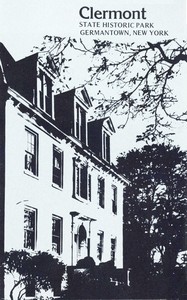
Clermont
STATE HISTORIC PARK
GERMANTOWN, NEW YORK
Robert Livingston (1654-1728), born in Scotland and raised in The
Netherlands, arrived in Albany, New York, during the winter of
1674-1675. Active in shipping and fur trading, he also obtained
responsible public and private positions and quickly gained wealth and
influence. In 1686 he was granted a charter establishing the Manor of
Livingston, which included 162,248 acres of land, the southern third of
present Columbia County. Robert became the first Lord of the Manor.
In 1728 Livingston left 13,000 acres of the Manor to his third son,
later known as Robert of Clermont (1688-1775). Tradition holds that this
gift was in gratitude for the son's success in rescuing his father from
an Indian plot. Known as Clermont, or the Lower Manor, this tract did
not carry manorial privileges. On a low plateau overlooking the Hudson
River, the mansion of the Lower Manor was constructed about 1730 as the
seat of the new estate.
[Illustration: _Portrait of Chancellor Robert R. Livingston, circa
1795, attributed to Gilbert Stuart._]
Robert of Clermont's only child, also named Robert (1718-1775), served
with distinction as Judge of the Admiralty Court and Judge of the
Supreme Court of the Province of New York. As a delegate to the Stamp
Act Congress, he penned the letter of protest to the King of England.
[Illustration: _The Drawing Room._]
In 1775, upon the death of Judge Livingston, Clermont passed to his
eldest son, Robert R. Livingston (1746-1813), later famous as a
Chancellor of New York State. In the years prior to the Revolution, he
was a strong advocate of colonial rights and, as a member of the Second
Continental Congress, was one of five nominated to draft the Declaration
of Independence.
With the outbreak of the Revolution, Clermont supplied men and materiel
to the American army. Probably because of the Chancellor's political
importance and his support of the patriot cause, in 1777, after burning
Kingston, the British continued up the Hudson and set fire to Clermont
and all of its surrounding outbuildings. The family and servants
escaped, however, and within a few years Clermont was rebuilt and
refurnished. Charred remnants of this earlier building are incorporated
within the walls of the present mansion.
Clermont's fame rose with that of Chancellor Livingston. In 1781 he was
appointed the first United States Minister of Foreign Affairs and later
served as Minister to France, negotiating with Napoleon for the
Louisiana Purchase.
Chancellor Livingston originally shared Clermont with his mother,
Margaret Beekman Livingston, but he eventually built a new house nearby
which was completed in 1794. A French-inspired building, it became a
showplace on the Hudson. Destroyed by fire in 1909, the ruins of its
remaining walls indicate its size and grandeur.
In addition to his public duties, the Chancellor was involved in
experiments to improve his breeds of sheep and to increase the yield of
crops on his land while retaining the fertility of the soil. His
fascination for mechanical developments drew him to Robert Fulton with
whom he compared experiments with steam engines. Their partnership
resulted in the first successful steamship, _The North River Steamboat_.
Later known as the _Clermont_, it stopped at the Chancellor's dock on
its maiden voyage up the Hudson River in 1807.
The mansion rebuilt after the fire of 1777 continued as a residence for
members of the Livingston family. A north wing built in 1802 contained a
new kitchen and an office where tenants paid their rent. A south wing,
constructed in 1830 for additional bedrooms, was enlarged in 1893. A
steeply pitched slate roof, added in 1874, greatly altered the
appearance of the mansion.
From 1813, when the Chancellor died, until it was acquired by the State
of New York in 1962, Clermont never passed out of the Livingston family.
The mansion, with its furnishings and spacious grounds, reflects the
lives of many generations of Livingstons, one of the New York's most
influential families.
[Illustration: _Clermont, as illustrated in History of Columbia
County, 1878._]
TACONIC STATE PARK & RECREATION COMMISSION
The Taconic State Park Region lies east of the Hudson River and extends
from New York City to just south of Albany. Official State Historic
Sites, set among the picturesque rolling hills and majestic rocky slopes
of the Taconic Mountains, are homes reflecting various eras and life
styles.
Castle-like Olana was the home of famed painter Frederic Edwin Church.
Clermont was the homestead of many generations of Livingstons, a family
active in the development of the state and national governments.
Imposing Mills Mansion reflects the grand living of the early twentieth
century, while Clinton House is a simple home of the eighteenth century.
Famed statesman and Chief Justice John Jay retired to John Jay Homestead
after many years of service to his country. Philipse Manor Hall was once
the family seat of the vast Manor of Philipsburg.
[Illustration: AREA MAPS]
OLANA
CLERMONT
MILLS MANSION
CLINTON HOUSE
JOHN JAY HOMESTEAD
PHILLIPSE MANOR HALL
Clermont
[Illustration: Clermont]
Clermont State Historic Park
R.D. 1
Germantown, New York 12526
518-537-4240
Mansion open: 9:00-5:00 Wednesday through Sunday Memorial Day weekend
through last Sunday in October: also, Memorial Day, Independence Day,
Labor Day, and Columbus Day.
Groups accommodated only by advance reservation.
Grounds open: 6:00 am-10:00 pm daily, year-round.
STATE OF NEW YORK
Hugh L. Carey, Governor
NEW YORK STATE PARKS & RECREATION
Orin Lehman, Commissioner
TACONIC STATE PARK & RECREATION COMMISSION
Jeanne F. Lewisohn, Chairman
[Illustration: NEW YORK STATE PARKS AND RECREATION]
105M 7/77
Transcriber's Notes
--Silently corrected a few typos.
--Retained publication information from the printed edition: this eBook
is public-domain in the country of publication.
--In the text versions only, text in italics is delimited by
_underscores_.
End of Project Gutenberg's Clermont State Historic Park, by Anonymous