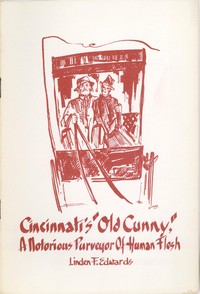
CINCINNATI’S “OLD CUNNY”
A NOTORIOUS PURVEYOR OF HUMAN FLESH
BY
LINDEN F. EDWARDS
Prepared by the Staff of the
Public Library of Fort Wayne and Allen County
1955
[Illustration: Boards of the Public Library of Fort Wayne and Allen
County]
One of a historical series, this pamphlet is published under the
direction of the governing Boards of the Public Library of Fort Wayne
and Allen County.
BOARD·OF·TRUSTEES·OF·THE·SCHOOL·CITY·OF·FORT·WAYNE
_B.F. Geyer, President_
_Joseph E. Kramer, Secretary_
_W. Page Yarnelle, Treasurer_
_Willard Shambaugh_
_Mrs. Sadie Fulk Roehrs_
PUBLIC LIBRARY BOARD FOR ALLEN COUNTY
The members of this Board include the members of the Board of Trustees
of the School City of Fort Wayne (with the same officers) together with
the following citizens chosen from Allen County outside the corporate
City of Fort Wayne.
_James E. Graham_
_Mrs. Glenn Henderson_
_Mrs. Charles Reynolds_
FOREWORD
In the following publication Linden F. Edwards relates the evil deeds of
Ohio’s most notorious resurrectionist, William Cunningham. The paper was
originally published in THE OHIO STATE MEDICAL JOURNAL, Volume 50, May,
1954. The author has graciously granted permission to reproduce the
article.
The Boards and the Staff of the Public Library of Fort Wayne and Allen
County present this publication in the hope that it will interest local
readers.
[Illustration: Linden F. Edwards]
The son of Albert R. and Mary E. (Hare) Edwards, Linden Forest Edwards
was born in Lewisville, Ohio, on November 25, 1899. He received the
bachelor of arts degree in 1922 and the master of science degree in 1923
from Ohio State University. Dr. Edwards continued graduate study at the
University of Michigan, the University of Illinois, and Ohio State
University. In 1928 the degree of doctor of philosophy was conferred on
Linden Edwards by Ohio State University.
Dr. Edwards has had considerable experience in the teaching profession.
His former positions follow: instructor in zoology, Ohio State
University, 1923-25; instructor in anatomy, University of Illinois,
1925-29. Since 1929 he has served in various capacities in the College
of Medicine at Ohio State University.
Dr. Edwards is a member of the following professional organizations:
International Association for Dental Research, American Association of
Anatomists, Ohio Academy of Science, Columbus Dental Society, American
Association of the History of Medicine, and the Franklin County (Ohio)
Historical Society. He was a member of Sigma Xi, Omicron Kappa Upsilon,
and Gamma Alpha. He is also a past president of the Ohio Academy of
Medical History.
Linden F. Edwards has published several books: ANATOMY FOR PHYSICAL
EDUCATION, CONCISE ANATOMY, and SYNOPSIS OF ANATOMY. He has also written
the chapter entitled “Anatomy” in Trapozzano’s REVIEW OF DENTISTRY FOR
STATE BOARD EXAMINATIONS and has coauthored the chapter entitled “The
Maxillary Sinus” in Orban’s ORAL HISTOLOGY AND EMBRYOLOGY. He has also
published scientific papers in the field of human anatomy. In recent
years he has developed an interest in the history of medicine,
particularly in the history of anatomy.
Dr. Edwards married Elizabeth Smith on September 2, 1925, and has one
daughter. He currently holds the post of professor of anatomy in the
College of Medicine at Ohio State University.
For the sake of accuracy and to be truly interpretative the historical
account of any era should include a record of the evil deeds of
disreputable characters as well as the good deeds of honorable ones,
albeit the tendency is to disregard the former in order to glorify the
latter, because of their greater appeal to the pride and esteem of their
fellow countrymen.
The medical colleges and the good citizens of Cincinnati during the
nineteenth century could well boast of their outstanding professors of
anatomy, such notables for example, as Doctors Cilley, Clendenin, Cobb,
Comegys, Gobrecht, Gross, Judkins and others too numerous to
mention—names which still grace the rolls of “Ohio’s Medical Hall of
Fame.” It is not the object of this paper to detract one iota from the
laurels of these professors of anatomy; rather, the purpose is to depict
some of the deeds and something of the character of a villainous
individual by the name of William Cunningham, a “professional
resurrectionist,” upon whom the professors relied for procuring their
anatomical material.
THE DRAY-MAN BOGEYMAN
More stories were told about Cunningham than of any other of the
resurrectionists in Ohio, of his grave robbing episodes and of his
escapades in eluding law officers. He was the bogeyman of all
ill-behaved children in the environs of Cincinnati during the period
when he plied his trade in corpses, which was between the years 1855 and
1871. He was known locally by various names, including Old Man Dead and
The Ghoul, but he was more familiarly called “Old Cunny,” not simply
because it was a contraction of his real name but since he was as
cunning as the proverbial fox, and due to his adroitness and daring, he
was deserving of the cognomen.
He was born in Ireland in 1807 and is described as having been a big
raw-boned man with muscles like Hercules, a protruding lower jaw and an
insatiable thirst for hard liquor. During the day he was ostensibly a
dray-man, but at night he plied his trade as a professional
resurrectionist, supplying the medical colleges of Cincinnati with
cadavers which he and his hired helpers exhumed from the local
cemeteries.
According to a Cincinnati physician, who knew him in a business way,
“Cunny was an expert in his business.... Usually he took the body to
town in a buggy sitting in the seat beside him. The corpse was dressed
up in an old coat, vest and hat. He would hold the reins in his right
hand while he would steady the corpse with his left arm around the waist
of his silent companion. Whenever people passed and the corpse would
gravitate forward and downward Cunny would slap his inoffensive partner
in the face and say to him ‘Sit up! This is the last time I am going to
take you home when you get drunk. The idea of a man with a family
disgracing himself in this way!’”[1]
OLD CUNNY’S CUNNINGNESS
Illustrative of Old Cunny’s cleverness are the following incidents
related about him. One night between the hours of eleven and twelve
o’clock he and two of his confederates stopped at a saloon in Carthage
to have a drink. His identity being known by almost everyone in the
environs of Cincinnati and his nightly movements always arousing
suspicion, after he and his helpers had departed several of the patrons
of the saloon organized themselves into a posse and proceeded to follow
the ghouls to the cemetery used by the City Infirmary in the rear of
that institution. The party in pursuit surrounded the cemetery just as
the ghouls were in the act of raising two subjects from their graves and
commenced firing promiscuously at them. His two helpers escaped into an
adjoining woods but Old Cunny stood his grounds and obstinately refused
to obey the command to hold up his hands. Finally when one of the
members of the party drew a bead on him with a rifle which failed to go
off when the cap snapped he reluctantly gave himself up and begged them
to spare his life.
Old Cunny was then piled into his conveyance and accompanied by his
captors was forced to drive back to Carthage. On their return to that
village, he persuaded his captors to stop at the saloon where he bought
them several drinks. When they were properly mellowed, he was released
and permitted to return to Cincinnati with his empty wagon. However,
instead of continuing toward that city, he circumvented the route and
returned to the cemetery, during which time his doughty captors merrily
dispersed to their homes. Meanwhile, his helpers, having been well
trained in their duty, had returned to the scene of their ghoulish task,
had hooked the two subjects from their graves, and placed them in sacks
all ready for transportation to one of the medical colleges.[2]
TWO BODIES TWICE SNATCHED
On another occasion, he and two of his helpers were apprehended on
Reading Road near Walnut Hills with their booty which consisted of two
bodies which they had just exhumed from a cemetery near Hartley and were
concealed in gunny sacks. The three were immediately placed under arrest
and taken to the Ninth Street police station and the bodies were
delivered to a near-by funeral establishment for subsequent
identification.
The following morning the suspects were released on bail, and that
afternoon two unassuming individuals, unknown to the attendant in
charge, called at the undertaker’s establishment and claiming they were
from the coroner’s office, demanded the bodies for the purpose of
holding an inquest on them. The two bodies were released without
hesitation. Upon the arrival of the proprietor, when told of the
incident he contacted the coroner’s office only to learn that the bodies
in question had not been sent for or been seen. Inasmuch as there were
no corpi delicti as evidence, no case could be made out against Old
Cunny, and he and his confederates were released.[3]
In the CINCINNATI DAILY GAZETTE, under date of November 22, 1870, is a
news item to the effect that a body delivered to one of the medical
colleges of that city “was stolen by the enterprising sawbones of a
rival establishment during the night. Old Cunny was therefore compelled
to make another midnight expedition last night much to his disgust—not
that he dislikes the business, but that he is now getting old, and that
which was once pleasant recreation has now become somewhat of a burden.”
Wonder if it ever occurred to that reporter that there is a strong
likelihood that Old Cunny himself might have been the guilty one who
“stole” the body and re-sold it to a rival institution? Such episodes
were known to occur.
Evidently not all of Old Cunny’s contraband was destined for the anatomy
laboratories in Cincinnati, as judged from a news item in the CINCINNATI
DAILY GAZETTE, dated January 20, 1870. According to this news report
“Cunningham, the resurrectionist, deposited a box at the U. S. express
office marked ‘Glass with care, C. O. D. Dr. M. P. Hayden, Leavenworth,
Kan.’ Suspicions of the company’s agents were excited, and when they
opened the box it contained the body of a negro woman prepared for the
dissecting knife and served up in a sack. The freight was returned to
Mr. Cunningham.”
A GHASTLY REVENGE
Old Cunny’s villainous nature is well illustrated in a story told of him
when he took ghastly revenge on some frolicking medical students who had
played some sort of a joke on him. According to the story, he became so
enraged with the students that he knowingly dug up the body of a
smallpox victim which he delivered to the dissecting room, as a result
of which the unprotected students promptly became infected with the
disease.[4]
Although Cunningham probably was booked in the police records of
Cincinnati more often than any other of its citizens during his time,
not all of the charges brought against him were based on his
resurrection activities. As mentioned previously, he was addicted to
strong liquor, and because of that weakness he was occasionally booked
on charges of drunkenness and disturbance of the peace. Thus, for
example, in the CINCINNATI DAILY GAZETTE on January 13, 1870, we read
that “William Cunningham, an express driver, who will be remembered by
all who have attended the medical colleges in this city, managed to get
arrested last night. He first fired his brain with whisky then fired off
an enormous revolver on Central Avenue.” The report goes on to say that
he had on his person more than seventy dollars in greenbacks, a sum
according to the write-up slightly larger than usual for station-house
visitors.
[Illustration: ... fired off an enormous revolver....]
Evidence that Old Cunny enjoyed a lucrative income from his nefarious
business is furnished by an editorial in the CINCINNATI DAILY ENQUIRER
on February 21, 1871. It comments upon the poor conditions of the
Wesleyan Cemetery in that city, pointing out that “several of the graves
look as though they had been robbed by a professional body-snatcher. The
heads of the graves about two feet square in area are sunken lower than
the rest.... Indeed, after a consideration of the ease with which any
one can get into the grounds, it is not a matter of surprise if Cunny or
some other professional has often paid nocturnal visits to the Wesleyan
and obtained subjects for the various medical colleges.” It then goes on
to say that “When men of small means, and endowed with a bare living,
can afford to purchase fine residences and building sites, can drive
home four-hundred dollar carriages right from the manufacturer, things
do begin to look somewhat suspicious.” It may be assumed that, by
inference, the editorial writer refers to none other than William
Cunningham.
“THE CHAMPION RESURRECTIONIST CAUGHT”
As is the usual fate of all culprits who fail to learn that “crime does
not pay,” the law finally caught up with the hero of this tale. Old
Cunny’s end is best described in a feature article which appeared in the
August 31, 1871, issue of the CINCINNATI DAILY ENQUIRER, entitled “The
Champion Resurrectionist Caught.” Under this caption it is pointed out
that
“Everybody knows ‘Old Cunny,’ the resurrectionist, whose occupation
for many years past has been to supply the various medical colleges of
the city with subjects for dissection, and, who, it is understood, has
amassed quite a handsome competency at his contraband employment.
“Twelve or fifteen years ago, when he was in the prime of manhood,
Cunny was so adroit and careful, though daring withal, that he carried
on the business almost without molestation. But of late years his
increasing age and infirmity have several times thrown him into the
hands of the officers, though by singular good fortune he has hitherto
escaped punishment.”
The news item then goes on to state that
“Yesterday morning about one o’clock, the attention of two police
officers was attracted by the figure of an old man driving at a rapid
rate down a Cincinnati street followed by a crowd of men and boys
running after him, hooting and hollowing ‘Stop him! Shoot him!’ and
the like. The officers called him to stop, but he only laid whip to
his horse and drove past them. The horse, however, was lame, and the
load in the wagon seemingly heavy and after a short race one of the
officers grasped the bridle while the other took charge of the driver.
The driver was Old Cunny, who, returning after a night’s work at his
ghoulish employment, had been delayed on his road home by an accident
to his vehicle. In the wagon was found a sack containing the dead body
of a man, while a similar package on the seat beside him contained the
remains of a child, a boy ten or twelve years old.”
Cunny was taken to the police station and ensconced behind iron bars;
his contraband was put in charge of the coroner, and he entered a plea
of not guilty. After paying bail to the sum of $300.00, he was released
from custody to answer to the charge of illegal possession of dead human
bodies at the next session of the Common Pleas Court.
On September 12, 1871, there appears a statement in the same newspaper
to the effect that Cunningham had been indicted on five counts. No
record could be found as to whether or not he appeared in Court to
answer these charges or whether or not he was found guilty and
sentenced. The next news we hear of him is in the October 23, 1871,
issue of the newspaper in which it is mentioned for the first time that
Old Cunny was a patient in the Cincinnati Hospital and that he “regarded
the announcement of his demise yesterday morning as an error.” The news
item goes on to say that he was suffering a temporary derangement of his
system from the use of too much poor whisky but that he promised to be
out in a few days ready for business, which he claimed was being sadly
neglected during his illness.
AN APPROPRIATE FINIS
It is not known whether or not he was able to fulfill his promise.
However, it is known from the announcement in the local daily press that
Old Cunny met his demise on November 2, 1871, at the age of 64.[5]
According to Juettner that was not the end, however, of his earthly
remains; for on authority of this author, prior to Cunningham’s death,
he had sold his body to the Medical College of Ohio, and when he died it
was turned over to that institution by his “bereaved widow” who managed
to get an additional $5.00 bill for his giant carcass. This author also
made the claim that, at the time when he wrote the statement, “the
skeleton of Old Cunny is to this day the _pièce de résistance_ in the
museum of the Medical College of Ohio.”[6]
Juettner’s claim as to the eventual fate of Old Cunny’s skeleton has
been verified by a statement received recently from the Department of
Anatomy, University of Cincinnati, College of Medicine, where the
skeleton is now housed.
This is not the last we hear of Old Cunny’s widow, who has been
described as being “a bony, brawny-jawed Irish woman, with a mouth like
an alligator.” She had evidently taken up Old Cunny’s business where he
left off, judging from a news item that appeared in the OHIO STATE
JOURNAL of December 6, 1878, under the date line Cincinnati, December 5.
According to this news report, a gang of resurrectionists consisting of
five persons was arrested in that city, included among which were two
women, one of whom was “the widow of Cunningham, of former notoriety in
this business.”
Upon such depraved characters as the Cunninghams did the anatomists of
the nineteenth century have to rely for the procurement of their
anatomical subjects prior to the passage of anatomy laws, which made it
unnecessary to resort to the nefarious and odious practice of body
snatching. Inasmuch as the identities of the procurers and of the bodies
which they delivered to the medical colleges were unknown to the anatomy
professors, all business transactions having been carried on through an
intermediary person—usually the janitor—the professors were consequently
absolved of being a principal or accessory to the crime of body
snatching. Granted that anyone who would be so wanton as to make his
livelihood by desecrating places of human sepulture was deserving of all
the villifying names hurled at him; nevertheless we should not lose
sight of the fact that the sins of commission of the ghoulish
resurrectionists were made possible by sins of omission of the public
and of their representatives in the legislative halls, who refused for
so many years to support an anatomy law, which, as time has proved,
abolished the need for resurrectionists.
REFERENCES
[1]Juettner, Otto: Daniel Drake and His Followers (Cincinnati, 1909), p.
395.
[2]Cincinnati Daily Gazette, December 24, 1870.
[3]Cincinnati Daily Enquirer, February 3 and 4, 1871.
[4]Juettner, loc. cit., 395.
[5]Cincinnati Daily Enquirer, January 3, 1872.
[6]Juettner, loc. cit., 395.
Transcriber’s Notes
—Silently corrected a few typos.
—Retained publication information from the printed edition: this eBook
is public-domain in the country of publication.
—Conjecturally restored the reference to footnote 5 to the least
implausible place in the text.
—In the text versions only, text in italics is delimited by
_underscores_.