AN
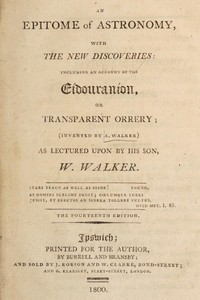
EPITOME of ASTRONOMY,
WITH
_THE NEW DISCOVERIES_:
INCLUDING AN ACCOUNT OF THE
Eídouraníon,
OR
TRANSPARENT ORRERY;
(INVENTED BY A. WALKER)
AS LECTURED UPON BY HIS SON,
_W. WALKER_.
STARS TEACH AS WELL AS SHINE! YOUNG.
OS HOMINI SUBLIME DEDIT; CŒLUMQUE TUERI
JUSSIT, ET ERECTOS AD SIDERA TOLLERE VULTUS.
OVID MET. 1. 85.
THE FOURTEENTH EDITION.
Ipswich;
PRINTED FOR THE AUTHOR,
BY BURRELL AND BRANSBY;
AND SOLD BY J. ROBSON AND W. CLARKE, BOND-STREET;
AND G. KEARSLEY, FLEET-STREET, LONDON.
1800.
AN
_EPITOME of ASTRONOMY_;
AS ILLUSTRATED BY THE
Eídouraníon,
OR
TRANSPARENT ORRERY.
This elaborate Machine is 20 feet diameter: it stands vertical before
the spectators; and its globes are so large, that they are distinctly
seen in the most distant part of a Theatre. Every Planet and Satellite
seems suspended in space, without any support; performing its annual
and diurnal revolutions without any apparent cause. It is certainly the
nearest approach to the magnificent simplicity of nature, and to its just
proportions, as to magnitude and motion, of any Orrery yet made: and
besides being a most brilliant and beautiful spectacle, conveys to the
mind the most sublime instruction: rendering astronomical truths so plain
and intelligible, that even those who have not so much as thought upon
the subject, may acquire clear ideas of the laws, motions, appearances,
eclipses, transits, influences, &c. of the planetary system.
Scene 1.
_THE SUN AND EARTH_:
With the Zodiacal Constellations.
As information is the primary object of this lecture, it is thought more
useful to exhibit PARTS of the solar system, separately, before a grand
display was made of the whole. This scene therefore, opens with only the
Sun and the Earth. The Sun seems suspended in the middle of the system,
and by spots on his face, is seen to turn round on his axis in 25¼ days;
light issues from his orb in all directions; in the blaze of which is
suspended the Earth, turning on its axis to produce day and night, and
revolving round the Sun to produce the seasons: its axis inclines 23½
degrees from a perpendicular to the plane of its orbit; and by that axis
keeping parallel to itself during this annual journey, the northern and
southern hemispheres are alternately addressed to the Sun; shewing, when
it is summer in one, it is winter in the other, and _vice versâ_. This
scene so naturally exhibits the cause of day, night, twilight, summer
and winter, spring and autumn, long and short days, &c. that a bare
inspection of the Machine is sufficient to convey the clearest idea of
these phænomena.
* * * * *
The Earth in this scene ought to be unshackled with meridians or
parallels of latitude:—to be a free and independent ball, with land and
water represented as they would appear to a distant spectator looking at
the real Earth. But as globes are seldom seen without these appendages, a
globe of two feet in diameter, equipped with meridians and parallels of
latitude (being requisite for illustration) will perform a diurnal and
annual motion round the Sun, and explain the above phænomena on so large
a scale, that their effects on the smallest island may be seen from the
most distant part of the theatre.
This scene is surrounded by transparent paintings of the twelve signs of
the Zodiac, shewing how the Sun, or rather the Earth, enters and passes
thro’ Aries, Taurus, Gemini, Cancer, &c.
* * * * *
Auxiliary scenes accompany this, to shew the principles of planetary
motion; the formation of the constellations and their allegorical
history; the oblate, yet nearly globular figure of the Earth; how ships
and mountains appear at sea; with ships moving round a large globe of six
feet diameter, &c. proving that the Earth can contain inhabitants on all
sides, &c.
Scene 2.
_SUN, EARTH, AND MOON_:
PHASES AND ECLIPSES.
Consists of the Sun, the Earth, and the Moon. The object of this scene
is to display the cause of the waxing and waning of the Moon, and of
solar and lunar eclipses: for this purpose the Earth perform its annual
and diurnal motions, and projects a conical shadow opposite to the Sun
during its journey round him. The Moon borrows her light from the Sun;
and which, in reflection to the Earth, is not more than one three hundred
thousandth part so strong: and performing her rotation round the Earth,
every 29D. 12H. 44M. will sometimes shew us more and sometimes less of
the enlightened part of her body. Hence, when she is between the Earth
and the Sun, her dark side is towards us, and we lose sight of her, and
call this part of her period the CHANGE; but as she revolves round the
Earth from West to East (the same way the Earth turns on its axis) in a
few days we see her above the Sun in the West, and seeing a small part of
her enlightened face, call the appearance the Horned, or NEW Moon: (for
her dark side, receiving no reflection of light from any neighbouring
body, cannot be seen except in very clear weather). As she proceeds on
her monthly journey, when the Sun sets in the West, we see her near our
meridian, and then she appears an HALF Moon, and we say she is at the
first quarter; as she approaches the FULL, more of her enlightened side
may be seen, and she assumes an OVAL or GIBBOUS appearance. At the FULL
she is opposite to the Sun, when the inhabitants of the Earth look at her
in the same direction as the rays of that luminary, and of course see
the whole of her enlightened face. In performing the other half of her
journey, she wanes; and exposing less and less of her enlighted side to
us, again disappears.
This scene receives also auxiliary illustration, before the grand scene
opens: and in maps of the Moon during its exhibition, particularly one
of five feet diameter, made from telescopes of the largest magnifying
powers, and laid down with the most minute correctness, with maps of
the appearance of the Earth as seen from the Moon, indicating from this
similarity, that they are worlds of nearly similar construction.
In the thirteen revolutions she will make while the Earth travels round
the Sun, it will evidently appear that the Earth is a Moon to her, but
appearing thirteen times as large as the Moon to us; that she does not
shine by her own light; that she has no diversity of seasons; that she
keeps the same side always turned towards the Earth, and therefore turns
on her axis every 29½ days; that her surface is mountainous[1]; and that
she shines without setting, every second fortnight, on the arctic or
antarctic parts of our globe, during winter: a very sublime and simple
provision for the otherwise long continued darkness that at opposite
seasons of the year would invelope the polar regions of the Earth.
If the Moon moved in the same plane or level with the Earth, we should
have an eclipse every full and change; but as she travels 5¾ degrees to
the North of it, and the same to the South of it, every lunation, she
only crosses the plane of the Earth’s orbit in two places, which points
of intersection (called the Moon’s NODES) though in a trackless path,
move 19¾ degrees towards the West every year, and therefore pass round
the Heavens in 18 years and 225 days; which is the golden number of our
calendar. Hence, when one of these nodes is between the Earth and the Sun
at the change, the Moon’s shadow is thrown on the Earth, and she eclipses
the Sun; and if she comes to the full when either node is opposite to the
Sun, she falls into the Earth’s shadow, and loses for a short time her
borrowed light: hence, as she mostly passes above or below the Earth’s
shadow, we have Eclipses very seldom. These phænomena are produced in the
Eidouranion as they are in nature, and perfectly evident on inspection.
Scene 3.
_THEORY OF TIDES_, ILLUSTRATED.
This Scene also consists of the Sun, the Earth, and the Moon. But the
intention is to shew how the Earth and Moon agitate each other round
their common centre of gravity, causing two tides every 25 hours. It is
a circumstance truly astonishing, to see in calm weather, and under a
serene sky, the violent agitation of the great fluid mass of the ocean,
whose waves roll against the shore with so grand impetuosity.—This
spectacle invites to reflection, and rouses a desire to penetrate
into its cause: hence the Earth’s THREE-FOLD motion appears in this
scene:—that, on its axis, to produce day and night: that, round the
Sun, to produce the year and our seasons; and that, round the centre
of gravity with the Moon, to produce spring and neap tides, by their
combined and opposite influences. The Moon is so near the Earth (240,000
miles at a medium) in comparison of the Sun (near 100 millions of miles)
that the Moon’s attraction on the waters of the ocean and on the air of
our atmosphere (for there are tides in both) is to that of the Sun as
ten is to three. So at the change of the Moon, the attraction of the Sun
and Moon being in the same direction, a power of thirteen influences the
sea, and we have SPRING tides; but at the quarters of the Moon, the two
luminaries counteract the attractions of each other, so the Sun’s power
of three being taken from the Moon’s of ten, leaves only seven operating
upon the sea, and NEAP tides take place.
A tumbler filled with water, may be whirled by a string vertically round
the head, without any danger of the water falling out of it. Those parts
of the Earth that come successively OPPOSITE to the Moon, perform a much
larger circle round the centre of gravity, than the parts immediately
UNDER the Moon: hence the waters opposite the Moon are THROWN OFF, as it
were, by their centrifugal motion, and rise above the common level, as
well as the waters exposed to the Moon’s immediate attraction; thus two
tides are produced in 25 hours, opposite to each other; and by the Earth
turning through those protuberances, its waters rise and fall.
The Sun would produce two small, but similar tides, if the Earth had no
Moon; therefore at the full of the Moon the Sun’s centrifugal tide being
reinforced by the Moon’s attraction, and the Moon’s centrifugal tide
being also assisted by the Sun’s attraction, spring tides take place at
the full, as well as at the change, of the Moon.
☞ This Scene also receives collateral assistance, exhibiting
and explaining the setting of the tides in all the large oceans
and the principal seas of the Earth.
Scene 4.
_THE SOLAR SYSTEM._
This displays the whole Copernican or Solar System, with every planet and
satellite in diurnal and annual motion! With awe and deference I offer
this daring but humble transcript of creation! Enough, if one idea can be
added, to the ingenuous mind, of the attributes and perfections of the
Deity.
The SUN, a huge globe of fire (957,942 miles diameter, and consequently
a million times as large as our Earth, and intended to give light,
heat, and vegetation, to seven primary and at least eighteen secondary
worlds) is placed in the centre of the system; and by spots on his disk
is discovered to turn on his axis in about 25 of our days. These spots
cannot be permanently fixed, because they are frequently altering in
their shape, situation, number, &c. tho’ some have supposed they have
seen small indentations on the edge of the Sun, as the spots have passed
it, and conjectured that a fluid matter surrounded a dark nucleus, which
sometimes becoming bare, might occasion the transient appearance and
disappearance of the spots.
MERCURY is the first planet in the order of the system; about 3498
miles diameter: he moves round the Sun with the greatest velocity of
any of the Planets familiar to our system (as being nearest the Sun) in
about 88 of our days; at the rate of 110,680 English miles every hour,
but the angle of his distance from the Sun, as seen by us, is so small,
that unless by the telescope, we can seldom discern him[2]; (and even
then an equatorial instrument to direct to its place, as indicated by
the Ephemeris, will be requisite;) and when we do, it is for so short a
time, and in twilight, that we can discover no spots on his face, and
therefore to this hour know nothing of the length of his days and nights:
we see him partially enlightened like the Moon, sometimes like a small
crescent, in other situations half enlightened, and sometimes gibbous or
oval, and are therefore certain he derives his light from the Sun, as she
does: so that no doubt he is a fellow world, with inhabitants adapted to
the heat of his situation: altho’ this heat is seven times as great as
that of the Earth. He is not much larger than the Moon. Our Earth, viewed
from Mercury, must appear much larger and more luminous than any of the
Planets, except Venus, appears to us.
VENUS is the next planet in the order of the system, and distinguished
by her _superior brilliancy_, as the Sun’s light is twice as great to
this planet as to the Earth; from this cause she is sometimes visible to
the naked eye in full day-light. She is about 70 millions of miles from
the Sun, or about twice the distance of Mercury; and like him, but much
longer and more conspicuously, appears under the different phases of the
Moon. These, as we have said, are proofs that both planets borrow their
light from the Sun. The orbits of these planets (as well as those of the
rest of the system) are inclined to the orbit of the Earth. Hence when
Venus and Mercury are found in the nodes of their orbits between the
Earth and Sun, they are transferred upon the Sun’s face like small round
black spots, and which in fact are partial Eclipses of the Sun; these are
called the TRANSITS of Mercury, or Venus.
Venus is a little larger than the Earth, or 9360 miles diameter;
and moves round the Sun in 224½ of our days, at the rate of 80,955
miles every hour. From faint spots seen upon her surface, Mr. Shroeter
apprehends she revolves on her axis in 23 hours, 21 minutes; that her
surface is irregular like that of the Moon, and some of her mountains
four miles high. The atmosphere of Venus has been calculated to be 50
miles high: and the Sun would appear to the inhabitants of this planet
twice as large as to us. When Venus is to the west of the Sun, she is
a morning star; when to the east of him, an evening star: her orbit or
track is included by the Earth’s, and as both move the same way, she
appears to be on one side of the Sun longer than the 224½ days she is in
going round him. The axis of Venus is said by some astronomers to incline
75 degrees to the axis of her orbit: and therefore her seasons vary very
fast, the Sun passing over more of her from pole to pole in one day, than
over the Earth in a quarter of a year. Hence the heated places of this
planet have time to cool: which suggest to our ideas that provision has
been made for inhabitants, that they might not suffer by their vicinity
to the Sun; this circumstance also gives her two winters and two summers
at her equator, and indicates her inhabited. The discovery lately made
by Mr. Shroeter, of a light faintly extended beyond the bounds of direct
solar illumination, when she has her falcated appearance like the Moon
near to her change, strengthens this probability: as these are signs of
twilight, and of an atmosphere. This astronomer has also observed her
to have considerable mountains; another character of a globe suited for
habitation.
The EARTH is the third planet in the order of the system: 8244 miles
diameter—moves at the rate of 68,856 miles every hour, and hence
completes its revolution in its orbit (the Ecliptic) in 365 days and ¼.
The MOON’s diameter is 2183 miles; she moves with respect to the Earth
2290 miles in her orbit every hour; and goes round the Earth from change
to change in 29 days and a half. But having devoted so much of this tract
to the phænomena of the Earth, as well as its satellite the Moon, we
proceed to
MARS, known in the heavens by his peculiarly red appearance, arising
from a very thick and dense atmosphere. This Planet is next above the
Earth, and hence has considerable less light from the Sun than we have;
is much smaller than the Earth, or about 4470 miles diameter. He is near
150 millions of miles from the Sun, and goes round him in something less
than two of our years, moving at the rate of 55,783 miles every hour. His
day and night is rather longer than ours, or 24H. 39M. 22S. and uniform
throughout his year, so that his axis being perpendicular, he has no
variety of seasons. When we pass between the Sun and him he has a most
fiery and alarming appearance, and is often mistaken for a Comet; but
when we are on the opposite side of our orbit, he appears small, and
scarcely to be distinguished from a fixed star.
JUPITER, far the largest of our Planets, near 1300 times the size of
the Earth, or 93,333 miles diameter, is the next above Mars, at five
times the distance from the Sun that we are; so that he enjoys but a
twenty-fifth part of the light, heat, and attraction of that luminary
we do.—Though indeed of the light and heat he may still possess, we are
not so certain as of the degree of attraction: that being invariably
proportioned to the distance; while these will be relative to the density
and other circumstances of the atmosphere, and the aptness of the surface
of the Planet to acquire and retain heat: after Venus he appears the most
brilliant Planet of the Universe. He is attended with four satellites
that revolve very regularly round him. The three first are eclipsed
every revolution, and every seventh day come in conjunction with him and
one another, as may be seen on the _Eidouranion_. Longitude, at land,
can be ascertained by the eclipses of Jupiter’s satellites, as well as
by a transit of Venus; and these would supercede the necessity of a
time-keeper, if they could be observed at sea; hence, in the Nautical
Almanack, these eclipses are very exactly calculated for the meridian
of Greenwich, and answer very good geographical as well as nautical
purposes. Jupiter is near twelve years in making his way round the Sun,
altho’ he moves at the rate of 30,193 miles every hour; he turns round
his axis in about ten of our hours, so that his days and nights are
but five hours each: and he has no variety of seasons; for his axis
is perpendicular to the plane of his orbit. Turning so swiftly on his
axis, his figure becomes more oblate than that of the Earth, being more
than 6000 miles longer in diameter from one side of his equator to the
other, than from pole to pole, or in the proportion of 13 to 14.[3] This
swiftness of his diurnal motion also draws his clouds and vapours into
streaks or lines over his equatorial parts, forming what are called
Jupiter’s Belts. An eclipse of the Sun, by this great planet, would be a
striking object even to the unassisted sight as viewed from Saturn.
SATURN, 85,782 miles in diameter or about 1000 times as large as the
Earth, is still a more remote planet from the Sun, round which he
revolves in about 30 of our years, at the distance of 916 millions of
miles. He moves in his orbit at the rate of 22,298 miles every hour,
and upon his axis in 10H. 16M. by this swift revolution on his axis his
figure becomes oblate in the proportion of 11 to 10, and his atmosphere
and vapours are drawn like a quintuple belt of 3 darker parts and 2
lighter upon his body. Saturn is attended by seven Satellites, the
outermost has been long known to have a period of apparent augmentation
and diminution, and hence probably to have a revolution on its axis, and
be composed of land and water.
A large, broad, double, and luminous _ring_ of 200,157 miles diameter,
surrounds Saturn, at a distance from the planet equal to the breadth
of the ring.—This ring inclines about 30 degrees to the plane of
the ecliptic, and must appear like a great arch of light to the
inhabitants of Saturn. It has a revolution every eleven hours on an axis
perpendicular to its plane, and keeps parallel to itself at all times;
hence it disappears twice every 30 years, when its edge is presented to
us; the Sun shines for near 15 of our years together on the northern
plane of the ring; and then leaving it, illumines the southern side for
the same period; so there is but one day and one night on each side of
the ring, but each will be of 15 years continuance without intermission.
The Sun’s direct light being but about a 90th part so strong to Saturn
as to the Earth, this ring is no doubt intended to increase it, by
reflecting a very considerable portion upon the planet, which added to
that from his seven Satellites, must render him a very comfortable abode
for rational and brute inhabitants.
The GEORGIUM SIDUS, or Georgian Planet (so called by Dr. Herschell,
its ingenious and indefatigable discoverer) makes the seventh in the
order of the system; the other planets we have described have been
known as such to the highest antiquity, but from its extreme smallness,
this has escaped ascertainment till the year 1781, although it had been
recognized as a very minute star by several astronomers. It is near
twice Saturn’s distance from the Sun, and will be near eighty-two years
and six months in going round him; is of a pale colour, and much larger
in its telescopic appearance than the fixed stars, being 100 times as
large as the Earth, or 37,230 miles diameter, and, on a clear evening,
is visible to the naked eye. The Dr. has discovered six satellites to
this planet, some of which are said to move retrograde. As familiarity
is the principal design of this Treatise and Lecture, it may be useful
to exhibit the distances of the planets from the Sun in the most concise
form, and in numbers they will stand thus:—if the distance from the Sun of
Mercury—Venus—Earth—Mars—Jupiter—Saturn—Georgium Sidus
is 4 will be 7 10 15 52 95 190
or, if a body projected from the Sun should continue to fly at the rate
of 480 miles per hour, (which is about the swiftness of a cannon-ball),
it could reach the orbit of Mercury in 9 years, Venus in 16 years, the
Earth in 23 years, Mars in 34 years, Jupiter in 118 years, Saturn in 216
years, and the Georgium Sidus in 432 years.
These we consider as the regular bodies of our system; so regular,
indeed, that every phænomenon respecting them is calculated for years
before hand, and it is almost considered as a criminal error to be a
minute of time wrong in the calculation. But we are sometimes visited by
COMETS, which may also be recognized as a part of our system: of these
our knowledge is very imperfect. By supposing that the same Comet has
appeared at equal intervals of time; by observing that, like the planets,
they describe equal areas in equal times; and by having three points in
an ellipsis given to make out its eccentricity; from these data it was
natural for mathematicians to suppose they could calculate the return of
all Comets that had been scientifically observed: but the actual return
even of that conspicuous one expected by Dr. Halley, has been thought by
some not to be sufficiently ascertained: yet, on examining the balance
of probability, as stated by Maupertius, Lalande, Messire and Martin,
for its re-appearance, probably this doubt will be greatly lessened, if
not removed. As new Comets are almost perpetually appearing, on which
calculation hitherto has been silent, there is reason to expect, in a
proper period of time, an adequate number of observations to decide the
question, whether in general they revolve at stated times, or traverse
our system without probability of return. Perhaps Comets of each
description time and observation may confirm to us. We know that Comets
accompanied with tails come very near the Sun, and from all quarters
of the Heavens! that the tails keep opposite to the Sun; consequently
they are only visible to us when seen obliquely to the Sun. Thus the
Comet of August, 1797, was observed to have little or no train during
any part of its appearance; but a faint hazy light diffused round it;
these trains, like electrical and borealean light, do not refract the
light of the fixed stars, &c. The appearance of the Comet of 1682, is
copied in the _Eidouranion_. It descends from the top of the Machine;
its train increasing in length and lustre till it arrives at the Sun,
diminishing as it ascends. Its orbit is so eccentric that the small part
of it visible is not sensibly to be distinguished from the parabolic
curve; and in this representation it finally disappears in the roof of
the Theatre; it being impossible, if its return were ascertained, to
represent the extent of such an orbit, and its motion in it, with any
degree of suitable proportion. The velocity of such of these as approach
nearest to the Sun, particularly of the Comet of 1680, (whose appearance
was tremendous) exceeds any swiftness that falls within observation;
except that of the rays of light; it being nearly 2000 times greater
than the swiftness of a cannon-ball, at the instant of its discharge;
yet scarcely a thousandth part of the velocity of light passing from
the Sun[4]. This Comet approached to within 40,000 miles of the Sun’s
surface, and was calculated to be heated 2000 times hotter than red hot
iron; a globe of iron the size of the Earth in this heat, would be 50,000
years in cooling. These amazing visiters, whom philosophy contemplates
with awe very different from that terror with which superstition had
long viewed them, moving in such amplitude of space, so numerous as they
are, and so great as some of them, must have functions assigned to them
proportionally important: either occasionally of terrific revolution;
or more generally of recruiting the atmosphere of the planets in their
successive appulse to any of them, and supplying the diminution of the
solar fires. Perhaps too they are useful in preventing the central
tendency of the planets to the Sun, from increasing more than in a
certain degree; so that the apparent disturbances, thus produced, will be
part of the necessary order and harmony of the system.
It is probable (though their orbits are so much oblique in all
directions to those of the planets, that it can rarely happen) that
Comets may be instrumental to great shocks; either by direct collision,
the effect of which, considering the velocity and mass of some of them
cannot be estimated, or by near approach: and of this latter a possible
result, and such as seems, in one instance at least, to have already
taken place, is noticed in the Remarks annexed to this account of the
_Eidouranion_. But the philosophic observer will have this reflection
presented to him from the phænomena of the Universe; that the apparently
disturbing and destructive powers are secondary and subservient; while
those of the preserving and meliorating kind are primary, continued, and
universal. And those incidental causes of a melancholy and distressing
aspect, when resolved into their ultimate tendency and necessary effects,
manifest themselves, in so far as we can trace them, to be parts
essential to the system of pure and perfect benevolence. Stability and
duration are stamped on the Universe, and the imagination is lost in
the immensity of the prospects; and whether we turn to the past or to
the future, our conception vainly pants to grasp the idea of boundless
Eternity.
* * * * *
But when we launch in idea into infinite space, and contemplate
the systems without number that fill it; here indeed we have a subject
truly worthy of the DEITY! Whoever supposes the fixed stars placed in a
concave sphere, as they appear to us, must have a narrow and contracted
idea of the SUPREME BEING; for one star appears large and another small,
because one is immensely distant from us in comparison of another.
Through Dr. Herschell’s large telescope many fixed stars appear double:
the Polar star is double; (but they are only stars at different distances
from us appearing nearly in the same line) some appear like a topaz,
others azure, others red; all are round, and many as perfectly defined
as a shilling is on black cloth. By telescopes we formerly could see
three times the number we can by the naked eye; and now, telescopes
having received further improvement, in the most crouded part of the
milky way, 116,000 have passed before the instrument in a quarter of an
hour. The Nebula of Andromeda must be composed of the united lustre of
many millions of stars. Agreeably to this, Dr. Herschell has noticed
single nebulous stars surrounded with a faint equable whiteness; such as
a system of Planets viewed at that distance from us might be supposed
to give: others he has seen, which have the appearance of yet unformed
systems. And there are, we may presume, points of view, in the immensity
of the Universe, in which all the fixed stars, accessible to the eye
or telescope from this station of ours, and all the inconceivable
space, through which they extend, vanish into a _nebula_, and almost an
indiscernible point. Such is the order and greatness of that Empire,
which these Discoveries, the farther they are pursued, must for ever
more and more present to our increasing admiration. Such the relation of
parts so astonishingly remote! Such the unity of intelligence, power,
and preserving goodness which pervades the whole! And why may not stars
be so remote, that their light may not have reached the Earth even since
the creation! We know that light takes more time in travelling from
the nearest stars to us, than we in making a West India voyage, (which
is usually performed in six weeks) a sound would not arrive to us from
thence in 50,000 years, nor a cannon-ball in a much longer time. The
Sun’s light could not therefore reach the fixed stars, and be reflected
back again with their lustre; of course they shine by their own light—if
so, they shine as our Sun, and consequently are Suns themselves.—Now,
as a principal of uniformity runs through the variety of nature, it is
reasonable to conclude these Suns to be centres of systems like ours;
and destined for the same noble purposes, viz. that of giving light,
heat, and vegetation, to various worlds that revolve round them, but
which are too remote for discovery, even with our best telescopes!
This idea is infinitely too great for the human mind; or indeed for
that of any created Being! For how inadequate must the utmost stretch
of finite faculties be to represent infinity! The stars, disposed in
constellations, and surrounded by concentric circles, may perhaps assist
the imagination a little: The attempt in SCENE V. if not admired, we
hope will be forgiven. But was it possible we could actually take our
flight into infinite space, or be borne on the wings of lightning, to the
most distant fixed Star we can now see, even there, perhaps, we should
find ourselves on the confines of creation, and see as many stars before
us as we left behind! For space has neither top nor bottom in it: it
is a circle whose centre is every where, but whose circumference is no
where! Even systems themselves may have revolutions round one another;
and account for that difference of distance that we are constantly
observing to arise amongst the fixed stars; for new stars appear, rise
into magnitude, and then diminish and disappear, which would also be
accounted for by supposing that our Sun himself is in progressive motion
towards some part of infinite space, and carrying his system of worlds
along with him. Stars of the _first_ magnitude, in Flamsted’s time,
dwindle into those of the _third_ or _fourth_, in our time. Some of
the stars change their magnitude periodically: as Algol, in Medusa’s
Head, which rises from the third magnitude to the second, in two days
and twenty-one hours.—Where such periodical disappearances are short,
they have been referred with probability to quick revolutions of such
stars on their axis, with part of their disk opaque; or to the regular
intervention of some very considerable Planet to intercept them from
us. But re-appearances of this kind, after very long intervals, would
indicate rather a revolution in a great orbit. By analogy we conclude,
that at a proper distance our Sun would dwindle into a fixed Star among
the rest, and his system of worlds disappear. Now as we see that almost
every particle of our globe swarms with life and animals, we cannot
suppose the other bodies of our system to be only intended as a faint
spangle for mortals to gaze at; more especially as they are as well
calculated for inhabitants as ours, revolving as regularly round the same
Sun, and seeming to have every other convenience for rational and brute
inhabitants[5]. But to carry this idea into infinite space; to recognize
Suns and Systems, above us, below us, to the East, the West, the North,
the South; to consider each Sun as the centre of a system like ours, and
every world inhabited!—In short, the astonished fancy turns round, and is
entirely lost and sunk in the abyss of nature! Well might the Psalmist
say, that, “The heavens declare the glory of God, and the firmament
sheweth his handy work.” Well might he express himself as overwhelmed
with the idea of the power and omnipresence of the Deity; since all our
discoveries serve only to convince us, that a progress of inexpressible
extent, continued through ages without number, would find us every where,
as here, surrounded with his infinite energy, eternity, and immensity,
filled with his vital presence.
[Illustration]
FOOTNOTES
[1] Her mountains by some have been calculated nine miles high; but
Dr. Herschell’s telescopes, which magnify 6500 times, have reduced her
highest hills to about _two_ miles. Mr. Shroeter apprehends that the
mountain _Leibnitz_ is not less than 25,000 feet high. The Craters of the
Moon are from 4 to 15 miles diameter. He discovers some new spots on the
Moon, and calculates her atmosphere to be 5376 feet high, an height so
inconsiderable that it might escape our best telescopes or most minute
observations.
[2] It is rather curious how the antients saw so much of him as that
his period was tolerably guessed, at least so far back as the days of
Cicero.—_De Nat. Deor. II._ 20. They knew it to be less than the Earth’s:
which, though far from accurate, was a nearer calculation than could be
then expected. And this is the more remarkable if Cicero had it from
Plato, and he from Ægypt and Syria.
[3] If the Earth turned round its axis in 84 minutes and 43 seconds,
the centrifugal _force_ would be equal to the power of gravity at the
equator; and all bodies there would entirely lose their weight. If the
Earth revolved quicker, they would all fly off and leave it.
[4] The velocity of a cannon-ball is about eight miles per minute.
Of the Comet in its perihelion 14,600
Of Light 12,000,000
[5] Perhaps the inhabitants of one system may be destined successively
to pass from planet to planet, and from systems to other systems. This
would answer, on an immense scale, to the analogy existing on Earth. It
is stated as a conjecture with much energy and beauty in a late work.
Illustrat. of Proph. T. II. p. 557, _Anno_ 1796.
DISSERTATION
ON THE PROBABLE CAUSE OF THE
Deluge.
So perfect are the laws by which this wonderful system is regulated, and
so effectual that Self-physic which the Almighty has instituted through
all his works, that if any seeming disorder happens in the system, there
requires no immediate interposition to prevent or cure the mischief: each
body carrying within itself the principles of preservation and cure; an
argument of wisdom and foresight worthy of the Deity!
The Planet Jupiter was attracted out of his orbit by the enormous Comet
which appeared in the year 1680. The Comet coming across the plane of
his track, had a temporary influence upon him; and it is observable, he
has not travelled by the same fixed stars since that period which he did
before it; and no doubt but his usual motion was momentarily retarded,
and the shape of his orbit altered. Now if Jupiter consists of land and
water (and by the spots seen on his face it is more than probable) it is
possible he might experience a revolution something similar to our flood;
for that our flood was occasioned by the near approach of a Comet, is a
most natural supposition, and in no wise militates against the scriptural
doctrine of that event: it being as easy, and as consistent for the
Almighty, to render justice by a secondary cause, as by an immediate
interposition. Nor is his attribute of mercy arraigned by the promiscuous
destruction the deluge occasioned; for it is evident, by reasoning from
his works, that he governs the universe by “general, not by partial laws.”
The vestiges of the Deluge are so remarkable, both on the surface and
within the bowels of the Earth, that if examined without prejudice, they
prove, I think, beyond a doubt, that awful revolution to have been the
work of a Comet. Not that the moisture of its tail drowned the World,
as was unphilosophically suggested by Whiston; but if the attraction of
the Moon be capable of raising the water of the sea above its common
level, what effects might not be supposed from the near approach of a
body perhaps many thousand times larger than the Moon? If a tide by such
an attraction was raised three or four miles above the level of the Sea,
the Earth, by turning on its axis, would have that protuberance dragged
over the land, and its surface would be plowed up into those inequalities
we call mountains; for that mountains are not of eternal duration, is
evident from their growing less, even in the memory of man. For every
thing tends to a level. Rains falling on mountains wash down their
asperities; this matter bemuds the rivers, and banks out the sea; rocks
themselves yield up their fantastic forms to the effects of air, water,
and heat; and land has been growing into the water ever since the Deluge.
But why should all assemblages of mountains be arranged like little
ridges of sand on the sea shore? Doubtless by having been produced by a
superior tide, and left to dry by an unreturning sea. Almost all great
ranges of mountains run North and South; the Andes of the Cordelleras;
the mountains of the Moon in Africa; the Dophranes, Caucasus, Allegany,
&c.—the Alps and Pyrenees excepted.
As Comets visit our system in all directions, why might not that in
question have its motion from North to South, and dragging the sea after
it, determine the mountains to those points of the compass? Whence
come the shells and fish bones we meet with on the tops of the highest
mountains? We have not discovered any power in nature disposed to work
such quantities of them thro’ the bowels of the Earth; and indeed
imagination has not yet been so wild as to carry them thither: they are
not a fortuitous assemblage of atoms assuming such forms; not _lusus
naturæ_, but _bona fide_, shells and fish bones, such as we meet with on
the sea shore! We find them also deep buried in the bowels of the ground,
far from the sea; we find them in rocks, and often converted into stone:
nay, may not the fat of fish, joined with vegetable substances, form the
bitumen of coal? We have experiments that warrant such a suggestion.
Now if ever the Sea was dragged over the surface of the Earth by the
attraction of a Comet, these effects must naturally follow.
In digging into the bowels of the Earth, we have still stronger evidence
that the flood was occasioned by the near approach of a Comet. It is well
ascertained, that the united attraction of every atom of the Earth forms
that Earth into a dense ball, and not any particular attraction in its
centre.—All matter being therefore affected by this power in proportion
to its density, one might conclude that the heaviest bodies would lie
deepest, and the lightest near the surface, but this is by no means the
case: Coal is lighter than stone; various minerals lie upon light earths,
&c. evidently proving, that the general order of nature has at some time
been disturbed, and the manner in which matter obeys the laws of gravity
disarranged. Hence the philosophic miner finds strata of various density
in digging downwards; and in pursuing his vein of ore, finds these
strata broken and divided; nay, if he loses the vein, he can easily tell
where to find it again, by the manner in which it broke off. In this he
never is mistaken: He sees, as it were, through many fathoms of Earth!
evidently suggesting, that some revolution on the Earth has broken up its
naturally arranged strata, and introduced this “regular confusion.”
The various strata of the Earth seldom lie on one another horizontally:
they generally dip; and near the shore commonly incline towards the
sea. On the South coast of England, the rocks incline Southerly; on the
opposite coast of France they incline to the North. Is it not probable,
that at the Deluge, the horizontal stratum was broken between these
countries: and the ends falling lowest at the breach, formed the channel,
into which the sea flowed, when it lost the influence of the Comet,
and again obeyed the power of gravity? Countries separated by narrow
channels, universally have their shores inclining towards the sea;
shewing that the general geography was at that time altered.
It is true, we have an old doctrine revived, and supported by
respectable authority, that mountains were formed originally by those
eruptions we call volcanos. The votaries of this theory pronounce the
hollows and cavities on the tops and sides of mountains, Craters, or
the cups of extinguished volcanos; and if the stone of the mountain
be of a bluish colour, then it is declared Lava; and the proof of a
volcano having existed there becomes incontrovertible! History, however,
affords us very few instances of mountains so formed. Yet this doctrine
seems to have received very just authority from the last scientific
circumnavigators. The rocks which surround the islands of the Pacific
Ocean, generally break off perpendicularly about a mile out at sea, which
makes their approach very difficult and dangerous; and as the stratum
immediately under the loam of the surface has an ashy, or lava-like
appearance, the voyagers very naturally concluded, that the immense
number of small islands which stud that extensive ocean, were the product
of subaqueous eruptions. Still if I might be allowed to hazard an opinion
against such respectable authority, I should rather apprehend that the
Pacific Ocean had been once a continent, and that at the Deluge, when
the Earth’s surface was disarranged and broken up by the violent motion
of the waters, the general body of it sunk beneath the level, or was
washed away to other parts, leaving only the more elevated and solid part
remaining. For volcanos throw up matter piece-meal; islands, therefore,
formed by them, would have a sloping, or gradually sinking shore: whereas
the islands of the Great South Sea are surrounded by perpendicular rocks,
that sink in that direction to an almost unfathomable depth in the sea.
Besides, how can we account for that similarity of manners, customs,
colour, and even, language, among the inhabitants of islands so distant,
that no mode of navigation they practice could ever make them acquainted,
or have any communication with one another? If these islands were thrown
up from the bottom of the sea, their inhabitants would not be thrown up
with them, and all with the same custom and language. Now if this immense
part of the globe was a continent before the Deluge, the inhabitants
might be alike; and if the elevated parts were above the subsiding
water, (a circumstance more than probable) inhabitants might be saved
upon them, with every circumstance of similarity we find among them; for
that revolution is not of so remote a date, but remains of antediluvian
manners might exist at this time.
* * * * *
_Sic undique omni ratione concluditur, mente consilioque
divino omnia in hoc mundo ad salutem omnium conservationemque
administrari. Quo Spectaculo nihil potest admirabilius esse,
nihil pulchrius. Quid tam apertum, tamque perspicuum, cùm cœlum
suspeximus, cælestiaque contemplati sumus, quàm aliquod esse
Numen præstantissimæ mentis, qua hæc regantur?_
CIC. DE NAT. DEOR.
_Heads of Mr. Walker, sen.’s_
Lectures,
IN CONDUIT-STREET, HANOVER-SQUARE,
Read every Monday, Wednesday, & Friday, during Winter,
AT ONE,
_On an Explanatory Apparatus_,
The most extensive and elegant.
ONE GUINEA THE COURSE.
I. On the general Properties of Matter, Magnetism, &c.
II. On the Laws of Motion, Mechanics, Machines of Agriculture,
Mills, Cranes, &c.
III. On the Principles of Chemistry.
IV. On Pneumatics, or the Weight and Spring of the Air, Musical
Vibrations, &c.
V. On the Gasses and new Discoveries in the Air.
VI. On the Hydrostatics, or the Motion and Pressure of Water,
Canals, Aqueducts, Machines, Ships, &c.
VII. On Electricity, its Laws, Effects, Circuits, Shocks, &c.
VIII. Ditto, negative and positive, Lightning, Thunder,
Galvanism, Medical Electricity, &c.
IX. On Optics, Laws of Light, Vision, Lenses, &c.
X. On the Figure and Motions of the Earth.
XI. On the Phases, Eclipses, &c. of the Moon, and on the Tides.
XII. On the Solar System in general, with the new Discoveries.
This Course may be read privately for 50 Guineas, or to General
Subscription amounting to 70 Guineas, on application to Mess. Walker,
sen. or jun.
Ipswich: printed by Burrell & Bransby.