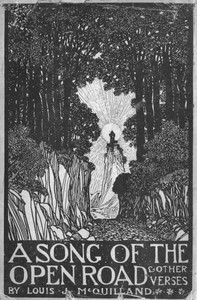
A SONG OF THE OPEN ROAD
AND OTHER VERSES
[Illustration]
A SONG OF THE
OPEN ROAD AND
OTHER VERSES
By Louis J. McQuilland
With a Proem in Verse by “G. K. C.”
A Preface by CECIL CHESTERTON
And an Impression of the Author
and Three Decorative Drawings by
DAVID WILSON
HEATH CRANTON, LIMITED
FLEET LANE, LONDON
NOTE
_Some of the poems in this volume appeared in the “Spectator,” “Vanity
Fair,” “The New Witness,” “The Sketch” and “The Gypsy.” Several of the
shorter verses were originally published in the “Daily News,” the
“Sunday Pictorial” and the “Sunday Herald.” Messrs. Boosey & Co., 295
Regent Street, possess the sole musical rights of the lyric, “When I
Sail to the Fortunate Islands.”_
_All rights reserved._
BALLADE TO AN IRISHMAN
To L. J. McQ.
To verse and to the long ago,
The game we played at, pretty dears,
When some of us were clever (oh!)
And all of us were Modern (Cheers)
When, Pioneers, O Pioneers,
Stuck in the mud in various ways--
I drink to Ireland down the years,
To thine, and mine, and better days.
Even then, at least we did not go
With them that lent their lengthy ears,
To Pigott, Carson, nark and Co.,
Not then preferred the snivelling sneers
Of damned and putrid profiteers
(If I may be allowed the phrase),
To justice and the great arrears,
To thine and mine and better days.
And now St. George’s shield can show,
Not shamed, with them that were his peers,
And on us too such daybreak glow
As shows your dying Fusiliers,
Borne high above the breaking spears,
The Breast Plate of St. Patrick blaze,
Cry, for a cleaner England hears,
To thine and mine and better days.
L’ENVOI
Prince, trust me, even Mr. Squeers,
Will only pummel while it pays,
And Carsons look for no careers
To thine and mine and better days.
GILBERT K. CHESTERTON.
INTRODUCTION
Though I have now known my friend Louis McQuilland for well over a dozen
years I am only just beginning to understand him. It may be that he is
only just beginning to understand himself. But I am not so sure; for he
is an Irishman, and the Irish have, as compared with us, a remarkable
capacity both for knowing themselves and for keeping to themselves what
they know.
For what it is worth, my own interpretation of the earlier and the later
McQuilland--they afford in some ways a startling contrast--is something
like this. I conceive a young man, an Ulsterman of the Catholic
Nationalist minority, the fiercest section of the Fighting Race, coming
to London and finding himself among an alien people whose eyes were so
different from his own, and, with the quick observation and adaptability
of his people, saying to himself, “I must not talk about my country; for
that is treason. I must not talk about my religion; for that is mediæval
bigotry. Let us talk about Art.”
It is fair to Mr. McQuilland to say that he not only talked about Art
but produced it. How well he did the sort of work that English poets
were then trying to do, you may see in many poems of this volume, in
“The House of the Strange Woman,” for instance. But even in playing with
the Decadence there was always a sharp Irish edge to his execution.
Read, for example, the little poem called “Fleet Street.” It is a novel
of George Gissing’s in twelve lines. To the same period, though to a
different mood, belongs, I think, the really very beautiful poem called
“The Joyous Comrade.”
Nevertheless, when one turns to the poetry of a later date, and
especially to the several poems evoked by the present war, there is a
change in the very movement of the times which no one can miss. In spite
of bitter blunders on both sides--but especially on our side--I cannot
help feeling in that change a good omen for the future friendship of our
two countries. For a common crusade in defence of that by which all
Europeans live, if it has affected nothing else, has, I think, made
Louis McQuilland feel that he can give himself away ever so little to
the English. Even a little of him is an acceptable gift.
Among these later poems there is one which every Englishman ought to
read in these times. It is called “The Song of the Flag.” It is a song
of Internationalism by a Nationalist; and it may serve to emphasize the
much needed truth that friendship between nations, no less than enmity,
depends upon every nation remaining strictly individual and separate.
Two strong men shaking hands, perhaps after good blows given and taken,
is a fine sight. Briareus promiscuously shaking hands with himself--the
Modern idea of Internationalism--is not.
CECIL CHESTERTON.
CONTENTS
PAGE
PROEM IN VERSE, by G. K. C. 7
INTRODUCTION, by Cecil Chesterton 9
A SONG OF THE OPEN ROAD 13
THE COUNTRY OF THE YOUNG 15
THE SONG OF FORGOTTEN HEROES 16
THE KING’S BRIDE 18
A GEORGIAN SNUFF-BOX 20
BALLADE OF FIGHT 22
TO THE NEW HELEN ON HER BIRTHDAY 23
“FOR ANY GOOD CAUSE AT ALL”: The Ballad of
Sir Kevin O’Keane 24
THE HOUSE OF THE STRANGE WOMAN 26
FLAMES 28
IN A LIBRARY 29
_Château D’Espoir_ 31
THE SONG OF THE FLAG 32
_Les Papillons_ 34
BALLADE OF ANGRY GALLERY FIRST-NIGHTERS 35
THE DIGGER 36
WHEN MY LOST LADY COMES AGAIN 37
WHITE ROSES 38
GLADYS IN THE WOODLAND 39
A SOCIAL FAVOURITE 40
THE JOYOUS COMRADE 42
TRUCE 43
ROMANCE AT REST 44
VOICES 45
SOME IMMORTALS AND A MORAL 46
THE LOST LAND 48
BALLADE OF ONE-AND-TWENTY 50
WHEN LONDON BURNS 51
WITH BERTHA UP THE RIVER 52
THE ISLAND OF A DREAM 53
BALLADE OF DEAD FAVOURITES 56
THE HORSEMAN 57
WHEN I SAIL TO THE FORTUNATE ISLANDS 58
LITTLE SONGS OF LONDON STREETS--
(1) FLEET STREET 59
(2) OXFORD STREET 59
QUEENS IN RED AND WHITE 61
MY LADY OF THE VIOLETS 62
OLD FRIENDS, OLD BOOKS, OLD WINES 63
THE POISONERS 65
PRINCESS FAR-AWAY 66
THE HUNS AT VERDUN 68
RESURGAM: IRELAND, 1916 69
IMMORTAL 71
LIST OF ILLUSTRATIONS
THE KING’S BRIDE to face page 18
TRUCE “ “ 43
THE HORSEMAN “ “ 57
A SONG OF THE OPEN ROAD
The old Earth-Mother calls us,
And we hearken unto her cry,
For we dare not question her bidding
Lest we sicken and droop and die.
The spirit of change is burning
As a fever in heart and brain.
In the ranks of the Free Companions
We must take to the road again.
We have lain in the tents of the Dwellers;
We have ta’en of their drink and food;
We, that were weary, have slumbered,
Have slumbered and found rest good.
We have kissed the lips of their maidens,
From their kin we have chosen our brides;
But the summons has come from the Mother,
And no one who hears it abides.
We do the will of the Mother,
We bow to the Word she sends,
Though we know not whither we journey,
Nor the goal where the journey ends.
On the quest of the Strange Adventure
We sally, hand-in-hand,
As the men of the days nomadic
When the Hunter was lord in the land.
The winds asweep through the forests
Shall brace our souls for the march,
The balm of the dews descending
Shall chasten the heats that parch.
Through vista of brakes entangled
The stars shall guide, in the night,
By day the sun shall quicken
The pulse of our life’s delight.
Ho! for the zest of travel,
The wayfarer’s romance,
The joy of the unexpected,
The hope of the noble chance.
We have girded our feet with sandals,
We carry the pilgrim’s load.
In the ranks of the Free Companions
We take to the Open Road.
THE COUNTRY OF THE YOUNG
TO H. A. MACC.
There is a kingdom cool and green,
Washed by the ever-moaning sea,
From whose wild surf, with furious mien,
Lir’s war-hounds struggle to be free.
The tempest breaks on tower and tree,
Exultantly proud winds are flung.
Joy in the storm the watchers see--
It is the country of the young.
There is a land that loved the green
Through all the sullen, bitter years,
The vengeance of the Tudor queen,
Swart Cromwell’s wrath, proud Strafford’s fears;
The Boyne’s despair and Limerick’s fears:
They fade, they die, as runes long sung.
Youth springs triumphant down the years--
It is the country of the young.
There is a land where hope is green.
Exultant in the eastern sky
Flashes a dawn whose golden sheen
Shall fall where Tone and Emmet lie.
The brave hearts sleep, they cannot die;
They speak to all with deathless tongue
Who serve the Cause with purpose high
Within the country of the young.
L’ENVOI
Fair is your crown, Dark Rosaleen.
For you are silver joy-bells swung.
A nation comes to hail you queen,
All in the country of the young.
THE SONG OF FORGOTTEN HEROES
Out of the furthest Eastward
A cry through the Gates of Dawn,
Borne to the ears of the dreamers
Ere the pallid stars have gone.
The song of forgotten heroes
Of unavailing fight,
Heard in the ghastly hush of sleep,
In the shadow of Death and Night.
The dead who died for honour,
Who sought not the victors’ bays,
Preferring the thorns of sacrifice
To the fruits of ignoble days.
The dead who died on the waters.
Ah, sound and sweet they sleep!
Who gave their lives for the love of men
And their souls to the God of the deep.
The dead who died in battle,
Trusted and true and tried,
Heading the ranks of a hope forlorn,
By a great cause sanctified.
The dead, the eager searchers,
With daring sails unfurled,
Whose blood is their seal and charter
In the far, waste ends of the world.
These are the men who sing it,
In the shadow of Death and Night,
This song of forgotten heroes
Of unavailing fight.
THE KING’S BRIDE
This is the King’s Bride,
Wonderful to behold,
Wearing in calm pride
Raiment of vair and gold.
Once in a thousand years,
Out of Eden Bower,
Her peerless like appears,
Fresh as a perfect flower.
Pale as the lily’s white,
Dark as the Mystic Rose,
Bloom of the world’s delight
In the King’s orchard close.
What shall I bring the Queen?
Strong men for her will;
Bucklers on which to lean,
Spears to harry and kill?
Jewels of ancient note
From East unto West,
Pearls for her columned throat,
A ruby for her breast?
Silks out of Samarcand,
Furs from the frozen deep,
Perfumes from champak-land--
Sighs of enchanted sleep?
[Illustration: _To face p. 18._]
I shall bring the Queen praise
Wrought into gracious song,
Sweet as the dawn’s amaze,
Loyal as years are long.
I shall give the Queen fame
When her treasures are rust,
Making her beauty flame
Out of the trodden dust.
A GEORGIAN SNUFF-BOX
Though fallen from your high degree,
Once tapped by princely fingers,
You breathe of more than burnt rappee.
Round you a memory lingers
Of those wild days of wine and wit,
Of patch, peruke and passion,
When sprightly Oldfield ruled the Pit
And Hervey led the Fashion.
When Walpole trimmed the ship of State
To meet each Tory billow,
When Poet Pug lampooned the great,
When Pulteney played spadillo,
When Worthless Moll amused the Court
With philosophic chatter,
When Bolingbroke pledged deep in port
“The King across the water.”
When flashed the lightnings of the Dean
To blind the eyes of Stella,
When scoffing Congreve vowed with spleen
The wares of Gay prunella;
When, sated with the board’s delights--
For Georgian bucks were gluttons--
The town sparks sought the shades of White’s
Or tossed the dice at Button’s.
When tabinets were all the vogue
For feminine adorning,
When Irish Biddy raised her brogue
And clacked her pails at morning;
When long and loud the conflict raged
Betwixt the Maccaroni,
As each his _diva’s_ cause engaged--
Faustina or Cuzzoni?
Old snuff-box could you thrill to speech,
In gossip none were greater,
Whose chronicles exceed the reach
Of _Tatler_ or _Spectator_;
But ah! as dumb as dead Queen Anne,
You lie in peace unbroken,
A remnant of the Georgian span,
A Hanoverian token.
BALLADE OF FIGHT
To G. K. C.
When slaves shall ride as their lords of yore
And kings in the gutter shall walk in shame,
When a knave shall borrow the statesman’s lore
And a charlatan the patriot’s fame,
When the praise of the past shall be as blame,
Out of Mancha shall ride a knight
With lance in rest for an outworn aim,
A stainless cause and a dauntless fight.
When a suppliant Peace shall still the roar
Of the battle thunders that burn and maim,
When fleets shall steal by a sullen shore
And squadrons wheel in a leaden game;
When the corporate voice has grown too tame
To raise a rally for God and Right,
He shall grace before squire and dame
A stainless cause with a dauntless fight.
When God leans out from the Ivory Door
And smites the dust of the worlds to flame
When up from the Pit the Great Shapes soar
Bearing Lucifer’s oriflamme,
Gay as a Gordon, proud as a Graham,
Though the Plains of Paradise invite,
He shall tilt for Our Lady’s name,
A stainless cause and a dauntless fight.
L’ENVOI
Prince, when the light of our days is o’er,
Solemnly, silently cometh night,
Grant us this passing flash, no more--
A stainless cause and a dauntless fight.
TO THE NEW HELEN ON HER BIRTHDAY
To-day is the most perfect day
Of all the rose-crowned year,
For then the lady of my love
On earth did once appear,
From some hushed kingdom of Romance
Which held her presence dear.
Hers was the face that burned tall Troy
And launched a thousand ships.
Men fought and died because they craved,
The draught that blest love sips,
The fragrance of her perfumed hair,
The sweetness of her lips.
O Helen, goddess, woman, queen,
Bend down, bend down to me,
As once in storied Argolis
You bent to Paris’ plea;
Your hair shall seal the earth for me,
Your lips shall snare the sea.
“FOR ANY GOOD CAUSE AT ALL.”
THE BALLAD OF SIR KEVIN O’KEANE
To C. C.
Sir Kevin O’Keane was an Irish knight,
Who never felt sorry or sad.
He had dreams of delight by day and by night,
And his friends all thought him mad.
Kevin was born when Patrick came,
And for sixteen hundred years
The sound of his name was a roaring flame--
He’d a yell that would split your ears.
He had hair as red as a sunset bright
And a thirst not thin or small,
And his soul’s delight was a smashing fight
For any good cause at all.
He harried Sitric at Malahide,
And he drove him into the sea,
And he sighed, “Great Danes I could never abide:
They never agreed with me.”
For Grace O’Malley he grasped a skean,
And to Essex himself he said,
“My black colleen is a greater queen
Though she may not take your red.”
When Sarsfield swore by the Boyne’s red tide,
“Change kings and we’ll fight again,”
Sir Kevin replied, though his wounds were wide,
With an oath and a deep Amen!
At Gettysburgh’s fray he charged with Lee,
When Meagher he met with Meade.
“On the bars,” said he, “if we can’t agree,
We can strike for the stars at need.”
’Twas much the same in Paardeburg’s snare,
When he came on a Galway Blake,
“Though with Cronje I fare in his lion’s lair,
I spare you for Connaught’s sake.”
Sir Kevin O’Keane is in joyous mood,
And alive and strong to-day;
And “There never was good from Luther’s brood”
Is a thing that he’ll often say.
He is drinking deep of an old delight,
And the cry that the lost years call
Is ever the might of a smashing fight
For any good cause at all.
THE HOUSE OF THE STRANGE WOMAN
The House of the Strange Woman
Whoso enters in,
Much shall he lose, but thereby
Much also shall he win.
The room is draped in velvet,
Sombre, funereal;
A grey, grey veil of silence
Enswathes it as a pall.
Her robes are of royal purple,
For ruler is she, I ween,
Exerting great dominion,
Captor and lure and queen.
Her form, blanched as the snowdrift,
So white, so white is it,
Recalleth some mystic cloister
Wherethrough do white bats flit.
Her hair drowns breasts and shoulders
In waves of bronze and gold,
Like the glint of brazen armour
In a battle picture of old.
Her eyes are dark with slumber,
Dark, dark are they as jet;
Her lips, so redly fashioned,
Whisper the word, “Forget!”
She mixes the cup nepenthe,
She sips of it, and then
She pledges the weakly sinning,
And the weaklings sin like men.
This is life’s wine audacious
That flameth in heart and brain.
In long, long draughts of the vintage
They pledge to her again.
The House of the Strange Woman
Whoso enters in,
Shall lose--but, ah, what matter
Beside what he shall win?
FLAMES
A flame shot out from the German line,
A flame shot up from Hell.
Satan spake, with a smile malign:
“Brothers, you have done well.”
A flame went up from the heart of France,
A flame from the sky down fell,
A Voice came out of Heaven’s expanse:
“Brothers, you have done well.”
IN A LIBRARY
[“The masterpieces of prose remain in the seclusion of the library.
Occasionally quoted, they are rarely read.”--_Literary Paper._]
Upon the shelves in solemn state,
Resplendent with morocco’s lustre,
Dull and disconsolate they wait
The flip of pert Belinda’s duster;
For long ago they learned the fact
That o’er their lore no bookworm muses,
These tomes which half the world collect,
And no one in the world peruses.
Resigned to dignified dry-rot,
Unscathed by dog’s-ears detrimental,
Iconoclastic hands shall not
Defile their tooling ornamental;
Yet can they feel with pensive pride,
Whilst indoors thus their charms are flouted,
By countless worshippers outside
Their claims to fame are proudly shouted.
Bowed with the learning of the years,
Blanched with the wisdom of the ages,
These greybeards in their lofty tiers
Seem like an Upper House of sages,
An Upper House too proud to bend
To popularity’s infliction,
Leaving the meed to those who tend
The lowly common-lands of Fiction.
Walton, great gun with hooks and flies,
Has grown too grave to care for angling,
Though Mandeville before his eyes
Some excellent fish tales is dangling.
Burton, who’s tête-à-tête with Pepys,
Muses with chastened melancholy,
While flippant Pepys betakes his steps
To paths of Restoration folly.
Rabelais jostles Verulam;
Sir Thomas Browne at Steele looks daggers;
Unmarred is Matchless Marlowe’s calm
As Mermaid Ben against him staggers;
Boccaccio pours in Chaucer’s ears
Some racy after-dinner stories;
Gibbon and Grote unite in tears
O’er Roman grandeurs, Grecian glories.
Thus while they shun the world’s delights,
Unmoved by mortal contemplation,
They pass laborious days and nights
Easing their woes by conversation.
In patience they possess their souls,
These hermits to decay devoted,
Knowing, while Lethe o’er them rolls,
That they’re occasionally quoted.
CHÂTEAU D’ESPOIR
In my little Château of Bon Espoir
There is room enough for a score, I trow,
Of the friends I made in the days long syne,
Of the loves I loved in the long ago.
There is a chamber where music’s spell
Dulcetly on the ears shall fall
From the lips of quaint old instruments,
Spinet and viol and virginal.
There is a high-domed dancing hall,
Sacred once to the minuet,
Where now in the maze of the waltz’s whirl
The flying hours shall chase regret.
There is the snuggest of tabagies
Where a man may sit as among the gods,
And the world shall not have a word to say
If Lucullus drowses, if Homer nods.
With ripple of laughter and snatch of song
Its echoing corridors shall sound,
With rustle of delicate draperies
A subtle scent shall be cast around.
The wine of life shall frothe in the cup,
Its bread possess a celestial leaven,
This earth shall be paradise enow
To quench the thirst for a happier heaven.
In my little Château of Bon Espoir
There is room enough for a score, I trow,
Of the loves I loved in the days long syne,
Of the friends I made in the long ago.
THE SONG OF THE FLAG
_This is the chant of the banner,
The song of the flag,
Raised for the doers and fighters,
The nations in panoplied battle._
The flag of St. George,
The great broad banner of England;
It has waved over Crecy and Poictiers,
It has flamed at Trafalgar.
The flag of the Fighting Race,
The green and gold of the Irish,
The men who have gone to death with a jest and a cheer
For the dear gold harp on an emerald field,
For the love and the honour of Ireland.
The red and yellow of Spain
Fluttering from the caravels of patient Columbus
Borne by arrogant Alva to cruel dishonour,
Rent and torn by the wind that swept the Armada,
Draping with tender pity the valiant shame of Cervera.
This is your boast, O Spain, proudest of nations,
Honour the flag!
The Tricolour of France,
Fierce heir of the Standard of Lilies,
Lo, ye, the Corsican bore it
Over the red bridge of Lodi;
Marengo and Austerlitz saw and rose to the pride of its eagles;
Over accursed Sedan it waned and it drooped.
Yet from disgrace, from despair, from contention, defilement,
It rises, the “Marseillaise” sounds; the Emperor lives.
_Vivat_ to France and Napoleon! _Vivat_ to the Flag!
The flag of undaunted Belgium,
Crucified Land of Sorrows,
Your sons shall ascend in glory.
The Mother of God bends down from her throne in Heaven
To weep for the martyred dead whose land shall arise from death.
The flag of the great Free States
With silver stars for their units,
Risen from conflict of blood
Never to sink again.
All is quiet to-night along the Potomac;
The Federal blue, the Confederate grey,
Coalesce in the fabric of history.
Antietam, Gettysburgh, Frederickburg,
The terrible battles of the wilderness.
All these agonies pass;
But the flag, the flag floats on.
Salutation Old Glory!
The flag of the Afric Dutch,
The farmer soldiers,
Fearless riders and trackers,
Dogged in a losing fight,
Tattered men with rifles,
Hailing the tattered Vierkleur:
We, too, hail it and greet it:
Honour the flag!
_As long as the red blood runs,
As the red blood courses,
Chant we the chant of the banner,
Sing we the song of the flag._
LES PAPILLONS
Butterflies carmine-and-white
Wheel into human view.
Out of the womb of the night
Into the town and its light
Butterflies carmine-and-white
Flutter and flicker for you.
Butterflies crimson-and-black,
Splashes of blood on the dark--
What do the winged things lack--
Breaking, perchance, on a rack?
Butterflies crimson-and-black.
Butterflies powdered with gold--
(How should a butterfly sting?)
Butterflies, selling, and sold,
Wheeling and curling behold,
Butterflies powered with gold.
Butterflies bistre-and-blue
(How should a butterfly kiss?)
Sinister wings flitting through
The Pit and its dreadful abyss,
Butterflies bistre-and-blue.
Butterflies carmine-and-white
Flicker and flutter for you
Into the town and its light,
Out of the gloom of the night,
Butterflies carmine-and white
Flutter and flicker for you.
BALLADE OF ANGRY GALLERY FIRST-NIGHTERS
I wonder in what quiet zone,
The Shades on high are not irate,
What Thespian temple, brick or stone,
Shrines Jupiters who will not slate
Pale authors still importunate,
And timid actors blenching grey
Beneath their grease-paints roseate--
Where are the gods of yesterday?
Where’s “Bravo, Hicks!” who held his own,
Sans hoot or shout or wild debate,
Declaiming in full, mellow tone
Heroic lines on virtue’s state?
Where’s comic Robson, Little-Great
(Great Little spoils the rhyme’s array),
Who ne’er incurred the High God’s hate?--
Sped with the gods of yesterday.
Where’s Poet Bunn, who roused no moan.
Or dreadful booh expostulate
By lyrics arduously thrown
To give an o’er-light opera weight?
Where does our Dion hibernate--
The Boucicault of once-a-day,
Master of his Hibernian fate?--
Gone with his gods of yesterday.
L’ENVOI
Let’s candidly commiserate
Playwrights and players turned to bay.
Let’s also freely objurgate
The gods who rule our latter day.
THE DIGGER
I dig a grave from hour to hour,
A little house of dole and death,
A gruesome court, a ghastly bower,
For love that drew dishonoured breath.
I dig a grave from day to day,
Without a pang or any prayer,
Irreverently, clay to clay,
I lay my dead illusions there.
I dig a grave from year to year.
God wot it needs be wide and deep,
For hopes that mock the chance of fear,
For dreams beyond the sport of sleep!
WHEN MY LOST LADY COMES AGAIN
When my Lost Lady comes again
With the glory of Old France,
Her sweet form will speak to me
Of the dames of dead romance.
Ninon, Diane, whence died a king,
In tourney, not in battle’s jar;
Marguerite the Valois’ pride,
Royal comrade of Navarre.
De Fontanges, De Montespan,
Ripe rose beauties such as these,
Lily too of Fleur-de-Lys,
Sad, frail, angel-eyed Louise.
All De Sabran’s swift allures,
All Du Barry’s silken wiles,
Sunlight of the Pompadour’s
When the Court said, “Lo, she smiles!”
I will kiss their gracious hands,
Kissing hers--for she will deign
To my homage, when, ah when,
My Lost Lady comes again!
WHITE ROSES
White roses, white roses,
In Holyrood’s Hall,
On dainty, white bosoms,
The whitest of all.
White roses at Derby,
Ah! withered long since
In the bonnets of laddies
Who fought for the Prince.
A curse upon Cheshire,
Its cowardly fear,
That drew not a sword
For the Young Chevalier!
God prosper brave Lancashire,
Stalwart for aye!
Proud Preston may droop,
But her rose shall not die.
God’s rest to the clansmen,
The Jacobite dead,
Who sleep where Culloden’s
White roses are red!
GLADYS IN THE WOODLAND
The birds of the woodland pause
As her footsteps pass:
Her song is as golden rain
In the singing grass.
Borne in the haunted air
By a fairy breeze,
Her song is as star-dust strewn
Through the laughing trees.
The song of the primal dawn
Of God’s sunrise,
The song Our Lady sings
By the Brook of Paradise.
A SOCIAL FAVOURITE
From Marble Arch to Holland Park,
They liked his gentle ways,
A youth who roused no rude remark,
But very often praise.
When paying calls at afternoon
A careful way he picked;
He let the cat ungallèd croon,
The poodle drowse unkicked.
He never screamed his hostess down,
Or raised a threatening arm,
When dining with his friends in town:
They marvelled at his charm.
When chatting with another guest
A pleasant word he’d pass,
Instead of growling, “Perfect pest!”
Or, “You’re a silly ass!”
If in the tango’s mazy whirl
A vagrant flounce he tore,
He suavely smiled, “My fault, dear girl,”
And never, “What a bore!”
When at the club the waiter gave
Him change for half-a-crown,
He did not dance, or rant, or rave,
And rarely knocked him down.
His life was calm and halcyon,
His manners so exact,
His friends proclaimed, “Dear Algernon
Has got such _perfect_ tact.”
THE JOYOUS COMRADE
To J. K. P.
The Joyous Comrade comes, and lo,
The silence thrills to a hidden song.
How changed the world from an hour ago!
In spite of man’s hate and the high gods’ wrong,
There has come a beautiful hour to me
With my _belle dame avec merci_.
Ah, she is gallant, debonnaire!
Some bold man spirit of her line
Charged at Edgehill, one may aver,
With dashing Rupert of the Rhine--
And the King still has his own, _sans_ fear,
When smiles my Joyous Cavalier.
In hose of green and doublet brown
Through Arden’s forest she has strayed
(Arden that’s nigh to Stratford town)
In dainty, straight-limbed masquerade.
And still her fearless walk betrays
A Rosalind in city ways.
To-night we shall essay the Town
Whence Strand leads out from narrow Fleet.
Thence Westward, while dim stars look down,
We’ll quest Romance by square and street.
For, oh, Romance is never dead
By paths which joyous comrades tread.
[Illustration: _To face p. 43._]
TRUCE
So still, so still they lie,
That neither the dew nor the sun
Can stir through the matted grasses
The men who strove by the gun.
So still, so still they lie.
An imperturbable pride
Crowns the day at its closing:
Yea; they are satisfied.
So still, so still they lie,
Stained clay on the blood-stained sod,
Sealing in placid covenant
The truce of Man and God.
ROMANCE AT REST
Where with shudder of surf and splash of spray
The surge to the curve of the cove advances
There lingers a memory all the day
Of his random fancies, his quaint romances.
The white waves murmur, the light winds moan,
The sea-birds call from the reef’s recesses,
With rustle of leaves strange scents are blown
From blooms half veiled by the trailers’ tresses.
Surely, indeed, he loved it well,
This lustrous speck in a waste of waters,
Where with shimmer of weed and sheen of shell
The great Pacific her bounty scatters.
Here Nature poured in his listening ear
Her secrets of earth and sea and skyland,
Till the far-off things of Earth seemed near
To Nature’s child in his Treasure Island.
Here, as foam-flakes hurled by the blast,
As burning sparks from the anvil beaten,
His aspirations found vent at last
In the bygone years by the locust eaten.
Still with shudder of surf and splash of spray,
The surge to the curve of the cove advances,
And the breeze still sighs to the isle from the bay
Of his tender fancies, his gay romances.
VOICES
The scent of violets,
Subtle, fragrant and faint,
Breathing a reticence,
An unaustere restraint,
Finds a nook in my heart
And wakes an old-time woe--
Long, how long, do you ask?
Oh, centuries ago.
The keening of violins,
Tenuous, passionel,
Wailing of stark despairs,
A madness of farewell,
Shadows all my soul
With night of forgotten things,
Blood and a passion of tears,
The yoke of accursed kings.
The ring of a splendid phrase
Flung out in the teeth of might,
The call of a great lost cause
Sounds in my ears to-night,
Falls on my ears to-night,
And the anguish disappears,
Swept by exultant defeat
Into the night of the years.
SOME IMMORTALS AND A MORAL
[“If the Immortals were privileged to revisit the glimpses of the
moon their reappearance on earth might cause many bitter
disappointments.”--_Literary Paper._]
If from out the Happy Valley,
Leaving the Olympian Ballet,
The Immortals forth should sally,
Wings unfurled;
Kicking o’er their starry traces,
If they sought more mundane spaces,
Would they fill their old-time places
In the world?
Would the _jeux d’esprit_ of “Sherry,”
Monstrous witty, wondrous merry,
To the “Vagabonds” seem very
Much a bore?
In the after-dinner Babel,
Flashing silver through their sable,
Would great “Titmarsh” set the table
In a roar?
Would the world be much indebted
To the Beau George Regent petted?
Would his garments be regretted,
Or the rage?
Would the Golden Sarah, sprightly,
Wear her laurel-crown as lightly
If the Grander Sarah nightly
Queened the stage?
Would the Dictionary Doctor,
Sulky as a College proctor.
By the “Savages” be mocked, or
Chaired in state?
Would the Commons be elated
If its bygone shades orated
(Say that Fox and Pitt debated),
Or irate?
Should th’ Immortals hither scurry
(Though they’ve got no cause to hurry)
Would they waken joy or worry?
Who can tell?
But they suffer no translation
From their sphere of elevation,
And, in view of complication,
It is well.
THE LOST LAND
Haugh the light and the love and the laughter,
Half the fruit and the fulness of earth,
Have sunk in the gloom that hereafter
Will make mute all life’s music and mirth.
Lost land of Bohemia, we mourn you,
Despond and desire and deplore;
Thou the pride of the Philistine scorn you,
Lotos-land, what a glamour you bore!
Veiled visions of youth, when Love, breathless,
In the meshes he wove, was ensnared,
We adored you with vows that were deathless
While our last crust and penny we shared.
Then Fame was the phantom we followed,
And Gold was the gain we denied,
And Want was the monster that swallowed
The pleasure of Art and its pride.
Then we built in the air a cloud palace
From the gold that our fancy had spun,
And we poured our hearts’ blood in Love’s chalice
In the dreams of the days that are done.
Red lips that were curved to enslave us,
White arms that encircled and bound,
From your sway bitter-sweet who could save us
When love in Bohemia was crowned.
Old friends and old loves and old pleasures,
As spectres you surge through the mist
That envelops our past kingdom’s treasures,
That lies chill on the lips that we kissed.
Lost land of Bohemia, we mourn you,
Despond and desire and deplore;
Though the ease of the Philistine scorn you,
Lotos-land, what a glamour you bore!
BALLADE OF ONE-AND-TWENTY
To toy with Amaryllis in the shade
Becomes a thing one ceases to enjoy,
To pat Nærea’s tresses (Clarkson-made)
As ecstasy admits of some alloy.
The fairy bloom forsakes the peach. The toy,
Stripped of its paint, mocks at delight’s long done.
The little duck results a dear decoy--
Oh! the brave days when we were twenty-one.
The World, the Flesh, the Devil all arrayed
In vain with gauds deck out their gross charoy.
Weary senility rejects the maid;
Gout lurks within the bubbles of “the Boy.”
Satan (in sulphur baths) we may employ--
A healing gift denied to Tomlinson
(Kipling as sponsor made Mephisto coy)--
Oh! the brave days when we were twenty-one.
Hazard’s the only game that now is played.
Death holds the Ace of Spades, so Clubs must cloy,
Hearts slower beat, Diamonds’ flashes fade.
Leaden despair succeeds the hopes that buoy.
Doomward the broken gamesters’ ranks deploy;
_Le jeu est fait_--the Table’s made its run.
Time’s croupier wields his rake but to destroy--
Oh! the brave days when we were twenty-one.
L’ENVOI
Prince, when the creeping shades of age annoy,
When Life’s kaleidoscope grows dark and dun,
Hearken our plaint ere Charon grounds his hoy--
Oh! the brave days when we were twenty-one.
WHEN LONDON BURNS
When London burns, the Iron Duke
Will tremble ’neath his pall,
In dread of the Mailèd Fist’s rebuke
And the Huns’ red carnival.
When London burns, our Admiral High
Will drop from his pillar tall,
And the Death’s Head riders trampling by
Will mock him in his fall.
When London burns--in a madman’s brain
Such dreams alone befall;
But England flames on the land, on the main,
To the Duke and the Admiral’s call.
WITH BERTHA UP THE RIVER
The day we rowed to Mortlake
The skies were all of blue;
The dainty house-boats mocked us,
But we didn’t care a sou;
For you had a new frock, pet,
And Bertha, I had you.
The eve we rowed from Mortlake
The air was all a-tune.
’Twas reaping time for kisses
Beneath the harvest moon,
And you were sweeter far, dear,
Than roses plucked in June.
The night we rowed from Mortlake
Is far away as Spain.
Brown fog is on the river,
And the wind beats up for rain;
But we shall row to Mortlake
When the summer comes again.
THE ISLAND OF A DREAM
To T., M. P.
The street is dark and drear to-night,
The rain comes rushing down;
In gusty red the lamplight flares
Within a nimbus brown.
God pity now the homeless ones
Within the cruel town!
So dense the gloom, so dark the night,
So thick the driving rain,
No star compassionate can view
The city in its pain;
Yet, lulled within the firelight’s glow,
My vision comes again.
* * *
White sails across the harbour-bar
Speed, speed me fast to sea.
Know ye not in the Blessèd Isle
My comrades wait for me?
And I would greet in old, old tryst
The golden company.
O’er the great waters crystalline
So speedily we sail,
The red gold of the living sun,
The dead moon’s silvery pale,
Flash on mine eyes from hour to hour
Till lo! the Isle I hail.
I stand upon its shining sands,
My comrades round me press.
After the years of sordid care,
The cark of fate’s duress,
I come into my own again
In life’s young eagerness.
Once more I meet the men I loved
In the dear days long syne,
The tried and chosen brotherhood
Who once were kith of mine.
The oath of the old fraternity
Is still a pledge divine.
We talk again of ardent days,
The glow of sparkling nights,
Tourney of wits in revelry
And jousts of smiling fights,
Grasping with grave-eyed happiness
The zest of past delights.
Night blooms with many a myriad stars
Over the Blessèd Isle;
The haunting scent of its orange-groves
Exhales for mile on mile;
The sapphired pearl of its sleeping bay
Is rippled with a smile.
The feast is laid in the banquet-hall,
The guests are summoned there,
Joyous but low the minstrelsy
Thrills in the rose-tinged air;
The wine is red as the Flame of Life,
In the days when the world was fair.
With laughter and song we find again
The heart of the Secret Rose:
We rise to the toast of the Brotherhood:
The Gates of Pearl unclose.
* * *
The fire is out, the dawn has come,
How chill the morning blows!
BALLADE OF DEAD FAVOURITES
In Egypt where the strange kings lie
The queens of love are queens no more;
Old Rome has seen white Eros die;
Bright Eros wings from Hellas’ shore.
Lutetias’s amorists deplore
Her siren voices spent and dumb;
By Thames the light ones’ reign is o’er--
To what complexion have they come?
Salome’s dance is ended night,
With all the witcheries she bore;
Faustina’s laugh gives no reply
To Christian’s wail or lion’s roar.
Aspasia with charms ten score,
Phryne with sins a countless sum,
Poor specks of dust ’neath heaven’s floor--
To what complexion have they come?
Naught can Du Barry’s kisses buy.
The golden-lilied Pompadour
Can shake no kingdom with a sigh,
For all the vows her lovers swore.
These ate kings’ bread in days of yore;
To-day they crave not bite nor crumb,
With frolic Nell and Mistress Shore--
To what complexion have they come?
L’ENVOI
Ladies, of frail degree and high,
When Mors turns down a callous thumb,
_Sans_ charm, _sans_ bloom, _sans_ lustrous eye--
To _this_ complexion must ye come.
[Illustration: _To face p. 57._]
THE HORSEMAN
A down the silent street
Where burns no vigil light,
With thunder of flying feet
A horseman rides in the night.
A rider, whip in hand,
Beats on a sleeper’s door,
Warning, perchance command?
But this, and nothing more.
A dreamer awakes within,
Chilled with a vague affright.
Through a world of Fear and Sin
A horseman rides in the night.
WHEN I SAIL TO THE FORTUNATE ISLANDS
When I sail to the Fortunate Islands
Over the Violet Sea,
May one friend, my soul’s friend,
Be there a-sail with me.
On the breast of the deep sweet waters,
In the arms of the white spray,
Sailing, sailing, sailing,
Till we come to Haven Bay.
In the peace of the Fortunate Islands,
By wood and hill and shore,
May one friend, my heart’s friend,
Abide with me evermore.
LITTLE SONGS OF LONDON STREETS
FLEET STREET
_La Rue des Pas Perdus_,
We hear the echoing feet,
Dragged by ghastly down-at-heels
Along the ghostly street.
The Street of Strange Shadows;
We see the shadows crawl,
Stumbling to the gutter,
Slinking to the wall.
The Street of the Dead Men.
Secure on Hades’ floor,
In sooth a gladder lot is ours,
For we return no more.
OXFORD STREET
In Oxford Street the nights are long,
Lamp-flares in myriad jets repeat.
The traffic-surge crests stark and strong
In Oxford Street.
In Oxford Street the girls are tall.
Some trip, some lounge with leaden feet,
For prices rise and prices fall
In Oxford Street.
In Oxford Street the nights are sad.
Bodies and souls all incomplete
Will burn in Hell for feigning glad
In Oxford Street.
QUEENS IN RED AND WHITE
I serve two queens, a queen in white,
All virginal and exquisite,
With lips too cold for man’s delight
And eyes where cloistered shadows flit,
Like little nuns that softly pace
Twin cells and ever gaze upon
Glory of Mary Virgin’s grace,
Mayhap the Grail from earth withdrawn.
I serve two queens, in crimson guise
The other flaunts the sullen hours,
A splendid scorn in sinning eyes,
On lips like passion-tainted flowers;
Crowned with dull gold, an Eastern queen,
Her sceptred arm a world enfolds,
And I, the maddest worldling seen,
Within the strange mad court she holds.
I serve two queens, in white and red,
Pale icicle and lambent flame,
One’s kingdom holy as the dead,
One wielding empery of shame.
Ah, what a peasant slave am I!
For ever doomed, in woeful plight,
To mark divided years go by,
The fretted serf of red and white.
MY LADY OF THE VIOLETS
My Lady of the Violets
Is pearl-and-ivory white;
She walks across the fields of day
As stars that tread the night;
Her wistful lips are tremulous
As leaves in autumn plight.
My Lady of the Violets
Has sorrowful cold eyes,
And ever in their shadow rests
A fathomless surprise,
As they would ask from Time and Death
The secret of the skies.
My Lady of the Violets
Has aureoled gold hair,
So like unto the pictured saints
The dim cathedrals wear;
But, oh, that she were woman-sweet,
Though she were not so fair!
OLD FRIENDS, OLD BOOKS, OLD WINES
In the Halls of Silence
Faintly falls the tread
Of the ghostly footsteps
Of the dear remembered dead,
Comrades of a golden prime,
Years and years ago,
Friends, of Yule and summer-time
Ere the world swung slow,
And ever in my ear
A dying voice repines
For the broken trinity,
Old friends, old books, old wines.
There were aye romances
In the Kingdom of the Dead,
Knights who rode from out the sunset,
Lance in hand and helm on head,
Dames as beauteous as the morn-stars,
To the world they gazed upon
Scattering night’s silvern lilies,
Flaming roses of the dawn.--
Scott and Stevenson and Dumas
Filled the world with livelier spooks,
In the brave days, the gay days,
Old friends, old wines, old books.
When did e’er Hellenic nectar
Such Olympian thirst assuage
As the draughts in which our Helens
Of a modern Pagan age
Toasted we both late and early,
Beauties exquisite and rare,
Was it bubbling Hock or Hiedsieck,
Or discreet _vin ordinaire_?
Ah, I know not, and I care not
For one sadly drinks and dines,
Musing on the vanished memories,
Old friends, old books, old wines.
THE POISONERS
They poison the air above,
They poison the wells below,
They poison Pity and Love
With the fumes of Hate and Woe.
They poison the heaven’s clear,
They poison the sea’s swell:
Satan recoils in fear
Lest they should poison Hell.
PRINCESS FAR-AWAY
Over the hills of Memory
And the seas of Long Ago,
A princess dwells in a lone land
Where quiet fountains flow;
A princess dwells in a grey land
Where harsh winds never blow,
Over the seas of Memory
In a kingdom of Long Ago.
There is peace in the quiet morning,
There is ease in the restful noon,
There is calm in the placid starlight
And the magic of the moon;
And ever a princess wanders
By poppied paths and sweet;
Dim lilies sway to her girdle,
Dream violets kiss her feet.
Her hair is crowned with the dawning,
Her arms enfold the day,
But the secret of the moonlight
Dwells in her eyes for aye.
Her soul is a sacred garden
Where mystical flowers uprise,
The violets of Eternity
And the lilies of Paradise.
Princess, our barques will never sail,
Our eyes will never know
The glory of your loveliness
In the land where the fair winds blow,
But ever you rule with a deathless love,
While the years drift to and fro,
Over the seas of Memory
In your kingdom of Long Ago.
THE HUNS AT VERDUN
Blow after desperate blow,
Blood in rivers red.
Down to the Shades they go:
The Dead Man strikes them dead.
RESURGAM
IRELAND, 1916
From the jangle and clangour of creeds, from the bitterness
born of division,
From the sorrow and shame and strife, dead shades of a bygone wrong,
A spirit shall rise with the national pride to turn the black
past to derision,
And Tolerance, nurtured of Freedom, descend on a land that
has waited its coming long.
Did you think, O partisan, this was the lesson that history
taught you--
An eye for an eye, a tooth for a tooth, crude code of a barbarous age?
Did you think that the wisdom evolved from the cycles chaotic
had brought you
To a time when our island page should be read as a gospel of
hate on a blood-smeared page?
You boast that you follow ancient faiths, that you rally
around a standard,
Under the shadow of which, for the cause they upheld, your
ancestors freely and fearlessly died.
Blood will have blood; you demand an account of the numberless
lives that were squandered;
For a section, a creed, and a party, the larger hope and the
fuller life must be ruthlessly stultified.
Yet surely a time shall come when, out of disunion united,
Welded together as links of a chain that is strong to bind
and endure,
Before the eyes of a wondering world a mighty pledge shall be
plighted,
And a nation of nations shall rise of her sons allied, in her
children’s love secure.
From the sound and the fury of sects, from the strife fratricidal,
From the fierce fanatic’s clamour, the slur of the bigot’s brand,
A spirit of love shall arise to join the hands of the North and
South in a deathless bridal,
And a peace that surpasseth the knowledge of man descend on a
storm-tossed land.
IMMORTAL
The hanging gardens of Babylon,
The halls of Nineveh and Tyre,
The palaces of Naishapur
Are dead as Ashtaroth’s desire.
Marble and stone
Crumble and fall.
A Castle in Spain
Outlives them all.
Omar’s soul as a rose-leaf sings
In Persian gardens far remote;
Ronsard’s love as a draught of wine
Moistens many a Gallic throat.
Lover and poet
Pass away,
But the wine of their song
Is a rose to-day.
Butler & Tanner Frome and London