The Project Gutenberg eBook of A boy's text book on gas engines
This ebook is for the use of anyone anywhere in the United States and
most other parts of the world at no cost and with almost no restrictions
whatsoever. You may copy it, give it away or re-use it under the terms
of the Project Gutenberg License included with this ebook or online
at www.gutenberg.org. If you are not located in the United States,
you will have to check the laws of the country where you are located
before using this eBook.
Title: A boy's text book on gas engines
a book for boys describing and explaining in simple language the automobile gas engine
Author: Fay Leone Faurote
Release date: October 31, 2023 [eBook #71991]
Language: English
Original publication: United States: Robert Smith Printing Co, 1908
Credits: Charlene Taylor and the Online Distributed Proofreading Team at https://www.pgdp.net (This file was produced from images generously made available by The Internet Archive/American Libraries.)
*** START OF THE PROJECT GUTENBERG EBOOK A BOY'S TEXT BOOK ON GAS ENGINES ***
Transcriber’s Note: Italics are enclosed in _underscores_; boldface
text is enclosed in =equals signs=. Additional notes will be found near
the end of this ebook.
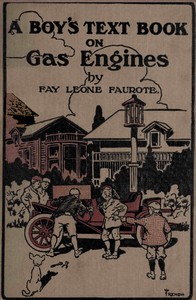
[Illustration: (cover)]
A
BOY’S TEXT BOOK
ON
GAS ENGINES
¶ A Book for Boys
Describing and
Explaining in Simple
Language the
Automobile Gas Engine.
[Illustration: (decoration)]
By FAY LEONE FAUROTE, B. S. [M. E.]
(Former Instructor Detroit Motor School)
Published by the Author
LANSING, MICHIGAN, U. S. A.
COPYRIGHT BY
FAY LEONE FAUROTE
1908
[Illustration: ROBERT SMITH PRINTING CO. CHICAGO--LANSING]
PREFACE
Knowing that the motor car is fast becoming the modern form of
transportation, both in the social and commercial world, and feeling
that the principles of the mechanism which constitutes its propelling
power are as yet somewhat of a mystery to the average individual and
to “Young America” in particular, the author feels that some of the
simple explanations offered in the following pages of this book will be
welcomed and appreciated. While they do not cover the entire subject,
it is hoped that they may tend to shed some light, and in a way make
understandable the construction and operation of the automobile gas
engine.
FAY L FAUROTE.
November 25, 1907.
[Illustration: A Four-cylinder Motor, so sectioned that it shows
interior of cylinder, valves, piston, crank shaft and connecting rods.]
A BOY’S TEXT BOOK ON GAS ENGINES
INTRODUCTION
Boys, when I was a small boy, I remember how much I was interested in
everything which was mechanical. The engineer was my hero; the solving
of the mysteries of an engine and the learning how to drive one, was my
ambition.
I remember well how I tried to read the dry, technical description
of motors, steam engines and such things. I remember, too, how hard
it was to understand those books; how the various technical terms
used to bother me, until at last, in despair, I would throw the books
aside. It seemed as if the men who wrote them never realized that boys
existed,--that boys wanted to know about such things.
At other times how glad I was when I found a good-hearted engineer who
seemed to know and understand my feelings and my desire to learn. How
easy it was to comprehend his explanations, because he used homely,
everyday things to illustrate his meaning. He made you forget there was
anything complicated about machinery. He simply took up one part at a
time, and when he had finished with it, everything was as plain as the
nose on your face.
Boys, then and there I decided that if I ever did understand some of
these seeming mysteries of engineering, I would write a book that boys
could understand. I would write it so that they couldn’t help it, it
would be so plain; there would be no secrets; they should know all
about it, and what is more, should be able to reason it all out for
themselves.
[Illustration: Fig. 1--The Essential Parts of a Gas Engine.]
Let me tell you about each part separately. After we have gone
over each part you will find that you will understand the action
of the motor and other parts of the car well enough so that you
will unconsciously reason it all out for yourselves. Some of the
descriptions and explanations may at first seem unsatisfactory, but I
think with a little thought and study you will be able to master them
in a short time. I want your confidence, boys, and then I know we will
get along all right together.
[Illustration: Fig. 2--A Single-cylinder Horizontal Engine. Note
location of valves in this type.]
[Illustration:
SUCTION STROKE COMPRESSION STROKE WORKING STROKE EXHAUST STROKE
Fig. 3--Four views of a section of a Vertical Cylinder, showing
position of valves, pistons and cams for the four different strokes.]
THE FOUR-STROKE CYCLE.
This subject looks like a bugbear, doesn’t it. Well, it is one of the
first things of which we shall have to dispose, and so we’ll tackle it
right away. We will start backwards, and take the word _cycle_ first.
If you will look in the dictionary you will find that this word means
“a circle or orbit; an interval of time in which a succession of events
is completed, and then returns in the same order.”
[Illustration:
SUCTION STROKE
COMPRESSION STROKE
WORKING STROKE
EXHAUST STROKE
Fig. 4--A Four-cycle Diagram, showing sequence of strokes in this type
of motor.]
This does not mean very much to you, does it? Well, let us go into
it a little farther. Supposing you were running relay races around a
block; you would run down on one side, across on another, back on the
other side, and then back to the starting point, wouldn’t you? You
would have completed a cycle then because you have taken a “certain
time in which a succession of events (streets) has been completed” and
you are back again at the start ready to “return in the same order.”
[Illustration: Fig. 5--Drawing showing comparison between gas engine
and a cannon connected with a grindstone.]
There is not anything complicated about that, is there? In other
words just change the _four-stroke cycle_ to a _four-street circle_,
and this will help you to keep in mind the meaning of this term. Do you
remember last Fourth of July when you had your cannon out, how many
things you had to do to fire it, or in other words to complete the
_cycle_ of operations. You did four things, didn’t you?
No. 1. You put in the powder.
No. 2. You rammed it in with a ramrod.
No. 3. You fired it by touching a match to it.
No. 4. You cleaned it out.
You had gone around your four-sided circle, and were back again, at the
start, ready to do the same things over again. You were running a gas
engine then, only you did not realize it.
Let us assume for the sake of argument, that you had a bullet in your
cannon, and that to this bullet was connected a rod which had its other
end fastened to the crank of a grindstone. Then if the barrel of the
cannon was long enough, and the rod which connected the bullet and
crank was short, the bullet could not get out of the cannon barrel,
could it? It would therefore have to go back and forth very much like
the pedal on a grindstone does. Of course the rod and the crank would
have to be very strong in order to keep the bullet in, but we will
assume that they are, and that the bullet must travel back and forth
inside the barrel. Now, if the bullet is going to stay in the barrel
we must provide some way to load the cannon, and also to clean it out,
therefore we will cut two holes in the end, one at I and one at E,
and then instead of using powder suppose you use some explosive gas
which will not leave so much soot behind it. You know how a squirt gun
works--how you draw the water in by pulling out the plunger, and how
you force the water out again by pushing it in again.
[Illustration: Fig. 6.]
Let us work the cannon the same way. Let us call the _farthest point_
to which the bullet travels _going in_ “H” and the _farthest point_ to
which it travels _going out_ “K.” Now let us assume that the bullet
is at “H,” and that it is just starting out in the direction of “K.”
If we open the hole “I” in the side of the cannon by taking out the
plug “L,” and put a hose, connected with our gas tank, in there, then
the outward motion of the bullet “P” will pull the cannon full of
gas, won’t it? Before the gas has a chance to escape we will put in
the plug “L” again. Now we have the cylinder full of gas, but as the
bullet is at the end of its stroke, and cannot go any further, we will
have to push the gas together again and get the bullet into position
“H.” This will be a good thing for the gas, because it will crowd the
particles of it closer together, and make it explode quicker, so we
will do this. Of course, in order to keep the gas in there we have had
to close up the touch-hole of the cannon, but now that we are ready
to fire it, we will take this plug out, and touch a match to the gas.
An explosion follows, and the bullet travels from the position “H” to
the position “K.” All this time the crank of the grindstone must have
been turning because the bullet and the crank are fastened together,
and therefore, instead of traveling through the air, the bullet has
used up its energy in turning the grindstone. When you get a grindstone
started it is rather hard to stop, isn’t it? And if you didn’t stop it,
it would keep on turning around, wouldn’t it? If this is true, we might
as well let it clean the cannon. As the hole “I” is connected with the
gas tank, we cannot let it force the burnt gas out there, can we? We
will therefore pull out the plug “J” in the hole “E” just as the bullet
reaches the point “K” so that in coming back it will force the burnt
gases and smoke out through the hole “E.” Now we are all ready to start
over again; the cannon has been cleaned out, and the bullet still
being fastened to the grindstone, which is turning, as a result of the
explosion, would immediately begin starting out on another outward
stroke. If we put in the plug “J” again and pull out the plug “L,” the
bullet or _piston_ as we might call it now, will suck in another charge
of gas.
[Illustration: Fig. 7--Grinding a valve.]
[Illustration: Fig. 8--A section of a Cylinder showing location of
various parts--end view.]
You can see that if you had two boys, one of them to pull out the
plugs, and another to fire the charge you could keep the gun firing
steadily, and run the grindstone. After you have done this for a while
you will get tired of taking out the plugs and putting them in, and
standing there with a match lit all the time, and you would wish there
was some way to make the grindstone, which was running, do all this
for you. This is exactly what happened to some of the old engineers,
and so they set about trying to accomplish this result. They succeeded
in rigging a piece of machinery that would open and close these holes
automatically, and with the introduction of electricity they also
devised a way whereby the charge could be ignited by an electric spark
instead of a match. The plugs which cover the holes, they called
_valves_ and the plug which contained the electric wires, used for
firing the gas, they called a _spark plug_.
Now let us see what we have learned in this chapter. We have found that
it takes four strokes to explode one charge of gas
1. _Suction stroke_, during which the gas is _sucked_ into the barrel
of the cannon, or cylinder as it is called.
2. The _compression stroke_, during which the gas is _compressed_ so
that it will burn easier.
3. The _explosive stroke_, or _working stroke_, called so on account
of the fact that the explosive force of the gas is used to _turn_ the
wheel.
4. The cleansing, or _exhaust_ stroke, during which the burnt gas and
smoke is _forced out_ of the barrel.
For this reason, a gas engine which works on this principle is called a
_Four-Stroke Cycle Engine_. It requires _four strokes_ to _complete the
entire operation_ and _bring it back to the beginning_ ready to start
over again.
THE CYLINDER
So far we have confined ourselves to the parts of a cannon, but now
that we are going to take up the study of the motor in its details let
us call them by their regular names. The _barrel_ of the cannon we will
call a _cylinder_. In an actual motor a cylinder is made out of cast
iron, carefully bored out inside, so that the hole is perfectly round,
and the sides of the wall as smooth as possible.
[Illustration: Fig. 9.]
You will realize that this is necessary as we want to reduce, as much
as possible, any rubbing or friction, as it is called, between the
piston and cylinder walls. Next we must provide some means of cooling
these walls, as you know that the continuous firing would soon make
them very hot. This is done by surrounding the cylinder with what is
known as a _water jacket_ through which water can be circulated,
thereby carrying off the heat, and keeping the iron from getting red
hot. We must also cut two holes in the side of the cylinder to make
places for the valves and a place for the spark plug.
[Illustration: Fig. 10--End view of Horizontal One-cylinder Motor,
showing piston, valves and valve mechanism.]
A cylinder is generally mounted on its side in a one cylinder engine,
and is set up on end when it is desired to use more than one.
Therefore, in a one cylinder motor you will notice that the piston
moves back and forth, whereas in a two-cylinder, four-cylinder or
six-cylinder type, the pistons move up and down. As far as the action
of the parts is concerned they work in exactly the same way, only that
the valve mechanism has to be changed somewhat.
The cylinder is bolted to a framework called the crank case which
furnishes a solid foundation upon which it can rest.
[Illustration]
VALVES
You will remember that in first discussing the _drawing in_ and
_cleaning out_ of the gas that two holes had to be cut in the sides of
the cylinder wall. One of these through which the _fresh gas_ might
be _sucked in_, and the other through which the _burnt gas_ might be
_expelled_. Also remember that we kept these holes plugged except when
it was necessary to have them open to perform their work.
[Illustration: Fig. 11--The evolution of a Valve.]
[Illustration: Fig. 12--A regular Valve.]
Now let us take a section of a _valve_ and see how it is made up. You
will notice first the little plug “A” which covers the hole in the
cylinder; it is tapered very much like a glass stopper in a bottle for
the reason that in this form it is easier to fit it to the opening;
it can be “_ground in_” in the same way that a glass stopper can, in
order to make an air-tight fit. “B” is a rod known as the _valve stem_,
and is simply a round piece of steel fastened to the valve plug “A.”
“S” is a _valve spring_ which holds the valve down into the cylinder
wall, or _valve-seat_, as it is called. In order to open these valves
you can see that all that is necessary for you to do is to _push up_ on
the _valve stem_ “B.” This will raise the valve “A” away from its seat
into the position shown by the dotted lines, leaving a space all around
through which the gas may enter or leave. In an actual motor, however,
little irregular pieces of steel, cut out in general shape shown in
Fig. 14 perform the operation of _raising_ the valve.
[Illustration: Fig. 13--Three positions of a Valve Cam.]
Fig. 13 shows three positions of one of these revolving pieces of
steel, technically called _cams_, first, in the act of just starting
to raise the valve; second, its position when the valve is entirely
open; third, its position when the valve has just closed. If both
valves are operated by these cams you can see that if they are set
at the proper position they can be opened at different times and
entirely independent of each other. If you will look at Fig. 3 you
will see a complete motor, the _inlet valve_ on the left side, and the
_exhaust valve_ on the right side. This figure will also show you the
little cams in their various positions at different points of the four
strokes. Sometimes the two valves, instead of being on _opposite_ sides
of the cylinder, are placed on the _same_ side, and _both cams_ are put
on the _same shaft_, which, by the way, is called a _cam-shaft_.
[Illustration: Fig. 14--Names of Valve Parts.]
Fig. 14 shows two such valves, the left hand one opening, and the right
hand one closed. The extreme left hand view shows the way they would
look if viewed from the end. It also gives you the names of all the
parts.
Fig. 7 shows how the valves are “_ground in_.” The way you do it is
to take the valve out, and coat it with very fine emery dust and oil,
and then put it back in place leaving off the spring, fit a wrench to
it on top as shown in the picture and twirl it around as you would a
glass stopper in a bottle until it is perfectly air-tight, after which
the valve should be removed and both it and the valve seat carefully
wiped off so that none of the emery will get into the cylinder or other
working parts of the engine and cause them to be cut.
There are several different ways of making valves and several places
to put them so that you must not always expect to find them in the
same place. Their action is the same, however, no matter where they
are situated or how they are operated, and I think with a little
examination and study you will always be able to find them and
understand how they work in any engine.
THE PISTON
The _piston_ forms, as you will recall, the _bullet_ in the cannon,
which instead of leaving the barrel, was made to travel back and forth
inside of the cylinder under the action of the explosive gas. Owing to
the fact that a solid piece of iron would be very heavy and would get
very warm, the real piston used in a motor is made _hollow_ so that it
is merely a shell. Instead of fastening the rod to the end of it, a
small rod, called the _piston pin_ is in the center of it, and to this
the connecting rod is connected. Fig. 16 shows a section of the piston.
You will notice that the piston pin is kept from sliding sideways by a
bolt that is screwed into it.
[Illustration: Fig. 15--A Piston, Piston Ring, and Piston Pin.]
Owing to the fact that both the cylinder walls and piston get hot, and
that iron expands and contracts according to its temperature, it is
not possible to make a piston alone which would remain air-tight all
the time. Engineers, therefore, found it necessary to put _rings_,
which were cut at some point in their circumference, on the outside
of the piston itself. These _piston rings_, due to the fact that
they are cut, can accommodate themselves to the varying diameters of
the cylinder, and can therefore keep an air-tight fit, even when the
piston is moving back and forth all the time. Most of you, no doubt,
know that the plunger in a pump is made air-tight by one or a set of
leather washers, which, owing to their pliable structure, can expand or
contract so as to always fit air-tightly the pipe in the pump. Piston
rings work in precisely the same manner, and are always kept lubricated
so that they will work smoothly, thus doing away with any friction
which might result.
[Illustration: Fig. 16--A section of a Piston, showing location of
piston pin and end of connecting rods.]
THE CRANK SHAFT
Most of you are familiar with a crank as applied to a grindstone.
A crank in a motor is practically the same shape except that it is
supported on two bearings instead of one and is therefore made in the
form shown in Fig. 17. The crank shafts for two and four-cylinder
motors are only a combination of two or four of these single cranks.
Crank shafts are made up of steel, carefully forged, and then turned
and ground down to proper size to fit the bearings for which they are
intended. They are hardened and every precaution taken to keep them
from wearing. They form one of the most important parts of the motor
because they _change_ the _back and forth motion_ of the piston into
the _rotary motion_ of the fly wheel. The _fly wheel_ in our former
illustration was represented by the _grindstone_ itself. In the real
motor the fly wheel is made of cast iron, and after being carefully
balanced so that it turns evenly, it is securely bolted to the crank
shaft, so that they practically form one piece.
[Illustration: Fig. 17--A Four-cylinder Crank Shaft.]
THE CONNECTING ROD
The _connecting rod_, as you can guess from its name, forms the
_connecting link_ between the piston and crank shaft, _transferring_
the _energy_ of the explosive gas, acting behind the piston, to the
crank shaft and fly wheel, from which it can be transmitted to the
driving wheels of the automobile. It is made up in some such form as
shown in Fig. 18 and is made of steel or bronze. It has a bearing at
each end, the smaller one fitting around the piston pin, the larger
one surrounding a portion of the crank shaft called the _crank pin_.
Both of these bearings are lubricated by oil which splashes up from the
bottom of the crank case when the engine is running. You will notice
that one of the bearings is cut in two and bolted together so that you
can take it off from the crank shaft, should you wish to examine it.
[Illustration: Fig. 18--A typical Connecting Rod.]
[Illustration: Fig. 19--The two halves of the Connecting Rod Bearing.]
THE CRANK CASE
The crank case of a motor serves as a foundation for the engine,
furnishes a support for the main bearings in which the crank shaft
revolves and encloses the working parts in such a way as to provide for
their lubrication and protect them from the dust and other substances
which might materially hinder the proper performance of their
functions. To a certain extent the crank case might be compared to the
framework of the grindstone, although the latter does not answer as
many purposes as the real crank case of the motor does.
[Illustration: Fig. 20--The two halves of a Four-cylinder Crank Case.]
The case itself is made of iron or aluminum, and is so put together
that, although practically air-tight, there is still a means provided
for getting inside of it for examination of the working parts or an
adjustment of the bearings.
THE CARBURETOR
The _carburetor_ or _mixing chamber_, as it is sometimes called, is a
device used for obtaining an _explosive mixture_ of gasoline and air.
It consists, as shown by the accompanying drawing, of two principal
parts, an air pipe and gasoline pipe, the latter running through the
wall and discharging into the center of the former.
[Illustration: Fig. 21--Simple drawing of a Carburetor.]
In order to make sure that the amount of gasoline flowing out of
the gasoline jet shall be just the right amount at all times it is
necessary to provide a little gasoline tank, which forms a part of
the carburetor casting itself, which is known as a _float chamber_,
so that the amount of gasoline in the main tank will not affect the
amount discharged at the nozzle. You can see why this is necessary if
you think of a water tank or a dam. If the water was almost up to the
top of the dam and you should bore a hole through the wall somewhere
near the bottom, the water would flow out faster than if the water was
low. By putting this little gasoline tank in the carburetor itself and
keeping a certain height of gasoline in this smaller reservoir, which
always automatically shuts off the supply at the right time, you can
make the pressure, and therefore the flow of the liquid, always the
same. The illustration will show this plainly. For instance, when the
gasoline gets low the little float will gradually drop down until the
ball on the end of the float stem will open the valve in the gasoline
pipe. The gasoline will then flow in from the tank until the proper
amount has filled the float chamber and caused the float to bob up to
its former position, carrying the ball, which closes the gasoline off,
up with it. By this means the requisite amount of gasoline is always
kept in the float chamber.
The amount of air entering the mixing chamber is controlled by changing
the size of the hole through which the air enters and the quantity
of gasoline admitted is regulated by means of a needle valve in the
gasoline pipe.
Although many carburetors, in fact most of them, do not look like
this drawing, yet their action is the same, and by careful study you
will find that the same principles enter into their construction.
Fig. 22 shows an actual sectional drawing of a carburetor used on a
four-cylinder motor. In this particular carburetor, however, the float
chamber and float surround the mixing chamber, and the float valve,
instead of being directly under the float, is at the right hand side
and is operated by means of a lever. The needle valve, which is the
little round rod having a “T” handle, running up through the center of
the mixing chamber, controls the amount of gasoline flowing from the
gasoline chamber to the nozzle. The air comes up through the bottom
and around the gasoline jet. At the left you will notice a small valve
which opens downward, which you do not find on the other carburetor.
It is known as an auxiliary air valve and allows a certain amount of
air to be added to the mixture, a small quantity of which is sometimes
needed to keep the mixture just right. The throttle valve, which looks
like a damper in a stovepipe and which controls the amount of gasoline
vapor going in to the engine, will be seen in the upper pipe.
[Illustration: Fig. 22--A Typical Four-cylinder Carburetor.]
THE IGNITION SYSTEM
The _ignition_ system is the name applied to the batteries, coils,
commutator and spark plug which, acting as a whole, produce an
_electric spark hot enough_ and at the _right time_ to _fire_ the
charge in the cylinder. There are three ways in which an electric
current may be obtained which have been found to be of practical use
in automobile construction. First, by a dry battery; second, by a
storage battery; and third, by magneto or dynamo. You can look up the
construction of these things in any good book on electricity, so that I
will not explain them further here. As the object of the whole system
is to produce a sufficiently hot spark to fire the mixture at the right
time, it is sometimes necessary to raise the pressure of the electric
current. When either a dry battery or storage battery or a certain type
of magneto is used, it is necessary to put it through what is known as
an _induction coil_ in order to _raise_ the _pressure_ so it will be
high enough to _jump across_ the two points in the cylinder.
An induction coil consists merely of a bundle of soft wires around
which is wound two separate coils of wire. The first, known as the
_primary_ winding, is of coarse wire, and the second, known as the
_secondary_ winding, is of fine wire. When the current flowing through
the primary coil is rapidly made and broken, another current of very
high voltage is created in the secondary circuit.
[Illustration: Fig. 23--Wiring Diagram, showing electric circuit for
one cylinder. The sketch is only diagrammatic--not a reproduction of
any actual wiring system.]
When the current starts to flow through the primary winding, the
bundle of wires immediately becomes a magnet and attracts the vibrator.
As soon as this occurs, however, the flow of the current is interrupted
and the vibrator resumes its former position and the action is
repeated. Thus you can see that the coil automatically makes and breaks
its own circuit. The rapidity with which this is done may be changed at
will by adjusting the vibrator screw.
[Illustration: Fig. 24--The Four-cylinder, Four-cycle Diagram, showing
the order in which the various cylinders do their work.]
Having thus obtained an electric current of sufficient strength
to fire the mixture it is necessary to supply a device which will
_automatically_ open and close the electric circuit at the _proper_
time. Such a device is called a _commutator_ and consists of two parts;
one a _rotating_ part, actuated by the engine, which makes a metallic
contact with one or more points on a stationary part, the points being
so located that contact occurs at the proper time for igniting the
charge in any particular cylinder.
[Illustration: Fig. 25--Four-cylinder Wiring Diagram.]
In the _four-cylinder_ wiring diagram (Fig. 25) various parts of an
ignition system may be easily seen. The electric current is furnished
either by a set of dry cells or by a storage battery. _Four_ individual
coils and a _four point_ commutator are used. The commutator is driven
by means of bevel gears from the engine itself. A single switch
controls the whole circuit, it being provided with two points, making
it possible for either battery to be used at will.
[Illustration: Fig. 26--Types of Spark Plugs.]
[Illustration: Fig. 27--A Single Cylinder Commutator. Diagrammatic
sketch.]
[Illustration: Fig. 28--A Two-point Switch.]
[Illustration: Fig. 29--A Four-cylinder Commutator.]
[Illustration: Fig. 30--A Two-cylinder Commutator.]
THE COOLING SYSTEM
In order to prevent the walls of the cylinder from becoming red
hot, it is necessary to cool them by some means, and this is done
by surrounding the cylinder with a _water jacket_ through which the
cooling water is circulated.
[Illustration: Fig. 31--A Diagram showing piping and direction of
circulation in a One-cylinder Water-cooled Motor.]
In order to prevent the water from boiling and evaporating, thus
making the constant addition of water necessary, a _radiator_ is
introduced into the system. This radiator is made up of very thin tubes
which give up their heat rapidly, thereby keeping the temperature of
the water below the boiling point. A fan is also used sometimes to
draw the air through between the tubes, thereby making the process of
cooling take place more rapidly. The system is so arranged that the
water is drawn from the lower part of the radiator where the water is
coldest by means of a pump and forced up through the water jackets and
back into the radiator again. Several different styles of pumps are
used, but a very common one is the _gear pump_ shown in Fig. 32. As you
will see by the drawing, it consists of two gears en mesh with each
other which revolve in the direction indicated by the arrow. The water
entering through the inlet pipe is drawn around the outside and forced
out through the outlet at the top.
[Illustration: Fig. 32--A Gear Water Pump.]
[Illustration: Fig. 33--Front End of Motor, showing radiator, fan and
cam shaft gears.]
[Illustration: Fig. 34--A typical Radiator.]
[Illustration: Fig. 35--Valve side of a Four-cylinder Motor.]
[Illustration: Fig. 36--Opposite side of same Motor showing Carburetor
and Inlet Pipe.]
[Illustration: Fig. 37--Bottom view of same Motor with oil pan removed
showing Crank Shaft, and Connecting Rods.]
[Illustration: Fig. 38--Top view of same Motor showing Valve Caps and
Holes for Spark Plugs.
NOTE--Both views show motor mounted in ring frames used for
assembling in factory.
]
THE TWO-CYCLE MOTOR.
Although the four-stroke cycle type of motor is used by most of the
automobile manufacturers, yet there is another type which has given
such good results that it is destined to become one of the important
forms to be used in gas engine vehicle manufacture.
[Illustration: Fig. 39.]
It therefore merits a brief description. It has the advantage of
being very simple in construction and operation, and for this reason
it has become very popular among the marine engine builders, although
with a few exceptions it has not as yet been accepted by motor car
engineers. It is called a Two-stroke Cycle Motor, so named because it
combines in _two strokes_ the series of changes ordinarily accomplished
in _four_ in the four-stroke cycle type. Its operation may be seen by
referring to the accompanying diagrams. It is first assumed that the
engine is being turned over by hand in the direction indicated by the
arrow. You will note that as the piston moves up it will uncover a port
(H), allowing the gasoline vapor from the mixing chamber to enter the
crank case. As soon as the piston moves down again, a port (J) will be
opened, allowing the mixture which has just been compressed to rush
through a “by-pass” (F), into the “combustion chamber,” or upper part
of the cylinder. Now, as the piston moves up again on the next stroke,
this charge is compressed still more, then as the piston reaches its
uppermost position the charge is ignited and the engine begins to work
under its own power. The gases continue to act on the piston until
nearly the end of the stroke is reached, when you will notice, by
referring to the drawing, the exhaust port (G) is passed. At this point
the burned gases rush out into the air. You will also notice that in
order to aid the discharge and fill the cylinder again, as the piston
travels a little farther down, the inlet port will be again uncovered,
and the next charge, which has meanwhile been taken into the crank case
and compressed, will enter the cylinder, forcing the exhaust gases out.
[Illustration: Fig. 40.]
In order to prevent the vapor which has just entered the cylinder
from traveling straight across and out through the exhaust port, thus
wasting a portion of the fuel, a “baffle plate” (K) is cast on top of
the piston which deflects the gases toward the top of the combustion
chamber, producing a sort of whirling action which tends to scavenge
the cylinder most thoroughly. In order to prevent the burning gases
from traveling back into the crank case and igniting the gas there,
thus producing a “back explosion,” a wire gauze (S) is placed in the
“_by-pass_.” You will note that this type of motor has no valves,
no cams and no cam shaft, in fact, its simplicity is such that it
practically cannot get out of adjustment. It therefore is a form of gas
engine which as soon as engineers are able to educate the public to
its peculiarities bids fair to become as popular and practical as the
four-stroke cycle.
INDEX
Cam shaft 21
Cam 20
Carburetor 28
Commutator 33
Connecting rod 26
Connecting rod--lubrication of 26
Cooling system 37
Crank case 27
Crank shaft 25
Cycle--explanation of four-stroke type 9
Cycle--explanation of two-stroke type 42
Cylinder 16
Electrical ignition 31
Exhaust valve 21
Fan--radiator 39
Float chamber 28
Gasoline valve 30
Ignition 31
Induction coil 32
Inlet valve 21
Piston pin 24
Piston ring 24
Piston 23
Pump--water 38
Radiator 39
Spark plug 35
Switch--electric 36
Valve grinding 21
Valves 19
Valves--mechanism 21
Water cooling system 37
Water pump 38
Wiring diagram--four-cylinder 34
Wiring diagrams--single-cylinder 32
ANOTHER BOOK BY THE SAME AUTHOR
A bigger and more comprehensive work on the same subject.
“The How and Why of the Automobile”
[Illustration]
Did you ever read a book which gave you just the information you wanted
without being compelled to go through page after page of introduction
and history?
¶ Did you ever talk to a man who came over on your side of the fence
and talked WITH you and not AT you--who explained things in such a
way that you laughed at yourself afterwards for not understanding the
subject before--it was really so simple?
¶ Do you remember when you used to study by outlines--how difficult
problems unfolded themselves--how the logical sequence of facts seemed
to make what you expected to find hard, readily understandable?
¶ Do you remember the innumerable times you have said to yourself “If I
only had somebody here to explain things--someone who would go through
this proposition with me until I understood it--someone who would use
homely and familiar examples to explain things, instead of talking over
my head by using technical terms?”
¶ The author realized all these difficulties himself, because he has
been through it all. Not only that, but his experience as an instructor
of a large motor school taught him the way to explain the various parts
of a motor vehicle in simple language, so that even the boy of fifteen
could understand and appreciate them.
¶ For instance, did you ever think that the physician uses a form of
carburetor whenever he gives chloroform or ether--do you realize that a
shotgun is a form of gas engine whose action is almost identical with
that of an automobile motor?
¶ Do you want to know what a sliding gear transmission is--explained in
such simple language that anyone can understand it?
¶ Would you like to see what’s inside of an automobile engine--would
you like to know the name of every part--be able to talk intelligently
about it and be your own mechanic--tell your chauffeur what to do--know
when he is bluffing you?
¶ In a word, would you like to know all about a motor car--how it
works--how to drive it and how to take care of it? Then subscribe for a
copy of
“THE HOW AND WHY OF THE AUTOMOBILE”
By FAY L. FAUROTE
PRICE, $1.00 PREPAID
Don’t delay--send in your order to-day. Get the complete story of a
motor car--the advanced course of which the book you have just finished
is only the beginning.
Address,
Motor Text Book Dept. ROBERT SMITH PTG. CO., Lansing, Mich., U. S. A.
“THE HOW AND WHY OF THE AUTOMOBILE”
A book of practical information for seekers after the fundamental facts
regarding the gasoline engine and its application to the motor car.
Interesting and instructive to both the beginner and the expert--the
former for information, the latter for reference.
Written by Fay L. Faurote, B. S. (M. E.), for five years closely
associated with the Experimental Department of a pioneer automobile
factory, for two years instructor in the Detroit Motor School.
The book, which is handsomely bound in full cloth, printed on
high-grade enameled paper, contains over 200 pages and 250
illustrations and covers the following subjects:
CONTENTS
=GENERAL THEORY OF GAS ENGINES=--Simple explanation of cycle--The
four-stroke cycle--The two-stroke cycle--Advantages and
disadvantages of each.
=MOTOR DESIGN=--CYLINDER, what it is and its use. VALVES, mechanical
and automatic--Forms of valves--Valve timing and its influence
on the motor--Valve grinding, how to do it--Valve nomenclature.
CRANK CASE--The construction Bearings--Accessibility--Working
parts--Uses. A crank case oiling system. CRANK SHAFTS--What they
are--One, two, four and six-cylinder crank shafts--Crank case
diagram, showing instantly conditions in all cylinders--Diagram
showing firing points and sequence of same. CONNECTING
RODS--Construction and material--Bearings and lubrication.
PISTONS--Piston rings--Piston pins.
=THE CARBURETOR=--A very simple explanation of carburetion--The
mixing valve--A few of the first types--Some of the modern
carburetors--Foreign carburetors.
=IGNITION=--The make and break system--A simple explanation of the
apparatus used. THE JUMP SPARK SYSTEM--Electrical units. SOURCES
OF ELECTRICITY--The dry cell--The storage cell--Dynamos and
magnetos--The spark coil--Commutators and timing devices--Spark
plugs--Wiring diagrams.
=COOLING SYSTEM=--AIR COOLING. WATER COOLING--Direction of
circulation--Radiators--Water pumps--Fans--Anti-freezing
solutions.
=THE TRANSMISSION=--Reason for and use of transmission. SIMPLE
EXPLANATION OF ACTION--Individual clutch type--The sliding
gear--The three speed progressive--The three speed selective--The
four speed selective--Planetary gear--Friction drive.
=METHODS OF DRIVING=--Single chain drive--Double chain drive--Bevel
gear drive.
=RUNNING GEAR=--FRONT AXLE--Construction of--Steering Gear. REAR
AXLE--Differential gear--The live axle--The dead axle--Wheel
construction--Bearings.
=HORSE POWER DETERMINATIONS=--Engine testing--Indicated horse
power--Brake horse power--Mechanical and heat efficiency--Road
testing.
What a Prominent Trade Paper Says About It.
=A HANDBOOK OF PRACTICAL VALUE=--The latest addition to the popular
type of automobile handbook. “The How and Why of the Automobile,”
by Fay L. Faurote, fulfills what its author has set himself to
achieve, namely, to present a plain, easily understood description
of the modern automobile. Assuming that his reader knows nothing
about the subject, the author introduces the automobile in as simple
and untechnical a manner as possible. The _entire field_ is covered
and covered _so completely_ that the work can be _recommended as a
handbook for beginners or those with only a limited knowledge of this
subject_.--_Automobile_, April 18.
Send in your order at once--don’t delay. The price is $1.00 postage
pre-paid, and the address is
Motor Text Book Dept., ROBERT SMITH PTG. CO., Lansing, Mich., U. S. A.
Transcriber’s Notes
Punctuation, hyphenation, and spelling were made consistent when a
predominant preference was found in the original book; otherwise they
were not changed.
Simple typographical errors were corrected; unbalanced quotation
marks were remedied when the change was obvious, and otherwise left
unbalanced.
Illustrations in this eBook are shown as close as possible to their
original positions in the printed book, so several of them actually are
mid-paragraph. This was done because some of them are referenced only
by their content, not by their names.
This book does not have a Table of Contents.
The index was not in good alphabetical order; Transcriber re-sorted it.
It was not checked for correct page references.
*** END OF THE PROJECT GUTENBERG EBOOK A BOY'S TEXT BOOK ON GAS ENGINES ***
Updated editions will replace the previous one—the old editions will
be renamed.
Creating the works from print editions not protected by U.S. copyright
law means that no one owns a United States copyright in these works,
so the Foundation (and you!) can copy and distribute it in the United
States without permission and without paying copyright
royalties. Special rules, set forth in the General Terms of Use part
of this license, apply to copying and distributing Project
Gutenberg™ electronic works to protect the PROJECT GUTENBERG™
concept and trademark. Project Gutenberg is a registered trademark,
and may not be used if you charge for an eBook, except by following
the terms of the trademark license, including paying royalties for use
of the Project Gutenberg trademark. If you do not charge anything for
copies of this eBook, complying with the trademark license is very
easy. You may use this eBook for nearly any purpose such as creation
of derivative works, reports, performances and research. Project
Gutenberg eBooks may be modified and printed and given away—you may
do practically ANYTHING in the United States with eBooks not protected
by U.S. copyright law. Redistribution is subject to the trademark
license, especially commercial redistribution.
START: FULL LICENSE
THE FULL PROJECT GUTENBERG LICENSE
PLEASE READ THIS BEFORE YOU DISTRIBUTE OR USE THIS WORK
To protect the Project Gutenberg™ mission of promoting the free
distribution of electronic works, by using or distributing this work
(or any other work associated in any way with the phrase “Project
Gutenberg”), you agree to comply with all the terms of the Full
Project Gutenberg™ License available with this file or online at
www.gutenberg.org/license.
Section 1. General Terms of Use and Redistributing Project Gutenberg™
electronic works
1.A. By reading or using any part of this Project Gutenberg™
electronic work, you indicate that you have read, understand, agree to
and accept all the terms of this license and intellectual property
(trademark/copyright) agreement. If you do not agree to abide by all
the terms of this agreement, you must cease using and return or
destroy all copies of Project Gutenberg™ electronic works in your
possession. If you paid a fee for obtaining a copy of or access to a
Project Gutenberg™ electronic work and you do not agree to be bound
by the terms of this agreement, you may obtain a refund from the person
or entity to whom you paid the fee as set forth in paragraph 1.E.8.
1.B. “Project Gutenberg” is a registered trademark. It may only be
used on or associated in any way with an electronic work by people who
agree to be bound by the terms of this agreement. There are a few
things that you can do with most Project Gutenberg™ electronic works
even without complying with the full terms of this agreement. See
paragraph 1.C below. There are a lot of things you can do with Project
Gutenberg™ electronic works if you follow the terms of this
agreement and help preserve free future access to Project Gutenberg™
electronic works. See paragraph 1.E below.
1.C. The Project Gutenberg Literary Archive Foundation (“the
Foundation” or PGLAF), owns a compilation copyright in the collection
of Project Gutenberg™ electronic works. Nearly all the individual
works in the collection are in the public domain in the United
States. If an individual work is unprotected by copyright law in the
United States and you are located in the United States, we do not
claim a right to prevent you from copying, distributing, performing,
displaying or creating derivative works based on the work as long as
all references to Project Gutenberg are removed. Of course, we hope
that you will support the Project Gutenberg™ mission of promoting
free access to electronic works by freely sharing Project Gutenberg™
works in compliance with the terms of this agreement for keeping the
Project Gutenberg™ name associated with the work. You can easily
comply with the terms of this agreement by keeping this work in the
same format with its attached full Project Gutenberg™ License when
you share it without charge with others.
1.D. The copyright laws of the place where you are located also govern
what you can do with this work. Copyright laws in most countries are
in a constant state of change. If you are outside the United States,
check the laws of your country in addition to the terms of this
agreement before downloading, copying, displaying, performing,
distributing or creating derivative works based on this work or any
other Project Gutenberg™ work. The Foundation makes no
representations concerning the copyright status of any work in any
country other than the United States.
1.E. Unless you have removed all references to Project Gutenberg:
1.E.1. The following sentence, with active links to, or other
immediate access to, the full Project Gutenberg™ License must appear
prominently whenever any copy of a Project Gutenberg™ work (any work
on which the phrase “Project Gutenberg” appears, or with which the
phrase “Project Gutenberg” is associated) is accessed, displayed,
performed, viewed, copied or distributed:
This eBook is for the use of anyone anywhere in the United States and most
other parts of the world at no cost and with almost no restrictions
whatsoever. You may copy it, give it away or re-use it under the terms
of the Project Gutenberg License included with this eBook or online
at www.gutenberg.org. If you
are not located in the United States, you will have to check the laws
of the country where you are located before using this eBook.
1.E.2. If an individual Project Gutenberg™ electronic work is
derived from texts not protected by U.S. copyright law (does not
contain a notice indicating that it is posted with permission of the
copyright holder), the work can be copied and distributed to anyone in
the United States without paying any fees or charges. If you are
redistributing or providing access to a work with the phrase “Project
Gutenberg” associated with or appearing on the work, you must comply
either with the requirements of paragraphs 1.E.1 through 1.E.7 or
obtain permission for the use of the work and the Project Gutenberg™
trademark as set forth in paragraphs 1.E.8 or 1.E.9.
1.E.3. If an individual Project Gutenberg™ electronic work is posted
with the permission of the copyright holder, your use and distribution
must comply with both paragraphs 1.E.1 through 1.E.7 and any
additional terms imposed by the copyright holder. Additional terms
will be linked to the Project Gutenberg™ License for all works
posted with the permission of the copyright holder found at the
beginning of this work.
1.E.4. Do not unlink or detach or remove the full Project Gutenberg™
License terms from this work, or any files containing a part of this
work or any other work associated with Project Gutenberg™.
1.E.5. Do not copy, display, perform, distribute or redistribute this
electronic work, or any part of this electronic work, without
prominently displaying the sentence set forth in paragraph 1.E.1 with
active links or immediate access to the full terms of the Project
Gutenberg™ License.
1.E.6. You may convert to and distribute this work in any binary,
compressed, marked up, nonproprietary or proprietary form, including
any word processing or hypertext form. However, if you provide access
to or distribute copies of a Project Gutenberg™ work in a format
other than “Plain Vanilla ASCII” or other format used in the official
version posted on the official Project Gutenberg™ website
(www.gutenberg.org), you must, at no additional cost, fee or expense
to the user, provide a copy, a means of exporting a copy, or a means
of obtaining a copy upon request, of the work in its original “Plain
Vanilla ASCII” or other form. Any alternate format must include the
full Project Gutenberg™ License as specified in paragraph 1.E.1.
1.E.7. Do not charge a fee for access to, viewing, displaying,
performing, copying or distributing any Project Gutenberg™ works
unless you comply with paragraph 1.E.8 or 1.E.9.
1.E.8. You may charge a reasonable fee for copies of or providing
access to or distributing Project Gutenberg™ electronic works
provided that:
• You pay a royalty fee of 20% of the gross profits you derive from
the use of Project Gutenberg™ works calculated using the method
you already use to calculate your applicable taxes. The fee is owed
to the owner of the Project Gutenberg™ trademark, but he has
agreed to donate royalties under this paragraph to the Project
Gutenberg Literary Archive Foundation. Royalty payments must be paid
within 60 days following each date on which you prepare (or are
legally required to prepare) your periodic tax returns. Royalty
payments should be clearly marked as such and sent to the Project
Gutenberg Literary Archive Foundation at the address specified in
Section 4, “Information about donations to the Project Gutenberg
Literary Archive Foundation.”
• You provide a full refund of any money paid by a user who notifies
you in writing (or by e-mail) within 30 days of receipt that s/he
does not agree to the terms of the full Project Gutenberg™
License. You must require such a user to return or destroy all
copies of the works possessed in a physical medium and discontinue
all use of and all access to other copies of Project Gutenberg™
works.
• You provide, in accordance with paragraph 1.F.3, a full refund of
any money paid for a work or a replacement copy, if a defect in the
electronic work is discovered and reported to you within 90 days of
receipt of the work.
• You comply with all other terms of this agreement for free
distribution of Project Gutenberg™ works.
1.E.9. If you wish to charge a fee or distribute a Project
Gutenberg™ electronic work or group of works on different terms than
are set forth in this agreement, you must obtain permission in writing
from the Project Gutenberg Literary Archive Foundation, the manager of
the Project Gutenberg™ trademark. Contact the Foundation as set
forth in Section 3 below.
1.F.
1.F.1. Project Gutenberg volunteers and employees expend considerable
effort to identify, do copyright research on, transcribe and proofread
works not protected by U.S. copyright law in creating the Project
Gutenberg™ collection. Despite these efforts, Project Gutenberg™
electronic works, and the medium on which they may be stored, may
contain “Defects,” such as, but not limited to, incomplete, inaccurate
or corrupt data, transcription errors, a copyright or other
intellectual property infringement, a defective or damaged disk or
other medium, a computer virus, or computer codes that damage or
cannot be read by your equipment.
1.F.2. LIMITED WARRANTY, DISCLAIMER OF DAMAGES - Except for the “Right
of Replacement or Refund” described in paragraph 1.F.3, the Project
Gutenberg Literary Archive Foundation, the owner of the Project
Gutenberg™ trademark, and any other party distributing a Project
Gutenberg™ electronic work under this agreement, disclaim all
liability to you for damages, costs and expenses, including legal
fees. YOU AGREE THAT YOU HAVE NO REMEDIES FOR NEGLIGENCE, STRICT
LIABILITY, BREACH OF WARRANTY OR BREACH OF CONTRACT EXCEPT THOSE
PROVIDED IN PARAGRAPH 1.F.3. YOU AGREE THAT THE FOUNDATION, THE
TRADEMARK OWNER, AND ANY DISTRIBUTOR UNDER THIS AGREEMENT WILL NOT BE
LIABLE TO YOU FOR ACTUAL, DIRECT, INDIRECT, CONSEQUENTIAL, PUNITIVE OR
INCIDENTAL DAMAGES EVEN IF YOU GIVE NOTICE OF THE POSSIBILITY OF SUCH
DAMAGE.
1.F.3. LIMITED RIGHT OF REPLACEMENT OR REFUND - If you discover a
defect in this electronic work within 90 days of receiving it, you can
receive a refund of the money (if any) you paid for it by sending a
written explanation to the person you received the work from. If you
received the work on a physical medium, you must return the medium
with your written explanation. The person or entity that provided you
with the defective work may elect to provide a replacement copy in
lieu of a refund. If you received the work electronically, the person
or entity providing it to you may choose to give you a second
opportunity to receive the work electronically in lieu of a refund. If
the second copy is also defective, you may demand a refund in writing
without further opportunities to fix the problem.
1.F.4. Except for the limited right of replacement or refund set forth
in paragraph 1.F.3, this work is provided to you ‘AS-IS’, WITH NO
OTHER WARRANTIES OF ANY KIND, EXPRESS OR IMPLIED, INCLUDING BUT NOT
LIMITED TO WARRANTIES OF MERCHANTABILITY OR FITNESS FOR ANY PURPOSE.
1.F.5. Some states do not allow disclaimers of certain implied
warranties or the exclusion or limitation of certain types of
damages. If any disclaimer or limitation set forth in this agreement
violates the law of the state applicable to this agreement, the
agreement shall be interpreted to make the maximum disclaimer or
limitation permitted by the applicable state law. The invalidity or
unenforceability of any provision of this agreement shall not void the
remaining provisions.
1.F.6. INDEMNITY - You agree to indemnify and hold the Foundation, the
trademark owner, any agent or employee of the Foundation, anyone
providing copies of Project Gutenberg™ electronic works in
accordance with this agreement, and any volunteers associated with the
production, promotion and distribution of Project Gutenberg™
electronic works, harmless from all liability, costs and expenses,
including legal fees, that arise directly or indirectly from any of
the following which you do or cause to occur: (a) distribution of this
or any Project Gutenberg™ work, (b) alteration, modification, or
additions or deletions to any Project Gutenberg™ work, and (c) any
Defect you cause.
Section 2. Information about the Mission of Project Gutenberg™
Project Gutenberg™ is synonymous with the free distribution of
electronic works in formats readable by the widest variety of
computers including obsolete, old, middle-aged and new computers. It
exists because of the efforts of hundreds of volunteers and donations
from people in all walks of life.
Volunteers and financial support to provide volunteers with the
assistance they need are critical to reaching Project Gutenberg™’s
goals and ensuring that the Project Gutenberg™ collection will
remain freely available for generations to come. In 2001, the Project
Gutenberg Literary Archive Foundation was created to provide a secure
and permanent future for Project Gutenberg™ and future
generations. To learn more about the Project Gutenberg Literary
Archive Foundation and how your efforts and donations can help, see
Sections 3 and 4 and the Foundation information page at www.gutenberg.org.
Section 3. Information about the Project Gutenberg Literary Archive Foundation
The Project Gutenberg Literary Archive Foundation is a non-profit
501(c)(3) educational corporation organized under the laws of the
state of Mississippi and granted tax exempt status by the Internal
Revenue Service. The Foundation’s EIN or federal tax identification
number is 64-6221541. Contributions to the Project Gutenberg Literary
Archive Foundation are tax deductible to the full extent permitted by
U.S. federal laws and your state’s laws.
The Foundation’s business office is located at 809 North 1500 West,
Salt Lake City, UT 84116, (801) 596-1887. Email contact links and up
to date contact information can be found at the Foundation’s website
and official page at www.gutenberg.org/contact
Section 4. Information about Donations to the Project Gutenberg
Literary Archive Foundation
Project Gutenberg™ depends upon and cannot survive without widespread
public support and donations to carry out its mission of
increasing the number of public domain and licensed works that can be
freely distributed in machine-readable form accessible by the widest
array of equipment including outdated equipment. Many small donations
($1 to $5,000) are particularly important to maintaining tax exempt
status with the IRS.
The Foundation is committed to complying with the laws regulating
charities and charitable donations in all 50 states of the United
States. Compliance requirements are not uniform and it takes a
considerable effort, much paperwork and many fees to meet and keep up
with these requirements. We do not solicit donations in locations
where we have not received written confirmation of compliance. To SEND
DONATIONS or determine the status of compliance for any particular state
visit www.gutenberg.org/donate.
While we cannot and do not solicit contributions from states where we
have not met the solicitation requirements, we know of no prohibition
against accepting unsolicited donations from donors in such states who
approach us with offers to donate.
International donations are gratefully accepted, but we cannot make
any statements concerning tax treatment of donations received from
outside the United States. U.S. laws alone swamp our small staff.
Please check the Project Gutenberg web pages for current donation
methods and addresses. Donations are accepted in a number of other
ways including checks, online payments and credit card donations. To
donate, please visit: www.gutenberg.org/donate.
Section 5. General Information About Project Gutenberg™ electronic works
Professor Michael S. Hart was the originator of the Project
Gutenberg™ concept of a library of electronic works that could be
freely shared with anyone. For forty years, he produced and
distributed Project Gutenberg™ eBooks with only a loose network of
volunteer support.
Project Gutenberg™ eBooks are often created from several printed
editions, all of which are confirmed as not protected by copyright in
the U.S. unless a copyright notice is included. Thus, we do not
necessarily keep eBooks in compliance with any particular paper
edition.
Most people start at our website which has the main PG search
facility: www.gutenberg.org.
This website includes information about Project Gutenberg™,
including how to make donations to the Project Gutenberg Literary
Archive Foundation, how to help produce our new eBooks, and how to
subscribe to our email newsletter to hear about new eBooks.